Welcome. You've got mail! I do recognize that.
That's all AOL. If you're familiar with my sounds, there's a good chance that you were one of AOL's over 20 million subscribers who used its dial up internet and AIM messaging system. What was your AOL user name?
Bsquad. Bsquad? My AIM screen names were bugsthatboy and traineeboyC.
I recall my AOL name being mockalot. AOL was considered by many to have been the king of media in the 90s and early 2000s. At the time, the company was so prevalent in U.
S. culture that it was a major plot point in the 1998 romantic comedy, "You've Got Mail," featuring Tom Hanks and Meg Ryan. I turn on my computer.
I go online. Welcome. And my breath catches in my chest until I hear three little words: You've got mail!
At its peak in December 1999, AOL had a market capitalization of $222 billion. But the influx of broadband internet and the burst of the dot-com bubble reduced the one time internet behemoth to a shadow of its former self. For me, watching AOL over the last 10 years, it's been it's been hard because in the 90s it really was the dominant company helped define the internet for so many people, helped bring so many people online for the first time.
But it's been a struggle. AOL was born in 1983, not as an internet service provider, but as a video game business. At the time, the company was called Control Video Corporation and it allowed gamers to hook up their Atari 2600 game console to their phone line to download video games.
The business was not very successful and was reborn shortly after as Quantum Computer Services. The company's software gave customers access to instant messaging, games, news, online shopping and email. It wasn't until 1991 that America Online, as AOL was formally known, came into existence with the goal of opening up the internet for all users, not just academics.
So when we got started and launched AOL, very few people were online. Even then, personal computers didn't even have modems inside. Most of the PC manufacturers didn't think people wanted to be online.
And the servers at the time were very hard to use. They required kind of real technology expertise. So the real focus for AOL was simplicity.
How do you create an easy-to-use, graphical interface that anybody could use? Under the leadership of CEO Steve Case, America Online went public in 1992 at $11. 50/share.
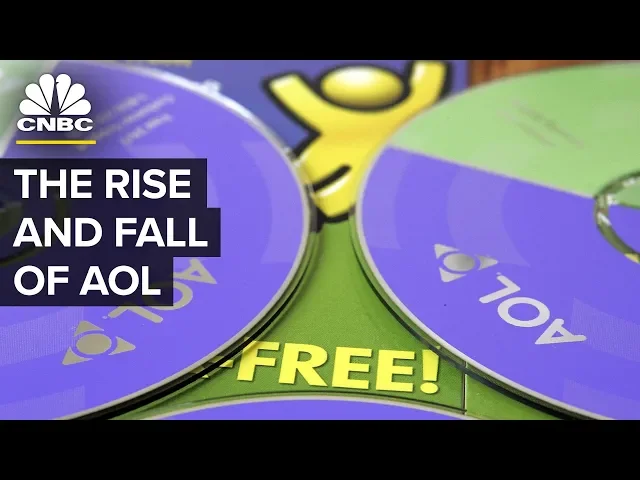
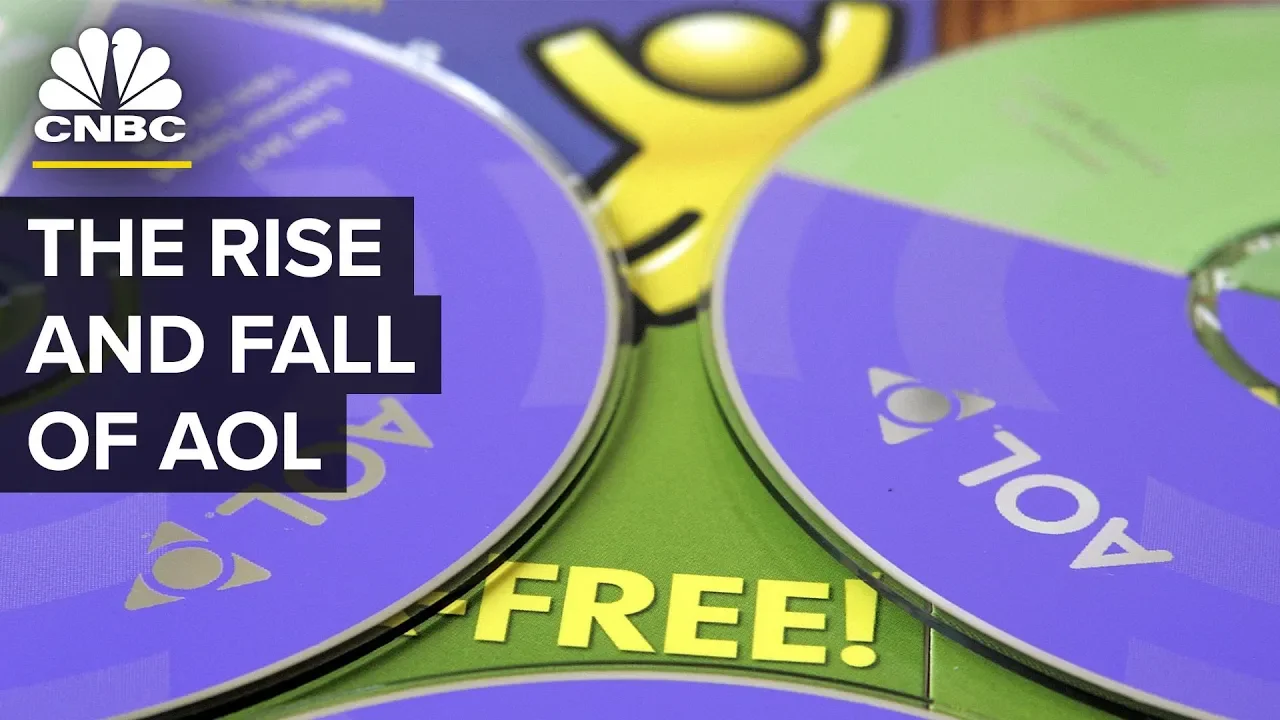
Beginning in 1993, AOL began an aggressive campaign to sign up new users by mailing floppy disks and later CDs containing the company's software and a few hours of free service to prospective customers. When I think of AOL, I think of those metal, tin cases that they would send to me probably like twice a week in the mail trying to get me to sign up for AOL. I probably had a hundred of them.
They would just come every month. The campaign worked. And by 2000, AOL subscribers had ballooned from less than 200,000 in 1992 to 25 million.
That same year, AOL announced that it would be getting even bigger. We're pleased to have all of you here with us today as we announce the merger to create the first global media and communications company of the internet century, AOL Time Warner. AOL's acquisition of Time Warner cost over $160 billion, making it one of the largest mergers in history.
At the time, it seemed like a really good idea. From AOL's perspective, we knew we needed a path to broadband. Time Warner was the largest operator of cable systems and also had a lot of brands, CNN and HBO and so forth, that we thought would be valuable in a broadband world.
From the Time Warner perspective, there were very strong media businesses but didn't really have a clear path to a digital future. And so the combination of those two companies we really thought was a winning combination. But things didn't turn out as planned.
From the very beginning, the merged company failed to live up to its lofty financial expectations. To make matters worse, technology stocks that had been thriving in the 90s suddenly fell off a cliff with the burst of the internet bubble. At the time, AOL's business consisted of dial-up internet and ad revenue.
When the air went out of the dot-com bubble in 1999 or 2000, all of these companies that were paying AOL money all went bankrupt or dwindled to the point where they could no longer pay AOL that money. So their advertising revenue, which was in the billions of dollars, dried up really quickly. And so that was sort of phase one of AOL's decline.
Phase two was on the distribution side. It didn't take long after that AOL Time Warner merger for people to start transitioning over to cable broadband. AOL Time Warner reported losses of $98 billion for the 2002 year, making it the largest annual net loss in U.
S. corporate history. The new economic pressures in the technology industry also caused a rift between AOL and Time Warner employees.
But there were a lot of people at Time Warner that weren't as enthusiastic about the digital path, weren't as enthusiastic about the internet, were worried how it might cannibalize some of their businesses, so they tended to play defense. The culture clash in some ways represented a lot of what sort of so-called traditional media and so-called internet or digital media. So at AOL, and this is paraphrasing from Facebook, you know, move fast, break things.
That was anathema to the Time Warner side, which, you know, if you think about Time Inc. , they weren't in the business of breaking things. They were in the business of being a standard bearer for certain kinds of journalism and activities.
Because the bubble burst on the internet, there became a lot of skepticism around what AOL's business model was and what their thinking was. And Time Warner, which had bounced along for decades as a sturdier company, they now looked at their buyer and said, we can't trust you. This doesn't work anymore.
You guys actually have to trust us. But Jeff Bewkes, who was chairman of Time Warner's Entertainment and Networks Group at the time, says AOL's problems stemmed from a lack of foresight into the changing internet technology, not a culture clash. I don't agree that a significant part of the challenges AOL faced had to do with the Time Warner company.
Think of the 90s, and you plug your telephone modem into the narrowband modem and you're connected for five hours in your house to the AOL server. There's no charge. There's no permission or deal that you have to do as AOL with the local telephone company.
That was a unique time and situation. And as the internet then developed in the first decade of the 21st century, that began to compete and people wanted to go using broadband. Which meant you had to then make a deal with the broadband provider if you were an AOL or if you were using their bandwidth.
Besides business troubles, AOL also had run-ins with the law. We are here to announce significant developments in the continuing corporate fraud investigation involving America Online, the internet company which is a wholly owned subsidiary of Time Warner Inc. In a criminal complaint that was filed today in the Eastern District of Virginia, the government has charged AOL with aiding and abetting securities fraud.
And by 2006, AOL was really struggling to keep up with competitors. With 113 million regular visitors, AOL commands the second biggest audience on the web after Yahoo. But AOL's roughly 18 million paying subscribers are fleeing, dropping their slow dial-up accounts for speedier broadband internet connections and getting email, messaging, and other services for free from competitors like Google and MSN.
Leading AOL at the time was Jon Miller, who says the company could have gone in a completely different direction had it had the support of the increasingly influential Time Warner. We had a line on buying YouTube before anybody else. We had an opportunity to step in with Facebook when Yahoo stumbled.
We had a chance maybe to step into Tencent, which is the parent of QQ in those days and WeChat today, a major company in Asia. And in all those turns, we just didn't get the support to do that. In 2009, Time Warner spun off AOL as a separate company again.
At the time, AOL's market capitalization had fallen to $3. 44 billion. That same year, AOL hired Tim Armstrong, a former Google executive, as the company's new CEO.
After taking over AOL and spinning out of Time Warner, it became really clear that there were a set of things that we had to get done to fix the company. Number one was the culture. And I think having gone from zero to $150 billion dollar company at Google into AOL that went from $150 billion down to $1 billion, the culture really needed repairing.
I think the employee base needed one thing, which was belief in the strategy and belief in where we're going. Number two was to set a clear strategy and set a strategy for where the industry was going, not where it had been. So that was about video.
It was about building content brands. It was about programmatic advertising. And it was really about using data as the oil in the new economy to help AOL become a much bigger, broader player in terms of being a personalized service for people.
In 2015, Verizon announced that it would be buying AOL for $4. 4 billion. At the time period that we sold AOL to Verizon, a few big dynamics were happening in the industry.
One dynamic was that mobile was really starting to take over and over 50 percent of our traffic was mobile. Number two was data was really important and I used to carry around a slide to our board that had some of these themes on it. But I used to say that data is the oil of the new economy.
And really in data what you needed was mobile data. The third was we needed to spend money on content. You had companies like Netflix and other companies coming, even though we were getting into content, the content war and race required lots of capital and we were a public company with investors that essentially did not want to put those levels of investments to really go big in mobile and really go big in video.
So we started thinking about partnerships and Verizon came as a natural solution to really the top three or five issues that we saw in our future business. In 2017, Verizon also purchased Yahoo and combined AOL and Yahoo into a division it called Oath. The main reason the Yahoo deal made sense for Verizon was because we're in the digital industry in the middle of the digital economy and probably the largest change that's ever happened in the world.
And Verizon was able to pick up a billion users at one-time revenue between AOL and Yahoo. So even today, if you look at 2019, the Verizon media properties that we put together at Oath are the fourth largest set of digital properties in the United States. Like AOL Time Warner, Oath had very high revenue projections.
When we put the companies together, the companies had roughly about $8 billion in revenue. So getting to $10 billion if you just took the normal growth rates in the industry was an achievable goal. And I think $20 billion could have been in sight if we had been able to plug in all the Verizon assets and power behind it.
But Oath disappointed and didn't come close to making $20 billion in revenue. In 2018, Verizon announced that it was taking a $4. 6 billion writedown on Oath, which basically meant that Verizon no longer believed that the company was as valuable as it originally expected.
Shortly after, Verizon killed off the Oath brand completely, making Yahoo and AOL part of Verizon Media. My hope and dream for AOL was always to have AOL stay at the center of the landscape on the internet. Even though things changed a lot over time, I think the AOL brand remains as one of the most iconic brands in this time period of the most incredible change that's ever happened in humanity.
I think AOL will go down in history as a company that sort of had its heyday, it passed, and then now will ride off into the sunset. I think it's a fact of the business world today that brands don't necessarily sustain. Some will and many won't.
And I think particularly as you have a generational change that doesn't have exposure and any emotional connection to the brand, I don't know that it is a sustaining brand at this point.