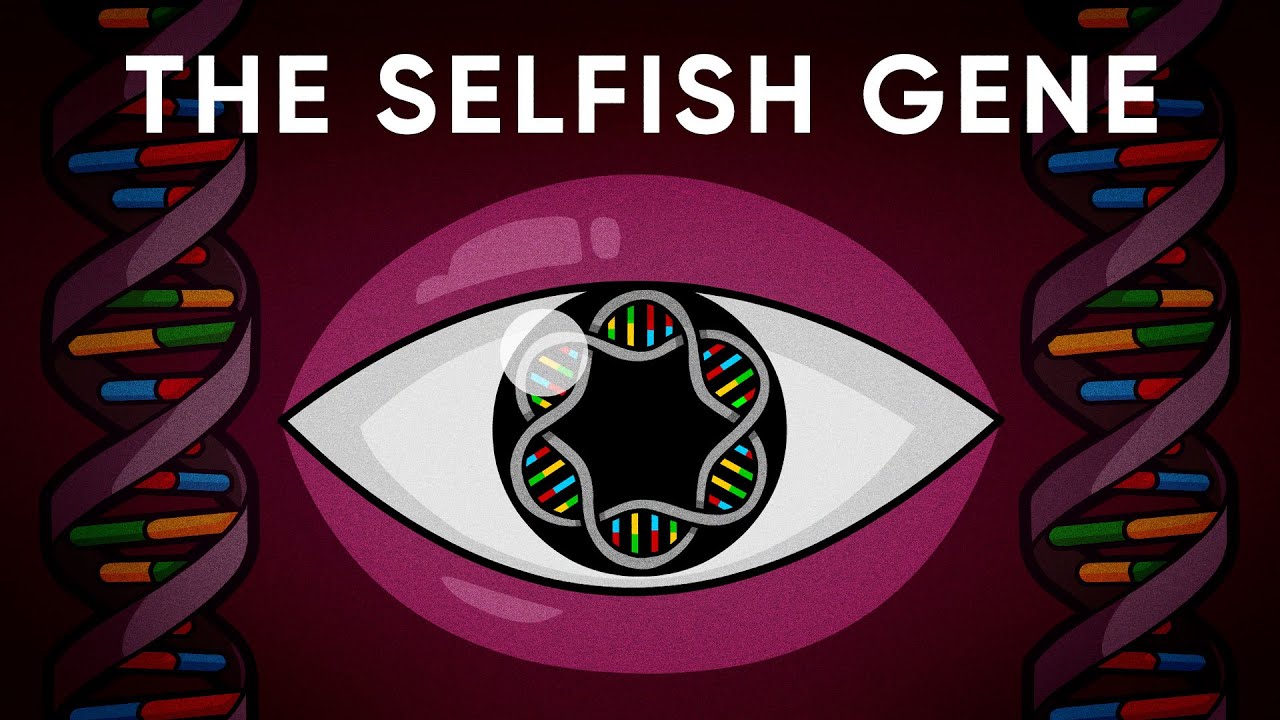
The gene is immortal. In fact a publisher once, when I showed him the first couple of chapters of the "Selfish Gene" he said: you shouldn't call it that. .
. you should call it the "Immortal Gene". and perhaps I should have done.
ahm Genes are immortal in the sense that the coded information they contain is reproduced, is replicated with almost total fidelity. . .
significantly, not absolutely total fidelity. Generation, after generation, after generation. .
. such that there are genes which are identical to what they were tens of millions of years ago. .
. Houndreds of millions of years ago in a few cases. ahm.
. . so genes are immortal.
. . not.
. . not the DNA, of course that's not.
. . that turns over in a very short space of time but the coded information is potentially immortal and that means that the difference between a successful gene and unsuccessful gene, really matters it's going to matter for millions of years.
So. . .
the genes that make it through those millions of years are the ones that are good at it and good at it means good at building bodies good at controlling the processes and Embryology to make bodies which have what it takes to preserve those genes and pass them on. So I use this phrase: "survival machine" a body. .
. an individual is a is a survival machine and that's by far the most powerful way of interpreting what an individual organism is. An individual organism is a throwaway survival machine for the self-replicating coded information which it contains.
And the fate of that coded information is crucially bound up with the fate of the body in which it sits. If the body in which it sits dies before reproducing than that coded information is not going to go on to the next generation, and the next and potentially for tens of millions of years so the genes that are in the world today, distributed as they are in bodies of millions of different. .
. different species. .
. are here today because they were good at what they did in the past. They've come through, an.
. . literally, unbroken line of successful ancestors where unsuccessful non-ancestor have been littered by the by the.
. . by the wayside.
And so the genes in a swallow, or in a kangaroo or in a hedgehog or in a human. . .
Are all very, very good at making swallows, or hedgehogs, or kangaroos, or. . .
or. . .
or humans. They had to be good at it or they wouldn't have come through the generations. .
. Ahm. .
. Today. Now that, I think, is an inspiring vision: and that's what fired me up.
. . about.
. . about.
. . the very idea of the Selfish Gene it in my.
. . When I first red Hamilton and then when I.
. . when I wrote it down in my.
. . first in my lectures and then.
. . and then in the in the Selfish Gene.
- So the idea. . .
The genesis of the idea comes in the mid-sixty's from, from bill Hamilton any then it sort of lies. . .
not. . .
not ignored, but. . .
not. . .
not really researched further and then some people like Bob Travers picks it up and. . .
-Yes, I mean. . .
actually to be fair. . .
I mean, its. . .
its inherent in the neo-darwinian synthesis of the 1930's, actually. . .
Ahm. . .
in Fisher and. . .
and. . .
and Holding. And Hamilton. .
. particularly applied it to the problem of the relationship between kin between. .
. Ahm. .
. but but it wasn't only kin it inspired me it was the. .
. the very idea of the survival machine. .
. of. .
. of. .
. immortal genes. Which goes back to the nineteen thirties, I think .
. . or should I call you: clint?
- Oh come on. . .
ok. . .
- So Richard Dawkins, as it says on page one of your autobiography. . .
- I have to read what the. . .
nobody will get the joke unless. . .
unless I. . .
- Well. . .
apparently you are called: Clinton.