Thank you, Nancy. Hello, I'm Angeliki Salamoura. And I'm Fiona Barker.
And we both work in the Research and Thought Leadership Group at Cambridge English. Welcome to the last in a series of six webinars on Understanding Assessment. So, what is today's webinar about?
Knowing grammar and vocabulary is at the heart of learning a language. The assessment of grammar and vocabulary, is one of the most common forms of testing for all language teachers. But why do we test grammar and vocabulary?
And what is the best way to elicit this knowledge? How to choose what to test at different proficiency levels? And what resources can help teachers?
We will discuss all of these questions and we will show you how a better understanding of the what, why, and how of testing grammar and vocabulary can help you create your own test, or evaluate others with more confidence. Our aim today is to explore key questions about assessing grammar and vocabulary and to give you some practical tips. There are six key questions which we need to address when we assess any skill, whether it's grammar, vocabulary, or something else, in order to be able to construct or select a good, reliable test.
In our webinar today, we will discuss three of these questions. These are, firstly, what am I testing? In other words, what aspects of grammar and vocabulary knowledge are we testing?
Secondly, how am I testing? So, here, we'll look at some different tasks that elicit grammatical and lexical ability. And lastly, how am I scoring?
In this section, we'll focus on ways to mark grammar and vocabulary tasks. Let's start with a question. Why is the assessment of vocabulary and grammar one of the most common forms of testing?
Please share your ideas in the chat box. Here's the question again. Why is the assessment of vocabulary and grammar one of the most common forms of testing?
So, put down your ideas in the chat box. Let's see. Your ideas are beginning to come through, so keep them coming.
People are saying that it's easy to score, require less time. And they're very important skills to show. They're whizzing past very quickly in front of my eyes.
But I think that you're mentioning a lot of ideas that we've also thought about. So, you're saying that it's easy to create a test. They're quick to score or mark.
We can test many items or points in quite a short timeframe. We also think that grammar and vocabulary tests are objective. And grammar and vocabulary are essential for language learning and language knowledge.
And they're an integral part of language knowledge, so really important. And grammar and vocabulary knowledge are good predictors of general language ability. And we'll touch upon all of these topics in our webinar today.
Okay, so let's start by looking at "What am I testing? " In other words, which features or what aspects of vocabulary and grammatical knowledge am I eliciting. We will begin with a poll, so please get ready to vote.
So, the question is, which of the following are aspects of grammatical and lexical ability? A, reciting rules? B, ability to provide an accurate translation?
C, ability to select the correct form from several options on a multiple-choice test? D, ability to use grammar and vocabulary correctly while writing, speaking, reading or listening, Or, E, all of the above? Please vote now using the poll.
So, the question again, out of the options on the screen, which are aspects of grammatical and lexical ability? Okay, so, waiting for some responses. I can see a number of people voting D, D, E, D and C, E, E, D, D.
Okay. Yeah. Please keep typing.
Yeah, okay. So, I think it looks like from the results of the poll that the majority of you, most of you have voted for D, the ability to use grammar and vocabulary correctly while writing, speaking, reading or listening, which is the most commonly view of grammatical and lexical ability today. But some of you also have chosen E, all of the above, which is not our own response either.
Because our perceptions of grammatical and lexical ability and, therefore, what to assess have changed a lot over the years, and they have included all these ideas. And as Professor Jim Purpura remarks about grammar, "Assessment of grammatical ability is nothing new. What has changed over time is what teachers have chosen to assess under the title of 'grammar'.
" And the same is equally true about vocabulary. So, in the past, no leads and accurate use of structures and forms were seen as the very core of language ability. No leads, therefore, of grammatical and lexical rules, the ability to translate grammar and vocabulary accurately, or choosing the correct grammatical or lexical form had a very central place in most language tests.
But times have changed. Nowadays, under the influence of communicative approaches to language teaching and learning, we think it is also very important to test learners' ability to use grammar and vocabulary correctly in context, in other words, as part of a communicative task while writing, speaking, reading, or listening. And in between knowing the rules and knowing how to use grammar and vocabulary in context, there is a whole range of skills that count as part of grammatical and lexical ability, such as being able to pronounce and spell a word correctly, or using these words appropriately in context or in a figurative way, for example, in a metaphorical way.
And the list that you see on your screen is by no means exhaustive. It is just meant to provide an overview. Going back to our initial question, why is assessment of vocabulary and grammar one of the most common forms of testing?
Some of you said that they're essential for language learning and language use. This is true, but let's unpack this point a little bit. For example, if we look at the cognitive knowledge required for the productive skills, for instance, speaking, a skill which was covered in an earlier webinar, we see that after coming up with the idea or ideas you want to communicate, you need to know the appropriate words and you need to know the relevant rules about putting those words together.
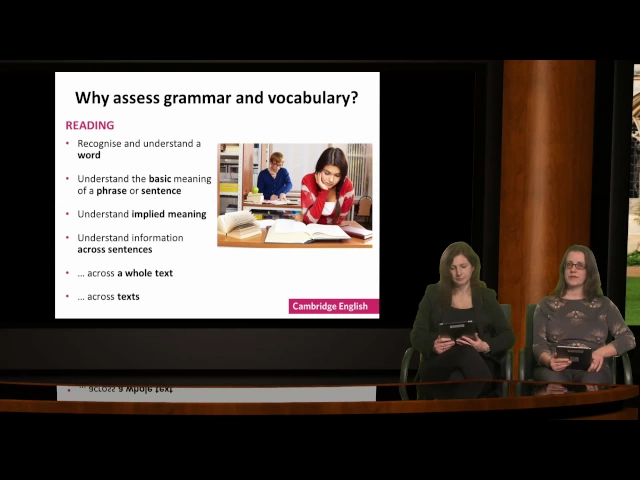
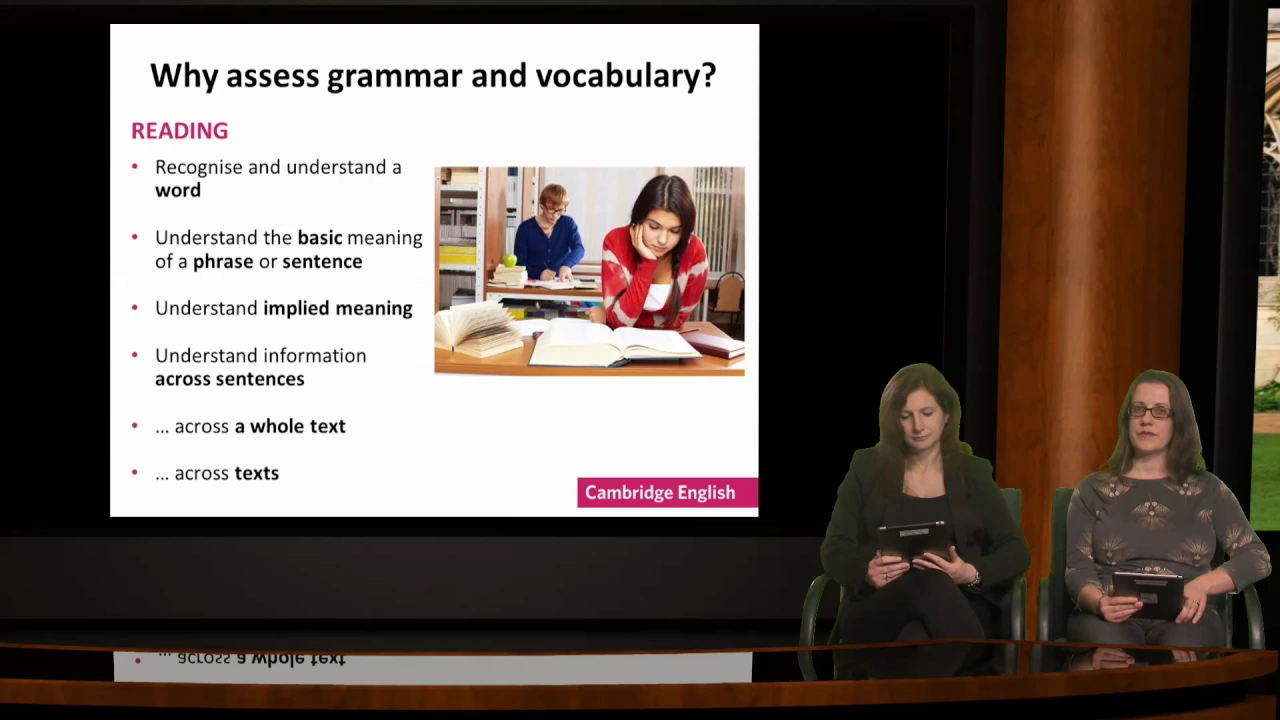
So, you need to have the grammar and vocabulary knowledge to convert nonverbal ideas into language. Similarly, if we tend to a receptive skill, for example, reading, we see that in order to be able to read, you first need to recognise and understand words, then understand the basic meaning of a phrase or whole sentence before proceeding to higher levels of meaning and text processing. And to do this, you, again, need knowledge of grammar and vocabulary.
In other words, grammar and vocabulary are enabling skills. Knowledge of grammar and vocabulary is essential in order to be able to perform well in the other language skills. Grammar and vocabulary are at the heart of learning and using a language.
And here's another important point to make in relation to the assessment of grammar and vocabulary. Although grammar and vocabulary contribute to communicative skills in a vital way, their testing should not be regarded as an end in itself. If we place too much importance on grammar and vocabulary in language tests, this could have a negative effect or washback, as we call it, undermining communicative teaching and learning in the classroom.
Imagine, for example, a situation where a class has to take a language test at the end of period of study, and that test contains only or mostly multiple-choice tasks which test grammatical and lexical points in isolation. These might in turn encourage the teaching and learning of grammar and vocabulary in isolation with no apparent need to use them in authentic language situations or tasks. So, a much better approach is to use or construct tests that include a variety of tasks which assess grammar and vocabulary separately, but also in context as part of communicative tasks.
And we will see examples of how to test grammar and vocabulary separately or together with the other skills in the next section. So, let's now think about how we can test grammar and vocabulary in terms of the task types that we use and which aspects of grammatical and lexical knowledge they can elicit. We will also provide some tips to help you evaluate your own and others' tests and tasks and to help you develop reliable test tasks yourself.
As we have just seen, the current view of testing grammar and vocabulary, which Cambridge English shares, is that testing grammar and vocabulary is about testing language learners' ability to use these skills correctly in context, often as part of a communicative task. It is not limited to solely testing the correct use of forms. But we'll now have a look at some examples of tasks that we use to test grammatical and lexical knowledge.
There are fundamentally two ways of doing this. Firstly, directly, through standalone tasks that test specific aspects such as lexical knowledge. An example would be a four-option multiple-choice cloze task, like the one you can see part of here.
You can also find this task on the handout. See number 1. a.
And direct tests of grammar and vocabulary are not normally communicative tasks. There is no built-in communicative reason for doing them. Such tasks focus on specific areas, such as producing or selecting the correct word to fill a lexical or structural gap, or transforming text written in a formal register to an informal register.
Secondly, we can test grammatical and lexical knowledge indirectly through writing and scoring a learner's use of grammar and vocabulary as part of a productive activity, such as a speaking or writing task, as you see on the slide. You can also find this task on the handout again. See number 1.
b. Alternatively, grammatical and lexical knowledge can be assessed as part of another skill, such as reading, and you might like to watch our earlier webinars on the other skills, or visit the Cambridge English website to find out more about assessing the other skills. And we'll send you links to these after this webinar.
And we'll find out more later on how we can evaluate grammatical and lexical knowledge and how this changes according to whether it has been tested directly or indirectly. Let's now look at three categories of task types, which vary according to how much the test-taker has to do to show their lexical or grammatical knowledge. You'll need your handout for this.
So, in the handout on section 2, you will see three example tasks, A, B, and C. Think about what type of response does each of these tasks elicit. Please share your ideas in the chat box.
Here's the question again. Look at the three example tasks in section 2 of the handout. What type of response does each of these tasks elicit?
Let's see which of you have the handout open and looking at it and providing some ideas about the task types. Let's have a look. Yes, all sorts of different ideas are coming in here.
Some of you are commenting that some of them are examples of direct testing, some indirect as well. Remember, we're thinking about what we're asking the learners to do with these tasks, okay. Okay, yes, there's some really, really good ideas coming through.
The example tasks we've just been looking at fall into three different categories, and you can see these on your screen. Firstly, if you look at the bottom portion, we have selected response tasks, as in Task A on the handout. And these are activities where a question or text is given and the test-taker has to select the correct answer or match up two sets of text extracts and labels from a set of options provided.
And these types of tasks vary in complexity for both the people writing the tasks and the test-takers. And examples of selected response tasks are multiple-choice questions, true/false tasks, and matching tasks. And if you look in the middle of the screen, the second type are limited production tasks, such as Task B on the handout.
And these are activities where test-takers fill in gaps in texts, provide short answers, typically five to 10 words or fewer, or transfer information given to them into another format, for example, from a list to a form. And the third type of task is called extended production, as in Task C on your handout. And this relates to the indirect testing of grammar and vocabulary within an extended writing or speaking task, for example.
We'd like to now give you some tips for evaluating test items using multiple-choice questions as an example. And we chose this task type, it is probably the widest known task type around the world. A multiple-choice question, as you know, has a stem, which is the question, and it has a response, which is the answer.
And the response consists of two or more distractors, which are the incorrect choices, and there's a key, which is the correct answer. There are other forms, but this is the simplest. And in this example, the task focus is on the grammatical structure of present-perfect for duration.
The verb is in the stem and the responses are all time prepositions. Let's look at another example. And this time, we'd like you to evaluate it.
So, how can you tell, how can you decide whether a test item is a good way of testing grammatical or lexical knowledge? Have a look at this item and tell us in the chat box if you think it's a good or bad example of testing grammar or vocabulary and why. Also, tell us if you would change anything else, for example, the layout.
So, the question again, have a look at this test item. Tell us if you think it's a good or a bad example of testing grammar and vocabulary. And tell us what you might change about it.
Let's have a look at your examples. It's interesting. Some people are saying it's easy to guess.
Some people are saying it's a good example. Some people say it's a bad example of testing grammar. The layout is identified by some of you as being poor.
The responses are still mixed, but they seem to be going towards the poor and no good side at the moment. Thank you for thinking about that. We'll ask you to think about a few more items in a moment.
So, summarising what you're saying. One good point about this example is that it is easy to understand what to do, but there are problems with it. So, firstly, the test focus.
This item tests more than one grammatical point as both the correct verb and the correct pronoun have to be selected. And secondly, the vocabulary in the stem, which is modem, is dated, so not relevant to the date to today's test-takers. And this affects the test's face validity.
And thirdly, there are some problems with the positioning on the page and the labelling of the options. There are similar response options here, c and d, "it does" and "they do," which shouldn't ideally be positioned next to each other. And there's too much space between options a and b, and c and d on the page.
Also, it's clearer to have a gap between the question stem and the responses, especially as here the stem is part of a dialogue indicated by uppercase A and B, which can be confused with the response options below, which are lowercase a and b. And you have definitely found more good than bad points about this item. But let's see how we could improve it.
We think we've improved this item by doing a few things. We've moved the pronoun "it" to the stem. So, the focus is purely on the grammatical form being tested, the auxiliary verb.
We've also changed the vocabulary in the stem to something more current, a webcam. And we've added some names. We've added Mike and Jenny, instead of A and B.
And we've moved the four responses closer together and separated the responses from the stem with a line space. This makes it clearer to test-takers what they need to focus on. But also note that we're only looking at one test item out of its context here.
So, if you're evaluating test items, they would normally be part of a larger set of items or a complete test. And you would need to consider additional things such as the overall variety of grammar or lexical items in the whole test and the proportion of the grammatical and lexical syllabus, if it's appropriate, that is covered by the whole test. You'd also consider whether the vocabulary and grammar are appropriate for the level of the learners taking the test.
And we'll later on mention some resources that can help you to better understand your learners' knowledge and use of grammar and vocabulary at different levels. So, here are some additional general tips for developing good multiple-choice questions, which you can apply more widely to any test or use to evaluate existing tasks. So, firstly, when writing multiple-choice questions, don't try to write tricky questions on purpose.
Depending on the level of your test, native or very proficient speakers should get the correct answer without any difficulty. Secondly, using short stems, a maximum of two lines long, will keep the reading load at a minimum especially for lower-level students. Thirdly, don't test prescriptive grammar.
So, don't test "With whom did you go? " but rather test "Who did you go with? " And finally, make the instructions clear and simple and always give an example.
This is useful for learners who may be unfamiliar with the task type, and reduces any fears they may have about not understanding what to do. You will find all of these tips in section 3 on your handout under the General heading. Now, let's look at another example with Angeliki.
So, here is another example, and we'd like you again to tell us in the chat box what do you think is wrong with this example and why. So, here's the question again. Please have a look at this example and tell us in the chat box what you think is wrong with it and why, okay?
So, waiting for some responses to come through. Okay, yes. Still waiting for some responses to come for this item.
Testing two grammatical items. It's a good example. Testing more than one point.
It's much better. Question is not clear. Distractors and grammar are one and the same thing.
So, I think, I would say that the majority of your responses also say that, yes, this is not a good example. So, thank you very much for all the suggestion. So, essentially, yeah, most of you have been right, because the issue with this item is that it focuses on both lexical point, love or hate, the choice between these two verbs, and the grammatical point at the same time, which is not best practice for multiple-choice items.
Because if a learner gives a wrong response here, you won't know whether this is because of their lack of grammatical or lexical knowledge, or both. So, the main point to take home from this is to think carefully about what is being tested in each item. And do not test both grammar and vocabulary in the same multiple-choice question.
Instead, keep the test item focus simple and clear. Test one point at a time. So, let's see how we could begin to improve this item now.
Okay, so we think we have improved this item by essentially focusing on grammar only. That is by varying the grammatical forms and keeping the same vocabulary, a form of the verb "love," in all three distractors and the key. And here are some more pieces of advice about keys and distractors this time.
Again, you can find these tips on the handout in section 3. So, first, there should be only one key or correct answer. Second, all distractors should be equally plausible and "attractive" to learners.
And finally, do not use distractors that test something your students haven't yet learned. And let's now look at one last example of a multiple-choice item. And for this item, again, we'd like you to tell us in the chat box what do you think is wrong and why.
It's again the same question. What do you think is wrong with this third item and why? Again, we're waiting for your suggestions to come through.
Okay. Still waiting for some responses to come through. Includes wrong responses.
Testing different tenses. Ungrammatical distractors. Not good distractors.
Yeah, Vague. . Yeah, all these are very good suggestions.
Okay. Thank you for all your responses. I think most of you are essentially saying that the important point here is that when we're constructing distractors, the distractors should be ungrammatical when placed in the stem, but they should be grammatical when considered in isolation.
In this example, as some of you pointed out, two of the distractors are ungrammatical in isolation, and, therefore, they can be easily discarded from the list of possible correct answers. So, how can we improve this item? So, it's quite straightforward, it's simple.
By making all distractors grammatical when you consider them on their own. And here's our final set of tips. And this time, they are about the format of responses.
Again, you can find this in section 3 on the handout. So, firstly, keys and distractors should be more or less of equal length. If response choices are of different length, then order them from shortest to longest, or longest the shortest, and no one choice should be really different from the others.
Finally, do not repeat the same word in the response if it can be put in the stem, as in this example you have on the screen. So far, we've talked broadly about what grammar and vocabulary are, what some of the different tasks for listing grammar and vocabulary are, and what considerations we should have in mind for writing or evaluating multiple-choice items in particular. Now, let's think about how we go about scoring grammar and vocabulary tasks.
So, how can we score grammar and vocabulary tasks? Let's start with a selected response task. Think about a true/false or multiple-choice question.
What score would you give a correct answer? What score would you give an incorrect answer? Please type your responses in the chat box now.
So, you're thinking about how you would score a selected response item. What would you give to a correct answer? What would you give to an incorrect answer?
Let's see what's coming through. Good, some of you are saying one point and one point only. One, zero.
Yes, it could be one, correct, zero, incorrect. Yes. And I think you're all most in agreement there that typically, an incorrect answer would score zero and then correct answer would score one mark.
That's straightforward. But how about scoring a limited production item, such as a sentence completion task where the learner have to maybe write two to five words, for example? So, here's an example.
We have a sentence, "Joan was in favour of visiting the museum," and a key word, which is "idea. " You need to complete the second sentence using between two and five words, including the word "idea," so that it has a similar meaning to the first sentence. And the answer is "a good idea to go.
" How would you score such an item? Please write your suggested answer in the chat box now. So, look at the item on the screen and tell us how you think you would score the correct answer, which is "a good idea to go," in the chat box.
Some of you are saying or most of you are saying two points. Some are saying two or one point. Some of you are saying yes, it's not very easy to score.
Okay, some of you are saying we'd give it more than the previous example. Okay, thank you for all of those. So, as many of you have suggested, we can score as correct or incorrect as before, but we can also split the answer into two parts, shown here by the vertical line between "idea" and "to go.
" And the first part is "a good idea" and the second part is "to go. " So, we give two marks if both parts are correct and one mark if only one of the parts is correct. This is called scalar scoring.
Finally, we mentioned that grammar and vocabulary can be tested indirectly as part of an integrated task, for example, an extended writing or speaking task. So, how can we score grammar and vocabulary in such a task? Although this is indirect testing of grammar and vocabulary, they can still be scored directly.
For example, here is an analytical mark scheme for marking writing tasks of B2 level with four criteria. You can find this table on the handout in section 4. As you can see, one of the criteria, fourth criterion is about language, and more specifically, assesses the use of vocabulary and grammar as one of the aspects that make up writing ability.
So, here for example, you can give full marks, one of the marks being specifically for grammar and vocabulary as they're used in the writing or, if it's a speaking task, And there are similar assessment scales, which are called analytic scales, for spoken language as well. And here's another important point. So far, we have been talking about giving scores as a way of assessing grammar and vocabulary.
And although this is a straightforward and easy way of testing, it may not be the optimal way of marking in all contexts or for all purposes of assessment. So, typically, scores are more appropriate for large scale assessment. Whereas, in a classroom environment, feedback or peer feedback on performance may be more suitable for helping learners to improve.
Here, for example, is a learning tool called Write & Improve that provides immediate feedback to learners about use of grammar and vocabulary in the written English. And this can be used in conjunction with other forms of scoring. So, it is an online free resource, and we'll send you a link after the webinar.
There is also information on this in section 5 of the handout. In our final section, we will introduce a couple of useful resources that can help us understand what learners at different proficiency levels can do with their language. Both of these resources are from English Profile, a long-term research program which Cambridge English and many other institutions, teachers, and students worldwide have been working on since 2005.
You can visit the website to find out more. We'll send you a link after the webinar. There's also some more information in the Resources section on the handout.
Again, look at section 5. The English Vocabulary Profile is a free online resource based on extensive research into vocabulary learning. It shows which words and phrases and individual meanings of each word and phrase are typically mastered by learners as the six levels of the Common European Framework of Reference or CEFR.
It is a valuable tool for decision-making around what to teach students as they progress and how to assess them at different levels. Here you can see the homepage where you can find out what the Vocabulary Profile is, why it is important, what it includes, and how you can use it as a teacher. And you can register for free on this website and use it to browse or check the level of many different words or phrases.
It is based on the Cambridge English Corpus, which is a huge database of spoken and written English, and the Cambridge Learner Corpus, which is another large database of written exam scripts, along with a wide range of exam vocabulary lists and classroom materials from around the world. And here you can see an example of a search from the English Vocabulary Profile using the phrase "over the moon. " There's a lot of information provided here, including pronunciation, definitions, CEFR levels, and examples of usage at these levels.
As you can see, the word "moon" is accessible at A2 level, but the phrase "over the moon" is first used at B2 level. Moving to the English Grammar Profile, this is another free online resource based on research into grammar learning this time. It describes a learner's gradual mastery of grammar across the six CEFR levels and how and where particular grammatical features are used.
It is another valuable tool for decision-making around what to teach students as they progress and how to assess them. We'll send you a link to this resource again after the webinar and also see the Resources section, number 5 on your handout. So, to recap, in today's session, we talked about why we assess grammar and vocabulary and how to write, evaluate, and score task items that assess aspects of these skills.
We said that grammar and vocabulary is core language knowledge that enables learners to perform well in other language skills. So, assessing grammar and vocabulary helps us to establish how much a learner knows about how a language works. So, what's the best way to assess grammar and vocabulary?
Here are the key important points to bear in mind. First, consider washback. We noted that if too much time and importance is given to assessing grammar and vocabulary in isolation, these can create negative effects in the classroom which could undermine a communicative approach to teaching and learning.
So, you need to think about developing or selecting ways of testing grammar and vocabulary that support learning. And one way of achieving this is by including a range of tasks and responses in your tests. For example, we looked at how grammar and vocabulary are tested directly, or through other skills, for example, writing.
We also looked at different task formats and response types. We presented tasks which require selected responses, for example, choose the right answer, and tasks which require limited production, for example, fill a gap, or extended production, for example, write an essay. Well-constructed items are also very important.
And for this reason, we gave you some tips for developing good quality test items and we suggested together how we could improve poorly written multiple-choice questions. Finally, we also presented you with options for scoring, depending on which task type is used, and some resources for creating appropriate items for your learners' level. So, the take-home message is that there is no one-size-fits-all approach to assessing grammar and vocabulary.
So, we encourage you to think of what you want to assess and think of your learners' needs and the positive effects that you want to create in your classroom when you're about to select or construct your own tests. We've now come to the end of the main webinar. And in a moment, we will answer any further questions you may have on today's topic.
Please type your questions in the chat box now. Before that, Nancy is going to show you how to find some additional resources to support you and your learners. Thanks, Nancy.
Let's now answer questions that have been suggested by some of you. Fiona, would you like to take the first one, please? Yes, I will.
And there are so many excellent questions. Thank you for engaging with our seminar. As Nancy said, a few of you are asking about the English Profile resources and asking particularly if your students can access them.
And we will send out details of how to do this, but, essentially, you have to sign up for free and you'll get a username and a password, and then you'll be able to access them whether you're a teacher or a student. So, hopefully, that will get all of you and your students engaged with these free English Profile resources. Angeliki?
Yeah, I'm going to answer a question by Nada. She's asking, does this criteria of assessing English grammar and vocabulary should all levels of learning? Yes, we would say that in general, yes.
These are tips and rules of thumb that can be applied across all levels of proficiency. But of course, the depth and breadth of grammar and vocabulary that will be assessed will vary from level to level. Fiona?
Okay. It's so difficult to decide. They're all such excellent questions.
There's a question here from Sibyl who says is it better to present vocabulary items of a reading test before or afterwards? And I'm sure you'd all have some views on that. I would say to try it both ways and to see what the advantages of both ways are.
So, some of these questions, there's no definite answer to them. So, I think you just have to try things out and see how that works for your learners and for yourself as a teacher. Angeliki?
Okay, and I'm going to answer a question from Analiza. How much time should you dedicate to grammar teaching in a lesson? How is it important to be grammatically correct when someone is speaking?
So, I think, the second question is more relevant to today's webinar's topic, which is, how much importance should we place to grammar and vocabulary when we are assessing speaking or when we are assessing grammar and vocabulary as part of speaking. And this is a very good question because it all depends on what exactly do we try, what is the purpose of assessment. And for example, if we want to see whether our learners are fluent and they can achieve the communicative aim of the speaking task without having any major problems and whether the interlocutor, the listener gets the message, then probably we should not rank grammar very highly.
However, if the mistakes in terms of grammar are such that impede the message, so the interlocutor, the listener cannot get the message from the learner, then this probably shows that grammar is not there yet and it should be taken that into account in terms of assessing and in terms of marking. So, it all depends. So, if our aim is to see how well our learners have mastered certain grammatical forms and they're used in context, then grammar should be assessed accordingly, should be weighted high.
If the aim is to see whether they are just fluent, then probably grammar should take a lower weight. Okay, there was another question here. Some of your questions are more practical and it's about the learning of grammar and vocabulary rather than assessments.
So, we're tending not to take those. But there was a short one from Claudia who asked, how can I help students record vocabulary? And again, that's a really interesting question that I would — I'm not going to ask you at all to respond to that now.
But I think try different things. And I don't know if it's been mentioned in any of the webinars, but we've also helped teachers do research in their classrooms through something called action research. And we'll send a link around with all the links from the webinar, sending you too some really interesting short articles written by teachers like yourselves around the world, looking into these sorts of problems, how to get their students to learn vocabulary better, what works in an extended reading program for lower-level learners, for example.
So, although I can't answer your question directly, now, Claudia, I'll send some links around and, hopefully, that will help you and the other people here today as well. Okay. And another question I saw by Marie is how often should grammar and vocabulary be evaluated?
Again, there's not a fast answer to this and it all depends on your context. But what we would advise is that do not wait to assess grammar and vocabulary only at the very end of a course. And this is the Cambridge approach.
But do create opportunities to assess with shorter tests or tasks how much learners have learned throughout the course. So, do not stop and then assess at the very end, but integrate assessment in a way that supports learning because that way you can get information that can help you inform your further teaching direction. Okay.
Interesting question here from Igle. and what you want your students to focus . Hi, Igle.
And you asked, what is the best division in terms of percentage in a test that assesses the four skills? And I know this is going slightly more broadly in grammar and vocabulary assessment. And again, there's no one-size-fits-all, as we've said at the end of our webinar today.
But I think it depends what the test is trying to show and what you want your students to focus on. If your students are going to be particularly needing to use productive skills, then obviously, you might test those slightly more in terms of the balance of skills. If they need to focus more on receptive skills, because of what they're going on to do after leaving your language classes, then you might focus on those.
And similarly, I think with assessing grammar and vocabulary, you need at some point to decide what the balance is between those selected response items, those limited production items, and those extensive production items we talked about today. So, maybe you can look back on this webinar and reflect and that will help you find the best way to assess your students across the different skills. Okay.
And here's another question by Naira. How to assess grammar and vocabulary in the mixed classes? Any tips which one is best?
Again, this is quite a challenging situation when we have mixed ability classes. But, again, one way to go about it is to try a variety of tasks with learners that are at different ability levels. For example, with levels of lower proficiency, perhaps you can target more specific grammatical and lexical points.
And also, whereas, you can give more advanced learners tasks that require more extensive use of grammar and vocabulary. But also having mixed ability groups that can practice together these skills as part of informal assessment, that can be one way to go. So, essentially, mixed ability classes is a challenge in terms of assessment, but the key is to include a variety of tasks that test grammar and vocabulary at different levels so as to capture ability from a wide range of learners.
Okay. There was a question here about vocabulary. Beatrice, hi.
Beatrice asked which activities would be the most appropriate when teaching vocabulary to adults? And to help you there, I would say have an explore around the Cambridge English website and have a look particularly on the resources pages for teachers where we have many different ideas for lessons that are suitable for all different levels of learners, from young learners right up to adults of any age. So, have a look at those, I would say.
Also, have a look at the English Profile website. When you can get into it, have a look at the Vocabulary Profile, the Grammar Profile. And we haven't mentioned, but there is another book series called "English Profile Studies.
" And there are a couple of books which are particularly relevant to teachers in that series which we can send you information about as a link after this webinar. So, those might give you some pointers on to how to teach vocabulary to adults. Okay.
And the thing I'm going to answer, a quick question by Esther. What do you think about exercises for which learners have to correct sentences which are ungrammatical? Yes, this is essentially good practice because this is how the learners can learn what is correct in terms of grammar, and they can perform better in a task, especially the target grammatical points.
So, yes, by all means. Okay, there's another question here from Annette. Hi, Annette.
Is looking for a resource on grammar and vocabulary that is not as general as the Common European Framework of Reference, the blue book, those descriptions, but not as detailed as the English Profile, English Vocab Profile and English Grammar Profile, which can be a little overwhelming and I agree with both of those. What I would say is that, and I think they're still on the website, so I will check after this webinar. We'll send the information around if they're still there.
There was a series of Grammar Gems, I think they're called, that were on the English Profile website. And this was a year or two back. But if they're still there, we can send the link out.
And those were summaries of some of the important parts of the English Grammar Profile. Okay. Thanks, Fiona.
And I think that's all we have time for. Thank you very much for attending today. For both Fiona and me, it was a great pleasure to be able to share all of these ideas and suggestions with you.
We hope you found it useful. And this is the end of the Understanding Assessment webinar series. If you missed any of the previous webinars, please look in the Cambridge English TV.
And we look forward to seeing you at our future webinars. The next one coming up is on using digital tools to enrich your learners' vocabulary. And that would be on the 24th and 26th of February.
Thank you very much and goodbye. And thank you and goodbye from me as well.