Something about this forest feels off. Pines twist into bizarre shapes. Spiderw webs hang crooked and uneven.
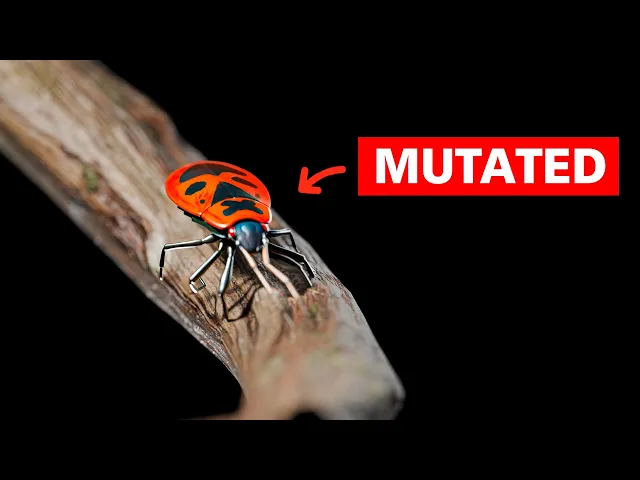
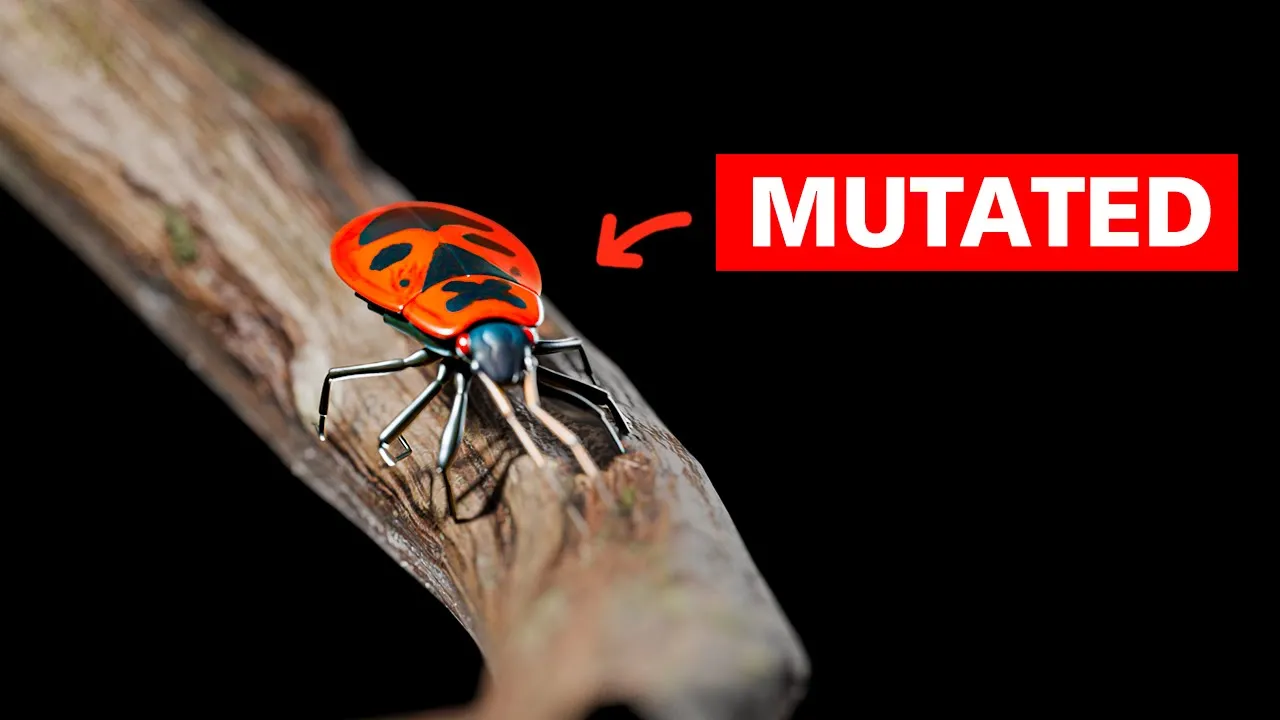
Red firebugs are crawling on the ground, but the patterns on their backs are warped. A bird flies overhead. Its beak is deformed.
There's a reason for all this. This forest sits inside a highly radioactive exclusion zone. It's one of the most contaminated places on Earth.
Not far from here, the largest nuclear disaster in history happened in 1986. A >> nuclear accident in the Soviet Union, and the Soviets have admitted that it happened. >> Deadly radiation is being released from >> thousands died from the radiation's immediate and long-term effects.
For humans, the area remains mostly uninhabitable until today. But nature stayed. Plants and animals, wolves, deer, wild horses, birds, and insects.
But the radiation changed them. Fern. Spring 1986.
In the dead of the night, reactor 4 at the Chernobyl nuclear power plant has just exploded. Massive amounts of highly radioactive material like iodine and cesium are hurled into the air. The radiation seeps into the cells of all living things in the area, including this deer.
30 minutes after the blast, it's dizzy and barely able to stay on its feet. The radiation has burned the mucosal tissue inside its digestive tract. Cells all across its body start dying.
Blood circulation in the brain falters. And since the blood can't flow properly, pressure builds inside the skull. The deer's blood pressure crashes.
It suffers seizures and multiple organs fail. The next day, the deer is dead. In the following days and weeks, the pine needles change color.
First to yellow, then to red. Trees die for kilometers around, giving the area a new name, the red forest. A few kilometers away, a shepherd dog lives in the town of Pleipat.
For the past day, it's been feeling unwell, tired, and nauseous. Its owners are worried. They too feel under the weather, though they don't know why.
Then a voice crackles over the radio with an announcement. Residents are informed about an accident at the nearby nuclear plant, but they are assured everything is under control. Just to be safe, people are told to leave town for 3 days and to leave their pets behind.
The family assumes they'll be back soon, so they leave enough food for the dog for a few days. But the Soviet authorities are lying. They're doing everything in their power to cover up a nuclear disaster of unprecedented scale.
Like tens of thousands of others, this family will never return. Their dog is on its own now. 3 days later, the food is gone.
On the fourth day, he leaves the house hungry and searching for anything to eat. He encounters other dogs wandering the empty streets. They too were abandoned and left behind.
Suddenly, shots are fired. The Soviet authorities have ordered police to kill all stray dogs. An attempt to stop the animals from spreading radioactive material.
The dogs flee into the forest. Just like all the other animals here, they find themselves in the heart of the world's largest nuclear exclusion zone. Radiation remains dangerously high for months.
Many animals develop chronic radiation sickness. Blood pools in their livers and spleens. Lymph nodes swell.
Thyroids fail. The animals grow thin and many die. Over the next 10 years, radiation levels drop significantly.
The only humans left are workers and guards looking after the ruins of the nuclear plant. Beyond that, the area is almost completely abandoned. In this vast and empty space, wildlife can spread freely.
Over the years, the zone evolves into one of Europe's largest nature reserves. Countless animals settle in. Bears and lyns, moose and foxes, and multiple packs of wolves.
Even some of the original residents remain. Hundreds of street dogs, descendants of the pets left behind roam the area. Swallows skim over the treetops.
Frogs leap through the undergrowth. And they are all followed by their silent companion, the radiation. The first thing you notice are the eyes.
>> One of the first signs of exposure to radiation is something called cataract in the eye. It's a cloudiness of the lens of the eye that happens to people who are exposed to to higher levels of radiation. >> That's Timothy Mosau.
He's a biology professor at the University of South Carolina. Few people know the creatures of Chernobyl as well as he does. He's talking to us from a research ship in the middle of the Pacific studying the effects of nuclear weapon testing on wildlife.
>> We've had many exciting visits to Chernobyl. Uh, you know, I've been going to Chernobyl pretty much two or three times a year. Uh, sometimes four times a year.
>> A so-called cataract is a clouding of the lens in the eye. It's a common disease in humans known as grey star. It blurs the vision and its most severe form can cause total blindness.
The high radiation levels in Chernobyl cause many animals to develop cataracts. The landscape itself has changed, too. This is what a natural pine forest looks like.
Green needles, straight trunks. And this is what a pine forest looks like in the most contaminated areas of Chernobyl. This trunk is twisted, stunted, and misshapen.
The wood has changed its color. If you look closely at the rings, you can see exactly when the disaster happened. Near the base, there are these strange clusters of tangled leaves called witches brooms.
This forest doesn't just look eerily strange. It's a stark reminder of what our actions can do to nature. Seeing it can make you feel powerless, but it doesn't have to be that way.
Planet Wild is a community-based environmental protection organization. Think of it as crowdfunding for nature. Every month, their community funds a carefully selected reing project to restore forests, bring back endangered species, and protect the oceans.
Planet Wild documents all their projects in monthly videos, so you can see how your contribution helps to protect nature. In one of their latest projects, they use chainsaw detectors to protect one of Europe's last ancient forests. Of course, environmental protection also involves broader systemic and regulatory change.
At the same time, collective efforts like these are essential to the larger cause. Support Planet Wild's mission by scanning the QR code or clicking the link in the description. Pay whatever amount feels right for you.
The first 100 people to sign up using our code fern 10 will get their first month covered by us. You can cancel anytime after that. Every forest has spiderw webs.
Normally, they're neat and symmetrical like this. But here in Chernobyl's most contaminated areas, the gaps in the strands are far too large. The patterns are warped and chaotic.
This is what a barn swallow usually looks like. Note the distinctive combination of blue black feathers and a rat face. This one from Chernobyl has white patches on its face.
Its tail feathers are crooked and its beak deformed, stuck slightly open. A lump protrudes beneath its plumage. a tumor.
Many changes are not visible from the outside. You can't see that the swallow will live a shorter life and have lower chances to successfully reproduce. Red firebugs are native to central Europe.
Their vibrant red and black coloring with its symmetrical patterns helps ward off potential predators. But Chernobyl firebugs are different. The patterns on their backs are warped and asymmetrical.
Some are missing an eye and the fine black lines are blurred. All of these changes trace back to mutations in the genetic code. This is where the DNA is stored, the blueprint for the insect's entire organism.
DNA is made up of two strands twisted together in a shape called a double helix. It's made up of base pairs. The genetic information is stored in the sequence of these bases.
Kind of like a computer carrying information using ones and zeros. Several of those bases form a gene. The body reads the sequence through complex molecular processes.
Genes act as a blueprint. They determine how the bug looks, the pattern on its back, and what it can and cannot digest. They also influence how long it lives, its vulnerability to certain diseases, and even its behavior.
Scientists believe these blueprints make up only a tiny fraction of our DNA. Studies in humans suggest that around 8 to 15% of DNA are functional and actively doing something important. Radioactive atoms like uranium and cesium are unstable.
They decay spontaneously releasing radiation. That radiation carries so much energy it can damage living cells the moment it makes contact. It can break DNA directly or split the water molecules in a cell.
This creates smaller particles called free radicals. These free radicals then rip through the DNA. Base pairs can be swapped or deleted entirely or the entire DNA strand can break apart.
>> When radiation hits the DNA, it damages it. Most of the time, the damage is repaired, but uh but often uh if there's enough radiation, this damage will persist. Sometimes it will lead to a disease like a cancer or a tumor or some other developmental problem.
Many of these mutations have no effect. The body either repairs them or they occur in parts of the DNA that don't serve an important function. But sometimes those repairs go wrong and that's when lasting changes can happen like the ones we see in Chernobyl.
These changes can even be passed down to future generations. But some of the animals around Chernobyl aren't just mutated. They seem to have adapted and are thriving in their new environment.
This is a tree frog. Normally tree frogs are green, but here in the exclusion zone, some of them are pitch black. The dark pigmentation likely comes from melanin.
Melanin is what makes your skin darker in summer. Your body produces it to shield your skin from sunlight, but melanin can also help protect against other types of radiation. According to a 2022 study, the darkest frogs in Chernobyl were found in areas where radiation levels used to be especially high.
So, does that mean they've adapted to high radiation? Timothy Moss is not convinced. He says the data isn't strong enough to prove a causal link.
Frogs in Chernobyl show no relationship between the melanism and radiation level currently. So, so inside Chernobyl zone, there are light frogs in highly radioactive areas and there are dark frogs in clean areas. That is just one of the many scientific debates around Chernobyl's wildlife.
What can truly be verified and what's too speculative? Both sides hold firmly to their findings. There's another organism that may be putting the benefits of melanin to work.
This black fungus, one of them grows here, right inside reactor 4, one of the most irradiated places on the planet. Radiation levels remain so high that nothing should be able to survive here. And yet, this fungus is thriving.
Multiple independent studies suggest that this fungus may actually be using gamma radiation as an energy source. Much like plants use sunlight for photosynthesis. Unlike in the frogs, the melanin in this fungus doesn't just block radiation.
It seems to convert it into energy, which the fungus then uses to grow. Melanized fungi like this one have been found in other highly radioactive places. Astronauts have even studied it aboard the International Space Station.
Researchers hope that one day this fungus could act as a natural shield against radiation, perhaps for space travel. As for the fungi in the reactor, it's still unclear whether they've truly adapted to the radiation or if they were just inherently able to cope with it. Larger mammals may have adapted to radiation exposure as well.
At least that's what biologist Cara Love and her colleagues at Princeton University believe. They suspect that wolves living in the Chernobyl exclusion zone may be less likely to develop cancer or more resilient to the disease overall despite constant exposure to high radiation levels. The theory goes like this.
Random and spontaneous mutations in DNA make some wolves less vulnerable to cancer. These wolves have a higher chance of survival while others are more likely to die from the long-term effects of radiation, often from cancer itself. The survivors reproduce.
Natural selection happens. Their offspring inherit the protective genes. Over time, they breed with wolves that are also better adapted to radiation and so on and so forth.
After a few generations, the whole pack is less prone to cancer. Researchers say the wolf's DNA evolved in regions around genes linked to the body's immune response to cancer. But is that actually realistic?
The research hasn't been published yet, which means there's no way for us or anyone else to verify it. This study and many others have one thing in common. They all suggest that the Chernobyl nuclear disaster may have triggered evolution right before our eyes.
Other scientists remain skeptical, including Timothy Mosau. We wrote a paper a few years ago where we reviewed all of the literature that had been published on on Chernobyl claiming to test for adaptations and rapid evolution. And and in every case except for maybe one uh the data were too weak.
They they did not have the strength the scientific strength to to to to support this hypothesis of of adaptation. Muso has studied potential adaptations himself. He and his colleagues sampled colonies of certain bacteria in Denmark and at various sites across Chernobyl.
The colonies are often found on the wings of swallows among other places. Back in the lab, they exposed both sets of bacteria to radiation. Some colonies from Chernobyl actually reproduced better under radiation, especially those that had lived for years in areas with moderate background radiation.
By contrast, colonies from Denmark, as well as those from the most highly contaminated parts of Chernobyl, were far less resistant to radiation. Because the experiment was carried out under carefully controlled lab conditions, the researchers are confident that this adaptation wasn't caused by any other environmental factor. To study the animals of the exclusion zone, Timothy Mosau set up around 100 motion activated cameras throughout the area.
In late 2021, they recorded something strange. Russian soldiers. In February 2022, Russia invaded Ukraine.
Russian troops occupied the exclusion zone for weeks. Overnight, nearly all research in Chernobyl ground to a halt. Some scientists were forced to flee the zone.
When the Russian forces finally withdrew in the spring of 2022, researchers returned to find their work in ruins. Military vehicles had kicked up radioactive dust. Offices and labs had been ransacked.
Computers and valuable equipment were stolen or destroyed. Long-term surveys were interrupted. And some irreplaceable research data may be lost forever.
Several promising studies were put on hold indefinitely. Carol Love and her team never got the chance to return and study the wolves in the field. It's a bitter blow to our understanding of the world.
Don't forget to check out Planet Wild and become a member. If you want to see them in action, check out their project protecting one of Europe's last ancient forests.