Are you wasting hours pumping only to get a few measly ounces? Are you feeling like there's probably milk left behind? You're just not able to get it out with a breast pump.
You are actually not the problem. Your pumping strategy is. So, in this video, I'll show you exactly how to pump efficiently so you can protect your milk supply and reclaim your time without the stress and frustration.
If you're new here, my name is Alison Tolman. I'm a lactation coach and a breast pump expert. I've helped hundreds of moms just like you navigate the confusing world of milk supply, especially in relation to pumping.
I recently spoke to a mom named Julie who was completely overwhelmed by pumping and what she said really resonated with me and hit home and actually prompted me to create this video. I was chatting with her. She was thinking about joining our program and she said, "I don't really know what you mean when you say pump efficiently.
And I also don't know if there's anything else I can even do differently. I feel like I've tried it all. " Julie had pumped for 5 months with her first baby and that's kind of where she was when I was chatting with her.
She'd been doing eight times a day, all the supplements, all the things she'd found, and still felt like she wasn't producing enough. She was exhausted and felt like she might as well switch to formula, which is actually not what she wanted. And that always hurts my heart when I hear moms in these situations, but it happens so much.
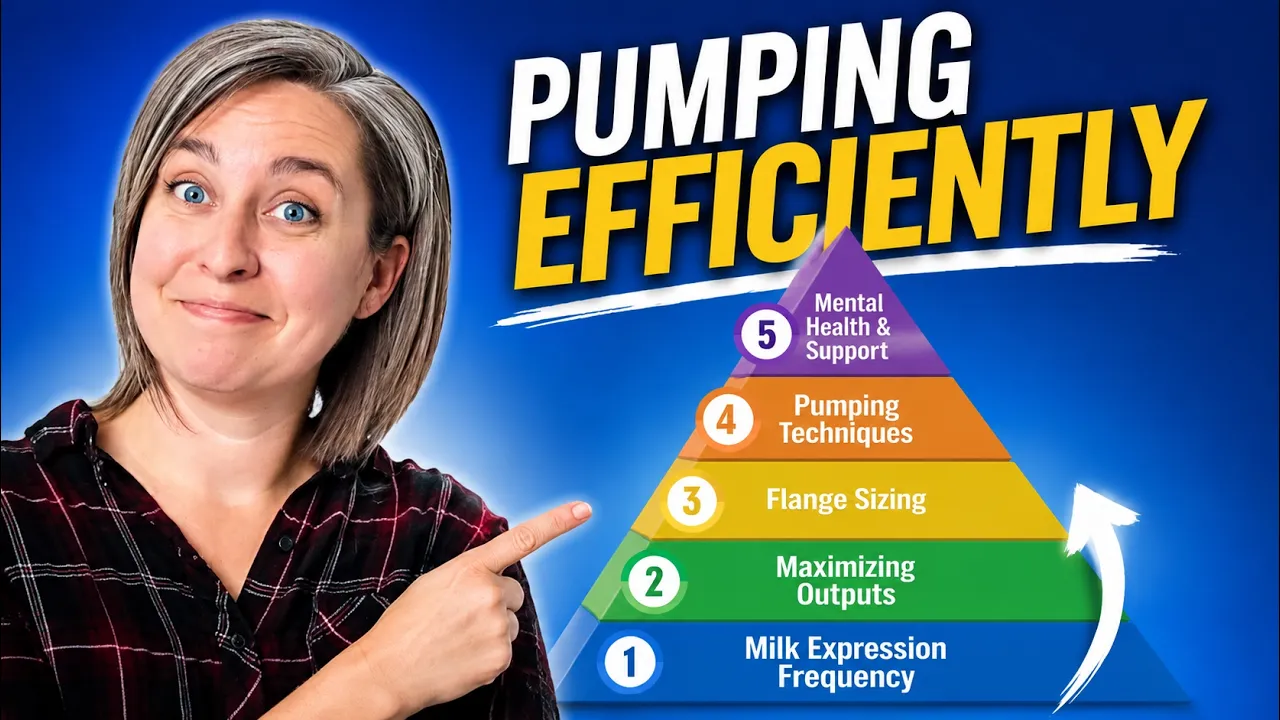
What she didn't realize though is that she had never been taught how to pump efficiently. She thought she had Googled and tried everything possible, but once we started working with her and taught her the methodology that I'm going to share with you today in this video, everything changed. So, what we're going to be talking about today is called It's called the proficient pumping pyramid, okay?
I designed this model after working with thousands of lactating mothers over the last 15 years. After specializing in pumping about 6 years ago and since then testing over 100 breast pumps with our custom device and working with hundreds of coaching clients. They're all working moms who are pumping at work.
We have found the most essential parts of pumping efficiently, okay? So, let's walk through the five levels here of my proven proficient pumping pyramid. It's a mouth It's a tongue twister, for sure.
But this is a method designed to help you get more milk in less time and with less stress. Let's start at the base of the pyramid. This is the foundation, okay?
This is the base for a reason. It is non-negotiable. And that is your milk expression frequency, okay?
Frequent and consistent milk removal and nipple stimulation are essential to establish and maintain milk supply. Nothing can replace removing milk frequently. If you're inconsistent or if you're going too long between sessions, your body gets the message to slow down production.
I kind of like to think of it like you're watering a plant. You can't flood it once and then ignore it for days, right? Milk supply is built through consistent and steady stimulation.
I actually had a client say one time, "When I started the program, I was pumping five to eight times a day. My schedule was random and exhausting. Once we found a rhythm that worked with my schedule, my supply stabilized and I finally felt like I could breathe.
It wasn't about doing more, it was about doing it consistently. Eventually, I was able to reduce the sessions to six a day and get my supply up and learned what my own milk supply could tolerate. " So, in the early weeks postpartum, a nice place to start is around eight expressions in 24 hours, okay?
The more evenly spaced throughout 24 hours these are, the better. If you're not exclusive pumping, but also adding baby at the breast or even exclusive breastfeeding, this number might be more because babies eat more frequently, especially when feeding on demand. So, you kind of have to find that happy balance for you.
Over time, you'll probably be able to find your magic number, okay? This is the number of sessions your body needs each day to maintain a milk supply. This is based on how much milk your breast can hold and the status of your current milk supply and a couple other factors as well.
This number can adjust over time, but having a good number for the day to shoot for is really key. And this is what we help our clients find, too. A couple of tips for you in this section is maybe use timers or tracking apps to help you build a routine.
It doesn't have to be exact, but it does have to be consistent, all right? Skipping sessions sends the wrong message to your body that milk isn't needed. So, if that's happening consistently, you may need to adjust based on what your milk supply can handle and find something more sustainable.
If this is happening frequently and you're ending every day with these tiny failures throughout your day because you aren't hitting your ideal schedule, this is the fastest way to burn out, okay? Reframing things so you can actually find a plan that's realistic and meets your goals can leave you with micro wins each day, which makes the experience a lot more enjoyable and way more likely that you hit your goals in the long run, okay? You ready for the second step in the pyramid?
That is getting a good flange size, all right? A well-fitted flange makes pumping comfortable and efficient. A poor fit can lead to pain, reduced output, and even clogged ducts, okay?
So, those are not things that we [laughter] want. A bad-fitting flange is like drinking a smoothie through a cracked straw, okay? It's frustrating and ineffective.
You may be able to get some out, but it's going to take longer and it is not going to be fun, all right? That's what your milk ducts go through when you have the wrong flange size. So, getting a well-fitting flange is one of the most common things our clients say make the biggest difference in their output and efficiency.
This is often a huge game-changer and the start of them getting back on track. Notice I didn't say find your perfect flange size, okay? I don't think we're shooting for perfect in any area, especially here.
It's about getting one that works well. So, not only does it it look like it's working well, but it's giving you good output. It's comfortable and the nipple's able to freely move in that tunnel.
One of our clients actually said, "I'd been using a standard 24 mm for months and it took forever to get my milk out. I always felt like I was leaving milk behind, too. It didn't hurt, but it turns out that I needed a 17 mm.
" This is so common. We hear this all the time. "Once I switched, pumping felt totally different and I got more milk in less time.
" And that's exactly what a well-fitting flange can do with you. So, a few quick tips on this area. When we're measuring for a flange size, we're looking at the diameter of the nipple, okay?
Has nothing to do with breast size. There are some tools online where you can measure yourself. I found that the most effective way is to get professional help from someone who knows what they're doing.
Nipples come in all shapes and sizes. I've seen such a wide variety of [laughter] size, of of elasticity, of Oh my gosh, you just would not even believe. So, after looking at thousands of nipples, it becomes a lot easier to kind of figure out the best path moving forward more quickly.
Some signs of a bad fit are pain, blanching, swelling, or low output. Often what I see is someone using the standard 24 mm that comes with the pump. Maybe it's not painful, but when I look at pictures or videos that they send, which is what we do with the clients in our program, there is swelling all around the base of the nipple and it can be a little bit hard to see if you don't know what you're looking at, but that's because it's not pulled into the flange correctly.
So, once we fix this, moms often say, "Wow, this is so much more comfortable and the milk comes out much more easily. " It's not that it was hurting before, but when they get a good size, it's like, "Whoa, okay, now I know what it's supposed to feel like. " Some things you can try on your own is you can try a few different sizes and shapes.
Not all nipples are the same and neither are flanges. And we have quite a few products out there that can help you find the right fit. Correct fit in a flange can increase output and comfort dramatically, okay?
We're on to step three in the pyramid. And that is maximizing your let-downs, okay? A let-down is your body's milk ejection reflex and this is key to actual milk flow.
You can have lots of milk sitting in the breast, but if you can't initiate a let-down, multiple let-downs, which we'll talk about, you are not going to get all of the milk out, all right? You want to aim for at least two to three let-downs per pumping session, all right? [clears throat] We put this one right after flange sizing on purpose, actually, because often getting a better fit in flange makes getting intentional let-downs a lot easier.
So, this pyramid definitely builds upon itself. I I structured it very intentionally, just so you know, all right? If you are not getting multiple let-downs in a pumping session, it's kind of like squeezing an orange one time and then throwing it away, all right?
You're going to get some juice, but there's a lot more left inside. Moving it around, second and third squeezes is really where that extra yield comes from, okay? If you've already made the milk in your breast, we don't want to waste it by leaving it behind.
One of our clients said, "I was finally able to get three let-downs at work and it felt like a miracle. I used to only get one and figured that was normal. Now I'm getting way more milk each session.
Turns out I was leaving almost 2 oz behind every time I pumped and I was only pumping through one let-down, okay? So, don't let that be you. I actually hear that really, really often, so let's not do that.
So, a couple of things when it comes to let-downs. For The first let-down is usually the easiest and it usually comes between that 1 to 2-minute mark. Usually, we're starting in stimulation mode on a breast pump and again, this is usually the easiest one and the most noticeable.
Even if you don't feel it, if you are pumping, you should be able to see it and or hear little drops of milk kind of plopping into the the bottle and you'll know, "Oh, now there Now my let-down has come. " Don't stop after one let-down, okay? [laughter] Keep going until milk flow slows significantly and then do it again.
Find the ways that work best for you to initiate a second, third, fourth letdown, okay? If you only pump through one, you could be leaving up to 40% of milk behind in your breast. That's a lot.
Few ideas, we have a couple other videos on letdowns as well. We actually have more videos on all of these topics on the channel. We This is not a secret.
We've been talking about this, maybe just not quite so organized as I'm showing you today, but there's a ton of videos on [clears throat] the channel to to help you there. Some tips to trigger more letdowns just kind of like off the top of my head are breast massage with compressions. You can try a warm compress, relaxing music or videos of your baby can sometimes help, mindfulness and deep breathing, and then and then returning to stimulation mode back and forth on your breast pump is also a great idea.
The most important thing to do though is to find what works best for you so that you can trigger them consistently and quickly. Okay. Number four step in this pyramid.
And I actually divided it in half because looking back, I probably should have just had six steps in [laughter] this pyramid. But these ones These ones go together a bit, okay? So first, [clears throat] we have your pump settings.
And that's kind of like customizing your settings and figuring out what works best for you. All right, pumping is not just plug and play, right? It's really about learning your body's language.
Customizing your pump settings is kind of like tuning a violin, all right? Everyone has the same strings and the same instrument, but the way you draw the bow, the pressure, the speed, the rhythm, this changes the sound completely, all right? You have to fine-tune your pump as well in a similar way.
If you're not a musician, another example might be using a blender, all right? You can't just hit high blend and walk away for everything. Some ingredients need pulsing and some need slow blends and others need a quick burst at the end.
Each body is different as well. It needs kind of its own combination of speeds, suction strengths, and patterns to get the best results. So, doing some experimenting there can really help you.
One of our clients told us, "I didn't even realize my breast had just stopped responding to my pump. Once I adjusted the settings, even just a small change in suction and cycle speed, I started seeing better flow again. It was like my body just needed something new.
" I had another client on the same topic say, "I was really struggling switching between two breast pumps. I was getting half the output with my portable one than I was with my Spectra. Once I used the tools in this program to match up the settings, I was getting the same output on both pumps and started taking my portable pump to work, which was so much better.
" Getting similar suction and speed on each pump made a huge difference. We have kind of a spreadsheet. I have all the data that I've have from all the pumps I've tested available to our clients, so they're able to match those up on different pumps and and kind of compare them that way, which is pretty fun.
So, a few things on pump settings is start in stimulation mode on your breast pump if it has it for 1 to 2 minutes to trigger that letdown, and then switch over to expression mode once the milk starts to flow. We usually recommend that you have the suction at the highest comfortable level, okay? Good suction is really important for milk removal, but more suction is not always better.
All right, there's another video on that. I'll put it down below for you. It's also a good idea if your pump has the capabilities to try different cycle speeds.
Some moms respond better to faster cycle speeds, others to slower ones. If your pump doesn't have the ability to change cycle speeds, I can bet that the cycle speeds are probably tied to the suction. So then you might need to find that balance between good suction and a speed that works well for you.
Some pumps are just a little bit more limited than others, but you don't have to go buy a new breast pump if it's not working. A lot of times, I can only think of like a handful of clients in the 300 that we've worked with in the last few years where I've been like, "I think we need a new pump. " Almost always we can make it work with the one that you've got.
And then the second step here is pumping techniques, okay? And so sometimes we lump these together in our teaching, [clears throat] but they really are two different things, but it's all about optimizing the breast pump and trying to make it as much like a warm, beautiful baby as possible, okay? A breast pump is a machine.
It's a cold, lifeless robot, and it will do what you tell it to do. So, adjusting your pump settings and your pumping techniques is kind of the way to figure out what works best for you. How can we help your body respond well to a breast pump?
One of my favorite pumping techniques is hands-on pumping. I find that really effective for a lot of moms, especially if they can get the technique right and figure out a way that works for them. There's a lot of different pumping techniques out there, but this is kind of where we focus on this step of the pyramid.
Okay, we're ready for the top layer, and this layer often gets ignored, all right? But it's crucial, all right? Here we go.
The mental and emotional aspects of pumping, okay? Stress, anxiety, and pressure can literally shut down your letdown reflex, [laughter] okay? And slow overall milk production.
I've had many clients where we've worked together ensuring that they're doing all the right things logistically. Everything on paper looks great, but they're still struggling to get enough milk for their babies. This section is often what's lacking.
And to be honest, sometimes we work through it and sometimes we don't. I've had a couple of clients, not many, who just could not overcome either their circumstances at the moment or some personal tendencies and were never able to make 100% breast milk for their baby because of this, all right? There are a lot of reasons that you might have low milk supply or that you can't make 100% breast milk.
This isn't always the case, but I can think of a handful of mothers where I suspect that they were simply getting in their own way and making things harder than they needed to be. Sometimes unintentionally and sometimes it's just a situation they're dealt, all right? Sometimes this is just an area we can't overcome, but sometimes everything's an area we can't overcome, right?
Everybody responds to a breast pump differently, and I think it's important to know that this really affects pumping, not only your output, but also your long-term milk supply. I actually had a client once that said, "I did everything right. I had a perfect pump, schedule, data, everything, but I hated every second of it.
I almost quit. Once I gave myself permission to relax and addressed a few key factors in my life that were adding to my stress, I actually started enjoying the process and my output improved almost immediately. " See this a lot.
Okay, this is a really important piece. "I was shocked how much my emotional state affected me. Pumping while you're stressed or while other things in your life in this area are not in check is like trying to breathe through a straw while you're running, right?
You're doing all the right things, you're moving, you're working, you're pushing, but your body can't keep up because it's overwhelmed. Ignoring this part of the pyramid is like planting a beautiful flower in clay instead of dirt, all right? You can have the perfect watering frequency, the perfect tools, like a pump.
You can be in a perfect spot in sunshine and all of these things, but if the soil, aka your emotional state, is dry, nothing thrives, all right? Creating a nurturing inner environment is what allows everything else to work. Makes everything else easier.
Letdowns are triggered by oxytocin, okay? And oxytocin thrives in calm. When you're anxious, when you're cold, when you're stressed, when you're it's like standing in front of a locked door, okay?
The milk is right there, but your body can't unlock it. Calming your mind and finding that key is how you get the door open. I will say that when there are issues here, we often see symptoms here in difficulty in getting letdowns because, again, your hormones are the key factor in in the milk ejection reflex, and oxytocin is in direct opposition with adrenaline and cortisol, the stress hormones, okay?
Prolactin is in opposition with those two, which is the milk-making hormone. I think the key here is that everyone is different, okay? This part of the pyramid affects some people more than others.
So, knowing yourself and your personal tendencies, like I said, even outside of the world of pumping, can really help you troubleshoot problems. I know there's a lot of ideas online, and they're usually all good ideas on how to make a peaceful pumping space, you know, uh dim lighting, cozy chair, something comfortable to focus on, but it goes well beyond this too, all right? How are you feeling in this moment?
In this day. In your life in general. Like, are you happy?
Are you feeling good about what you're doing? Do you know why you're doing this? What other aspects outside of pumping might be affecting this moment and making it more challenging for you?
Letting go of perfection is key. Pumping isn't a performance, it's a process. Adjustments along the way are necessary and normal.
Breast milk doesn't have to be all or nothing, and I know I've said that before in lots of videos, but I mean it, okay? And the clients that we've worked with, this is something we harp on a lot with them because it's so easy to get into that all or nothing mindset, but it's a bad place to be, all right? You are allowed to do what you want to do, and sometimes our circumstances, the place that we're put in, sometimes are beyond our control.
And so kind of figuring out what can I control is essential in figuring this out, all right? I actually love this part of the process, okay? The logistics of pumping are cool, and pump testing breast pumps is fun, but I really love helping a mother look at themselves in a in a holistic way and try and looking at the process, looking at their life, and trying to figure out what other things are getting in my way.
When we're talking to mothers who apply to join our coaching program, this is not usually like a big selling point, but something that I love to see is that you might actually get to know yourself better as a person by the end of this experience. Usually they just want to improve their milk supply or reduce anxiety or fit pumping into a busy working schedule or get milk out faster, and we do all of that, too. But often at the end of the journey with us, they actually learned a lot about themselves personally.
Mastering pumping, especially as a busy working mom, gives you a sense of empowerment that's really difficult to describe. This is such a hard experience. Motherhood is.
[laughter] And often this pumping piece is kind of the culminating peak of growing, delivering, and now feeding your baby. It's like the final 10 miles of a marathon. Well, of the first marathon you're going to run.
Motherhood is a long, a long game. But you've already spent 9 months growing this baby, you've delivered the baby, you've got feeding off to a good start, and then now we have to sustain this often for a year. That's a really common goal for working moms that we work with.
I don't care how long you do it, and that's a topic for another video, but it is a marathon. But if you can accomplish this, and by accomplish I don't mean drag your tired broken body across the finish line. Okay?
If you can become your own pumping expert, learn how your body works, get in tune with your mind, your needs, learn how to set effective and clear boundaries, learn to set goals, prioritize what matters most to you, know your areas of weakness and likely distractions, you actually end up becoming a better person. All right, a more self-aware person. A person who is never done learning, adjusting, and trying to thrive instead of just survive.
Motherhood will test and push you in ways you never imagined possible. You can lean into it and grow into a better version of yourself if you let it. Pumping can actually be a vehicle to get you to that place, which is really, really cool to watch.
If you want some help becoming your own pumping expert, to know and understand your body, and to feed your baby on your own terms, I'd love to help.