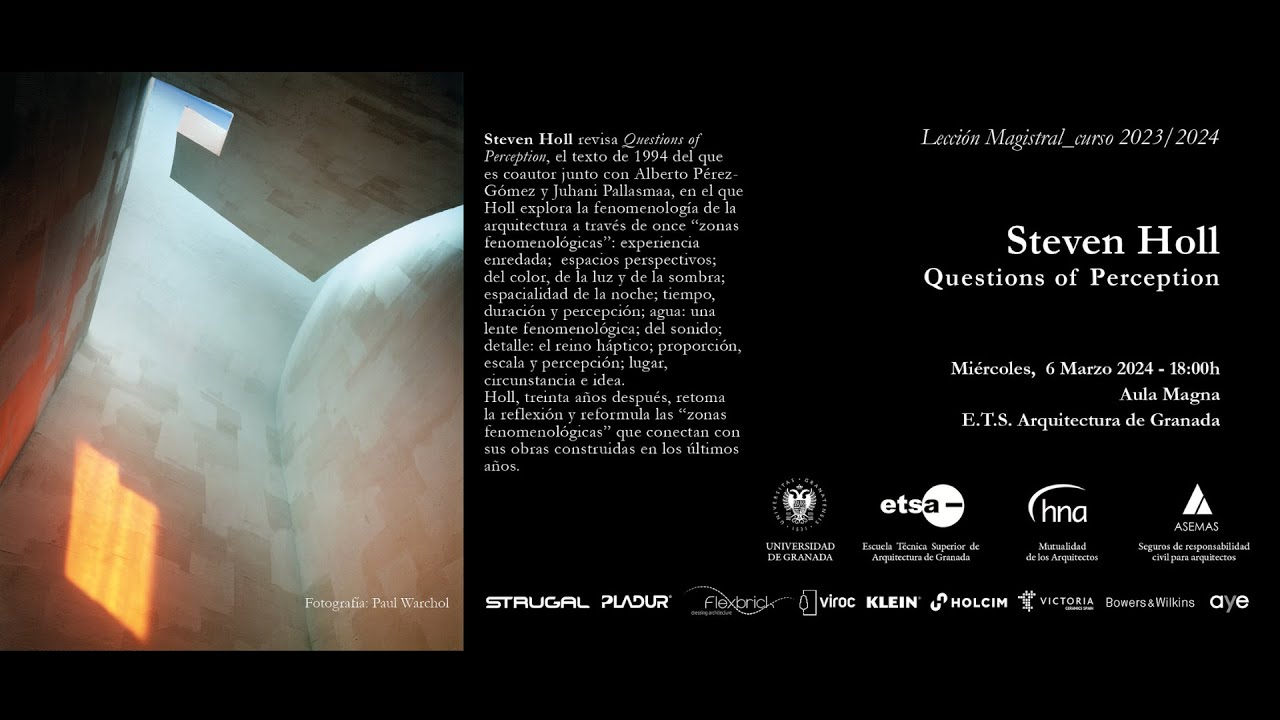
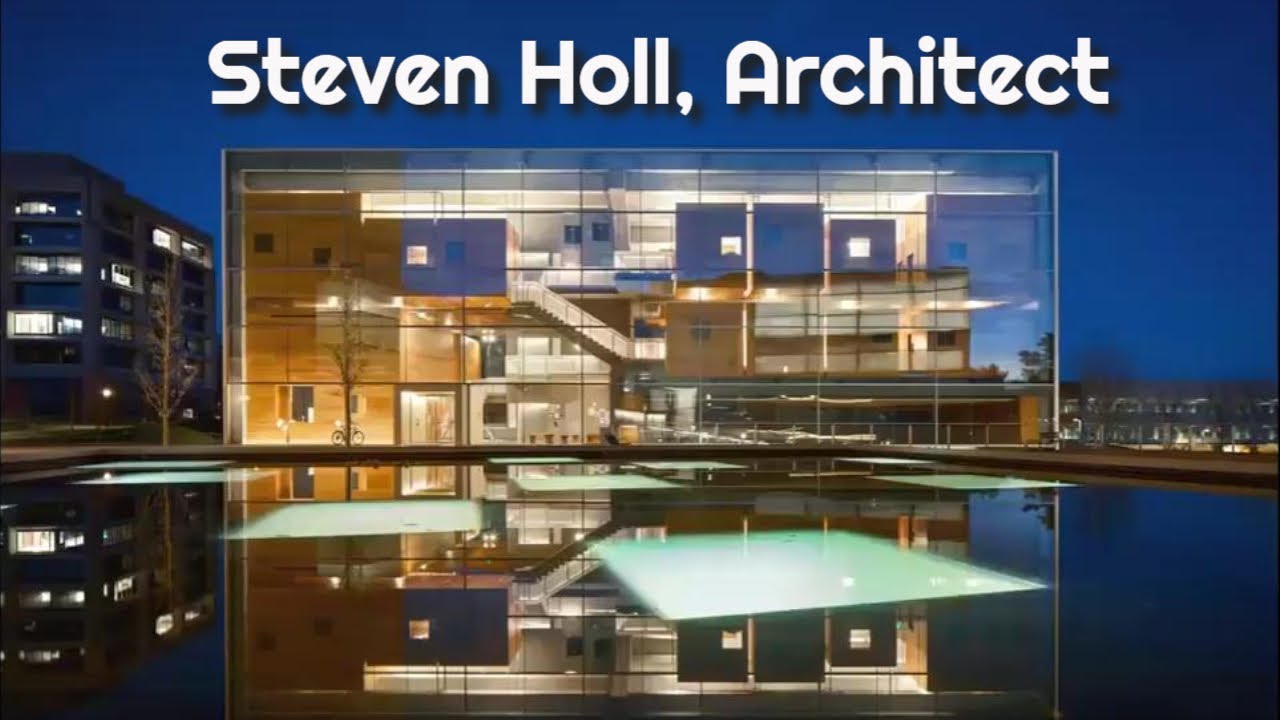
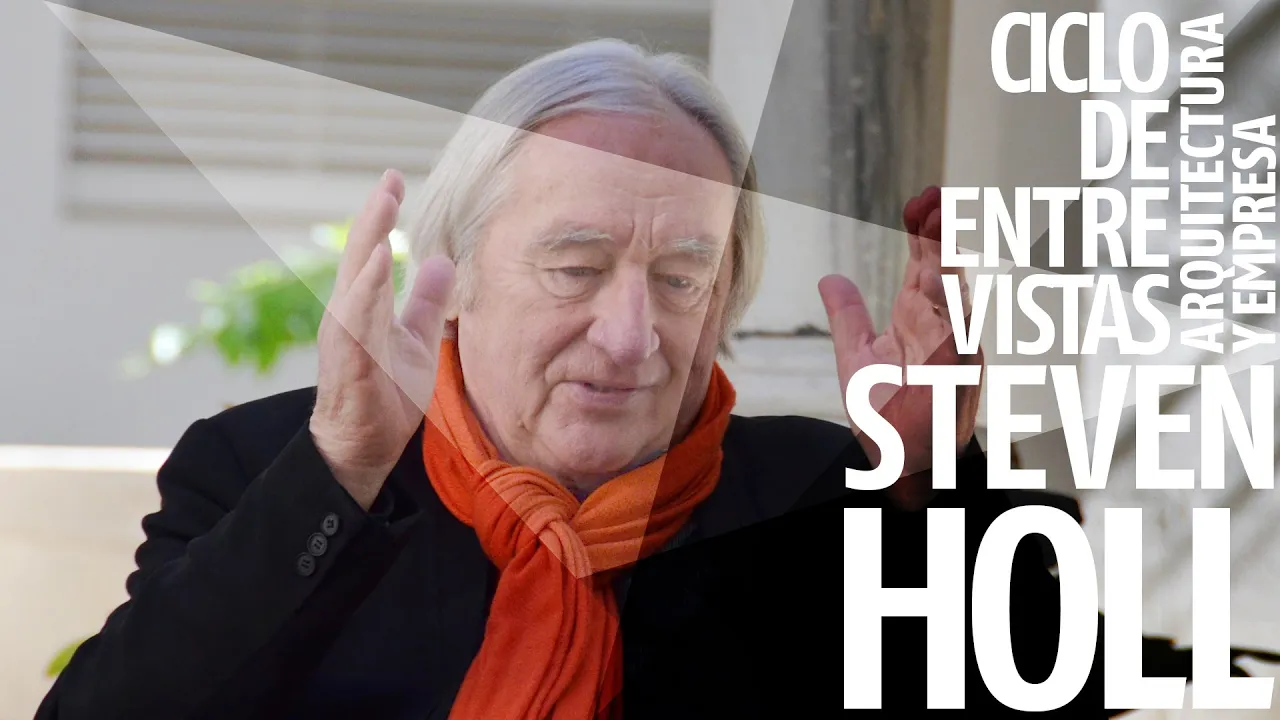
[Music] good morning stepen thank you for coming to Granada thank you for for this exclusive interview for to architectur and Essa it's a really a great honor to have you here in Granada my pleasure and my pleasure me too and I'm you you are here because we are going to do a lecture about the phenomological stones of the book of question of of perception that celebrate the 30 years of its first edition and uh I want to know what from the 90 to to present you have developed uh uh methodological work with the conceptual representation
through watercolors that synthesize the ideas of each project I I want to know what is the your methodological uh practice and how did you start with this system of thinking first I want to say what a wonderful space that I'm in I'm absolutely amazed about this School of Architecture because uh I was here in Granada 11 years ago and I never saw it because this was under construction and I think the proportions the the feeling of the material the the light uh and it's it's absolutely a great School of Architecture so I'm really excited about
the fact that you have such a great school and in fact I've been to many architecture schools and sometime they're in terrible buildings in America really uh so I think it's very important you have good proportion good light good material good space as a training ground for students and the other thing I want to say is I brought these 12 students here because I think that alhamra is one of the most important works of architecture and landscape and space for them to study I used to say that my most important building was the pantheon but
it's an object the thing of alhamra has landscape and architecture fused the the feeling of the space the light the water there's all these Dimensions they can learn much more from uh especially today when we think about what how should we change uh the way we teach architecture so they I'm very happy they've been yesterday morning for several hours in alhamra and uh I'm hoping that it gets into the their project that they're making for our site next to Alberto's building and regarding the watercolor you know for me I believe that the real dimension of
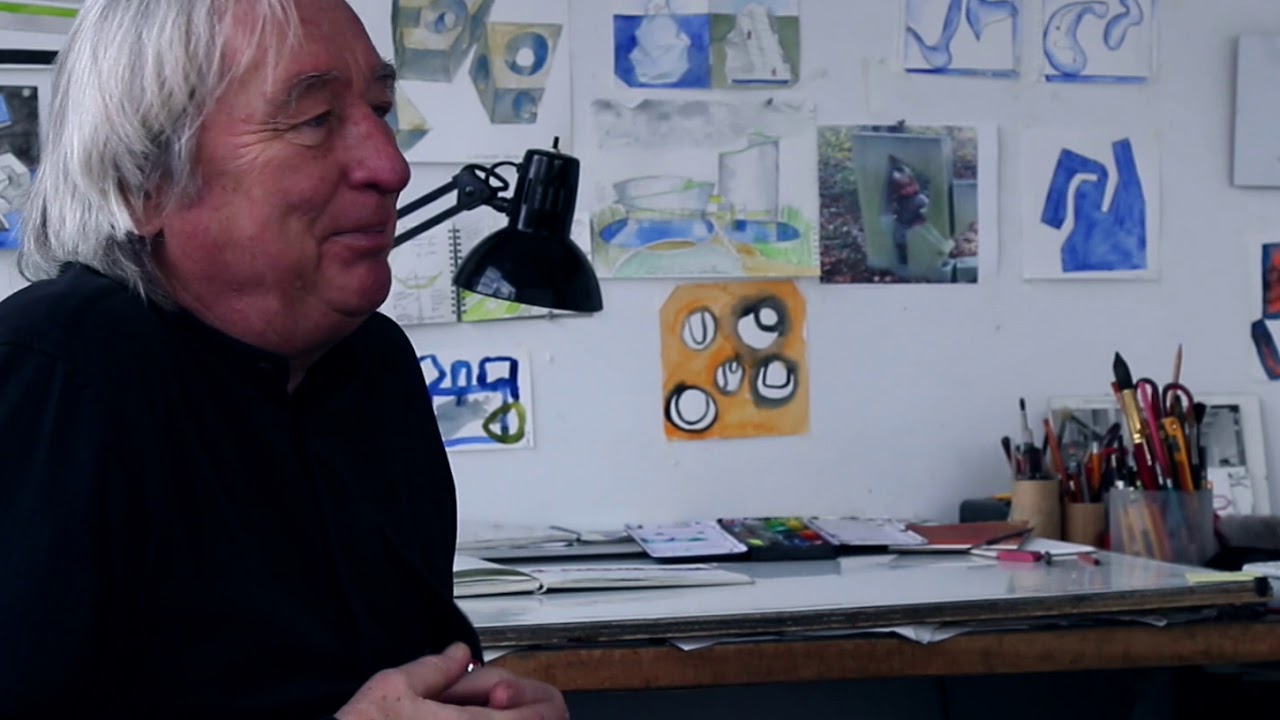
Architecture is in the experience in the perception in the in the in the phenomena but it it can't start from that it's must be driven by an idea in my my watercolor process is trying to have an idea that drives the design some somehow a meaning that's beyond the the space the material and I I begin every project by this small sketching many years ago I was making these pencil drawings that took many hours and around 1980 I was uh making a competition for leol in Paris and I made this big pencil drawing and it
took me one week to make the drawing and I said enough I have to find another way and then I then I chose this 5x7 watercolor pad because they fit in my my bag and on the on an airplane I can open it on an airplane tray so for many reasons the there it's the way I start the day every day and actually this morning I'm working on a competition in Albania and this morning I redesigned the whole thing on two sheets of 5x7 in watercolor and I sent it to the Beijing office and he
said got it I like the redesign I'm starting over so it's a way of working yeah this is and actually when the the iPhone came out 20 years ago or whatever I could take the picture of the waterolor perfect and that became a secret weapon because I could always work with the team in Beijing and New York wherever just one snap and send it to all all all people working on the same project so it's a it's a method yeah it's a it's a method of working today thank you so much we are very lucky
to have this school for our student and we we are like very lucky to have you here with us so you you have a lot of energy in your projects you transmit for to each of them your passion for the architecture what is the your secret to maintain this passion passion and and effort for each project well it's my nature yeah you know when I was in high school I had a passion for hot rod cars really so yeah so before I decided to give that up I was crazy about cars so I had a
a 1939 Chevrolet that I had restored completely metallic red leather you know then I traded that for a 1931 modle a Ford with a 283 V8 engine this is a very American beginning right in Bremington Washington and and then I had the fastest car in Birmington Washington a 1957 Chevrolet with a 327 engine and you know and I would wax it every day it was perfect you know spotless and I was reading all the magazines about hot rod car culture carcraft but it was kind of empty but I was passionate about it right then I
discovered architecture that's what I want to do and I gave up the cars really and then I got in to architecture wow and uh you know I have to say I think it's the greatest profession the greatest art the greatest way you could if you can make a living doing what you love that's the greatest thing in life and if it's creative then you really have something because each thing is a creative effort yeah and then if you can leave something for another generation to to to experience it that's that's really it's rare I I
don't believe every building has to be built you know I I respect many architects who didn't build very much at all like LeBus Woods or Raymond Abraham we just had an exhibition of Juliano fenoli's wonderful drawings he didn't build very much in his life but still there's a passion for architecture I I really believe that's something important so it's not that you have to build many many many building that's not the art form is something that has a spirit in it and you can embed that in the space okay great so your work has even
more Merit because you developed your your work in United States and where architectural film is tend to have more corporated image so but in your case you have resisted to make an outdor architecture and maintain a small Studio to make H to control the project and to research please tell us um what has been the key to resist to the anonymous American corporated system I'm sorry the key to to resist to the company's huge and system of uh uh the all the yeah the commercialization of the architecture no I I I'm I remain with my
with demitra who's also a partner in the architecture Studio the dedicated to the passion of architecture which means we do we do an idea we realize the drawings and we work on every detail we work out all the parts and pieces and you can only do this if you're a small team as soon as you grow a larger and larger you lose control and uh I had one time an office of 75 people about 15 years ago and I said this is all this is too commercial because once you have 75 you have to worry
about the overhead of the monthly cost and then you have to start taking projects you wouldn't want to do in order to pay the bills right and that's what happened to many architects today they became 500 people or 300 people whatever and then it's a different game it's a commercial it's a commercialization yeah and then they can't be very uh they can't be very idealistic right they have to say oh oh yeah well we could do that even though they know it's not they wouldn't believe that would be the ideal project so we we always
then after I was too large I reduced down and I said I only want to be maximum 30 33 people maximum never going any higher than that and we still stay below that we're 20 25 or something like that that's also a focus on the quality of the work and uh um I'm sure that's the right decision I think what happened I won't name names but some people who are my age they became so large they lost track of what even and even dropped out let the five Partners take the corporation farther and just build
things yeah this is not architecture with a capital A this is a commercial operation yeah and it's happening all over now you know but they said how do you get a balance between the this architectural order therefore with private clients and the practice of the competition because you do a lot of competition so this is what is the bance we don't we don't win them yeah we do we maybe we win one in 10 yeah it's all right when you do a competition you you're you're you're having a creative idea you know you hope to
win you're having a creative idea you get very excited but it you know most of the time you don't win so you must take uh a Don kote attitude right you just keep going you keep smiling and the windmill goes around and you you you know do the work and uh you don't win and you have to forget it and go on to the next thing yeah and so but you make the project you know you make something with an idea uh it's exciting to make a model of it so I have many many unbuilt
projects that I'm very proud of like the Berlin Gaden bibl dick from 1989 or the from 1990 the pazo de Cinema yeah yeah nobody nothing was built in that competition yeah nothing but we made a very important project for us because many people there were there was a domus a special issue of domus all the competitors you know alar Rossi James Sterling John Nel all published very well in domas yeah and newel came up to me and he said Stephen yours was the best best so that's like really an interesting compliment from a architect who
also got too big right John DeVille but I respect his work and that was a great compliment and from that competition we were given the chance to do the competition in Helsinki and that we won the kosma and that's how I started my my office name we won that in 199 comp and it opened in 1998 so that was a beginning really of Steven Hall Architects the kiasma and now it's it's in great shape in in Helsinki yes so it's a very fulfilling um thing to do competitions that you can realize with all that ideal
that was in the the design in the first place yeah so I think it's it's true that you I'm agree it's how you started too the beautiful competition you did on the the street in Granada right fantastic we saw last night all the lights all the way down I mean it's a very important work and you were only what 31 31 yes yeah and I was I was 40 I think I was 42 43 yeah something very good so also you teach in the in the columia university and I think it's very important for you
what is re really the influence in your practical uh profession what is the the teaching to the student helps you to to what is no the teaching is is I just convey my my passion for architecture and my belief in in and in what it can do to change people's lives and I try to make the students have their own idea not to follow any style to come up with their own idea that drives their design and to realize that in models and space and light think about perspective think about the proportions and the material
and uh every student is different you know everyone is a unique individual yeah and uh you respect that and I think teaching is also a way of not being uh weighed down by the pragat pragmatics of of a practice yeah you know yeah you can I come into the office in New York and listen to this problem and that problem and this problem and that problem say bye-bye going to teach teach very nice so in Columbia also in The Graduate School of Architecture planning and [Music] preservation Ken fro was also a professor very very good
professor was he was my uh supervis of my thesis and I know very very very well him but what is your opinion about Kenneth franto because I think you are a friendship well he's still know he moved to London yes recently 94 and uh I just had a letter exchange with him and he had a book signing at the architecture Association last week last week so yeah okay so he's still lecturing and uh you know amazing you know some you know some people you know keep going and he's a really important figure uh in in
in the history because he made a this wonderful the history of modern architecture which tried to make a position that was of clarity and uh connected Alberto sorus was on the cover yeah and I think it's in like the 20th Edition or something like that it keeps getting reprinted in a adds more and keeps getting reprinted so he has a very particular position um which I respect you know I mean I think one thing I say sometime that comes from Kenneth ideas a structure is at least 25% of the cost of making a building it
should have some role in the expression in the the idea of the building should have some relation to the structure this is very different than uh some people working today you know where the post modern movement lost that connection and also deconstructive movement lost that connection but can you know kept that that simple thought and I think our work keeps somehow keeps uh keeps that idea once I gave a lecture in sarch and I put on the screen there was a screen as big as that wall and I put a big image of the uh
dormatory we did at MIT where the structure is this kind of this every room has nine windows so it's like a kind of sponge porous uh but that's the structure that holds the building up the same yes holds the building up so I'm in Los Angeles and Auditorium is full of people and then and the next day the newsp the local news guy wrote he's criticizing Frank G I never said I never said a word about Frank G yeah but somehow they said that I was be you know it's just the way I was working
right yeah anyway I Frank Gary just turned 95 years old like 3 days AO pretty interesting character and uh I think it's amazing uh figure in the history of architecture but it's not exactly what I was doing but yes okay and on the other hand you I know that you have uh a great friendship of what you had uh with her had it right yes and her loss affected you a lot I remember that the same day that uh he died she died you publ a news item recalling your friendship you meet in the '
70s I know I think right we met at the how how was she how was she no she was the real thing and we met she was a student and I was a a graduate student at the architecture Association in 1976 and she had been a student of Leon careers and so in this very special project that was laid out by Ilia zalas um it it was a very important project because normally when you give a studio problem to a student you give a program and a site and they come up with a form Ilia
gave a form which was a architecton by Mich and the student had to come up with a program and a site and there were like 12 students or 15 students and I came to I had just arrived at the AA and REM coolhouse was sitting here Peter Cook was sitting there El is in was the professor and when zaha put her project up we both leaned forward it was brilliant she made a bridge over the temp she took the architect on and made a bridge and we both said wow this is a brilliant work but
it had arches in it from from Leon career studio in pink magic marker and we said n you got to redraw this this is a great project but you have to redraw it anyway she always denied that it was pink magic marker and arches she always did anyway anyway but you know we were together from you know there at the AA and then many years later um you know whenever she was winning a competition I'd send her congratulations you know cuz we were up against each other in several competitions and I would win and she'd
Stevie Wonder congrat she called me Stevie Wonder Stevie Wonder but you know in the end she didn't like the size of the office yeah she said actually she came to our apartment the year the 3 weeks before she died of a heart attack she came to our apartment and said in in uh New York and uh she brought a little YY Miyaki dress for my our daughter wow IO and but she said I just wish I could go away and have a studio with five people and get away from this too big office so she
didn't like it yeah and now they're just doing a style right they're not doing what she was doing it doesn't have the passion it's sort of it has the shape it's a kind of branding operation right and big big big projects all over and uh I don't know I mean it's the same problem of the commercialization of architecture yeah okay some some Architects spent a period living and studying the European culture no of the classical tradition for example l k after his stay in US USA academic in Rome at the age of 50 he began
to develop his best projects so in your case after you studying in United States architecture you also spent some time in Rome right what I was what you do you learn there in Rome do because you were there what is the your experience you know I just made a film I just made a small video for this exhibition it's opening in R lvia called Rome and the teacher ostra Zarina that was my teacher in Rome so uh that's a 39 minute video when you ask me what did I learn in Rome please look at that
it's 39 minutes long many things I learned many many things you know and she was a great teacher and I never forget it and now when you get older and you think back of what happened how did you get here what you know really it's somehow begins there because from from Bremington Washington or Seattle it's not much uh you know you have to have some grounding and Rome was a was a grounding and then I lived in London in 1976 uh when I studied at the AA so London was also a another dimension that was
very important in my education yes I suppose cool tell ask uh what of two buildings from Classical period are your favorites for example I know the pantheon is one of of them and other maybe and a couple from the modernity period what do you think what do what is your better project that you well I've returned several times to La tette I think is an amazing work of lobier in Leon and uh and now I'm making a project in alas which is not very far from ramp so visiting those over and over again great inspired
works I always I say to my students you have to visit the architecture you have to walk through it and really be in it until we really understand it it's very important yeah I think so your Manifesto through your books are already a classic uh for all the students could you synthesize the most important points of maybe this manifestos maybe in the lecture today I'll cover some those points yes this is the question it's very hard to make some some larger thoughts in you know catchphrase it's very difficult I suppose and uh I know that
you recently found the Steven M Hall foundation and uh please tell us the reason of for its creation and what activ activities it uh carries out what is the the the reason that you create this uh foundation and what is your the activities that you are you are going to do there we are we are it's been going on uh for a number of years um um it was it started as a magazine 32 bny which was trying to talk about the ideas and the current ideas but we had very difficulty Distributing the magazine so
we had a not for-profit organization and we started the the the t-space exhibition so we're we're having one show of architecture and then painting and sculpture and always having a a poet uh at the opening and a original piece of music so it's the synthesis of the Arts bringing together music architecture sculpture painting poetry with living artists it's a very small uh operation it's only 800 square ft Gallery but it's very pleasing and we have a whole community that comes and comes to those um exhibitions and listens to the Poetry you know we've had some
very good poets Anne Carson spoke um Robert Kelly and this year we have Pierre joris and we open in June um with the the painter Peter Holly and uh yeah it's a way of bringing architecture painting sculpture poetry in a small community gallery and it's near my archive where I have all my models everything so it's also an Archive Building and uh yeah I think it's something very pleasing for me to do but it's also something communicating these ideas to others I think it's so nice this idea so finally U we are at the School
of Architecture in Granada please tell to the students uh a recommendation for the young architect starting his or their professional career what did you recommend it to to them for students would say if they could work in a studio you know that's dedicated to architecture like Alberto compo bayaza Studio or Ensemble studio in in Madrid Antonio very good Studio of course or um I mean there are lots of good places and that's that's to me is the first thing once you get out of school if you could work where they're doing they care about architecture
because if you go to work for a corporation you you get their values right yes you in a way if you go to work for S so or kpf you have the values of s so or kpf so either do your parents house start on your own or go for a small Studio that's really is doing some something they care about like your studio if you could you know that would be the way to start you know yeah this is a good recommendation thank you so much Stephen for for coming thank you so much for
architectura Essa for this interview and I hope you you can work come back here and for a nice lecture a nice visit thank you for coming to Granada thank you so [Music] much [Music] a