Every millionaire has multiple income streams. Don't put all your eggs in one basket. We've all heard this advice.
Sounds logical. It sounds safe, but it's actually a lie that had haunted me for years. And I know this cuz I followed it religiously.
I was selling products on Amazon. I was doing freelancing. I was running a YouTube channel.
I was working 50 hours a week, constantly switching between side hustles. And what's the result? I was making just about $1,000 per month in total combined.
But two years ago, I abandoned everything to focus on this new approach. And within four months, I was already making $10,000 every month, and it has grown ever since. And the difference wasn't about being more consistent or working harder.
It was understanding one simple concept that most people overlook, which is what I call the distribution first model. But before we get to that, you have to understand the trap that beginners always fall into, which is starting multiple side hustles. Because building multiple side hustles all at once is actually the riskiest thing that you can do.
Cuz think about it, you want to be that guy who sells fitness products on Amazon, who's also doing graphic design, freelancing, and maybe doing YouTube on the side. Cuz when you're chasing every side hustle opportunity, you end up doing multiple things at once, and you'll just be mediocre at everything instead of exceptional at one thing. And even if you're making good money, you'll find that it's short-lived.
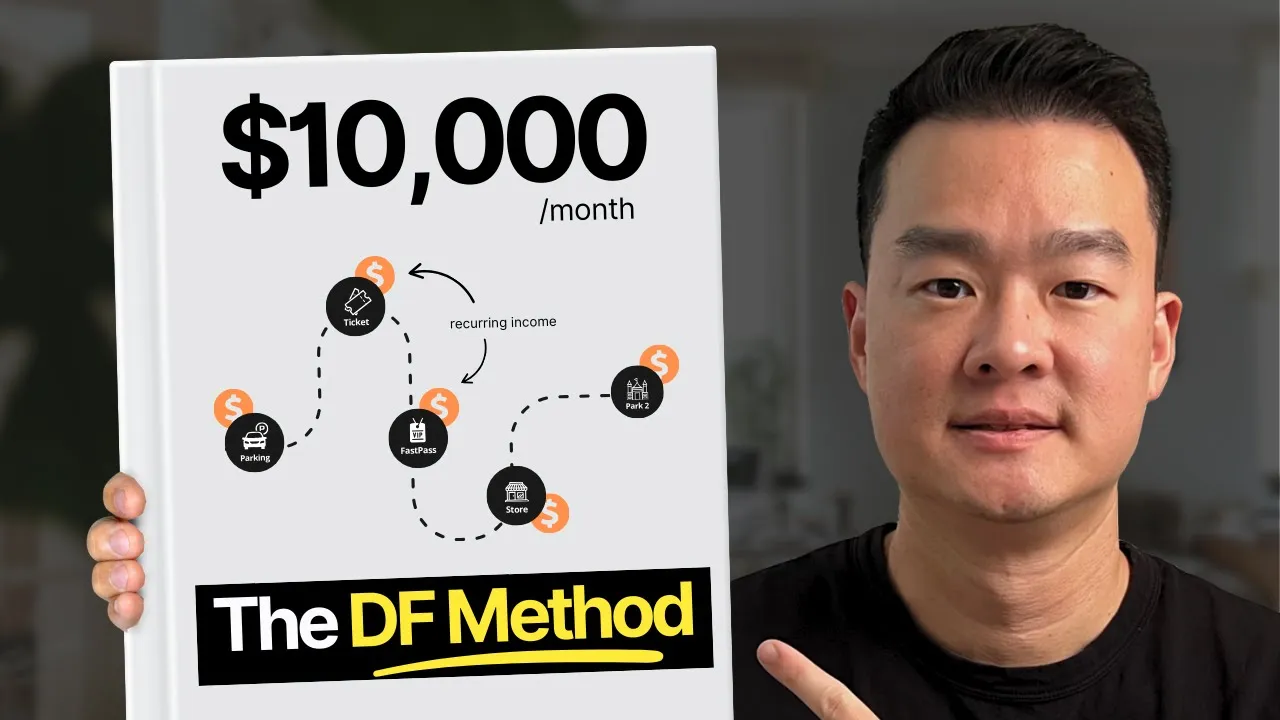
So instead of this, you want to follow the business model of Disney. So, think about the last time you went to Disneyland. When you arrive, you pay for parking and then you probably buy tickets to go in.
And once you're in, they make you pay for fast pass to cut the lines. Then you buy lunch. Then before you leave, you'll probably buy something from the Disney Store.
And then once you exit the park, maybe you stay at a Disney hotel where you're going to spend on rooms and probably a meal as well. And the following day, you probably go to the second theme park and do this all over again. But do you see what they're doing?
Disney is not in the business of selling parking spots. They're definitely not in the food business. They're not running 10 separate businesses, but they've built one cohesive business with 10 different income streams.
Now, you can do exactly the same thing as a creator. So, instead of building 10 disconnected side hustles, build your personal brand first as your main theme park with you at the center of it. So, you're creating one business, which is you, with multiple ways to make money flowing from that single source.
Now this is not just a theory because you want to think about the most successful entrepreneurs today. Look at Ali Abdal, Alex Hermoszi, Cody Sanchez. They didn't start by diversifying.
They started by building a distribution channel. Ali didn't start by selling courses. He built an audience first through YouTube solving problems for medical students and helping people become more productive.
And now he has a multi-million dollar business with selling courses, brand sponsorships, and a bestselling book on Amazon and a thriving community. Now I'm following this exact strategy for myself. I'm building my audience through a YouTube channel and I'm generating revenue through brand sponsorships, affiliate earnings, digital products, consulting services, and a membership community.
But here's what most people miss, right? When you build a personal brand, you're not just creating content or trying to be a YouTuber, but you're building a one-person business to build authority, to build trust. And when that happens, becomes easier to sell products to create or recommend in the future.
Now, speaking of selling products, here are the several types of income that you can generate from this. Now, there are four core income sources that will help you reach your $10,000 a month faster than anything else. Now, many of you already have a product that you're planning to sell, whether they are digital products or physical products.
Maybe you're a fitness coach and you want to sell fitness bands or supplements online. So, strategy is simple. You want to build your audience through content on YouTube or Instagram and then link to products you sell on Amazon or Shopify.
Now, I think for physical products, the easiest way to set it up is on Amazon because they handle the warehousing, shipping, and fulfillment. And of course, you can always set up your own website. But if you don't want to handle any of the shipping, I think Amazon FBA is a great way to get started.
But here's the thing you got to understand about selling products on Amazon. Reviews are not just important, but they are the lifeblood of your products. So, without them, it's basically impossible to compete with existing sellers who already have thousands of reviews.
So, you're going to need a system that generates reviews automatically. And that's where today's sponsor comes in. Get Reviews AI is a game-changing tool that helps you collect genuine verified reviews across all the major platforms like Amazon, Shopify, Walmart, and even Target.
So, the concept here is simple. They help you create package inserts with QR codes that make it really easy for customers to leave authentic feedback. So, I've been testing this tool myself, and what impressed me the most is how intuitive the entire system is.
So, they've got this uh design tool that let you create professional inserts in just minutes. And you can customize it with a QR code. And you can include things like extended warranties, gift cards, or special promo codes to boost your response rates.
Now, what makes them different is that they'll able to connect seamlessly with over 10 e-commerce tools like Google Sheets, Clavio, Shipbop, Tremendous. And you know, this is not just about getting more reviews. It's about building a complete customer feedback loop.
And if you want to get started, it comes with very comprehensive video tutorials that will walk you through every feature step by step. And since I'm partnering with Get Reviews in this video, you can get 15% off any plan by using the code Jason 15 off at checkout. If you want to get it with a discount, just click on the link down below.
And thanks Reviews AI for sponsoring this video. Now, number two is platform advertising. So, this is why I specifically choose YouTube over other platforms, cuz the ad revenue is significantly better, which means that you're essentially getting paid to build your distribution channel.
Now, I'm getting paid thousands of dollars from ad revenue by just creating videos before even selling any products. Now, for those of you who are new, YouTube ads operate on a CPM basis, which means that certain niches do earn more than others. So topics like finance, tax, crypto, they typically have higher CPMs just because advertisers are willing to pay more to reach those audiences compared to niches like lifestyle, food or entertainment channels.
But there's one big mistake that I see a lot of creators make. They obsess over AdSense revenue. Cuz this should be treated as a lowhanging fruit.
It is basically the baseline income that happens automatically because there are a lot of ways that will make you more money. And that brings me to my next one which is brand deals. Yes, this is also a form of advertising, but it pays more than AdSense.
Again, the fee varies, but it can range from a few thousand to tens of thousands of dollars per video depending on your reach or the average views you get on your channel. Yes, it is tied to the amount of views you get, but your personality and your conversion rate can dramatically increase what you can charge to brands. Now, the best thing about brand deals is that you can deal with multiple videos across many months.
For example, I'm currently booked out for four to five months now. So basically my income from brand deals is quite predictable and it's not something you can get from running random side hustles. Now if you talk about products in your videos, you can also earn commissions when somebody clicks on your link through something called affiliate commissions.
Yes, most people share their Amazon affiliate links where they will earn a one-off commission when somebody buys through their link. But what most people don't know is that if you promote software, the commissions are actually recurring. So for every customer that you help sign up, you get a maybe a 30% commission for every month that the customers stay subscribed.
So for example, whenever I get a brand deal with software company, I'm not just getting paid a flat fee to mention them, but I'm also earning ongoing commissions from everybody who signs up. So this means that I'm getting a stream of passive income that I don't have to work extra for. Now the next one is books or digital courses.
So this is where you package your knowledge into a product that people can buy in the form of books or digital courses. So as you guys know digital courses is the ultimate scalable income source. You create it once you can sell it forever right virtually with no additional production cost.
Now books are also quite similar except there's probably a small publishing cost if you are selling printed copies. So for example, creators like Ali Abdal with his productivity book or Noah Kagan with his recently published book Million-Dollar Weekend, but you know they didn't launch this product immediately but they built the distribution first and then leverage their audience when the timing was right. Now there are certainly other revenue streams like paid newsletters, coaching programs, membership communities but the principle is still the same.
You want to focus on building distribution first. You want to develop your personal brand and when you own the audience, selling products or services become a lot easier. Now, I've got three strategies to share with you if you want to get started with this.
Number one, you want to focus on people and solving their problems. So, why does this matter so much? Cuz when you consistently solve specific problems, you naturally position yourself as the go-to expert on that topic.
Now, think about the viewer mindset. When somebody watches pure entertainment content, they are in relaxation mode. They're not in buying mode, right?
They're scrolling, they're laughing, they're enjoying, probably not thinking about pulling out the credit card. But when somebody's looking to solve a problem and finds your video, they're already primed to take action, including purchasing any product or service from you if that means they can solve the problem faster or better. Now, the problem is most people think that they have to be an expert.
Look, you don't have to have a degree in the topic to be able to talk about it. Cuz look at this creator, Daniel Craig. He's just documenting his journey building a software startup.
And he's not trying to come off as the expert. doesn't have all the answers, but he's just showing what he's doing, sharing what's working and what's not. And if you notice here, he's got 35,000 views on his very first video and 1,200 subscribers just with three videos on his channel.
Number two, you want to focus on painful and recurring problems. The more painful and the more recurring the problem is, the more profitable the business can be. Let me give you some examples.
So, think about a video on how to properly polish a car. So, is it a problem? Yes.
But is it really painful? Not really. And is it recurring?
Not at all. Because once you learn the trick, you got it right. There's nothing else to learn.
But now think about how to fix a broken marriage. Is that painful? Absolutely.
Is urgent? It's emotional. And is it a one-off solution?
No way. People need ongoing support. Or what about how to fix your lower back pain?
Is it painful? Yes. Is it recurring?
Yes. For most people, it keeps coming back again and again. Now, I'm not saying that everything has to be extremely painful or recurring to make money, but this falls on a spectrum, right?
The more painful or recurring a problem is, the more profitable your business can be, cuz people will pay almost anything to solve, intense pain points, that keeps coming back. I think it's just something to keep in mind when you're thinking about what problems to solve with your content because you don't want to randomly pick topics. You want to look for those painful recurring issues where people are desperately seeking solutions.
Number three, you want to use trends. Now, when I say use trends, I don't mean trying to go viral. Because when you focus on solving problems, you don't have to chase trends or try to go viral to make money.
Cuz I made my first 10K months on YouTube without going viral. But instead, you want to use trends strategically. The key is not to jump from one trend to another, but marrying a proven trend with your core content.
So when I first started my channel, it was when chat GBT was first released and I combined AI content with my business content which at that time not many people were doing yet and that helped me boost my channel and grow much faster. So think about what current trend that is happening right now and how you can incorporate that into your content in a way that aligns with your topics. Now you might be thinking all right I love this one person business model idea but what's the catch here?
I think every business model has its downsides and I want to be completely honest and show you one big downside. Here's the thing. When you're using social media to build your audience, you don't actually own those platforms.
You're essentially renting space. So, it's like building a beautiful house but on somebody else's land. Cuz think about it, algorithm can change.
They can tank your reach overnight. Your videos can get demonetized for the stupidest reasons. you might get shadowbanned or even worse the entire platform could change hands because look what happened with Twitter after Elon bought it or what about Tik Tok that is facing potential ban.
So what you want to do instead is while you grow these audiences on these platforms, you also want to funnel those audiences to assets that you completely own. And what is that asset? I actually dive deep into this in one of my recent videos here.