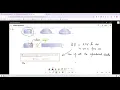
Let's continue with our discussion of this section with the um method of cylindrical shells. Now this time we consider a region below the graph of y = to f ofx as shown on the left right here and obtain a solid by rotating the region about yaxis. Okay.
And then we get to this region. Now, previously, okay. So, previously what we are doing like from um let's see, we're going to use washer.
Okay. So, by the washer method, what we are going to do is this. So, we're going to have uh let me do it this way.
We're going to have a ring here, right? And we can also have other rings like this. A smaller one.
Okay. And I can also have a let's see the bigger one like maybe here. So those the radius depends on y = to f ofx.
Okay. However like um so r Uh let's see big r equals to um f ofx and then little r well big r would be let me see how can I do that will be x which is the inverse function of y. So a little bit harder and then little r is basically a.
However, when it comes to the bottom part, so when it comes to this part, the bottom part, okay, it will be a perfect cylinder. So when I say perfect cylinder, I mean or well a ring. Okay, I mean the radius will not change.
The radius will not change. Okay, so that's that that that's the trouble part, right? We cannot really use the washer method to evaluate this easily.
Now for this case, the cylindrical shell would be very useful and a way to see it to visualize it you can see it from here. Okay. So instead of you know instead of drawing rings this way you know instead of drawing rings this way we're not drawing rings like that.
So we are drawing a vertical line. Okay. Now let me use the marker.
So we're drawing a vertical line going down. And then do the same thing on the left hand side. And then we draw a cylinder.
So this is what we call a cylindrical shell. Okay. This is what we call cylindrical shell which is right here.
Okay. And as we cut it, you know, as we draw this um shell on different position, we're getting different cylindrical shells like this one, right? And I can also have uh smaller one but a little bit um tall, right?
I can have another cylindrical shell like this. Okay. So once we have the cylindrical shell as you can see here we open it.
Okay. We open it and we'll see that this is the radius and this would be the height. All right.
Therefore, our volume would be circumference 2 pi r time height time delta the thickness in this case is delta x which is 2 pi x * f ofx dx and this is how we get this formula right therefore We sum up all those cylindrical shell. Sum up all the shell. Oops.
Then we'll get this. Okay. Now a remark.
Use a black Okay, the formula above only works only for rotation about Y axis. this. Okay.
Now for rotation about xaxxis we have volume equals to well this time I'm using cd instead of uh you know ab we have 2 pi y g of y and then dy where zero less than um not necessary not necessary so where C is less than less than D that's all okay could be negative it's totally fine it's totally fine okay now if the rotation is about other lines like x = k or y = to m. Then we need to analyze the graph. Okay.
But no matter what, this always work. Circumference time height time thickness, okay? Times thickness.
And of course, the volume will be the integral of delta v d well dx or dy. So it depends. Okay.
Depends dx. So ab or v would be cd delta v dy. Okay.
And the thickness keep that in mind. Okay. The thickness you can see the thickness.
Okay. Would be delta x in this case. So here will be delta x and then delta y would be the other way around which is the rotation about x-axis and we will demonstrate that with examples.
![Neeli Kothi - Episode 10 [Eng Sub] - 6th January 2026 [ Anmol Baloch & Talha Chahour ] - HUM TV](https://img.youtube.com/vi/YvheljHZems/mqdefault.jpg)




![Masoom Episode 22 [CC] - 04 Jan 26 - SPON By Leather Galleria, Happilac Paints & Jhalak Beauty Cream](https://img.youtube.com/vi/2QG9FUAcZGc/mqdefault.jpg)

![Daam-e-Mohabbat - Episode 03 [ENG SUB] 6th Jan 2026 - [ Janice Samuel & Mubashir Mehmood ] - HUM TV](https://img.youtube.com/vi/hgCQZOe0Ah8/mqdefault.jpg)