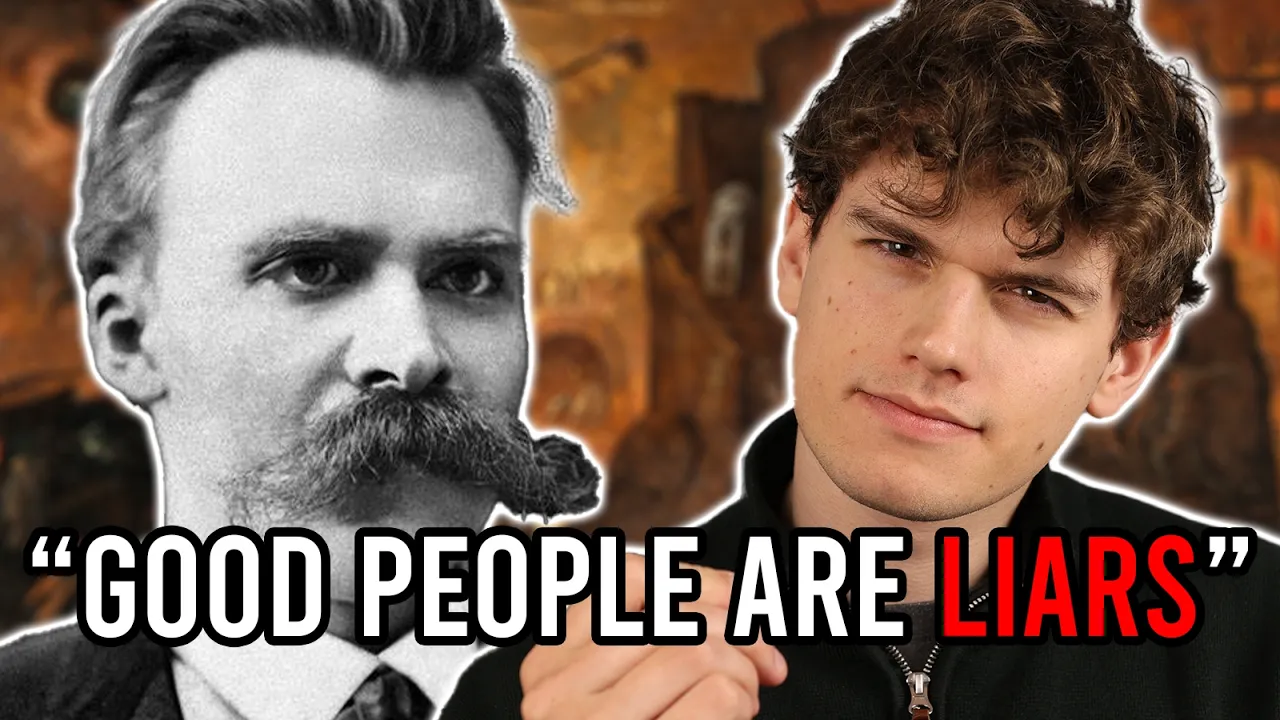
Friedrich Ncher needs no introduction. Through his writings, thoughts, and iconic mustache, he's gone down in history as a philosopher who managed to infuriate almost everyone around him and challenged almost every established orthodoxy of his day. But perhaps no idea was more controversial than his critique of morality, which was developed and systematized into his genealogy of morals.
Here he wants to challenge some of our most deeply held values like selflessness or pity or even the concept of morality itself and show that they have hateful, resentful or otherwise repellent origins. Before we get started, I just want to acknowledge that my interpretation of nature here is heavily indebted to the scholar David Owen and I'll be drawing on his work throughout this video. Additionally, as with almost everything in nature, all of this is controversial, both in terms of how it's interpreted and nature's actual arguments, which have been disputed by various other thinkers.
But first, let's start with nature's outright attack on our most common sense moral notions. One, Rosanti Mo and morality. Nze begins the genealogy of morals by outlining his main aim to break the spell of our current value system which nature equates with Christian values.
Hence the whole work will be a critique of Christian morality which he just calls morality. And interestingly he wants to do this not just by directly challenging Christian ideas but by giving his interpretation of how such a morality came to be. This already makes his project quite different from some modern anti-theists.
Whereas someone like Christopher Hitchens pointed to atrocities committed in the name of Christianity to argue that the religion was harmful. Ner wants to go one step further and argue that Christian ideals themselves are deeply flawed and what's more undignified. This makes nature's projects partly philosophical but also partly rhetorical and he would freely admit to this.
On the one hand, he does want to critique our inherited moral systems. But on the other hand, he also wants to make them less emotionally appealing. This is because nature thinks that adopting a morality is not a matter of pure rationality, but instead comes from our deeper nonrational aspects.
To quote him directly, under what conditions did man invent for himself those judgments of value, good and evil? And what intrinsic value do they have in themselves? This is what makes the book a genealogy.
Nature is going to try to disillusion us with our inherited moral systems by telling us a story about where he thinks they come from. And this is not just a historical story in the straightforward sense, but also a hypothesis on what psychologically drives the adoption and continued existence of these moral systems. The genealogy is composed of three essays, each of which takes a slightly different target, and together they aim to strip away morality's beautifification and reveal what nature thinks are the ugly instincts underneath.
The first essay focuses on how we came to condemn some things as evil. That is, not merely bad, but positively immoral. To explain this, Nze constructs a quasi legendary story set in the distant past where there are so-called nobles and so-called slaves.
These are not nobles and slaves in the modern sense of the words, but rather those with a lot of physical power and influence and those without any physical power or influence. Nature thinks that those with power will naturally take pleasure in this. It is a nice thing to feel powerful and this pleasant feeling will cause those nobles to conclude that they and their way of life are good.
That is they have a positive definition of good that roughly means like us. Nature appeals to certain ethmological evidence to illustrate his point. For example, he points to the ancient Greek word agaros which both means good in the sense of desirable but also noble or highborn.
By contrast, nature thinks that the nobles used the word bad to just mean whatever is not like us. That is, it was defined negatively. The nobles had a positive goal towards worldly power, strength, and confidence and wanted to avoid whatever was not this.
Nature calls this approach to life noble morality. And it's worth noting that nature doesn't think this is wholly a positive thing. While he praises it for its confidence in this worldly existence, he also calls it stupid and unthinking.
It is a bestial kind of morality and nature thinks this is both for better and for worse. For example, nature thinks it is the very unthinking nature of noble morality that will eventually allow it to be conquered by its urswile rival, slave morality. But before we continue with the video, if there's one thing I am very passionate about, it is learning and critical thinking.
which is why I recommend you check out today's sponsor, Brilliant. Everyone knows that studying subjects like maths and science and other STEM topics can be really tricky. These things can get very abstract very quickly, which often presents a challenge for students.
But this is where Brilliant comes into play. They have courses on a wide variety of topics from programming with Python to classical mechanics to learning the ins and outs of AI large language models and each one is crafted by award-winning research teams. Plus, brilliance learning is all structured around completing activities and exercises which improves both retention and understanding.
It's also a great alternative to social media doomcrolling since using their app, you can complete quick lessons or exercises on the go rather than spending the whole afternoon arguing with someone on Twitter. A friend of mine also wanted to particularly recommend the calculus exercises as they are apparently very fun. If you want to improve your own critical thinking skills, then you can check out the logic courses on Brilliant, which are great tools for seeing what logic is all about.
And with even basic logic, the world of philosophy is a much clearer place. To try everything Brilliant has to offer for free for a full 30 days, visit brilliant. org/unsolited advice or scan the QR code on screen or you can just click the link in the description.
I don't mind which. You'll also get 20% off an annual premium subscription. So, please do check it out.
But anyway, back to the video. For nature, slave morality is the moral system inevitably cooked up by powerless people in response to their own helplessness. It consists of two components.
The idea of freely chosen will and a condemnation of the powerful. To understand this story, it is vital to realize just how important nature thought power was in human psychology. For him, one of our primary human needs is a feeling of personal power.
This comes in many forms. It can be the power you feel exerting your will on the world as when you complete a project or a work of art. It could be the power you feel over other people as in the case of say Napoleon.
It could also be the power you feel over yourself when you self overcome and become the master of your own will. Nature's conception of power is far more complicated than this, but this will have to suffice for the purposes of this video. Nature thinks that these slaves had basically no power over the physical world and that they didn't really have the ability to self-overcome either.
So they are initially deprived of any feeling of power. But they find this totally intolerable. So they must deceive themselves into thinking that their powerlessness is both freely chosen and a fundamentally good thing.
That is they start to recoup a sense of power in their imagination. They also begin to hate the powerful for the way that they can dominate those beneath them. And so they condemn the powerful and all the attributes of the powerful as evil.
This potent mixture of unconscious drive and emotional hatred is what nature calls resant or just resentment. In some ways, this general structure of thinking is something that manifests in quite everyday instances. We've all known someone who's failed to achieve something and so decided that they didn't want it anyway.
and indeed thought that that thing was bad in itself. This has happened to me in the past. I auditioned for a music conservator a few years ago and I didn't get in.
So, I spent the next month or so trying to convince myself that actually it was a rubbish place and I didn't want to go there anyway. I just wasn't being honest with myself. The truth is I did want to go there, but it was easier to badmouth the institution than accept that I did not have the power to achieve what I wanted in this situation.
This is not exactly what nature is getting at here, but it's along similar lines. At the very least, this example might help bring it down to earth. Since the slaves are powerless, nature thinks they have to convince themselves that they just didn't want power anyway because power in the end is evil.
And so they thus voluntarily chose this life of weakness. To quote his first essay, the oppressed, the downtrodden, and the victims of violence say to themselves, "Let us be different from the evil ones. Let us be good.
And he is good. Who does not violate, who harms no one, who does not attack, who does not retaliate, who leaves vengeance in the hands of God, who stays in hiding as we do, who avoids evil and demands little from life, who is like ourselves, the patient, the meek, the righteous. Yet all of this, if given an objective, dispassionate interpretation, means nothing more than we, the weak are simply weak.
It is best if we do nothing for which we are not strong enough. This concept of freely chosen wills also allows them to blame the nobles for persecuting them. And since they are far clever than the nobles, this also allows them to eventually convince the nobles themselves that they are doing something wrong.
At this point in his philosophy, Nze is a determinist and thinks that blaming the powerful for enacting their power on others is to pretend that they could have behaved in any other way, which nature thinks is impossible. Nature thinks you can only behave in line with your nature. He thus thinks that free will in the sense of being able to freely choose your actions was a way for weaker people to tell the stronger people that they were blamew worthy and thus encourage them to change their behavior, stop oppressing them and take pity on them.
Nze identifies our slave morality with early poorline Christianity and claims that this is the origin of our current ideas that to be selfless, meek and humble is the same thing as being good. He thinks that this slave morality is essentially reactive. It defines evil as everything the nobles are and merely defines good in opposition to these nobles.
Thus, even in structure, nature thinks that slave morality has a negative skew. This is why he says that the slaves revolt in morality begins when Rosantimon itself becomes creative and gives birth to values. A resentment experienced by those who are forced to obtain their satisfaction in imaginary acts of vengeance.
Now things get even more complicated because nature does also think that the nobles have a form of selflessness which he calls magnanimity. In beyond good and evil and in parts of the genealogy of morals, he describes the magnanmity of the noble man as stemming in some sense from their supreme confidence in their own power and position. They do not feel at all threatened by others and so their cup overflowth and they can be magnanimous towards others especially other nobles.
The difference between this and slave morality is that whereas this magnanimity comes from a position of strength, even if it's just internal strength, slave morality comes from a position of weakness and resentment. We see this same distinction again in nature's later work, The Antichrist, where he praises Jesus himself as an unresentful man who truly could forgive any harms against him with a cheerful smile, but condemns his followers as merely pretending to do this while nursing a deep resentment inside. The difference is nature thinks the latter group of people are kidding themselves.
They're just too weak to take revenge. This whole story where nature identifies resentment as the motivating factor behind Christian values and their later counterparts like humanism is a key part of his thesis in the genealogy. In his eyes, he has successfully defrocked Christian morals by showing that they do not come from a genuine place of love but from a place of hate.
For him, the true image of Christian morality is not the overwhelming internal power of Christ who really can forgive the Romans even as they persecute him, but the statement by St. Thomas Aquinas that the blessed in the kingdom of heaven will see the punishment of the damned so that their happiness will be more delightful to them. That is, nature sees Christian morality and Christian theology as the reaction of a powerless people who wish that they could dominate the powerful in this world but must content themselves with morally condemning them and imagining their eternal torment instead.
He also sees it as a power grab by a priestly class who do want to gain some worldly power and are using this ideology to do so. Of course, as I said, everything about this idea is intensely controversial and is disputed by almost every major Christian thinker that's come after nature. But if I went into the critiques of nature as well, we would be here all day.
I just want to re-emphasize that you should absolutely take all of this with a grain of salt and a heavy dose of critical thinking. What this does for nature rhetorically is it gives him a story of Christian morality that does not make it seem dignified or holy, but instead as a resentful power grab. Nature judges Christian morality by its own standards and does not think it lives up to its claims of universal love.
But despite this being the most famous part of the genealogy, there is much more to the book than this. So let's move on to the second essay and how nature examines our guilty conscience. Two, the origins of a guilty conscience.
For all our outward skepticism about shaming people, we live in a pretty guilt-based culture. That is, our moral systems rely on people recognizing what they've done wrong and administering some sort of internal correction for their misdeeds. When asked if someone's apology is genuine, we often show that it was by saying something like, "Well, they felt awful about it.
" We consider this kind of punishing conscience overall a pretty good thing. It purports to keep us on the right track and ultimately make us better people. So, it's perhaps unsurprising that this is nature's second target.
N's aim in this essay is quite similar to the previous one. He wants to delegitimize having a bad conscience when you've done something evil or when you have evil instincts. In some ways, the work is already partly done by the first essay, but whereas that was to do with the origin of a particular morality, this is to do with the general psychological state of feeling guilty.
Nature's ultimate claim about bad conscience is that it is someone's will to cruelty turned inwards. We can immediately notice another structural similarity to the last section. Just like nature said that slave morality was a wish to become powerful that became twisted through the imagination.
Guilt is an instinct towards being cruel that then gets pushed towards ourselves. The first part of this essay is not actually about bad conscience itself, but its more positive counterpart, the sovereign individual. This is a self-leating person.
The kind of person who has enough mastery over their own will to make promises and keep them and enough wisdom to know which promises they would not be able to keep and so they don't make those. They have a self-directed form of personal responsibility and a conscience that is not in any sense a bad conscience. They have values, but those values are self-directed rather than imposed from the outside.
Most of all, this comes with a sense of personal endorsement and esteem. They are not ashamed of anything, nor do they feel guilty about themselves. They've just tamed some of their wilder instincts and so have the ability to make promises and rely on themselves.
Nature thinks this is a more positive product of civilization. After this, nature lays some groundwork with a long discussion of the creditor debtor relationship and the nature of punishment. He claims that debt in the broadest sense of the word first emerged among individuals as a form of bartering but soon stretched far beyond this to be a real cornerstone of civilized society.
He says that gradually the idea of debt became abstracted from individual cases to characterize a person's relationship with their community. That is we owe things to the community with these obligations enshrined in law and in return we are granted all the considerable advantages of belonging to that community. This included the sense that we owed something to the founders of our society.
Hence the emphasis many cultures place on tradition and custom. But what is to reinforce this patchwork of societywide credittor relationships? Well, it is nothing other than punishment.
Ner thinks that civilizing mankind is a pretty brutal affair. He describes the first complex societies as heavily tyrannical and points to the long history of torture and execution in Europe to support this idea. He considered the purpose of these punishments to be establishing and supporting laws so that each person in a society will learn a few broad prohibitions and thus the community will be stabilized.
However, this is not yet bad conscience in the Nietian sense. So far, this is just punishment from the outside. There is not yet the idea from the criminal themselves that they've done something wrong.
They might fear the punishment, but they do not yet think the punishment is just. Nature thinks that bad conscience comes when the human instinct for cruelty is turned inwards and directed at one's own baser or animal will which is condemned by their morality. Remember that for nature we humans desire power both over ourselves and over one another.
However, morality to use nature's terminology tells us that we are not to exert our will over others that this instinct is wrong. But since we still have it, it finds release by punishing us. That is bad conscience is the punishment we give ourselves for not living up to the standards of our morality.
It is an impulse to cruelty that's internalized. This finds its apotheiois in the idea that we are offending God whom we owe everything to with our sin. Thus, we are told that these instincts which nature thinks are totally unavoidable are evil.
So, we're put in a constant state of punishing ourselves and even taking a twisted kind of pleasure in this self- abuse since at the very least it is through this that some of our cruer instincts are being satisfied. They're just being satisfied with ourselves as the victim. We can see how this relates to the point in the last essay.
Nature is arguing that guilt is not a sort of upward striving to become better, but rather a self-abasing cruelty. This is another knot in the overall thread of his argument that our seemingly dignified ideas about goodness and evil may have far less illustrious origins, thus sewing seeds of doubt in the mind of the reader. But why should we care about this?
Most of us don't want to indulge our crulest or basist instincts. And to be clear, nature is not in favor of a total return to this more bestial attitude. The figure of the sovereign individual does seem to be the more positive side of the civilization coin.
This is a person who genuinely has achieved a level of selfmastery, consciously makes and owns their own commitments, and who thus does enjoy responsibility as a kind of rare privilege and evidence of their own personal power. This reminds me a little bit of the organized will that we find in nature's notebooks, the kind of person who has not condemned their animal instincts, but instead incorporated them into their intentions. It's a little bit similar to Jung's distinction between integrating and repressing the shadow, though I'm not sure nature would have seen it that way.
The reason this all matters to nature, why he cares about it is because of his overall worries about the threat of nihilism. Bernard Register in his interpretation argues that nihilism for nature is not simply an abstract loss of values, but a loss of felt significance to life. And this felt loss can come about not just because someone ceases to have ideals, but when they realize that their ultimate ideals are totally unattainable.
You sometimes see this in everyday life. Some people totally lose their faith in love after a heartbreak because they realize that this perfect Disney romance where everyone lives happily ever after and the course of eternal love never requires any work or effort is just not attainable in this world. For nature, the self- condemnation involved in a bad conscience sets up an ideal for what a good person is that can never truly be fulfilled.
He doesn't think we actually can purge ourselves of our darker or cruer or power-seeking impulses. And all this bad conscience does is keep us in a state of existential self-sabotage. By condemning what is human, we implicitly say that we humans are in need of a justification for our existence from the outside.
In nature's terminology, it causes us to lose faith in mankind. We move from I have evil instincts and am in some way evil to humanity as a whole has evil instincts and so is in some way evil. For nature, this is what makes us crave redemption so very much and leads to what he says is the genius in the Christian story.
Christianity's true stroke of genius. God personally sacrificing himself for the sins and the debts of man. God as the one being who can deliver man from what man had become unable to deliver himself.
This is part of the nuance in nature's position. He thinks that Christianity does provide an answer to a problem. He just thinks it's a problem that Christian morality created.
Our bad consciences tell us that we are in need of redemption and for our debts to God to be forgiven. And then Christ is said to have redeemed us. Nature's problem is that he thinks this story is false.
And we will gradually lose our faith in it. And as we do, we will simply be left with a bad conscience, but nothing to alleviate that conscience. We will feel in need of redemption with no one to redeem us.
We will still perceive ourselves as in debt to the moral order of the universe, but without anyone to hear our confessions nor forgive our sins. This helps explain why nature thinks both Christianity and also the fall of Christianity are steps along the road to nihilism. By contrast, nature thinks it is in these baser instincts that we will rediscover the natural human inclination to affirm life.
That is that in the proper treatment of drives like the will to power, we will find the kind of instinctive love for existence that nature assigns to the nobles. We will organize our wills into a coherent whole just like the sovereign individual and thus we will find the sovereign individual's esteem. It's worth noting that this ultimately seems like an empirical idea.
So where the nature is right here depends on if his prediction comes true. If we did learn to let go of our bad consciences and organize our instincts, would we actually attain a natural love for life or would we find this existence unfulfilling? Ner describes the kind of person he's talking about at the end of the essay.
Man has for too long regarded his natural inclinations maliciously. We need spirits of an altogether different sort. Spirits strengthened through wars and victories for whom conquest, adventure, danger, even pain have become neat.
Although nature is using terms like war and conquest mostly metaphorically, I wanted to quote this to illustrate just how different nature's conception of the ideal man is from most peoples and particularly from Christianities. In a sense, whereas Christianity attempts to dignify life by asking us to aim upwards towards heaven and reject these bestial sinful instincts, nature thinks that a natural love of life is found precisely in these instincts. This is one of the reasons he refers to himself as an antichrist.
He seeks to overcome Christian and humanist values in just the same sort of way that those Christian values overcame pagan ones. This is partly why nature's conception of morality in particular is so controversial. It is explicitly opposed to almost anything that is normally considered good by your average person and it is so by design.
But Nichze's critique does not just stop here. His final essay is even broader in scope and targets not just morality but the entire conception many of us have of the world. These essays really do only get more controversial as they go on.
Three, the aesthetic ideal and its enemies. Yes, I've had a haircut, and yes, I had the haircut in the introduction to the video, and it feels so good to have my hair out of my eyes. But anyway, for this last essay, I'm going to move away from nature's particular structure because he covers an awful lot of material here.
He talks about art and science and religion and a whole lot more. And if I approach it in nature's order, this will just come across a bit like a list. So I'm going to focus instead on outlining the aesthetic ideal and then explaining why nature was so vehemently critical of it.
For nature, the aesthetic ideal is sort of an all-encompassing way of approaching life that crosses ethics, metaphysics, and existential attitudes all at the same time. If it has a general characterization, it's probably this. First, the prioritization of the abstract and intellectual over the instinctive to the point of pathology.
And second, the idea that this world is inherently lacking in some sort of way. Of course, this is nature's idea of pathology. So, he doesn't mean when it causes the average person harm, but rather when it prevents the development of his exceptional individuals or in some way holds humanity back.
In his opinion, as we'll see, nature doesn't just consider the aesthetic ideal itself as a sort of illness, but also as an attempted solution to a pre-existing illness, that is the weakness of our general condition. In the ethical sphere, the aesthetic ideal does roughly what it says on the tin. It values aestheticism over expression or indulgence and attempts to cut us off from the instincts that we discussed in the last section.
Think of the classic image of an aesthetic monk. This is someone who forgoes bodily pleasure and bodily instinct in the hope that it will bring some spiritual reward. They attempt to want less to reign in their wills and achieve a kind of passive peace.
Nature is not just talking about Christianity here, though he certainly thinks this is an example of the aesthetic ideal. It's also a critique of his old philosophical inspiration Schopenhau who advised that we should learn to let go of our desires in order to free ourselves from all the pain and suffering that unfulfilled desires cause. He was in turn inspired by Buddhist thought or at least the picture of Buddhist thought that had filtered into Europe in the 19th century.
Nze also thinks that this aesthetic ideal characterizes the classic approach of the philosopher. Quite plausibly, he argues that philosophers have tended to place the workings of the intellect over that of the body or the animal will. Think of Plato's symposium and how he says that the love of ideas is higher than the love of things in this world or Aristotle's notion that contemplation was in fact life's greatest pleasure.
Thus, nature is painting with a much broader brush than he has been in the previous chapters. Whereas the first essay does blame Christianity for the modern incarnation of slave morality and the second essay talks about God and worship as the originator of bad conscience. Nature thinks that the aesthetic ideal characterizes priests, philosophers, scientists and scholars alike.
And this is its ethical dimension. The praising of ideas over instincts and the division of mankind's will into a higher will, an intellectual will, and a lower one, an instinctive will. with the lower one to be fought against and rejected by the higher one.
Metaphysically, the aesthetic ideal comes in many forms. The most obvious one is the idea of heaven or just an afterlife more generally. I'll be drawing a bit more widely than simply the genealogy here, but I still think it's all pretty relevant.
Nature thinks that what an afterlife does existentially is encourage us to view this life as in some sense either less significant or totally insignificant. That is that whereas this existence contains suffering and is imperfect and constantly frustrates us, we shouldn't worry because the next life will provide everything that this one does not. Some Christian thinkers have argued that this promise of eternity is what imbuss this life with significance.
In his confessions, Toltoy claims that the feeling we will matter even when our lives are over is a deep human need and that this is part of the function of religion. Nature just disagrees. He thinks that it's only because we are not strong enough to deal with suffering headon that we create this higher realm that we will one day end up in.
He thus sees ideas like heaven as ways of rejecting or escaping pain rather than learning to love every aspect of existence including the unpleasant parts as in his idea of amorati. This is again part of why Nze argues religious belief is life denying. While this may look like justifying suffering or transforming it as part of God's plan, nature thinks it is still seeing suffering as a necessary evil that we ultimately should aim to escape rather than a part of life to embrace.
It's a tricky position to get your head around, but we can think about it a bit like this. For nature, if there is some perfect world that we may or may not one day attain, and whether we attain it depends on our conduct in this life, then there's only one sensible course of action to take. We must view this life as pretty much totally insignificant except in as much as it brings us closer to this future perfect world.
Thus, nature thinks the idea of heaven discourages us from fully embracing this plane of existence as the only one we have and so it disconnects us from life and so is in his terms life denying. This also links back to the ethical dimension that we've looked at already. Nature thinks that one of the functions of heaven or the afterlife is partly to make the aesthetic way of life make sense.
Without an afterlife, if I told you to spend your whole existence denying yourself in a whole host of ways, would you still do it? It would strike nature as absurd. The aesthetic would seem like a fool.
Without this future, nature thinks that religious style aestheticism would just be denying yourself for no reason. But if there is an afterlife, then aestheticism makes an awful lot of sense. The aesthetic is simply delaying their gratification until the next life, which is an eminently sensible thing to do, especially if you think that next life is eternal.
Nature might have even agreed with the aesthetic's behavior if he thought that heaven actually existed. But he doesn't. And so he generally sees afterlife doctrines as implicitly telling people, "This life doesn't matter, and it will only matter if there is some other one to come.
" Thus with the death of God and the potential lack of an afterlife, nature thinks we will lose this idea of heaven but still not know how to deal with the unpleasantries of this life without appealing to something beyond. We will be so stuck in our old ways and thus we will fall into nihilism and despair. Heaven is for the world what a bad conscience is for the individual person.
Whereas before we were in need of redemption, now the world itself is and it can only be redeemed by this other better world. Ner thinks that we ought to embrace this world fully rather than posit the existence of any other. As he thinks that's the only way that we won't lay the foundations for future nihilism when we discover that this other world doesn't in fact exist.
Though I do also want to point out here that many aesthetics have argued for a roughly aesthetic lifestyle or at least an aesthetic value system on worldly terms. Some Buddhist thinkers are one example of this, but also someone like the orthodox saint St. Maximus the Confessor did argue for worldly benefits in terms of inner peace to an aesthetic lifestyle as well as heavenly ones.
Though I think nature would still probably critique this as life denying. it would just be critiquing it as he critiques Schopenhau rather than as he critiques Christianity. But nature doesn't simply equate the aesthetic ideal with heaven even in a metaphysical sense.
He sees it in any philosophy which paints this world as somehow not enough. So he sees it in the idea that we live in a fallen world and that humanity has brought its suffering upon itself because this fallen world conception implies that there could have been a non-fallen world and even that we might attain that. It depreciates the world that we currently exist in.
The purpose of all of this, in nature's view, is to mitigate the pain of just not having the right constitution to cope with suffering. As nature puts it in quite scathing terms, that dominance depression is primarily fought by weapons which reduce the consciousness of life itself to the lowest degree. Wherever possible, no more wishes, no more wants.
Shun everything which produces emotion, which produces blood. No love, no hate, equinimity, no revenge, no getting rich, no work, begging. As far as possible, no woman or as little woman as possible.
As far as the intellect is concerned, Pascal's principle, one must become dull. To put the result in ethical and psychological language, self annihilation, sanctification. This picture of the aesthetic ideal is obviously slightly different to the aesthetic ideal of the philosophers that nature posited over as that was in some way the glorification of the intellect.
But these are complexities we probably can't get into here. This again is where the ethical and the metaphysical branches of the aesthetic ideal intersect. The metaphysical promises some great sanctified world be it in heaven or the earthly piece of the aesthetic and the ethical system is meant to guide us there.
If you personally are not religious, you might think that nature would be happy with you, but it is certainly not. So nature's final attack on the aesthetic ideal is an attack on the supreme value of truth itself. Nature thinks that positing a world in itself separate from the way that we perceive it is yet more aestheticism.
For him, this too is a kind of rejection of the instincts. It's saying that our perspective and our desires are far less important than the world as it actually exists. This is not how nature's noble thought.
The noble man wished to shape the world in his image, whatever it took. This will certainly involve learning how the world works. But he will not for a moment think that truth is the ultimate good in and of itself.
Just like everything else, it is to be used for life affirmation. Thus, nature sees in science by which he means totally dispassionate inquiry more generally a further extension of the aesthetic ideal. This can seem strange as many people today see religion and science as implicitly in some kind of tension.
But the point nature wants to emphasize is that science alone and dispassionate inquiry alone is not enough to avoid nihilism. By its very nature, science prizes a lack of emotional involvement, an attempt to rid your own standpoint of all that is idiosyncratic and reflects your instinctive will. This is partly what it means to be unbiased, or at least as unbiased as possible.
This may be a very good thing as far as investigating phenomena and patterns of phenomena goes, but nature thinks this will make scientific inquiry unfit to re-enchant us with life all by itself. And it's not that he's anti-scientific. He praises empirical study incredibly highly in human or too human.
He just thinks that the underlying ethic given by science, which prizes the world in itself and unbiased study, is not fit to combat nihilism. for nature. If science is how we find our values, we will be sorely disappointed.
It's just not the right tool for the job. He's trying to combat a kind of scientism in finding values that was more prominent in his time than it probably is now. Moreover, he does not think we can simply get by on a will to truth, but thinks we need something more passionate, more instinctual, the type of person we discussed way back in the first section, someone with a strong and confident feeling of power.
and thus a strong affirmation of life. In this work, nature is not overly optimistic about the fall of the aesthetic ideal. The genealogy of morals ends by commenting that although the aesthetic ideal does set us up for future nihilism, nature also thinks it is the only way thus far that we've been able to make sense of the suffering we undergo in a conscious, considered, and self-reflective fashion.
He tells us that he will deal with what we should do next in a work he is preparing called the will to power but ultimately he never finished it. Although we do have sketches from his notebooks and some indications from his other works we have them in far less detail than these critiques. But in some ways what is distinctive about nature's genealogy is his critical style and his critical approach.
The genealogy is a landmark work in the history of philosophy for a whole host of reasons. But if I were to pick one out, it would be this. Nature attempted at a philosophical, historical, emotional, and rhetorical level to make the reader see their value system as not just flawed, not just as having bad aspects, but as being totally and utterly repellent.
This is part of what makes the genealogy a palemic. Nature takes everything we view as valuable, including kindness, selflessness, conscience, and even the supreme value of truth, and argues that they are either inadequate or even worse, robbing humanity of its chance to be truly great. More than almost any other work in the history of philosophy, in this book, nature tried to turn the entire philosophical system that he inherited on its head.
And although people have critiqued each of his claims, it is still worth reading for this reason. You will rarely find a work that is willing and able to drag you down to your base layer presumptions and force you to defend them or give them up. And if that is not high praise for a philosophy book, then I don't know what is.
But if you want to follow up on some of the threads that we touched upon in this video and go more into nature's critique of truth more generally, then you can check out this video on the underrated free spirit works. Thank you so much for watching and have a wonderful day.