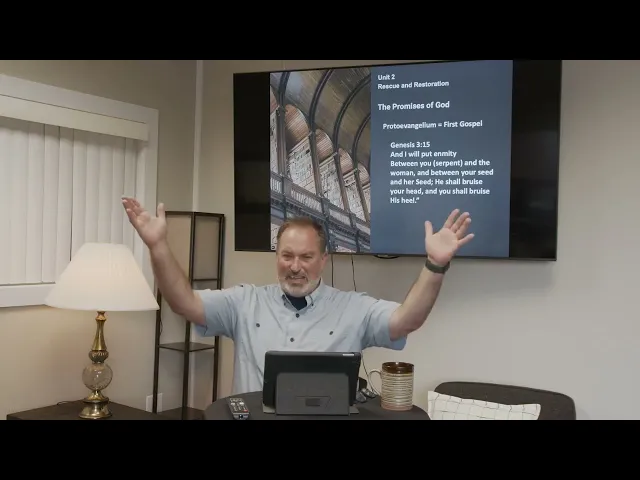
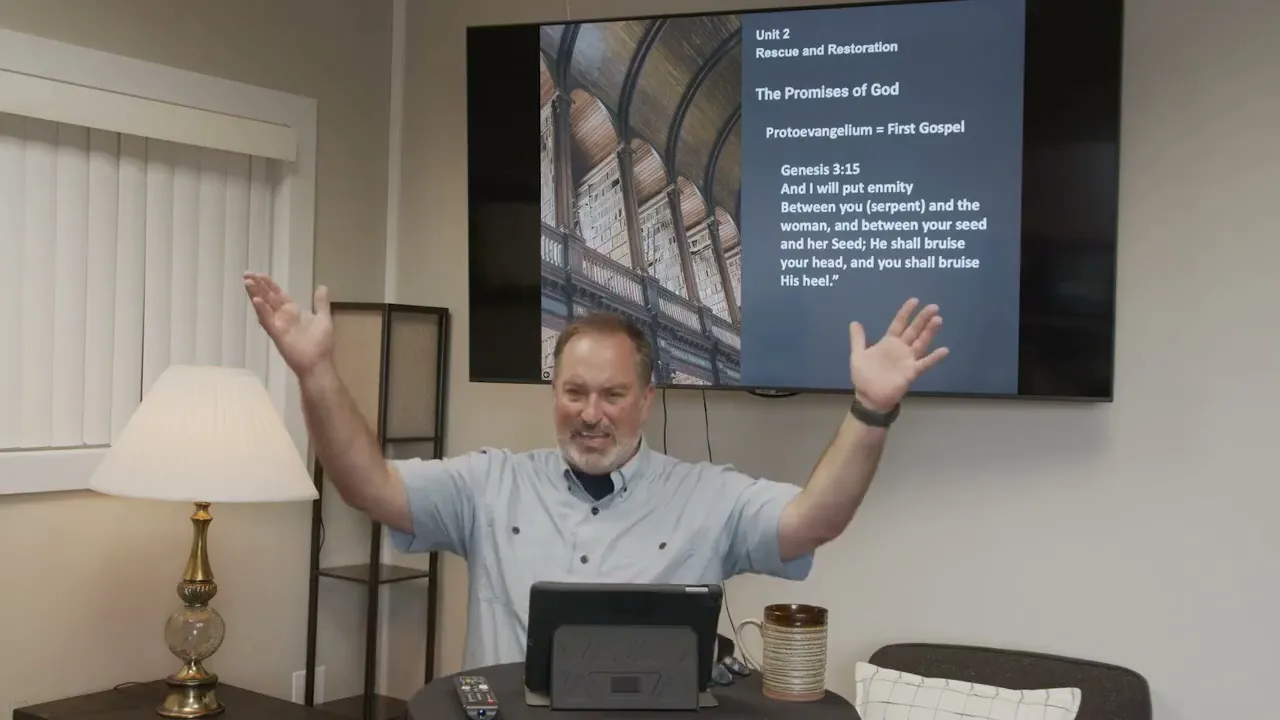
Hello, I'm Professor Timothy Moore and I get to be your instructor in this course, Christian spirituality. And this is unit two, rescue and restoration. We're going to be talking about um the promises of God as they relate to the coming, the first advent, the first coming of the Lord Jesus Christ.
Um what we're studying here um in theology is referred to as a biblical sotiology. The word sotas means savior, the one who rescues and restores. And when we look at what the Bible teaches about this process of salvation, this rescue and this restoration, we're developing a biblical sotiology which is a foundation for effective ministry because we need to understand every aspect of God's plan of redemption.
And specifically in this lecture, what I'm going to be talking about and covering is um prophetic promises. The things that make the Bible unique. Imagine, if you will, that you were in a um a theological bookstore, a place where you go to get your textbooks on campus, and you're in the the section with all of the Bibles, [snorts] and uh the these are the low tech Bibles, not the Bible apps, but the ones that are leather, thin pages, and and those new Bibles have that new Bible smell.
and you're in there and you're just admiring the Bibles and someone comes into the store and they they take one of the Bibles off the shelf and with a snarl they wave the Bible in front of your face and they say, "What makes this book different than any other book? " And they wait just a couple of seconds and you are startled and so you don't respond. and this person just in a very disrespectful way throws the Bible back on the shelf and storms out.
How would that make you feel? Well, that's exactly what happened to me when I was 19 years old. I was in Bible college at the Chrisell Center for Biblical Studies in Dallas, Texas.
was in the bookstore admiring those Bibles and an older man, probably the age I am now because that was about 34 years ago. He comes in and he does exactly that. Wave that Bible under my nose and said, "What makes this book different than any other book?
" And then he slammed it down on the shelf and he stormed out. And I'd like to think now after nearly 12 years of Bible college and graduate studies in three different seminaries and 34 years of ministry that my response to that man would be very quick, concise, and correct. And so that's what I hope will happen to you after you listen to this lecture and think about how you can express the sacred and unique qualities of God's word specifically as it relates to the promise of Christ's coming to this earth to be our savior, our rescuer, our redeemer, the one who restores us to relationship relationship with God.
Can we pray about that? Pray with me. Father God, thank you for your sacred and unique word.
I pray that you would open the eyes of our understanding so that we can see your great and precious promises that we can embrace them by faith and that we can understand Lord God how unique and precious your plan of redemption is. And I pray God that you would get your glory through the lives of the students as they grasp this and are able to apply this truth in their lives and in their ministry. In Jesus good name we pray.
Amen. Amen. So [clears throat] that's the encounter with the critic.
What we're going to see in this lecture is what Dr John Piper was expressing when he said Christ is at the heart of the scriptures. In all of the Bible, in all of the Old Testament, let's just talk about the Old Testament. Christ is patterned.
He is promised and he is present. From Genesis onward, everything connects to Christ. to his pattern, promised or present.
Second Peter 1:4 touches on this. It says, "Because of his glory and excellence, he, God, has given us great and precious promises. " These are the promises that enable you to share his divine nature and escape the world's corruption caused by human desires.
God has given us incredible promises. And we're going to be looking at those promises as they relate to Christ being patterned, promised, and present from Genesis forward. [snorts] Jesus himself [snorts] testified that the scriptures were all about him.
In John 5:39, Jesus said, "You search the scriptures because you think they give you eternal life, but the scriptures point to me, yet you refuse to come to me to receive this life. " the Pharisees, the Sadducees, the religious leaders, uh the the um the lawyers, the the religious legalists of the day rejected Christ because they felt like studying the scriptures, the Old Testament scriptures, um and and their knowledge would save them. And Jesus was saying to them, "Those scriptures that you're studying all speak about me.
" And they considered that to be blasphemy. And that's why they wanted to kill Jesus. But again in Luke 24 and verse 27 says Jesus took them through the writings of Moses that's the first five books of the Bible and all the prophets major prophets minor prophets explaining from all the scriptures.
And so he's talking about what we consider the 39 books of the Old Testament from Genesis to Malachi. And he says, "All of these are about me. They concern him.
" And we're going to see how that plays out in scripture in this lecture. The promises of God. There are 365 prophetic promises.
Prophecies are promises. Um but there are 365 prophetic promises with specificity. In other words, they they specifically talk about a time, an exact time, a place or an experience fulfilled directly in the person of Jesus Christ.
No other book, no there there's no writing, religious writing that has prophecies of specificity. No other specific prophecies about one individual written up to 1,500 years before that individual was born with time, place, and experiences. that doesn't exist in any other religious literature.
And so what we're going to do is we're going to go um back to what we covered in unit chapter 1, that protoe evangelion, that first gospel, Genesis 3:15. That's where it begins. And and it's like a a funnel, a large funnel that begins in in Genesis Genesis with the fall.
And this funnel narrows, narrows, narrows throughout the 39 books of the Old Testament until it comes to a extremely narrow point expressed in the first couple of chapters of the Gospel of Luke where this point can only aim at one person and that person is Christ. And so here's that verse that we studied in unit one. I'll put enmity between you the serpent and the woman between your seed and her seed.
Remember seed is zera in the Greek sperma the reproductive fluid of a man it's never used of a woman this is the virgin birth and he it's a male child that will be born and do this will bru will crush the head of the serpent even though the serpent crushes his heel bruises his heel that's the protoe evangelium the first gospel the fulfillment. So the point of the funnel, top of the funnel is the protoe evangelium. The point of the funnel is Luke 1:31, the fulfillment of all of the prophecies of Messiah, Savior, Redeemer of the Old Testament come to a point in Luke 1:31 where it says, "And behold, you will conceive.
" This is the angel Gabriel speaking to Mary saying, "You will conceive in your womb and bear a son, and you will call his name Jesus. " Jesus means Yahweh God saves. His name is God saves.
He will be great and will be called the son of the most high. And the Lord God will give to him the throne of his father David. And he will reign over the house of Jacob forever.
And of his kingdom there will be no end. And so it starts with the protoeangelium gen Genesis 3:15. And we have 365 promises, prophetic prophecies with specificity that can talk about no one else.
No one else fulfilled all of those prophecies. Every single prophecy, time, place, specific experiences, all fulfilled in Jesus. So let's examine uh more about that funnel of fulfilled prophecy.
And time would never permit us in this course to go through all 365 prophecies of specificity. So I've just handpicked a few that we can go through and understand the context of the content and the context and where they came from. And again, we've already talked about the top of that funnel, the garden promise, the protoeangelium.
And then beyond that, I want to talk about the promise that's made to Abraham. And I want to tee that up a little bit before we look at that exact promise in in Genesis 22:18. After the fall and this uh pronouncement of judgment and then the promise that is given, Adam and Eve go out of the garden.
And in Genesis 1 through the end of Genesis um 11, we have the development of two things. First and from from Genesis 3 to Noah and and the flood, we have the development of what is called secularism. Uh a life without God.
Secular means to be separated from God. separated from anything that has to do with faith or belief in God. And so people began to live for possessions.
Uh they lived uh for what they could experience physically and they lived for um for pride and position. In other words, 1 John 2:16, lust of the eyes, lust of the flesh, and the pride of life was expressed in secularism, godless living. Lust of the eye is materialism.
It's wanting what you see. You see, God created Adam and Eve with the intention that they would love God and use things. And then the lust of the eye, materialism, instead of loving God and using things, it is using God and loving things.
And so that is how they were living their lives. They were chasing after possessions. They were chasing after sensual experiences.
That's the lust of the flesh. and they were chasing after achievement and positions. That is the pride of life.
And that um the pinnacle of that was building a tower, attempting to build a tower, the tower of Babel all the way into the heavens, the achievement of man apart from God. And so you had this rise of secularism. And the pinnacle um of that secularism was the judgment of God and the flood that Noah and his three sons and their family survived in the ark and then began to repopulate the earth.
But unfortunately as they repopulated the earth instead of secularism develop developing an even more heinous thing an even more evil thing developed and that was idolatry. That was the trinket god movement where um where people were just expressing what Adam and Eve fell for in the garden which is they will be like God. They wanted to be gods.
When someone starts building gods carved out of wood that you can put in your pocket, what they're really saying is, I want to be God and I want something to serve me. So, if I'm going to call it God, I'm going to carve it, put it in my pocket, and it's going to serve me. And if I don't think it serve serves me, I'll get another one that someone else has carved or I'll carve another type of idol, and I'll worship that.
And if I have good luck and I have good things happening in my life, then that will be my God. And that increased that idolatrous movement increased from the time of Noah till the end of Genesis 11. And that is the time of Tara.
Tara was the father of Abram. Abram's name was changed to Abraham. And Abraham with his father and all of his brothers worshiped idols.
We see that in Joshua chap 24 and verse 2, which says that Joshua said to the people, "This is what the Lord, the God of Israel, says long ago, your ancestors, including Terara, that's the father of Abraham, the father of Abraham and Nahor, lived beyond the Euphrates River, and they worshiped other gods. And so Tara, his sons and Abram, who became Abraham, were a part of that idolatrous movement. They were worshiping those trinket gods.
And then somehow in Genesis 12, God reveals himself. The one true God reveals himself to Abram and promises are made to Abraham and a covenant of grace unfolds between God and Abraham so that all of Abraham's descendants and that's not his necessarily his physical descendants because the scripture says in Romans all who believe all who have faith in Christ are children of Abraham. But God develops this covenant of grace from Genesis 12:1 through Genesis 22.
There are 10 chapters as God unfolds the covenant of grace with Abraham. His name was Abram. In Hebrew, it's a V.
Aam. Aam means father. Araham means the father of nations.
And so I joke with my kids, Ara means daddy and Abraham means big daddy. Um he's he's going to impact nations. And there's one thing that's going to happen through Araham, the father of nations.
One thing is going to be the key piece that impacts and blesses all the nations of the earth. And we see that in Genesis 22:18. where God says, "It is through your seed that I will bless the nations.
" It's through your seed. It's the same word as Genesis 3:15, Zerah, and it is singular. So he says to to Abraham, I'm going to make you a father of many nations, but one descendant, one Zeron, not all of them, just one will be the one that blesses all people of all nations.
This is a promise. So we have the proto evangelium. We have the promise made to Abraham.
And so it's not just a descendant of Eve and Adam. Now we know it's a descendant of Abraham. So the prophetic funnel begins to tighten a little bit.
And the next thing is the promise to Judah. So Abraham has a son Isaac. Isaac has a son Jacob.
Jacob's name is changed to Israel, the prince of God. And Jacob has 12 sons. And those 12 sons eventually become the 12 nations of Israel or the 12 tribes, excuse me, of Israel.
And when Jacob is at the end of his life, he pronounces blessings over his sons. And there's a blessing that's promised to Judah, one of the sons. And that blessing is that the scepter, the king's scepter, will never depart from the tribe of Judah.
In other words, there will be a king that comes through the lineage of Judah who will reign forever and ever. It's the promise of the king scepter. And when Christ came, he was called the lion of the tribe of Judah, the king of all kings and the lord of all lords.
One interesting thing as we look at these promises is I think about the people that the promises are made to and their faults, their humanity, their sin is recorded in the scripture. Um obviously the sin in the garden, obviously u Abraham lied. He deceived people about his wife twice and it's recorded in scripture.
And then Judah, who's called the most righteous son of Jacob, his life was like uh a crazy talk show. his son dies and he leaves a wife named um Tam Tamar and Judah's wife dies and Tamar had never had a child and so she dresses up like a prostitute and Judah goes in and lies with her and she becomes pregnant and so Judah gets his daughter-in-law pregnant, thinking she was a prostitute. And then when he finds out that she's pregnant, he orders her to be killed, to be stoned to death.
And he had given the prostitute a ring. And she said, "The father of the child is the one to whom this ring belongs. " And then Judah repents and he says, "She's more righteous than me.
" And so the faults of these people are recorded in scripture. And yet God forgives them as they repent and put their faith in God. God forgives them and he uses them in beautiful ways.
And that is a part of the covenant of grace. God not just being merciful, but going beyond mercy and having grace. And so that's the promise to Judah.
The scepter will not depart from Judah. So you have the garden promise tightening to the Abrahamic promise and then tightening again to it's one son of Jacob that the Messiah will come to the earth. The the one who rescues and restores will come through that son.
And so you see the funnel getting smaller and smaller. And next we have the promise to David. In 2 Samuel 7:16, God is making a covenant with David.
And he makes a promise to David. In verse 16, he says this, "Your house, your kingdom will continue before me for all time. And your throne will be established forever.
" So we have the garden. We have the promise to Abraham. We have the promise to Judah.
And now we have the promise to David, King David, that it's his throne that will be established forever. And when Christ came to the earth, he was called the lion of the tribe of Judah. And he was called the son, the descendant of David.
And he was a descendant of David. Mary, the Virgin Mary, was a direct descendant of King David. And Jesus is the fulfillment of that promise.
And then there's the promise to Isaiah later on about 400 years later. God raises up the prophet Isaiah. And he gets very specific with Isaiah in seven uh chapter 7 verse14.
He says, "Therefore the Lord himself will give you a sign. Behold, the virgin shall conceive and bear a son, and shall call his name Emmanuel. And so God is clearly expressing what he implied in Genesis 3:15 that the virgin seed will crush the head of the serpent.
He says, "The virgin shall conceive and bear the son, and you shall call his name Emmanuel. " Emmanuel in Hebrew means God is with us. And so Jesus had a name and he had a title.
His name Jesus means God saves. And his title Emmanuel means God is with us. And then in chapter 9 verse 6 he he the Isaiah says unto us a child is born.
Unto us a son is given, and the government will be upon his shoulder, and his name will be called Wonderful, Counselor, Mighty God, Everlasting Father, and the Prince of Peace. And so the funnel's getting tighter. garden, Abraham, Judah, David, Isaiah, and he starts talking about the fact that he'll be born of a virgin and his character, what he will be like.
And then there's a promise to Daniel, an incredibly specific promise. In Daniel chapter 9, it says in verse 25, "Know therefore and understand that from the going forth of the command to restore and build Jerusalem until the Messiah, the prince, there shall be seven weeks and 62 weeks of years. " And so the weeks represent years.
And so 7 and 62 is 69. 69 * 7 is 483. And so what God is doing with the prophet with with Daniel as a prophet, he's giving him the a prophecy with specificity and saying the exact year and time that the Messiah, the Christ, the one who will rescue, the one who will restore will be crucified.
483 years from the time a decree goes forth to rebuild Jerusalem. And we know that that happened. King Ardiserxes of Persia financed it.
He made the decree to restore and rebuild Jerusalem. And from the time that he made that decree until the time that Jesus was crucified was exactly 483 years. 69 weeks of years.
That takes you from the time of the declaration to the crucifixion of Jesus is 33 AD. and and he says later in that um chapter Daniel chapter 9 that uh he says that the end of the end of wickedness the payment of sin talks about why Jesus died in Daniel chapter nine so this is unique it's unique to specif speify a time that something would happen 483 years in the future. And so that funnel is getting very tight, very, very tight, the funnel of prophecy.
And you got to remember there are hundreds of prophecies between these. There's 365 of these total, and we're just looking at a handful. But speaking of specificity of place, the prophet Micah in Micah 5:2 about 600 years before Christ was born said, "But you Bethlehem, Ephraa, Bethlehem," he's talking about the city and the region, the town and the region.
says, "Though you are little among the thousands of Judah, yet out of you will come forth to me the one to be ruler in Israel, whose goings forth are from old, from everlasting. " And so Micah specifies the place of the birth of the Messiah. He says it is the town of Bethlehem.
Now, I have gotten push back in the past when I've talked about the prophecies with specificity or any of the prophecies of Christ in the Old Testament. And someone um said one time, "Well, Jesus was Jesus knew those scriptures and he was just um trying to live those out to make people think he was the Messiah. " And my response was, "How do you choose where you're going to be born?
How do you choose the place of your birth? Micah 5:2, 600 yearsish before Jesus was born said he will be born in Bethlehem. And the magi came from east from Persia through the deserts to the place.
Why? Because they had the prophecies of specificity. and they knew when and they knew where the Messiah would be born.
That's what makes the Bible unique, these prophecies with specificity. And then an another amazing prophetic psalm is Psalm chapter 22. This is written uh over a thousand years before Jesus was born and it describes the crucifixion of Jesus.
In verse 16 it says, "For dogs have surrounded me. The congregation of the wicked enclosed me. They pierced my hands and my feet.
I can count all my bones. They look at me and stare at me. They divide my garments among them and for my clothing they cast lots.
So this is not only talking about crucifixion and having his hands and his feet pierced. It's talking about what the soldiers would do. They gambled for the clothing of Jesus because someone had given Jesus a cloak that was one uh one piece of fabric which was very unusual for that day.
But from the neck to the floor, one long piece of fabric and it was worth something. And so the soldiers gambled for that clothing of Jesus. And this is talking about that over a thousand years before Jesus was born.
Not crucified, before he was born. And it's talking about it hundreds of years before the first crucifixion ever happened. The first recorded crucifixion happened in 550 BC.
The world had never seen a crucifixion. Yet in Psalm 22:16-18, the Bible describes the crucifixion of Jesus and even that the soldiers would gamble for his clothing. And so the funnel is coming to an incredibly sharp point.
In his book, Science Speaks, Peter Stoner applies the modern science of probability to just eight prophecies, not the 365, just eight regarding Christ. Uh Dr Stoner is a mathematician. He's not a theologian.
But he says that the chance that any man might have fulfilled eight prophecies is 1 in 10 to the 17th power. That would be one in 100 quadrillion. That's 17 zeros.
And so, uh, Stoner suggests that when we take 10 to the 17th power, and again, that's just a probability of eight prophecies being fulfilled in Christ. And this is what uh, Dr Stoner said. If you take that many silver dollars and you cover the entire state of Texas, they would be two feet deep.
And if you marked one of those silver dollars somehow and you stirred the whole mass of silver dollars thoroughly and you blindfolded a man that that didn't see any of that. You brought someone in and you put a blindfold on them and you could tell you tell that man he could travel as far as he wishes, but he must pick up only one silver dollar. What chance would he have of getting the right one?
I'll tell you. 10 to the 17th power. One in a 100 quadrillion.
That's the probability of someone fulfilling eight prophecies with specificity. And Jesus fulfilled 365 prophecies with specificity. We don't have numbers in in human mathematics.
We do not have numbers to express the magnitude of that. So what do you do with it? What do we what do we do with this information as people who are training for ministry as people who are in ministry?
I mean what do you do with it personally? How do you apply it in your ministry setting? Well, first personally, you let it strengthen the veracity, the the verification, the truthfulness, the trustworthiness of God's word as sacred and unique.
and you let it assure you that this great plan of redemption that's prophesied from Genesis and fulfilled in Luke chapter 1 in the birth of Christ and then the perfect life of Christ, the crucifixion, the resurrection, his perfect example for us and and the promises of the future are our hope, our confident and joyful expectation. And the scripture speaks of the return of Jesus Christ to this earth. Eden was perfect before the fall.
And when Christ returns, the Bible says everything will be Eden again. Not just one garden. The earth will be what the theologians call Edenic.
It'll be the Edenic Earth. Jesus will make all things new, all things as they were meant to be, and there will be no hurtful thing. He will come back to this earth.
And when his feet touch down, we see the evidence of that. His feet touch down on the Mount of Olives. The Bible says it splits in two and living waters flow into the desert.
And the desert blooms like springtime. There's flowers throughout the desert and that continues over the entire earth. The earth blooms as the garden of Eden and all things are restored.
That's why the Bible ends with the phrase even so come Lord Jesus. He will make all things right. He can make all things right in the heart of an individual now that is receptive to him and he will eventually not just restore relationship with God.
He will restore all creation. Romans chapter 8 says all creation groans and waits for the day. The creation longs for the day because he doesn't just save our immortal souls.
He he saves all of creation from the corruption of the fall when he returns to this earth. And so I would say um if you haven't put your trust in Christ as savior example and king eternal follow your heart and that pull of your heart. Come into a relationship with him.
Romans 10:13 says, "Whosoever calls on the name of the Lord shall be saved. Believe in what he's done for you. He died for your sins, he rose from the grave to prove he's your source of forgiveness.
" Invite him to come into your life. And we can lead others to do that as well in our ministries. and they can have the assurance of an eternal relationship with God, forgiveness, the possibility of an abundant life, and know that when this life is over, they will be received by the Lord, welcomed into heaven.
And I want to finish with the words of Isaiah. In Isaiah 55:6, he said, "Seek the Lord while he may be found. Call upon him while he is near.
Let the wicked forsake his way and the unrighteous man his thoughts. Let him return to the Lord and he will have mercy on him and to our God for he will abundantly pardon.