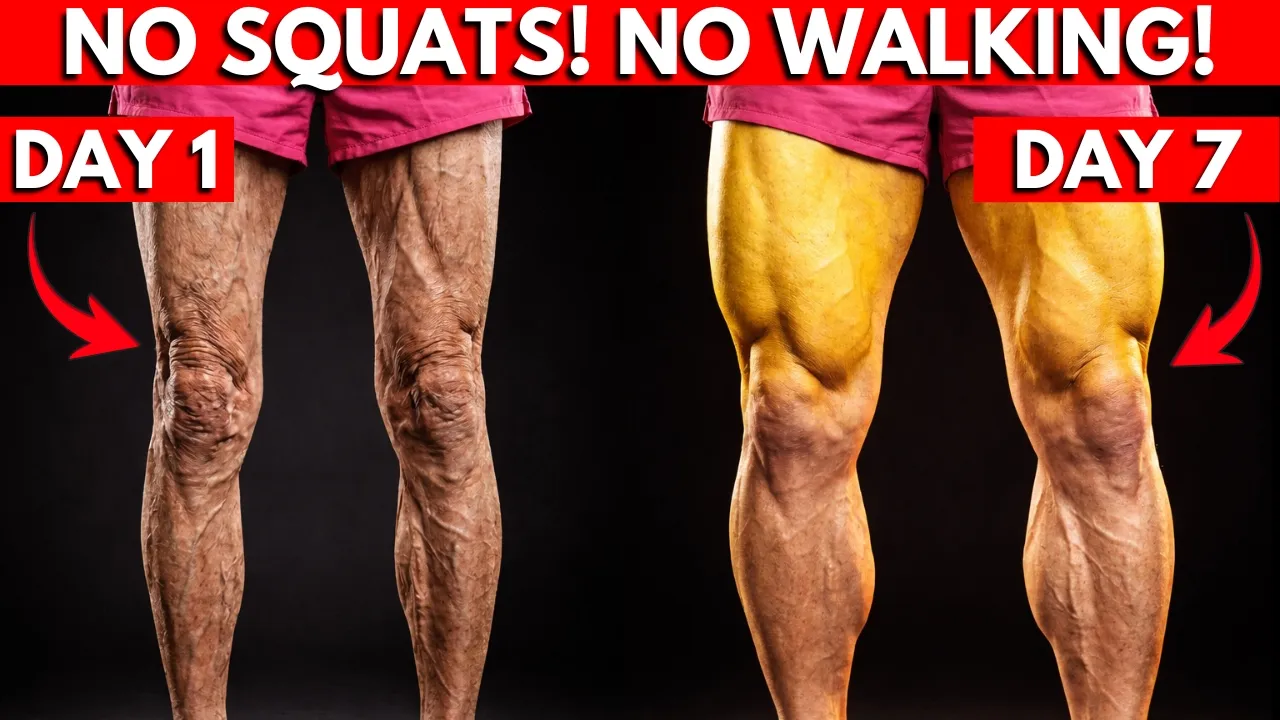
What if you could regain your leg strength in just 7 days without doing a single squat, without going on long walks, and without putting more stress on your knees? I'm Mark, a physical therapist with over 25 years of experience, and I've worked with thousands of older adults who believed their strength was gone for good. Most people are not losing their leg strength simply because of age.
They are losing it because the communication between the brain and the muscles is breaking down. After 50, research shows adults can lose up to 30% of their quadricep strength. But the real problem is not the muscle.
It is that the brain is no longer sending a strong enough signal to turn it on. When that signal weakens, the muscle stop responding, strength fades, stability drops, and the joints begin taking on stress they were never designed to handle. So what you are dealing with is not just weakness, it is a loss of proper activation.
And in the next few minutes, I am going to show you five simple exercises you can do at home, designed to restore that connection step-by-step. The last movement in this routine is something I call the activation switch. Stay with me until the end to learn how to use it correctly.
Do this every day for 7 days and your legs will feel stronger and steadier, like they did 10 or 15 years ago. Before we begin, write your name and where you are watching from in the comments. I always enjoy seeing where everyone is joining from.
Here is what is actually happening. Your muscles have not disappeared, but your brain is no longer activating them the way it used to. Think of your brain like a power station and your nerves like electrical wiring.
Over time, that wiring begins to weaken, the signal leaks, and even though the muscle is still there, it no longer receives enough power to fully turn on. So the muscle does not disappear, it just dims. That is why pushing harder does not fix the problem.
So instead of trying to force strength, we are going to restore the signal. For the next 7 days, you are going to follow a simple activation system. The first 2 days focus on waking the muscles up and restoring that signal.
Days 3 through 5 focus on control, slowing everything down so your muscles relearn how to work together. And the final 2 days focus on rebuilding strength through proper activation, not heavy effort. This system is simple.
You can do it at home. You do not need equipment. This is not about working harder.
This is about waking your body back up. What matters is doing it the right way. The first movement is called bed leg activation, and this is where everything begins.
Most people over 60 make one critical mistake. They get out of bed and immediately put their full weight onto muscles that have not been activated yet. That is when your knees feel stiff.
That is when your legs feel weak. That is when you reach for something just to steady yourself. Because overnight, your nervous system down regulates.
The signal to your muscles becomes weaker. And if you stand up without restoring that signal, your joints take the load instead of your muscles. This movement is designed to reverse that.
Research on neuromuscular activation shows that low load, controlled movements before weight bearing can significantly improve how your muscles respond. You are not just moving your legs, you are turning them back on. But here is where most people get it wrong.
They rush, they treat it like a quick warm-up, and when they do that, nothing changes. Speed kills activation, control restores it. To perform bed leg activation, lie on your back with your legs extended.
Slowly lift one leg a few inches off the bed, keeping it straight. Hold for about 2 to 3 seconds, then lower it down with full control. Then switch sides.
Move slowly, stay in control, do not let momentum take over. You should feel a light, deep engagement in the front of your thigh and your hip, not strain, not pain, just your muscle starting to respond again. Perform three sets of eight repetitions per leg.
And here is where this becomes real. When you finish this and then stand up, your legs will not feel as heavy. Your first steps will feel more stable.
That shaky feeling in the morning starts to disappear. That is how you know the signal is coming back. The second movement is called seated march, and this is where you start rebuilding coordination between your hips and your legs.
Most people think walking is controlled by the legs. It is not. It is controlled by the hips.
And as you get older, this is one of the first systems to break down. The hip flexors and stabilizers stop working together. The signal becomes delayed, and that is when your steps start to feel slower, less stable, and less predictable.
This is also why many people begin to shuffle instead of step. Research on motor control shows that when coordination declines, it is not just strength that is lost, it is timing. And once timing is off, balance becomes unreliable.
This movement is designed to restore that timing. But here is the mistake almost everyone makes. They lift their leg quickly and drop it back down.
It becomes a reflex, not a controlled action. And when that happens, the brain never relearns how to properly control the movement. Control rebuilds coordination, speed destroys it.
To perform the seated march, sit upright in a chair with your feet flat on the floor. From this position, slowly lift one knee up as if you are marching. Bring it up to a comfortable height, then hold it there for about 2 to 3 seconds.
Then lower it back down slowly. Alternate legs one at a time. Keep your back straight.
Do not lean back. Do not use momentum. You should feel the work deep in your hip, not just in your thigh.
That is how you know you are activating the right muscles. Perform three sets of 10 repetitions per leg. And here is what changes when you do this correctly.
Your steps begin to feel more controlled. You are not just moving your legs forward, you are placing them with intention. That is the difference between walking and being stable when you walk.
The third movement is called the glute bridge, and this is where real strength begins to come back. Most people over 60 are not lacking effort. They are lacking glute activation.
Years of sitting cause the glutes to shut down. They do not disappear. They stop doing their job, and when that happens, the lower back and the knees start taking over work they were never designed to handle.
That is where stiffness begins. That is where pain begins. Research on the posterior chain shows that when the glutes are not firing properly, force is transferred into the joints instead of being absorbed by muscle.
That is one of the fastest ways strength declines and injury risk This movement is designed to reverse that. But here is where most people fail. They lift their hips up and drop them right back down.
No control, no pause, no real activation. And when there is no hold at the top, the glutes never fully engage. The squeeze is where the strength comes from.
To perform the glute bridge, lie on your back with your knees bent and your feet flat on the floor. Press through your heels and slowly lift your hips toward the ceiling. At the top, your body should form a straight line from your shoulders to your knees.
Hold that position for about 2 to 3 seconds and squeeze your glutes hard. Then lower back down slowly with full control. Do not arch your lower back.
The movement comes from your hips. Perform three sets of 10 repetitions. You should feel a deep contraction in your glutes, not pressure in your lower back.
That is how you know you are doing it correctly. And here is where this shows up in real life. When your glutes start working again, standing up feels easier.
Your lower back feels less tight, and your knees stop taking unnecessary load. This is where your strength actually starts to rebuild. If you want to stay mobile as you age, hit subscribe now.
I post new systems every week designed to help you stay strong, stable, and independent. The fourth movement is called the heel raise, and this is where you rebuild the foundation of every step you take. Most people underestimate how important the calves are, but your calves and your Achilles tendon are what control how your body connects to the ground.
Every step you take depends on them. When they weaken, your steps become softer, less stable, and harder to control. That is when balance starts to decline.
That is when walking begins to feel uncertain. Research on lower limb function shows that calf strength is one of the strongest predictors of walking ability and balance in older adults. When this muscle group declines, independence begins to decline with it.
This movement is designed to rebuild that connection. But here is the mistake almost everyone makes. They bounce up and down quickly.
They use momentum instead of control. And when they do that, the muscle and the tendon never receive the signal they need to adapt. The benefit comes from the full range and the control.
To perform the heel raise, stand upright and hold onto a chair or wall for balance if needed. Slowly rise up onto your toes as high as you can. Pause briefly at the top, then slowly lower your heels all the way back down until [clears throat] you feel a stretch in your calves.
Every inch of the movement should be controlled. Perform three sets of 12 repetitions. You should feel both the stretch at the bottom and the contraction at the top.
That combination is what rebuilds strength and stability. And here is how this shows up in real life. Your steps begin to feel more solid.
You feel more grounded when you walk. That unstable feeling starts to disappear. This is what it feels like when your foundation becomes strong again.
The fifth movement is called sit to stand control, and this is where everything comes together. This is the movement I told you about earlier, the one I call the activation switch. Because this is not just an exercise, this is the exact moment where all the muscles you have been reactivating are forced to work together under real load, standing up.
And for most people over 60, this is where strength quietly breaks down. Because this movement requires coordination between your hips, your thighs, your core, and your balance system all at once. If even one part is not working properly, the whole system compensates.
That is when you start pushing off your knees. That is when you lean forward too much. That is when you feel unstable halfway up.
This is where most people get it wrong. They rush the movement. They use momentum.
They push up quickly just to get it done. And when that happens, the muscles are not doing the work. The joints are.
This is where strength actually rebuilds. Control, not speed to perform form sit-to-stand control. Sit on a chair with your feet flat on the floor about shoulder width apart.
From this position, slowly lean forward from your hips. Then begin to stand up. Move in phases.
First, shift your weight forward. Then press through your heels. Then rise up slowly.
Do not rush any part of the movement. Once you are fully standing, pause briefly. Then lower yourself back down slowly with full control.
Do not drop into the chair. Control the descent all the way down. Perform three sets of eight to 10 repetitions.
Now pause the video and try this once. Stand up slowly exactly as I showed you. Notice how it feels.
You should feel your thighs, your hips, and your entire lower body working together. Not strain, but control. And here is where this becomes real.
When you do this correctly, the moment you stand up feels different, more stable, more solid, more under control. That is the activation switch. That is what it feels like when your legs are working again the way they were designed to.
Now step back and pay attention to what starts to change as you go through this. By day three, most people notice the first shift. Your legs begin to feel more awake.
Not stronger yet, but more responsive. That heavy, slow feeling in the morning starts to ease. By day five, something more noticeable happens.
Your legs feel lighter, movements become smoother. You are not thinking about every step as much. The response is faster, more natural.
And by day seven, this is where it becomes clear. Standing feels more stable. Walking feels more controlled.
That sense of uncertainty begins to fade. Pause the video and tell me in the comments, which day are you on? This is how progress shows up.
Not all at once, but in how your body starts responding differently. But you also need to be smart about this. If you feel sharp pain, unusual swelling, or anything that does not feel right, do not push through it.
Stop and pay attention attention to what your body is telling you. And if you have existing medical conditions or those symptoms continue, consult a health care professional before continuing. Because the goal here is not to force movement.
The goal is to restore it the right way. Now here is your challenge. For the next seven days, follow this system exactly as shown.
Five exercises done every day. No skipping. No rushing.
Track what changes. Pay attention to how your legs feel when you stand up in the morning. Notice how your steps feel as you walk.
See if your balance starts to feel more stable and more controlled. These are the signals that your body is responding. And consistency is what makes this work.
Not intensity. Not more effort. Just doing it the right way every single day.
Because the truth is, most people never give their body the chance to relearn how to move properly. They try something once or twice, then go back to old habits. Do not make that mistake.
Give it seven days. Stay consistent. Let your body respond.
And if this helped you understand how to rebuild your leg strength the right way after 60, subscribe to the channel. Every week, I share simple training systems designed specifically to help you stay strong, mobile, and independent as you age.