My name's Gina Tatto, and my brother was mentally unwell. He didn't get the help that he needed when he needed it the most. It ended in tragedy, heartbreak.
Two families have been torn apart, one life lost. These are the families that Australia's mental health system has failed. My name is Vicki Walker.
I'd just like to talk to you about what happened with my son Clinton in December 2016. Please don't judge my son Clinton. He didn't get the help he needed and the help that he'd asked for, and as a result of that, myself and his girlfriend were stabbed.
There's a terrible cost when people are denied the mental health care they need. We begged and we begged for my son to be admitted to a mental health bed but was told that there was a bed block and no beds available. So we took my son home and two days later.
. . .
. he killed my grandson. REPORTER: This family tragedy played out in a quiet cul-de-sac at around 7:00 this morning.
Tonight, on Four Corners we investigate how our overburdened mental health system is failing those desperately seeking help, and reveal public safety is being compromised by a lack of access to treatment. Hi. I'm Clancy Daly.
I'm a mother of a schizophrenic boy, mentally ill. It's just so hard, and I begged for them to take him and couldn't get the help because the way things are. And it wasn't because the people weren't doing their job, it was because they could only do so much.
The system is wrong. One morning in November 2016, Clancy Daly's son Ben left the family home just after daybreak. A short time later, he was captured on CCTV at the local shopping centre.
Ben Daly had a long history of mental illness. Tell me, what is Ben like when he's unwell? Well, the first thing is he starts pacing.
As sad as it is, he does a drooling, which is really embarrassing to him. Then he starts a horrible high-pitched scream when the voices are so bad. And I have to get the medications - as soon as I see that anything's starting to go wrong, I had to get the medications into him quick.
His mother had been trying for months to get him admitted into a psychiatric hospital. I wanted them to take him away and put him in a safe environment and medicate him and get him mentally well before he was released. And what happened?
Nothing. They took him to hospital, got him medicated, got him calmed down, and sent him back home to me. And then sometimes when they'd send him back home to me, three hours later, he was off again and I'd have to ring again.
On that November morning, CCTV shows Ben Daly walking from the shops to a nearby bus stop. Moments later he randomly stabbed an innocent stranger in the neck. The man Ben Daly killed was landscaper Ian Baz Bosch, a loving father of two small children.
My name is Emerald Baz. My husband was killed by a man with severe mental health issues. I'm here because I'd like to see a change in mental health services to prevent this sort of tragedy from happening again.
Ian Baz Bosch had been on his way to buy food for a kid's birthday party. To someone who's never met and didn't know Ian, how would you describe him to them? He was just kind, funny, gentle.
He was very generous with his time. You know, he'd always stop and listen, and he would always try and help as much as he could. Clancy's son Ben was first diagnosed with schizophrenia in his early 20s.
He struggled with taking his anti-psychotic medication. He also used ice and cannabis. He told me, he said, "If I use the drugs, "I get two hours' break of screaming voices.
" And I just said to him, "Don't do it in my home "and don't do it around me. " But. .
. I didn't want to condone it, but I understood it. Four months before the killing, Clancy warned doctors her son was becoming increasingly violent.
Did he ever hurt you? Uh. .
. He king-hit me one day because he thought I didn't wash my hands. He was admitted to hospital for five days and released.
Fearing for her safety, Clancy started locking herself in a separate part of the house. When I was going to go to bed, I would say to him, "Get your food for the night, "get your drink for the night, go and shower, "have your toilet, get a toilet roll "and take the portable bush potty that we had for camping, "take that in case you get a thing in the night, "but I'm going to lock you in your room. " I think people at home would be shocked to hear that you were forced to lock up your mentally ill son because you were worried he would hurt someone.
Well, I wouldn't kick him out. So there was no choice. They couldn't house him, they wouldn't take him.
I was left with it. After his last hospital stay, mental health workers visited most days to ensure he was taking his medication. They would not take Ben.
They'd come out, they'd ask the 12 questions. And if a schizophrenic can get it together for that time frame to answer those questions, and then straight after be mentally, totally gone. And so they'd go and say, "He's left with you 'cause he's sane.
" They'd leave me with him and then two hours later, I'm ringing the police and ambulance again. The court was told Ben Daly was a paranoid schizophrenic and drug user. When he inflicted the fatal wound, the angels inside his head were telling him to hunt and kill paedophiles.
REPORTER 2: MrDaly claims at the time he was so mentally ill he did not have the capacity to control his actions and to know what he was doing was wrong. Late last year a judge found Ben Daly not guilty of murder because he wasn't of sound mind. He's detained indefinitely in secure psychiatric care.
It took the murder of an innocent person, Ian. . .
. . for Ben to be removed from the community and receive treatment.
There is something seriously wrong with the system. Emerald Baz wants her children to understand the man who killed their father needed help. I said, "He has a mental illness and he's not well.
"He's not thinking right. " I said, "He's not necessarily a bad person. "He's done a terrible thing, you know, he's done a bad thing.
. . ".
. and sometimes people that have mental illnesses "do things that don't make sense. " It's frustrating because you just know that something has to be done and obviously what is currently available is not sufficient.
It's not working. There are terrible gaps in our system. Patients, I think, come to harm on a regular basis and we're incapable of providing care for.
. . certainly for the sickest patients in our community on a regular basis.
There's not enough capacity in our system. There's not enough acute beds. There's not enough capacity in our community and there's not enough services provided to provide 24-hour-a-day services.
The Government of Western Australia last month announced it would fund 20 new mental health beds. But across Australia, acute mental health services are under-resourced and struggling to cope with demand. I've lived through the last 30, 40 years of mental health care in Australia.
I've seen the Burdekin inquiry appear in the 1990s, which swept away the old asylums, and there was a tremendous optimism that we were going to develop a modern community-based system of care. And we reduced the number of beds on the basis that we would have strong, dynamic, effective community mental health services. That promise was broken by every single state government in this country.
We did not develop those sustainable systems and they've just crumbled. Australian Institute of Criminology data shows over the past decade around 10% of homicide offenders were found to have a mental illness. I think the tragic cases are happening with monotonous regularity.
You know, we know there's about half a dozen homicides by the mentally ill in New South Wales every year. About half of them have presented to mental health services in the weeks or two beforehand. There's reluctance to talk about this group because it might stigmatise the wider group of people with mental illness who, you know, do not present a risk of violence, who are not violent or dangerous.
I don't think it's helpful to ignore the problem, but it is helpful to have balance and perspective. # I'm only one call away # I'll be there to save the day # Superman's got. .
. # # I'm only one call away. # Before this catastrophe, I had a life.
I had a beautiful son, and a beautiful grandson. And within a blink of an eye, it changed. It changed my life.
It changed the family's life, and it will never, ever be the same again. We begged, and we begged for my son to be admitted to a mental health bed, but was told that there was a bed block, and no beds available. We took my son home and two days later.
. . .
. he killed my grandson. WOMAN: I still miss him every day, still want him to come back.
I keep asking myself why it happen like that. Why is it happen to me and my son and my partner? You want to put onion on, too, Mum?
I have no onion. You did have a red one. For legal reasons we can't use the real names of anyone in this family.
We've changed them for this story. It's not supposed to be dry, Mum. I know, I know it's not supposed to be mooshy.
Maybe a bit of. . .
Oil. Yeah. Susan's son Michael has schizophrenia.
That's good now. Yeah. Ann is Michael's partner.
They had a baby boy in 2012. And I thought, "Oh my gosh. " I have never been so proud or so happy as I was that day, first grandson.
He was very good. He loved his son. He took him everywhere.
He used to. . .
. . pick him up, put him over his shoulder and walk.
Like, so proud that he was a father. Wheels. Ooh, wheels!
Good job, Daddy. You're an excellent man, Daddy, I like you're a excellent man. He good.
He love his son so much. Couldn't imagine how much he loved that boy. This.
. . this one here.
Like that. OK? Not long after his son started school, Michael's mental health deteriorated.
Be good for Daddy. Bye-bye. Have fun.
You could tell it by his. . .
the tone of his voice, the way that he sits, the way that he's trying to tell us something but doesn't quite know how to get it out. So we knew that he was not well. We took him to Hornsby Hospital and he admit that straightaway, by one of the psychologists there.
So she found a bed for him. What did doctors assume was wrong with him? That he hadn't been taking his medication.
In fact he was, but the high dose simply wasn't working anymore. Doctors changed his medication. The switch to a medication that is lower in potency and proved to be ineffective for his symptoms, and as a result of that switch, there was a relapse.
After a month in hospital he was discharged to the care of his local community mental health team. PROF. McGORRY: When you change a medication, you don't know if the new medication is going to work as well as the old one, so you really do have to monitor the person very, very carefully in that early period after changing, probably for the next few weeks, actually.
And the system, because it's so weak and threadbare, is unable to do that, really. Ann was worried as her partner's behaviour became increasingly erratic. He get a little bit confusing and talking about, you know, just the devil, God, something like that.
I keep monitoring him. Keep watching him, watch what's wrong with him. But he seemed to be.
. . not getting better.
He stopped eating, but he still take medication from discharge from hospital. Michael was seen by community mental health workers several times. When they ask my partner questions, he always say, "I'm alright.
I'm fine. " And that's it. And they not even want to ask me any question.
I'm trying to push so hard to tell them he not well, he not good, he need help. . .
. . but they just ignore me.
In a last-ditch attempt to get help the family took him back to Hornsby Hospital's mental health unit. When you said, "He needs to be admitted," what did they say to you? There's no beds.
There's a bed block on the North Shore. I said to her that he'd just come out of hospital and that he was having thoughts that his son was the devil. Anyway, I pleaded with her.
Oh, my God, I've never pleaded so much in my life. I've never pleaded so much. Anyway, with that, I took my son, I took him out.
I said, "Come on, we'll go. " And he's going, "I want to go home now. I want to go to bed.
" He said, "I'll be OK. I'll be OK. I'll sleep it off.
" He was in need of some attention. He was so in need of some attention, but they just. .
. . .
just weren't interested. They just weren't interested. Two days later, their lives changed forever.
I took his partner to work and then I went back to get him ready for school. REPORTER: Good morning. A 5-year-old boy has died after been stabbed in a horrific case of domestic violence in Sydney.
REPORTER: Weighed down with shock and grief, a grandmother falls into the arms of police. REPORTER: A 36-year-old man, believed to be the boy's father, has been taken into police custody and is currently being questioned. REPORTER: Sources close to the family say he is a victim, too, a man who tried over and over again to get help.
I saw him in prison about, I don't know, four or five weeks after this event, and he was still acutely unwell, actually, with florid delusional beliefs and other signs of acute psychosis. Did he have an understanding of what had occurred when you interviewed him? Not the first time, no.
He's still affected by acute delusions and just didn't have a full appreciation of it. Four Corners has obtained the Health Department's internal investigation which catalogues a disturbing litany of failures. It shows poor communication: .
. and lack of checks led to a lower dose of antipsychotic being given to Michael. Critically, the report states that mistake: New South Wales Health told Michael's family: The Health Department told Four Corners it's implemented all the report's recommendations including improving communication and staffing.
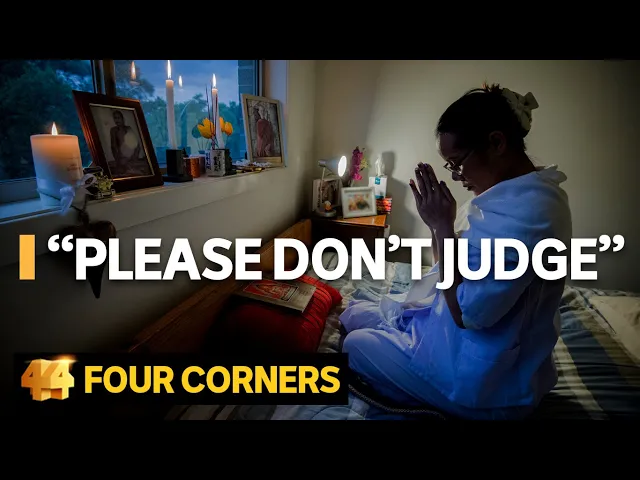
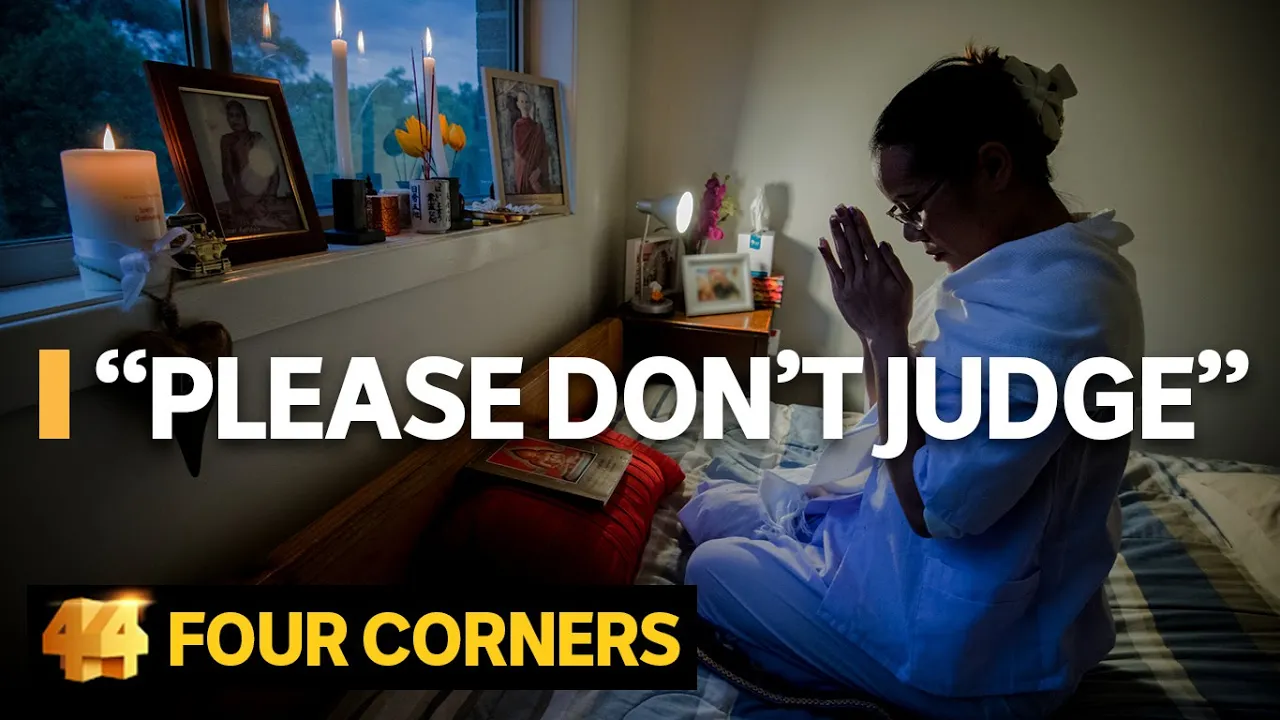
(PRAYS IN NATIVE LANGUAGE) Michael was found not guilty of murder by reason of mental illness and is now in a secure forensic hospital indefinitely. His partner Ann seeks solace in her Buddhist faith. (PRAYS IN NATIVE LANGUAGE) I'm not angry with him, even first day when it happened.
I worry about him, what he's gonna be doing in the future. I forgive him, the first time. I'm concerned, I worry he's gonna get hurt, he's not gonna get fixed, he's not gonna get better.
If your son had been admitted to hospital that day, do you think this would've happened? No. No, definitely not.
Because he would have got the help he needed. He would've had his medication sorted out. He would've been fine and we would not.
. . .
. we wouldn't be here today. What's your reaction when you see these horrendous crimes on the news?
Well, it's an intense feeling of frustration and even I feel physically sick sometimes because I think this tragedy has occurred, it's preventable, and it's caused endless suffering for so many people and it's preventable. My name's Gina Tatto, and my brother was mentally unwell. He didn't get the help that he needed when he needed it the most.
It ended in tragedy, heartbreak. Two families have been torn apart, one life lost. NEWSREADER: Joshua Josef Barker deliberately drove onto a footpath, killing Dale James Watson who was walking to the shop.
NEWSREADER 2: A Kings Meadows man has pleaded not guilty to murder after a fatal hit-and-run in Launceston. The 31-year-old's defence argued Barker had post-traumatic stress disorder after being assaulted in the area years before. In March 2018 in Launceston, Joshua Barker drove his car off the road, killing another man.
His sister still struggles to understand how he could take a stranger's life. It's not like he woke up one morning and went nuts. His mental health deteriorated over a 10-week period.
Because we're not experienced, we didn't know what was happening. We didn't realise the signs. But to a professional, they would've known exactly these signs of his declining health.
It was an escalation. Four weeks before the hit-and-run, Gina called 000 when her brother threatened to hurt himself with a knife. And I just said, you know, "Look, he's not crazy, "he's not dangerous.
"He's just. . .
he's getting sick. "We're scared he's gonna take his own life. " MAN: He was taken by police to the hospital so that they could then have him presented to the hospital to be given some assessment and, if appropriate, admission to the hospital, or at least observation and treatment.
Josh arrived at the hospital and was discharged within half an hour. What do we do now? That was our last resort.
Um. . .
We were deflated, we were exhausted. We felt so alone. For the next three weeks, Joshua Barker had no treatment while his family struggled to manage his increasingly erratic behaviour.
I frantically called anyone and anyone I could. Anything that said "mental health", I rang it. We didn't know what to do.
I reckon I called eight or nine places. With all my experience with these mental health lines, that's all I got constantly, was, "He's gotta come in himself. " And I kept saying, "But he doesn't know he's getting sick.
"He thinks he's fine. " The night before, the 8th, before Josh took somebody's life, Josh sat for several hours with his friend and talked about all of his beliefs, believing that the world was divided into three groups of people that were angels and devils and people in between. His mental health is gone.
He's out of reality. He's delusional, he's saying weird things. Um.
. . so, then I panicked, started ringing everyone again.
The last person I rang at 10:45 Friday morning was the hospital, the CAT team, Crisis Assessment Team. Um. .
. told them it was urgent, we needed help desperately. And she said, "I'll get someone from the assessment team "to call you straight back.
" Hour and a half later, they called back. It was too late. Joshua Barker was already driving to a suburban street in Launceston's south.
Dale Watson was in the same area. The two had never met. My name's Terry Watson.
Um. . .
I'm here because my son was mowed down at Prospect by a hit-and-run driver, by Joshua Josef Barker. Our family's struggled with this for near. .
. . oh, two years, and we're still waiting for answers.
Why? And we still get no answers - why? Dale Watson died on the pavement.
He went up to see a friend. He was just walking down after seeing his friend, coming around a corner, going to the shop he was, and this Josh Barker come from behind, rode a gutter. And Dale was nearly on a lady's front lawn.
He'd come that far over to hit him. Joshua Barker kept driving. The next day, police charged him with murder.
Prison staff there. That's the actual prison van that Josh will be in. That's family.
That's Gina waving to Josh. Joshua Barker's murder trial was held last September. (VEHICLE REVERSING ALARM BEEPS REPEATEDLY) If somebody with a mental illness ends up before a court, then that's a failure, in my view.
Somebody with mental illness should be assisted through the mental health system. And if they end up before the criminal justice system, it's because they've not been able to. .
. . .
or haven't received the appropriate care and help that could've prevented that happening. As the jury considered its verdict, both families waited for news. (KNOCK AT DOOR) Better answer the door 'cause it could be security staff.
MAN: We have a verdict. We have a verdict. GINA: You're joking.
Yep, so, the jury's obviously reached a verdict on the case. Um. .
. when it comes to a verdict, I'd ask you not to react no matter what the verdict is, OK? So, if it's one that goes in your favour, then don't react.
If it's one that we're not expecting, then stay calm. Go! They won't convene without me, Gina.
It's alright. But what happens if I do react? Just do your best, mate.
So, we've just a had quite a quick outcome from the jury. After just 40 minutes of deliberations, they've found him not guilty by reason of insanity. In this, there's no answers.
You know, I feel sorry for his parents too. You know, they've lost a son in one way, so, you know, we're both losers, so. .
. MAN: Thanks for speaking, Terry. Good on you, mate.
WOMAN: Thank you. The judge ordered Joshua Barker receive psychiatric treatment in a secure hospital indefinitely. Our prisons are now our new asylums and we've got literally hundreds of people with severe mental illness in prison, uh.
. . receiving, often, their first ever treatment.
GINA: It's starting to get chilly now. (BLEATS) Oh, yeah, they've just found their food. Joshua Barker's family wants him to be treated in the community.
Do you worry that, if he is released, that something like that could happen again, he could hurt someone else? No. No, he's on board now.
He's on board. He wants. .
. he wants the help. He wants to make sure that he never gets to that level again.
Terry Watson believes his son's killer shouldn't be released. TERRY: My own opinion is that he should pay for what he's done 'cause I believe if he gets out, like I said, he'll do it again. Do you think there needs to be better mental health resources for people like Josh?
Yes, there's gotta be. There has to be. Because if we don't do anything about it, it's gonna keep going on and on, and whoever commits a murder can plead post-traumatic stress, insanity.
I could kill you here now, five minutes later, walk out of that door and say, "Look, I had post-traumatic stress. "I didn't know what I was doing. " Research shows offenders who receive intensive psychiatric treatment are far less likely to offend again.
Once they've been treated and rehabilitated over a long period and gradually returned to the community, they're actually a very safe group. The forensic mental health system is effective, but it's costly, and it is. .
. you know, you don't really want a mental health system that can only provide that level of care once someone's committed a very serious offence. That we have to wait for that to happen makes no sense.
Well, look, it's a complete indictment of the system, isn't it? You know, to think that the only way you can get good treatment - and the treatment you get in the forensic mental health system is, you know, the best treatment available - is by committing a tragic offence, you know, is, um. .
. . .
it's, uh. . .
it's, um. . .
absurd. My name is Vicki Walker. I'd just like to talk to you about what happened with my son Clinton in December 2016.
Please don't judge my son Clinton. He didn't get the help he needed and the help that he'd asked for, and as a result of that, myself and his girlfriend were stabbed. REPORTER: For years, Clinton Walker collected swords and knives.
Last night, police allege he used them. REPORTER: Police found a harrowing scene at the home, seizing a machete and a sword, and forcing their way into a room where the two women were hiding. We just heard this screeching and swearing, and, "Get out, f-ing this and f-ing that.
" REPORTER: It's believed that these women were being repeatedly stabbed from head to toe by a man who was armed with not only a machete but also a sword. (BURBLES) Are you trying to tape me on video? Are ya?
Are ya? Are ya? Vicki Walker's son Clinton grew up on the outskirts of Sydney.
MAN: Good on you, Clint. He was an outgoing child and a promising rugby league player. VICKI: He was first diagnosed with having a mental illness when he was about 16, but that was mainly depression, anxiety.
It wasn't until he was 18 that he got labelled with PTSD and anxiety. They didn't know whether he had schizoaffective disorder or schizophrenia. .
. . .
following an assault on him. And what was that like when he was diagnosed? Oh, it was pretty scary but.
. . Because no-one really talked to you about what it meant or.
. . .
. what future Clinton could have or how it would affect him. Throughout his early 20s Clinton had a series of hospital admissions.
Clinton would recognise when he was becoming unwell and we would, through his help with his psychiatrist, get him back into the private hospital. In late 2016, Clinton began having disturbing hallucinations. He said to me, "Mum, I need to go back and see a doctor," who he hadn't seen a lot in a couple of years before because he'd been well.
So, he started seeing him again and. . .
Anyway, probably two weeks before everything happened, he was really unwell, he became really paranoid. Clinton was taken by ambulance to hospital in delusional and paranoid state. He believed his mother's house was on fire, which was not the case.
And ambulance officers on arrival on the scene decided that it would be good for Clinton to be examined by mental health team. VICKI: He'd never been this anxious and this paranoid before, and he'd been scheduled before for a lot less symptoms, if you like. So, in Clinton's mind, he thought that they weren't going to give him a bed, he thought that they weren't going to help him.
After waiting for two hours, Clinton left without being seen by the mental health team. His medical notes recorded no follow-up was required. Well, the problem was he wasn't treated, you know?
He was given, I think, a small dose of a low potency antipsychotic medication, and no arrangement was made for proper follow-up of what was an acute relapse that was really going to require hospital admission. I really thought that the police would come back and get him because they'd scheduled him so many times before for a lot less symptoms and a lot less bizarre behaviour. They didn't come and then I thought, "Oh, well, maybe the after-hours mental health service "from the hospital will come.
" They didn't come either and Clinton slept. The next night, Vicki woke to Clinton screaming, and went to check on him. He had this ornamental sword and.
. . I didn't know that's what it was, but that's what come through the door, and it happened to get me right in the abdomen area.
I just froze. I didn't know what the hell was going on. I'd never ever seen Clinton violent before, let alone.
. . .
. do anything like that. Clinton's girlfriend was also in the house and rushed to help.
She was stabbed too. And it was that point that I got scared because I thought. .
. . .
"He doesn't know who I am. " I think that's when he said, "What sort of mask you got on? " That's when he cut my face.
And I went to put my hand up and I got cut on my hand too, across there. And then he went outside again, yelling at neighbours, "Come and help me. " YEVGENY: Vicki required surgery, extensive surgery, as a result of the assault and now suffering from psychological symptoms following the assault.
Clinton Walker was arrested a short time later and charged with multiple offences, including grievous bodily harm. He spent several months in jail before he was found not guilty due to mental illness. In his case, he had fully recovered by the time he came to court, and they were able to make an immediate order for treatment in the community, which, as I understand it, he's continued to receive treatment in the community for better or worse and remained well.
You know, if he became unwell or didn't abide by his conditions, he would be taken back into hospital. Australia's acute mental health services are under enormous pressure. Those who work in the system say the problem can't be ignored.
Public safety is being put at risk by this continuing neglect of mental health care in this country, particularly at the more severe and complex end of the spectrum. I'm sort of a bit over people listening and nodding encouragingly and saying that they understand. They actually have to spend some money and actually improve the system.
More than three years after her son attacked her, Vicki Walker still struggles with PTSD. She blames her trauma on the mental health system that failed to help him. Clinton is still living with his mum.
I think a lot of people would be really shocked to hear that he's back living with you here in the house where he almost killed you. Probably, but I guess at the time, I thought it was a temporary thing, and I didn't want to see Clinton go back to jail. I really thought that they were actually going to put him in like a supported accommodation-type thing and work with him and help him move forward with his life and give him trauma counselling and all this stuff.
To date, none of that's happened. CLINTON: I love you, Mum. I know.
Clinton Walker watched off camera as we spoke to his mum. He didn't want his face to be filmed. He still has a lot of shame and guilt because he says to me, "Mum, you're the one person that I love more than anything.
"Why would I. . .
You know, why? " is his big question. I'm just.
. . See, it's our life, you know, it's all the future.
You're alright. I'll get out of. .
. No, you're right. You have to say what.
. . I thought you needed my support but.
. . (SPEAKS INDISTINCTLY) I blame the mental health system for not recognising Clinton's psychosis for what it was.
Please don't judge my son for what happened. He knew he was unwell and he asked for help and didn't receive it.