hello and welcome to the review of chapter 66 of guyton and hall's medical physiology textbook in this chapter we go over how various food particles get digested and then how they get absorbed into the gastrointestinal tract to then go around the body and be used as energy so if you enjoyed the chapter please don't forget to give it a like and subscribe to the channel as it helps us out greatly to begin with we have to know what our food actually is made out of and it's really made out of these three main components so
carbohydrates fats and proteins there are small amounts of other types of nutrients such as electrolytes and vitamins and minerals but these are the main components that we actually have to absorb because they are large particles and the key thing that's similar between these three molecules is that they are formed through these linkages of many smaller particles through a process of condensation condensation just means water a hydrogen ion on one end and a hydroxyl ion on the other end which makes water is removed and removing that water from two precursor molecules causes a linkage so for
carbohydrates those two precursor molecules are monosaccharides so a single sugar unit gets condensated and the two monosaccharides forms a disaccharide when you have many monosaccharides linked together then you have a large polysaccharide when it comes to proteins this linkage is called a peptide link and they link two amino acids together two amino acids together as a dipeptide three is a tripeptide and mini is a polypeptide and polypeptides together make proteins and in fats the main one in our diet is triglycerides which is a neutral fat and that's made out of three fatty acids connected to
a glycerol molecule via condensation so once again condensation creates these linkages so in order to digest these products and break those linkages we have to add water adding water to break down a molecule is the process of our hydrolysis another similar for the digestion of each food type the major difference is just the enzyme involved because you need an enzyme to allow hydrolysis to occur to allow that water molecule to break up that food group and that will really consist of the majority of what we're going to learn here is where these enzymes are located
throughout the gastrointestinal tract now remember an enzyme typically ends in a's so aese so sucrase breaks up sucrose so if we go through our different sources of our enzymes we have three major sources of carbohydrates sucrose which comes from sugar sns lactose which comes from milk and then starches which is the majority of our carbohydrates that comes from potatoes and vegetables these non-animal foods now starch is a large polysaccharide whereas sucrose and lactose are both disaccharides so they're just two monosaccharides connected together there is also a large amount of hydrolyzing cellulose in our diets but
they're not really considered food because we can't break that down and that's what really differentiates us from herbivores herbivores are able to break down the cellulose in the large intestine so the digestion of carbohydrates starts in the mouth due to thailand which is actually alpha amylase in your saliva secreted by your parotid glands and that only does a small amount of digestion that really just breaks down a bit of carbohydrates with the thought that it's just related to our taste senses so you're able to break a little bit down notice that there is some carbohydrate
and then you obviously swallow that saliva and that will continue in your stomach until it actually becomes too acidic at which point the amylase gets broken down so about 30 to 40 percent of the starch gets hydrolyzed into maltose until the stomach acids inhibit that alpha amylase and then this continues mainly in our small intestine due to our pancreatic amylase the pancreatic amylase is very similar to the mlas from our saliva but it is several times more powerful and what that does is converts all that maltose which comes from our starches our large polysaccharides gets
converted into small glucose polymers so the whole goal pre-intestine and in the initial intestine is to break down these large polysaccharides and to maltose and then maltose down into glucose now some maltose and in glucose lactose and sucrose then gets presented to the enterocytes or the epithelial lining of the small intestine which contains enzymes to actually break down these disaccharide molecules and the enzymes correlate to their name so lactase breakdowns lactose sucrase breakdown sucrose maltese and alpha dextrinase as well so these are able to break down these disaccharides into monosaccharides to then get absorbed in
the villi so that all occurs right at the epithelial lining of the intestinal tract the result is about 80 percent of our carbohydrate being absorbed as glucose because of the large amount of starch in our diet and then 10 galactose which it comes from lactose and 10 fructose which comes from sucrose so that is our carbohydrates starches eventually get broken down into glucose lactose gets broken down into galactose and glucose and then sucrose gets broken down into fructose and glucose and then the glucose galactose fructose gets absorbed at the epithelial lining that we'll cover very
shortly here but first we have to cover proteins so the digestion of proteins starts in the stomach with the enzyme pips and then remember pepsin needs a very acidic environment to actually work or else it's inactivated so that's why we produce so much hydrochloric acid in the stomach from the parietal cells it then activates the pepsin the pepsin starts a digestion of protein but more importantly breaks down collagen collagen is this very very tough protein molecule that actually contains all the meat which is the major component of connective tissue in meat so in order to
actually get to the proteins within the meat you have to break down that collagen which is very hard to digest so pepsin is able to do that in an acidic environment and almost release the rest of that protein to be hydrolyzed in the small intestine so in the stomach we're really making protein more available to be digested in the small intestine where the pancreas secretes four main proteolytic enzymes trypsin chymotrypsin carboxy polypeptides and elastase trypsin and chromotrypsin just breaks it down into dipeptides tripeptides these very small polypeptides that only contain a couple amino acids and
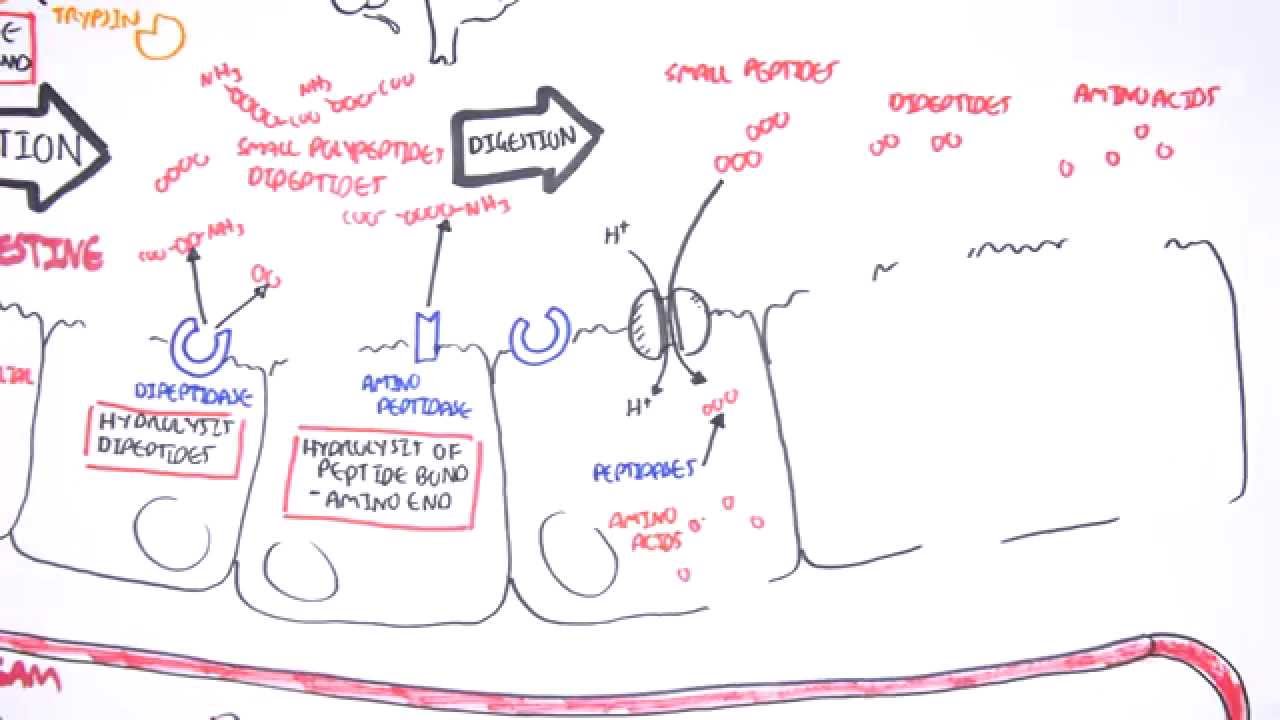
then carboxy polypeptidase cleaves these into individual amino acids elastase breaks down the elastin that actually holds meats together as well so then we mainly get relief with dipeptides and tripeptides the dipeptides and tripeptides then go to once again the epithelial lining of the intestinal tract and just like the carbohydrates those small molecules are able to be broken down right at the lining due to multiple peptidizers mainly amino polypeptidase and dipeptidase so right at the intestinal border it breaks down these very large components into individual amino acids that then get absorbed protein molecules that aren't able
to get digested are often the cause of serious allergic and immunological disturbances so then lastly here we have the digestion of fats now fats are a little bit more complicated because they are not water-soluble so they are going to almost transport as just one glob of fat that won't mix well with the water within the intestine so that is the main issue that we have to overcome it contains mainly triglycerides which comes from animal origin but we also have phospholipids just plain cholesterol and cholesterol esters which is a cholesterol with one or two fatty acids
attached now cholesterol doesn't have fatty acids attached to it but it is a breakdown product of triglycerides and also acts like a fat so this is considered a fat in the diet so there is a tiny amount of breakdown of fats in the stomach about 10 due to lingual lipase it's secreted from the lingual glands in the mouth but this enzyme is only really able to attack the outer surface of this congregation of fat that's all stuck together because it's not water-soluble so how do we overcome that that's where bile comes in bile is once
again secreted from the liver stored in the gall bladder and then is then released whenever a fatty meal is sensed in the small intestine in the duodenum the bile contains bile salts and this phospholipid called lecithin both of these components have a lipid soluble side and a polar side which is water-soluble so what happens is that these molecules are able to go and attach itself to fat and then really reduce that interfacial tension of fat with water so you reduce that tension reducing the tension that allows the fat to be easily mixed and broken down
into smaller portions so then you're able to create much smaller fat particles greatly increasing the surface area of the fat within the intestine that greater surface area then allows those fat enzymes to come along and interact with the surface and break down the fats and that's where lipase comes in pancreatic lipase comes in interfaces with these fat globules and starts to break it down into fatty acids and monoglycerides but monoglycerides and fatty acids themselves are also highly insoluble so we have to once again shuttle them away from each other so then they don't form their
own little glob and that's where bile salts come in once again they form these missiles which are like little spheres these little packets which just go and gobble up or hide these monoglycerides and fatty acids within them shuttle them over to the intestinal epithelium and the lining of the epithelium and then allow those insoluble products to be absorbed through the intestinal lining so the bile acids are able to one emulsify the fats so that's the initial process of breaking down the big congregation of fat into tiny little globules so then it can then be digested
but it also functions as these missiles which are like little packets that then shuttle all the breakdown products from hydrolysis of the fats over to the intestinal warning so then again it get absorbed now lipase breaks down triglycerides whereas our phospholipase a2 breaks down phospholipids and cholesterol esters hydrolase breaks down our cholesterol esters now these bile salts missiles are so important that essentially no cholesterol is absorbed without those muscles so that is digestion of fats carbohydrates and proteins so next is absorption so when it comes to absorption the majority of it happens in the intestinal
tract barely any occurs in the stomach other than highly lipid soluble substances like alcohol and aspirin but that only occurs in very small quantities because it doesn't have this villus that we'll get into and they have very strong epithelial tight junctions to prevent absorption so the stomach is mainly involved with mixing the contents breaking down the collagen within the protein starting the digestive process whereas absorption really occurs in the small and large intestine the majority of nutrients are actually absorbed in the small intestine whereas water and electrolytes are absorbed in the large intestine as we'll
get to now the very important concept here is that the small intestine has the structure to greatly increase its surface area and this structure is three-fold so we have the folds of kirchhorn which are outlined up here these big folds that occur within the mucosa and then we have these villi on top of the folds and then on top of the villi we have microvilli which is a brush border and as you'll see over here this is the brush border of a single villi which has all these micro villi now all of these components greatly
increases the surface area to allow absorption to occur over a large quantity of epithelial lining all of these factors turns your small intestine surface area to the size of a tennis court which is quite dramatic now we've already talked about the structure of a villi how we have this epithelial lining we have the central lacteal that absorbs all your fats and then we have our circulation with artery and vein coming down which allows the absorption of nutrients now if we go into each specific component remember water is able to be absorbed quite easily via osmosis
and that just follows its osmotic gradient which is typically promoting absorption but can result in secretion when it comes to the absorption of just about everything it really relies on the absorption of sodium so what happens the main component here is that sodium gets actively transported out of the epithelial cell into the interstitial fluid so away from the intestinal lumen which also drags chloride with it out of the cell so then this low concentration of salt within the cell or low concentration of sodium within the cell specifically promotes the secondary active transport of sodium through
the epithelial lining from the intestine into the epithelial cell and with it sodium will drag amino acids glucose and drag water across into the interstitial fluid either through the trans cellular or paracellular pathway paracellular between the cells trans cellular through the cells so the secondary active transport of sodium through the epithelial lining from the intestine results in the co transport of your amino acids and your glucose because these protein these transport proteins require both sodium and another molecule either amino acids or glucose to be attached in order to absorb the sodium so that is how
everything gets absorbed in the intestine except for your fats but before we get to our fats another important little thing to notice here is that as chloride is absorbed across the intestinal lumen we also get bicarbonate being secreted now this is very important later on in the small intestine and the ilium and then also in the large intestine mainly to combat the production of acid that's produced by the bacteria and the intestine whereas the co secretion of hydrogen ions when we absorb sodium allows in the upper small intestine this hydrogen to come in and bind
with all that bicarbonate that has been already secreted in the upper duodenum that initially actually neutralize the stomach acid now this acid has to come in and bind with the excess bicarbonate which then forms your carbonic acid that then dissociates into carbon dioxide and water before they gets absorbed carbon dioxide easily gets absorbed and gets breathed out in your lungs so then you're able to recycle your bicarbonate quite easily and then later on your bicarbonate is ex secreted so that you're able to neutralize the acid produced by your bacteria now when it comes to our
other minerals calcium gets absorbed under the influence of parathyroid hormone which activates vitamin d that allows calcium absorption in your intestine that we will cover in our endocrine chapters iron gets absorbed in the small intestine and proportion to the body's needs especially for hemoglobin and then our monovalent ions meaning that they only have a one positive charge or a one negative charge potassium magnesium phosphate for example they get absorbed with ease in in great quantities so there's no issue there the bivalent ions the calcium for example they're not as easily absorbed so they require that
assistance through the hormones so now how does fat get absorbed remember the fats have been shuttled away in the bile missile so then they don't become insoluble products the bile missiles then go over to the brush border and then kind of open up so then the monoglycerides and free fatty acids can then get absorbed through the epithelium quite easily because they are lipid soluble being lipids so they're able to transport straight over the membrane once they have crossed the membrane those fatty acids and monoglycerides can get taken up by the cell's smooth endoplasmic reticulum to
then reform the triglycerides these triglycerides are then released as chylomicrons to flow through those lacteals up into the thoracic duct through the lymphatic system to then dump into the vena cava into the circulating blood now we do have the absorption of some fats straight into the portal blood so do not take the lacteal pathway and these are only the short and medium chain fatty acids and that occurs because they are more water-soluble than those triglycerides so now lastly here we have the large intestine the large intestine absorbs the water and electrolytes predominantly in the first
half of the colon which is called the absorbing colon and then also forms feces and stores feces until you can excrete them in the storage colon which is the second half of the colon and the absorption of water and electrolytes occurs in the same manner in the small intestine sodium gets actively transported across the basal membrane creates that gradient of sodium within the cell itself to then promote the secondary active transport of sodium across the epithelial membrane dragging with it chloride and any other electrolytes now the sodium transport is also greatly enhanced with aldosterone remember
aldosterone gets released whenever the rest system is activated if you're very dehydrated you have a low blood volume so then you're able to absorb more salt more water and rehydrate yourself and then once again the bicarbonate ions also get exchanged for the chloride to then neutralize the acids produced in your bacteria now your bacteria also have some other role they can actually digest the cellulose which is a much greater role in our herbivores they have a large large large large intestine so then they can able to break down that cellulose and that's where the majority
of their digestion occurs but in people the bacteria mainly produces vitamin k for our clotting vitamin b12 for the production of our red blood cells thiamine riboflavin and then also obviously various gases carbon dioxide hydrogen gas and methane which is responsible for flatulence so then we form our feces which is predominantly made out of dead bacteria a little bit of fat some inorganic matter just a tiny amount of protein about two to three percent and then 30 percent of indigestible roughage so that's our cellulose our feces are brown because of the breakdown of bilirubin which
turns into stercobilin and urobilin and the odor is caused due to bacterial action and that is the end of our chapter i hope you enjoyed it if you would like to support the channel please have a look at the patreon link where you can get access to downloadable audio files otherwise feel free to drop a comment and we'll see you in the next chapter