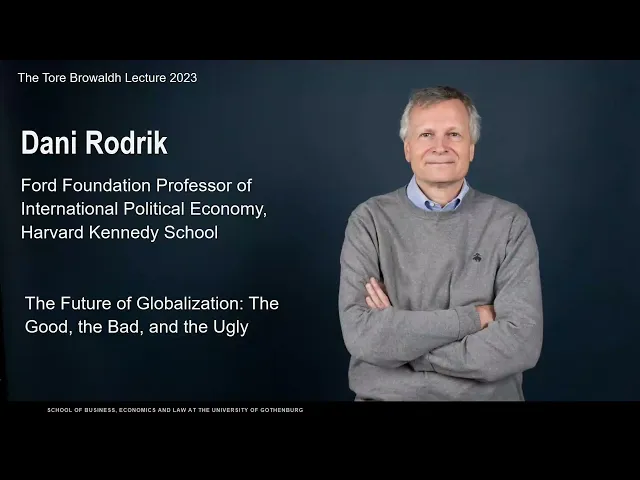
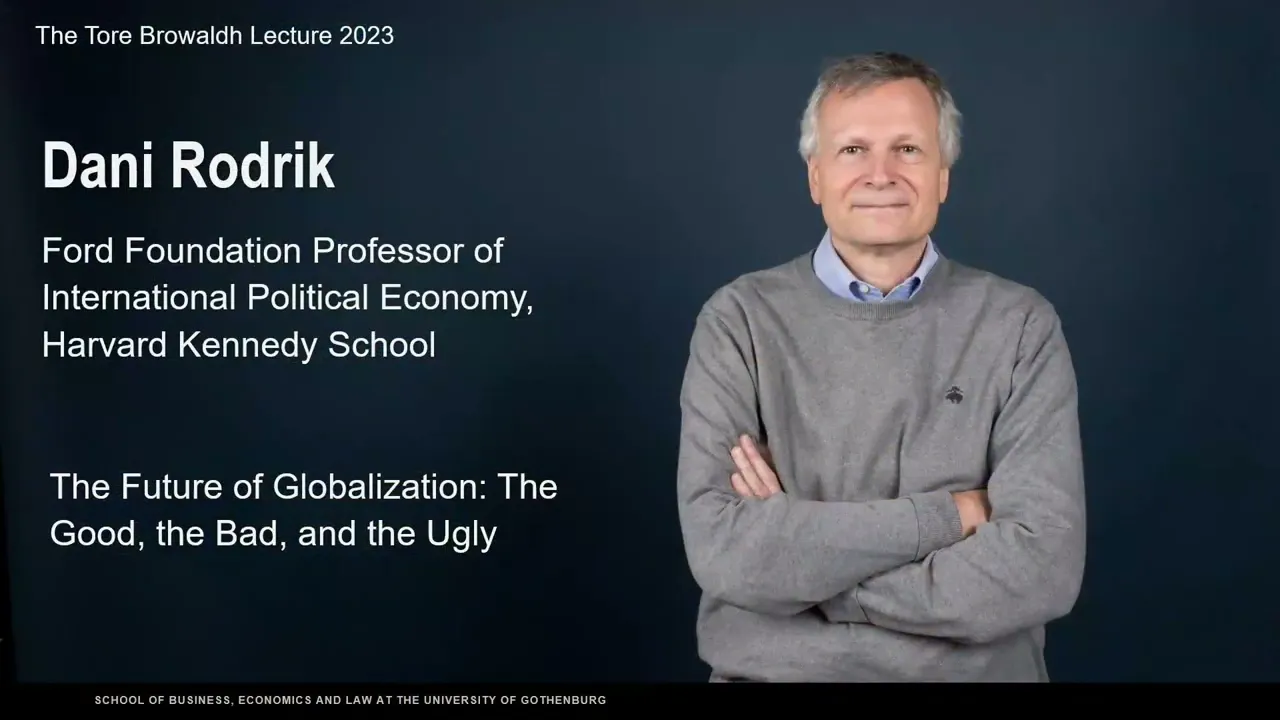
Dear colleagues and friends I wish you all very welcome to the 2023 edition of the Tore Browaldh lecture Tore Browaldh, he was a true multi-talented person who during his long career held high positions both in public administration and within the corporate sector. He was heavily engaged in the Reconstruction of the Swedish economy and Swedish trade relations in the aftermath of World War II. Later in his career he took up the position of CEO of Handelsbanken and became a member of the board of a number of the largest Swedish industrial corporations. Moreover Tore Browaldhd had
a sincere interest in academic excellence and in this spirit the annual Tore Browaldh lecture was established to further a qualified discussion on societal challenges in the Nexus of Economics, political science, and international relations. And since 1989 the Tore Browaldh lecture has been held by a series of extremely qualified individuals such as Ralph Darendorf, Paul Krugerman and Timothy Snyder giving their reflection on societal development. Now when we gather for this year's lecture we do that against the backdrop of a societal development that is highly problematic and worrying. This development includes increasingly evident common challenges to the
sustainability of the conditions for our society in combination with increased geopolitical tensions and eroding structures for multilateral collaboration when we need those the most. It is therefore of very high importance that we within the academy and in society at large develop an insightful and qualified discussion about the possible roads forward to meet these challenges. The future of globalization. And with that said I leave the floor to my colleague Professor Ola Olsson to introduce our speaker and the theme of this edition of the Tore Browaldh lecture, thank you . Please, Ola. Thanks a lot Per. As
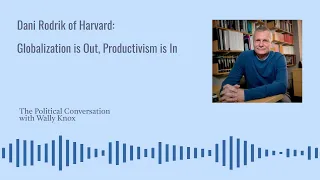
he said my name is Ola Olsson and I'm really honored today to introduce today's speaker Professor Dani Rodrik of Kennedy School of government at Harvard University. Professor Rodrik is a leading economist within several fields of Economics such as development economics, international trade, and also political economy. He has published a numerous influential articles on several topics in in top economics journals that have been really important. One of my own favorites is for instance his paper Institutions rule the Primacy of Institutions over geography and integration in Economic Development from in general of economic growth. Quite often his
uh his articles in the titles of the article so very self-explanatory and very intuitive and immediately gives you a an excellent idea what the work is about. For instance, 'Why do more open economies have a bigger government', from General political economy. And one that I really like is 'Economic development as self-discovery', in Journal of development economics . But apart from his numerous article uh production he has also written influential books for instance, 'The Globalization Paradox: Democracy and the future of the world', from 2011. As well as these more most recent work 'Combating inequality rethinking government's
role', from 2021. So as you will probably find and many of you already know he's work I would say is characterized by being very policy oriented very Innovative thinking which has contributed greatly to economics and we just open new fields of research in in some areas. And so and the topic of today then will be The Future of Globalization- The Good the Bad and the Ugly. Once again an excellent title for a talk I would say. So we're very happy to to welcome Professor Rodrik. I should say that the seminar will be recorded and distributed
after the lecture for those who are interested and there will be a session for questions so we would like to invite both you the audience here in the room as well as our zoom discussions to ask questions after Professor Rodrik's talk so with that said I leave the floor to to Professor Dani Rodrik. Thank you very much uh Ola for this very generous introduction um it's a great honor uh to be presenting this lecture. I'm sorry I could not uh be with you there in person. I hope my voice is clear um and that you
can see my my presentation. As Ola mentioned my topic is The Future of Globalization um I think it's fair to say that we're at a moment of transition and I want to present this transition as a transition of our narratives. The narratives of globalization. Why do I focus on on narratives, I think um any global economic order has to be sustained by the stories that policymakers and the general public tell themselves because a global economic order is not maintained and enforced or developed through a a global government or a global enforcer a global institution. There
is no such thing in the world economy. So any global order therefore must rely on on self-enforcement that is on sort of the norms and the practices and the priorities that we internalize in particular policy makers internalize. So these stories that we tell ourselves and policymakers tell themselves about what they are supposed to do. What they're not supposed to do. These both create the norms as well as enforce the norms that make a world economic system run in an orderly fashion. So these norms that are internalized in government behavior is that's what makes the system
work rather than the International law or multilateral institutions, which at best really can play only a kind of a reinforcing role. Because the WTO does not have an army cannot send gunships to enforce its rules or nor for that matter can the U.N or or really the IMF. So um one way to understand the importance of these narratives and how they've shaped our global order is by taking a quick tour, a historical tour of how these different narratives have shaped different types of globalizations. So one of the ideas that I want to I want you
to take away from this talk is that globalization is not just one thing. There are many different types of globalizations, each come with a different set of narratives, different set of priorities, different set of norms and practices. And where we are right now is precisely in a kind of a transition and I'd like to think about where we are in the debate that we ought to be having less as do we have more globalization less globalization but much more about what kind of a globalization uh are we going to have. So one of the earliest
forms perhaps you know the first fully formed system of globalization was the gold standard. And the gold standard was based on the idea uh that um uh each nation would maintain a fixed uh parity between its currency and the value of gold. Each nation would maintain open borders to International capital flows. For the most part also it was a system of relatively free trade and also free movement of labor for much of this system. But the the narrative that underpinned the gold standard was that the economy was a kind of a self-adjusting self-equilibriating economic system.
So if a particular national economy was running an imbalance uh was having large trade deficit or trade surplus there would be corresponding movements in gold which would translate to changes in the money supply and there would be a kind of a self equilibriating adjustment that would re-establish equilibrium. Because an economy was viewed as a kind of a self-adjusting system that really did not require a lot of government activity or stabilization policy on the part of the government. This was a system that was best supported by governments having very limited role in the management of their
economies, and not interfering in the free movement Of capital or goods and people. So essentially putting macroeconomic policy on automatic pilot. Um uh this system really was, could be resuscitated really ran between roughly 1880 and the first world war. It was briefly resuscitated in the interwar period but came up against the realities of a modern economy that really proved to be not so self-stabilizing, self-adjusting after all. And um the kind of a system of global economic order or globalization that emerged after World War II which I will call sort of the Breton-Woods system um was
underpinned by a very different narrative. The Bretton Woods narrative emphasized the role of the state um in both the macroeconomic and microeconomic domains. That in the macro domain you needed to undertake active stabilizing policy, Keynes himself of course was one of the architects of the Bretton Woods era and he was very keen to ensure that governments had the autonomy and the space to conduct independent counter-cyclical stabilization policies. So that required that the macroeconomic policy be insulated from short-term capital flows And the whims of financial markets. But on the microeconomic sphere as well governments were engaged
increasingly in significant efforts to provide social insurance, create welfare states as well as a variety of industrial policies to restructure their economies and similarly those effects also had to be protected from too much import competition or too much shocks from the external environment. So this the Bretton Woods narrative revolved around the kind of what one might call a a model of shallow integration uh that is that trade liberalization did take place but it was limited to manufacturers, it was limited to advanced countries and even within manufacturers when certain sectors like governments came under too much
pressure in a way that might upset uh domestic social equilibria that there were immediately barriers that were put up as happened in the 1970s on garments. So this model of shallow integration essentially allowed each country to go more or less its own way. Erect its own social and economic systems and and these systems were protected by the presumption that there would be Capital controls and free trade would be limited and there was very little harmonization of rules in terms of domestic rules on Industrial policies, investment rules or agricultural rules or rules with regard to services
for example. Nevertheless as I'll come back to um later in the talk uh even though the Bretton Woods narrative revolved around kind of a shallow integration a thin model of globalization to actually promoted significant expansion of international trade and long-term investment, I'll come back to that at the end of my talk. Now um what uh took the place of um The Bretton Woods narrative after the 1980s and really in full force after the 1990s is what I've called a system of hyper globalization. The hyper globalization narrative in many ways harked back uh to the gold
standard era of globalization in terms of prioritizing the needs of the international economy. Prioritizing the need to maintain openness in capital flows and increasingly deep integration in terms of off-track. And the story that went around hybrid globalization was that through deepening the process of economic integration, through financial Globalization that would create so much gains through economic globalization. The gains from trade the gains from the free flow of capital, that eventually this would lift all boats would also have significant political effects. That they would tend to strengthen democracy. We tend to blunt conflict, so the the
political science or the international relations versions of this argument has been known as sort of the liberal internationalism argument. But this this system um really harked back to the gold standard and putting the needs of the global economy before national economic goals. Though it did give governments a greater role and also positive explicitly benign political consequences in the form of democratization uh from deeper economic integration. Now it's important to emphasize that under the hyper globalization narrative the governments did not necessarily deny the importance of other agendas besides openness and integration to the global economy such
as social Equity distributional concern, environmental issues, or national security goals. But the technical presumption and this is where really economics And economic logic really played an important role was that these other goals could be met with other policy instruments that did not interfere with free trade or capital mobility. So in some say you could have your your cake you could and eat it too you could have all the openness and integration the world economy without necessarily sacrificing your domestic, economic, social, environmental agendas at the same time. And I think in you know sort of in
practice the reason that the hyper globalization failed and and why we're sort of you know are in the midst of a transition away from it is that the kind of this neat separation uh did not work. And it did not work on at least sort of four different domains. In the domain of economic growth proper I think it's fair to say that that the the promise of hyper globalization, that countries that hitched their um their wagons onto the global economy would be the ones that would prosper the most uh was you know fulfilled at best
only half of the way. It is true that some countries like China and many other countries in East and Southeast Asia did very well um uh in this era, but uh the paradox The apparent paradox of course is that those countries uh combined the the you know sort of a strategy of leveraging the world economy with a set of domestic uh policies that were really based much more on the Bretton Woods logic of significant intervention in their domestic economy, and significant industrial policies and um and and and restructuring and diversifying of their economies. China of
course is the premier example of that. China was a incredible miracle in terms of growth and poverty reduction after the 1980s but a lot of the policies that made China so successful were really policies of the Bretton Woods era uh not the hybrid globalization era in the sense that China pursued industrial policies, significant trade restrictions, subsidies, State ownership, exchange rate management, controls on Capital flows that were policies that were at intention with the rules and norms of the hyper globalization era. Whereas other countries that actually did entirely buy into the hyper globalization narrative such as
Mexico for example which relied on free trade agreement with Mexico with the United States And opening up its borders to International Capital flows completely um actually did very very poorly. So countries that made globalization their growth strategies did not do all that well . There were also in the context of the advanced countries mostly there was um uh the uh issues of equity and inequality and fairness that could not neatly be separated. That uh just in fact as uh trade theory predicted there were significant distributional consequences especially for low educated workers and some of the
declining regions in Europe and in the United States. And in practice it proved either politically convenient or economically infeasible to actually compensate to losers as the theory would have us do it. So there were stark distributional consequences of of uh hyper globalization. There was a broader uh kind of a political or an accountability problem which is that as countries pursue the deep economic integration and the concept of free trade agreements and and um sort of doing what was required in their domestic financial macro and regulatory policies to integrate into the world economy, they became also
less responsive uh To their domestic stakeholder and to the demands of um domestic economic and social policy cohesiveness. So when confronted by uh protesters that you know who felt that their democratic countries were being less accountable to social, environmental goals. Leaders like Tony Blair in in the UK or or Bill Clinton in the United States would say well you know globalization is like a force of nature or you know you might as well debate whether Autumn follows summer so these are like you know what there's nothing really to debate, which of course created a sense
of all you know helplessness. A sense of loss of control, a sense that the political Elites had become distant and were serving a different Cosmopolitan agenda rather than the agenda of the domestic economy and society. And finally of course you know that the you know that the hyper globalization narrative was relatively blind to the fact that as China became more powerful economically that there would be corresponding geopolitical tensions that would arise, and that the U.S China relationship could turn from a beneficial economic interdependence to one of increasingly zero-sum geopolitical Competition that would undermine some of
this economic interdependence. So some of these were some of the ways in which I think that sort of narrative um has has collapsed. So as I said um at the at the outset we are now in the midst of a shift in this narrative um and and so I think it's fair to say that the hyper globalization narrative is dead the question is what will replace it. So I'd like to you know going back to to my subtitle um I think there are really um three scenarios: The Good the Bad and the Ugly. I'm going
to spend most of my time on the good because I'd like us to be optimistic about the future but what would the the bad be uh the bad would be of course a kind of a return to the 1930s. Kind of more or less in return to autarchy uh this would entail a global decoupling not just between US and China but also among sort of all major um uh parts of the world. It would create an implosion that is an actual sort of steady reduction in the volume of world and uh in the volume of
World Trade and investment as took place in the 1930s. Now I don't think um this would be a kind of a disaster and um uh I don't think really That this is um where we are likely to end. I think for one thing we are we have levels of economic interdependence which would make uh such an implosion of World Trade and investment really um way too costly and I I just cannot see populations sort of really standing up to it. But also there are sort of you know deeper political economy reasons why I think this
is unlikely uh to be the case internationally we do have institutions that we did not have in the 1930s. You know such as the OECD, the G20 um the WTO the IMF which as weak as they might be are for a you know it's not coordination at least a certain degree of cooperation and I think also internally the domestic political economy in the advanced countries is and many middle-income countries as well is very much in favor of openness. So I just don't see those political forces being overwhelmed uh in in the short run at least.
So I don't think the the bad scenario is particularly likely. There is an ugly scenario um which is sort of one step removed from that and I think I would think of that scenario as one where Increasingly geopolitical competition between US and China uh becomes uh the lens through which economic relationships and the world economy are perceived um. So this would be a world in which great power rivalry particularly between US and China becomes a dominant perspective. So I call this the the kind of hyper realist scenario and I'm by realism I'm referring to the
school of realism uh in international relations that argues that major powers are always destined to be in conflict with each other. So this would be a scenario in which U.S would seek to assert its Global Primacy not simply in political terms but also in terms of rule setting and economics and technology in digital areas while China would increasingly flex its military muscle at least initially regionally but ultimately globally as well. In that model everything becomes a zero-sum competition including the world economy. So the benefits of trade and investment the gains from trade which economists like
to focus on all become subsumed under the rules of this Zero Sum power competition. And economic interdependence becomes weaponized, that is to say countries Use their economic relationship to extract geopolitical advantage uh from other countries and of course we have a world in which at least with respect to China there is a significant amount of decoupling. Now this would be a world that I describe it as ugly because I think um it would entail a unnecessary and very difficult choices for third countries in terms of being able to being forced to choose sides. And I
think for the major Powers it's unnecessary because I think it is possible for countries like the US China and regions like Europe to maintain their legitimate national security interests without turning this into a kind of zero-sum competition. That they could protect their legitimate National Security interests but also coexist uh peacefully side-by-side economically and significant have significant economic relationships with each other. So I don't see the logic of realism uh necessarily pushing us into a world where everything becomes zero-sum and economic interdependence uh is weaponized to the extent that it would be under this this ugly
path. So that brings me to what I think is a good path Um. Now I should be clear that by the good path I'm still talking about a model that is um that entails a certain amount of um uh moving away from the hyper globalization model. So in some sense this would be a kind of a return to the spirit of the Bretton Woods era where focus of Economic Policy makers nationally once again becomes their domestic economic social environmental agendas, and they pursue these agendas in a way that prioritize their domestic electorate and stakeholders. Even
if occasionally that means imposing some consequences on other countries because they might entail you know buy local or by domestic agendas, they might imply some tariffs on on third countries. So you know so I call this reintegrating domestic economies because I think you know one consequence of hyper globalization was that as the as the global economy became more integrated the domestic economies became less integrated, became disintegrated because economic social regional cultural gaps within countries became wider. So I think this path that by focusing on domestic reintegration would tend to fix some Of these blind spot
of um of hyper globalization. So this would folk this this kind of the set of policies would focus on on economic, social, and environmental agendas. Focus on good jobs, middle class jobs. And and revitalizing declining regions um uh and as as we've seen a wide range of new industrial policies and climate policies that often have sort of implications for the rest of the world. For business Elites that would you know sort of would imply to some extent the kind of a greater emphasis or renewed emphasis on social and domestic solidarity as opposed to globalism and
for portable Elites of course is prioritizing the domestic stakeholders over International companies, financial institutions, or highly skilled globally mobile professionals. So this would involve this would I think result in a thinner but I think ultimately a healthier globalization. I think in the in the areas of international trade the guiding principle would be economic coexistence. That is understanding that different countries have different types of economic systems and rather than trying to harmonize those Things rather than having common rules in areas like in you know subsidies, agriculture, Services, intellectual property rights, industrial policies and so forth sort
of allowing these different systems to coexist uh with each other and and countries would have the right to protect their own standards and regulations or tax regimes but not to export these rules onto other countries. In international finance I think that there would be much greater regulation much greater use of credential Capital controls uh much greater control on financial pure, Financial tax savings. Again a recognition that there is not necessarily a single regulatory model that different parts of the world different countries may want to choose different uh points along the straight-off between Financial Innovation versus
Financial stability and each one of these different points would entail different regulatory models. National Security would have to be protected so that's one of the clear legitimate prerogatives of nation states but within justifiable limits, that countries would have the right to protect their own National Security but not to explicitly Uh you know work to undermine the security of other countries. So this policy has been described in the U.S contact by National Security advisor Jake Sullivan as a policy of small yard high fence so there's we carve out um those areas such as advanced semiconductors which
we believe are very important to our national security and that we protect them uh very rigidly. But we do not sort of multiply these beyond those areas where they're critical to legitimate National Security goals. Now with their actual practice in the United States uh aligns with that is still a question that remains to be seen but I do like this metaphor of small yard high fence. And Global governance I think would focus on the big areas where there are really large amount of gains from global cooperation. And those of course are largely in the area
of climate change and Global Public Health to some extent close border labor mobility as well and a sort of a side note here which I think is important as we think um about the future of this kind of a thinner model of globalization which puts more emphasis on governments pursuing their domestic priorities And prioritizing their domestic, economic, social, environmental policies is sort of would that necessarily entail the world in which basically each country going its own way. Would entail you know sort of the collapse of the world economy. And I would argue that in fact
uh that logically does not follow. That in fact if countries are due the kinds of policies that are appropriate from their own standpoint whether it's macro policies trade policies regulation regulatory policies or policies in the area of climate or in fact even solve their own domestic equity and social problems that these are things that are actually also good for the world economy and and when we think about sort of genuine areas where we need Global governance whether it's Global public goods or genuine better than neighbor policies those are really very narrow areas and um and
and and and and we should focus on them uh but the main point uh is that it still leaves a lot of autonomy a lot of space for countries uh to pursue their their own policies in a way that not only would actually not harm the world economy in fact are critical to sustaining uh healthy World Economy so there's a a a a quote from Christine Lagarde which I'd like to turn on its head a few years back Christine Lagarde said Bretton Woods launched a new era of global economic cooperation in which countries helped themselves
by helping each other that is you know in this quote by sort of trying being more Cooperative internationally there were also helping their domestic agendas I think the lesson of Bretton Woods was actually is closer to the opposite of this The Genius of the Bretton Woods era was that countries were allowed to help themselves first and um that by helping themselves that they also actually ended up helping each other so if you look at um the expansion of uh trade and economic activity in the Bretton Woods area it actually compares very favorably to what um
happened under the Bretton Woods era so the the apparent Paradox of the Bretton Woods era which is a relatively thin model of globalization where countries had a lot of space and they were doing mostly their own their own domestic agendas it also was an era where world trade and world economic investment and world GDP really rose very rapidly and I think the the the Um the Paradox is resolved by considering that countries that are healthy that have a healthy economy that are socially cohesive where their economic equity inclusiveness problems are also uh being taken care
of as was mostly the case during this first few decades after the second world war are more likely to continents um uh sort of you know openness to trade and investment and engage more in the world economy so that a healthy World economy a prerequisite for that is actually health healthy economies and that's why I think this agenda of reintegrating domestic economies is critical if you want to actually have a a a good model of globalization so let me let me end um by uh just sort of hazarding a guess in terms of where we
are going I think there's a a at present at least looked at at this from the perspective of the United States there is a significant zone of overlap between the domestic integration narratives and the geopolitical narrative and in that zone of overlap we've already seen significant and Lasting changes in American policies so we see this range of trade policies that are uh generally more protectionists And support the reassuring of manufacturing Industries industrial policies that support manufacturing green policies that favor domestic producers or as in the case of Europe of course the European Union are put
are are ready to put up barriers at the border in the form of seba um so because all these policies are seen as serving simultaneously the interests of both these to domestic and the geopolitical narratives so the big question is when these come into conflict uh what will dominate so if environmental goals come into conflict with geopolitical goals or equity and good jobs goals come into tension uh with the geopolitical which set of considerations are going to trump I'm sort of I don't know what the answer to that is I worry that uh it's going
to be geopolitical competition that's going to trump that and I think if that is true we come closer uh to the ugly scenario um I described earlier uh but I hope uh that is not the case but let me end uh where I started which is that that we are sort of we're reshaping The Narrative um that's going to determine what kind of a global economic order we have Um and I think even though we are moving away for heart to globalization that is not necessarily a bad thing in fact that was almost a necessary
it was necessitated uh by the uh simultaneous uh by the significant tensions that were created a number of different fronts by the hybrid globalization narrative so some stepping back from hyper Global globalization is not a bad thing as long as we can re-channel the energies into what I've called this this agenda of domestic reintegration thank you very much and let me stop here [Applause] Thanks a lot for a very nice lecture and very inspiring so this then starts the Q a session so please think of anything you'd like to ask Professor Rodrik here um let
me just start by one reflection regarding what you last said about the inflation reduction acts there are many many of us in Europe to start with cheered it in a sense because it finally took environmental concerns climate change concerns for real the question but then there's this anxiety that it will actually lead to a very strong protection of U.S Industries And that that could be to the detriment of EU economic production so on the whole would you say this the IRA for the Biden presidency introduced where would you categorize that is is it a is
it mainly a good thing or is it uh uh potential you mentioned that it was potentially uh harmful According to some dimensions yes yeah thank you that's a great question um so I mean um are you I use this quote which comes from something that Avinash Dixit once said which says the world is second best at best which says that that you know if we're dealing with the climate issue it would be great if we had a first best set of arrangements and um where you know everything was you know you know decided through some
kind of a global agreement and and you know site transfers could be negotiated the fact is that if we're going to address climate it's going to be much messier than that and you know climate policies will have to be politically supported by domestic constituents and domestic electorates and that means that each country or set of countries will have to figure out a way in which they target the climate transition Um uh through mechanisms that are domestically politically supportable now in the context of the United States that happens to be IRA so extensive subsidies uh for
uh you know Green Investments complemented with these by U.S policies which is the protectionist element you're referring to now in the context of the EU with carbon pricing is domestic carbon pricing which politically requires uh putting up barriers at the border CBAM on uh on on exporters of you know Carbon intensive products which is also a kind of protectionism um so uh you know so the EU is justifying with where we're leveling the playing field but leveling the playing field is is like is is code word for protectionism in in trade Economist language um and
and so the fact is U.S and Europe are both doing this now I say that in this area it's so important artists of the climate objectives the fact that we're actually getting some action whether it is in the form of subsidies in in in in the U.S and high carbon price in the case of EU this is orders of magnitude more important than commercial or mercantilist objections in terms of whether our domestic Firms are being hurt uh by these climate policies let me give you an example another example you know probably nothing has been done
nothing has been more important uh for reducing the prices of renewable sources of energy then China's policies of subsidizing solar and wind right um this has been single-handedly the most important thing in bringing down the price of of um uh solder by almost you know uh you know reducing by almost at 10th uh you know wind but not as much but also significantly these were policies that China in terms of pursuing policies that were uh you know um you know sort of would be WTO illegal because they were you know subsidizing their own firms and
both Europeans and Americans you know cried bloody murder before commercial or mercantilist uh reasons um yet I think the climate and the world as a whole has been big winner I you know from the perspective of the climate transition there's nothing better for the world than having a subsidy War this would be this would be a good thing it would not be a bad thing and uh so of course I understand the uh the commercial implications and how some firms and Some sectors in other countries might get hurt but again you know the world is
second best at best thank you okay so now we have a number of questions starting there and then you won please keep it close to thanks my name is Carl Mosfeld I run what you call a climate transitional office in gothenburgs it relates to your your issues and you talk a lot about the International Space and the National Space and the potential benign overlaps kind of opportunity space in between there you say less about the potentially emerging space underneath the national level Gothenburg where at least we sit not you is intriguing in the sense that
it's quite a forceful industrial region um which curiously lacks particularly clear representation in the National Frameworks nor maybe even the ability to project itself via those Frameworks what do you think about that Dynamics and that's potential contribution to the vision of the next stage of globalization you see and what it would take to make it come true yeah I mean I think a lot of so when we take when we Um focus on on this agenda that are called reintegration reintegrating domestic economies agenda a lot of the specific tools and policies and approaches there Intel
um work that is sub-national so a lot of the work that I'm doing in terms of um uh you know coming up with good jobs policies policies that that you know work with a variety of local actors whether they are training agencies whether they are firms whether they're Local Economic Development agencies that entails sort of significant cooperation and coordination among these to create good jobs on the part of a particularly local service firms which are you know is unlike sort of exporters I think is going to be the bulk of the jobs in the future
are going to come from local service forms whether they're reading retailers are there um uh you know you know care providers um uh and and these entail sort of these very local action so I so indeed much of the much of the work that needs to be done I think the national government has to set up an overall framework and has to be ready to provide resources but the actual work a lot of that really has to happen very very Locally and and creating this cross-sectoral sub-national coalitions to get the work done um and organize
um sort of you know to creating sort of you know undertaking the you know good job creation and given that both the climate transition and the industrialization means that there are a lot of sectors where that are dead are not going to be revived and the new jobs are going to be in services but many of those especially in the United States are very low productive low-paying jobs how can we make them more productive and also simultaneously increase standards in a way that would not kill the job creation process that's that's critical so that that
work is very very local and and um so in in that sense I think empowering local authorities uh not just governments but local actors that might be non-government and civil actors I think is is a very important part of this domestic reintegration agenda thank you you won well thank you and of course I also hope for the good development but I would like to ask you about the implications for the global institutions and especially United Nations I am active in an organization called democracy Without Borders and we work for a sort of parliamentary better parliamentary
anchored uh sort of parliament in in the frame of of United Nations and in in the long run the Ethiopian goal is directly elected World Parliament so I would like you to to think a little about this implications for the global institutional system yeah that's a fascinating question and and you know um um you know at some level there is very little reason why we shouldn't you know um uphold that utopian goal of creating you know so as you call democracy Beyond borders but then I get a headache thinking about you know how we're you
know whether we're actually likely to to ever reach that and it also um um I also think about of course the experience of the European Union which you know is has been very very tough in terms of being able to create anything like a political Community uh even within Europe you know uh let alone the world um and so and then there are other reasons that also I'm a bit skeptical about um uh you know Global parliaments and things like that because I think You know um like you know like all economists I I like
to think about trade-offs and you know sort of the benefits of global Parliament or democracy Beyond borders is basically just um you know you know having more coordination on cooperation globally but there's also a downside a downside is that you know we'd like to is the principle of of um subsidiarity which is that we would actually like decisions to be made um closer uh to uh the people whose um you know lives are going to be affected by those decisions and most of the decisions that we make like in the field of you know I
think uh education social policy environmental like not not many types of environmental policies uh um or or Economic Development policies uh don't necessarily need to be coordinated globally they don't need to be decided by global bodies um and so uh you know that argument the subsidiarity argument actually suggests that we should actually have multiple um uh you know political communities that they com that they compete with each other also in generating solutions that we don't want one body that's sort of trying to coordinate everything That we actually want decision to be making to be more
local so that would be a justification where why we have a system of nation states although you know that's a historical artifact and may not necessarily aligned with you know the nature of the problems that we have or what the principle of subsidiarity would necessarily call for but having divided political Authority globally is one mechanism where we get actually healthy competition in different models now I care I think very much about the importance of moving forward on on Democracy globally I'm just not um convinced that having a global Parliament a global political Authority is the
best way to do it and I do think that those countries like Sweden who are actually National democracies have a very big role to that but not by necessarily trying to shape other countries politics but by by standing as good examples of democracies and I think uh you know if Europe and countries within Europe like um like uh Sweden can be good examples of how democracies can produce cohesive societies Equitable economies prosperous economies that democracy play is critical for that that's how Other countries um you know can be moved in that direction too because then
they look up to those examples and say well we want to be like that too um and and I think part of the reason why democracy is regressing is is that Europe frankly has lost its appeal in that way um uh in in recent decades um and part of the of course the China's appeal is because economically they've done so well although I don't think that's a result of their authoritarianism so I think you know that that democracy is the best way they can promote democracy globally is by being in good Role Models themselves in
the way that they're on their own society and economy and polity thank you I think we should let questions from the zoom room in now the good scenario here a return of the aethers of the bretonwood agenda and also Renaissance domestic economic and social agenda links into the question of subsidiarity of course but not only on a Global Perspective but also in a regional and the question here from the zoom room is that does the good scenario here also imply a criticism of regional integration like the European Union and to what extent uh Regulatory competition
within the European Union could actually be used as an instrument to favor social values environmental values Etc yeah great great question um so I on on Europe on the European Union I'm really of two minds I mean I do think that um there is a structural imbalance in in the European Union between um the extent of its economic integration on the one hand and the extent of its institutional and political integration on the other and I think that in the long run that's really unsustainable and I think many of the problems and crises both of
legitimacy and as well as financial and economic crisis that the European Union and in particular the Eurozone have experienced in the last few decades arises from the fact that economic integration the aqui Community the single Market uh The single currency in the case of the Eurozone has vastly outpaced uh the degree of political integration and this mismatch between the scope of economic integration and the scope of politics so markets being completely Regional and politics still being National that is uh A fundamental structural problem that will have to be addressed in Europe now there are two
ways you can address that one way is to go to political political integration way which is uh to conceive of a political community that is as Broad and wide as deep as the single Market is and The single currency is that I think ultimately through of the the founders of the European Union uh ultimately thought that this is what was going to happen that pushing for economic integration with coal and Steel Community and ultimately all that path would lead to more cooperation more like-mindedness uh more of a political community and that economic integration will be
the Leading Edge for institutional and political integration now for a variety of reasons that has not taken place and I think partly the idea of the 1980s of pushing single-minded Leon for the single Market I think went too far and created uh you know social political and economic risks um and you know part of the argument going the other way is that maybe countries do want different you know social models they don't want regular different regulatory models they might Even want different trade policies because Britain has gone the extreme in in that direction and and
and so again it's attention but it's a political decision that has to be made and I think the political leaders in Europe have to be at least explicit about you know what they want to do so either there's economic Union to want to maintain the economic Union that calls for also political union and that has to be explained to people and yes you're giving up something you're giving up your local and National politics but here is what you're getting in return if a political union is judged by the political Elite and leadership as being undesirable
or unattainable then I think a certain amount of honesty is required to say that look we have to find ways of giving up on some of our economic integration um and what that might mean I don't know but if it's sort of economic clubs or whatever but again I think one has to be you know very upfront about this and say you know okay we'll return Authority and and accountability to National policy makers in a way that they can no longer say it's the fault of Brussels or is the fault of Frankfurt uh but Um
but they're you know you're here's what you're giving up uh and uh so let's be let's have an honest discussion about of that the neo-functional theory of integration is far from perfect I think thank you so much I will connect to the idea of of global recuperation and then slightly less utopian than Nuance formulation now in question I guess but that's related and relate to equity and of course different dimensions why we need more more cooperation but but equality I think is an important one at least within country equality which has increased in most developed
countries for the last uh 40 years or so and and one reason for that as you touch upon I guess is is that hyper globalization which has sort of in particular within country equality has probably increased due to that and if you I mean rose that back a bit you might think that you could reduce that problem with increasing equality to some extent but there was other forces uh working in the direction of increased inequality inequality and one of those is technological change which is hard to say that we should sort of stop or or
so and that's whatever we think about it it Will continue so we need forces for that and one one way of dealing with that is to have an increased Global cooperation uh to stop sort of uh uh well tax tax uh I mean you discussed that it might be good thing to have a competition among subsidies of of this uh solar energy but for for you don't want tax competition right and one reason one way to deal with that would be increased cooperation such as it could increase in maybe in utopian flavor right now would
be Capital International Capital taxes for example let's pick it to another suggested so I would like you and that in a sense that goes against that to decentralization every country decides for themselves that so that type I think that's and personal I think is a very important question that has spillover effect for a lot of other problems such as climate and so forth so I would like to reflect a little bit what you think about those issues great um thank you so um I had a bunch of slides which uh I I I didn't have
time to talk about which uh gets precisely to the question you're asking and your question you're asking is you know When there are you know spillovers from domestic policies onto other countries you know what are the how should we think about uh when we expect Global cooperation to be the solution as opposed to still leaving it to national uh you know decision makers in other words what's the what's the what should be our our guiding principle as to where we draw the line between National governance and um and and Global governance and when there are
things like you know when you know so you know might might think of on this is that spillover is the idea of spillovers doesn't get us very far because practically everything that National governments do has spillovers for other countries you know uh you know when Sweden invests in you know education supposing you know Sweden doubled this investment in education so therefore it strengthens its comparative advantage and skill intensive uh uh manufacturing Goods that hurts countries other countries that compete in the same markets for um uh you know high-tech or skill intensive Goods uh you know
when a country you know you know you know raises or lowers this highway speed limit uh that has an adverse impact On oil exporting countries because it reduces the demand for oil so there are lots of areas that we think are naturally think as domains for domestic policy like education policy spending on R D you know highway speed limits you know they also have spillovers but we don't normally think of them as domains for Global governance we think of them as belonging domains of national governance so I think so we need a more demanding criteria
and and I think the Criterion that I would apply is you know you know sort of the what no I would say policies that are strictly speaking beggar Thy Neighbor policies so those are policies that uh you pursue because the benefits you get are in are are immediately linked or an immediate byproduct of the harm that it causes on other countries so if you're pursuing you know your domestic education or R D policies you're pursuing it not because you want to harm other countries and if even if other countries were not harmed you would still
want to do it whereas you know when you're restricting an export of a critical mineral to to raise it your domestic price you know you're actually the benefit you derived you Wouldn't derive any benefit unless other countries were hurt or when you're deliberately undervaluing your currency so you can generate more employment that only comes at the expense of low employment elsewhere employment wasn't reduced elsewhere you didn't improve your trade balance you would not get the employment benefit so that's a more demanding requirement and that's where I would draw the line about beggar Thy Neighbor policy
so the the example of that you raised about um Capital taxation um so is that a beggar die Neighbor policy there are certain examples certainly cases of countries that maintain very low tax regimes Capital taxation regimes purely because they want to you know sort of Steal tax revenue from other countries where you know you know basically you know in Bermuda Bahama you have all these shell companies right so that's pure tax competition where you're not actually getting any physical investment You're simply getting the tax revenue that seems to me like a clear case of a
beggar Thy Neighbor would argue for Global cooperation but there might be other cases where some developing countries say look You know we're short of capital we want to attract we cannot fix all our governance problems we want to attract foreign investment uh by reducing the in you know tax rate on investment so we get the investment that way now they're doing it not because they want to harm the fiscal tax base of other countries but because they actually want to get the physical investment so that would not in my book be a beggar Thy Neighbor
policy so I would want to have maybe kind of a floor uh for you know as I think in the current system where you have a relatively like 15 rate of Capital Tax taxation which without fewer of the exceptions because few countries would want to go be below that but you would also actually leave significant degree of autonomy for countries to have different rates above that so that's how I I think about these issues of spillovers we will continue with a question from the zoom room I guess the process you've been describing leading to the
new scenarios a little bit of a dialectical pendulum between dominance of the market and dominance of the political System protecting social values environmental values Etc and the scenario of the good we have it dominance of the political system over the economic then and we have peaceful economic coexistence the question here now is really for those States certainly many developing states that are very weak political institutions to what extent would they be able to handle a system which is based on the scenario of the good foreign look I come from the United States and if you
want to talk about weak political systems I don't think no it gets any worse than that so I don't think it's just developing countries but you know I I I I don't like to talk about you know so a lot of time we hear you know the counter argument that well developing countries don't have a lot of you know political capacity or the capacity of their their their public sector is very weak and therefore you know they really can't do that um so I think that discussion is is not a useful discussion to have for
at least two reasons one is that um you know how are you going to build capacity other than by actually trying to do Things so capacity is built uh you know by you know doing things in the process of doing things learning and and so forth so it's not doesn't fall you know from the sky um and um and um so this is you know number one which is that you know if you it's really a question of having a good sense of your priorities and your and your vision and then of course you'll make
a lot of mistakes along the way but you know just build capacity and trust with your private sectors only in the act of trying to do things and and so so you know so you know the answer to weak political weak capacity or weak politics is just to try to do better the second is that you know there's a presumption that you know if we're doing something else we're if we're pursuing more um market-based policies somehow that we're economizing on public or political capacity and I think that's completely wrong because almost as much if not
more political um uh you know capacity and public capacity is needed to run a market-based system now this is the difference between the gold standard and Hyper globalization because under the gold standard Economists thought that or you know the prevailing narrative was that you get it's okay to leave markets to themselves uh but by the 1990s not even economists believe that anymore I mean because it was that yes you should let markets to themselves but that requires you know sound monetary and fiscal policy it requires you know good regulatory institutions and of course internationally it
requires you know framework agreements and and a well-functioning sort of multilateral Institutions and free trade agreements and so forth and and so that requires capacity and when you look at how that worked out first of all it's clear that a lot of low and middle income countries you know let alone the United States you know could not actually figure out how to appropriately run Prudential and financial regulations uh for a you know free market Financial system right so that was why we got into all these Financial crises so you can say that that's an argument
why we should not have that Financial liberalization uh because you couldn't actually um um have and then you know a lot of the international agreements that underpinned the hyper globalization order You know their agenda was captured by special interests and lobbies as much as domestic political economy domestic politics would have been captured if you are not you know sort of more nationally based uh kind of orders you know it was you know the pharmaceutical companies um you know that you know wrote the intellectual property rights agreement it was American Express and other financial institutions that
got their way on financial global and so forth so so it is not you know it's not like you know the alternative is one where you don't have uh you don't require a capacity of of the public sector or good politics uh it's just to what end are you deploying politics is more the difference great thanks we might have a room for one more question from the audience uh there's one there a little bit brief thank you thank you I'm from Ethiopia uh I've uh I'm very happy to participate in this event I have one
question my question is like what do you think the current increasing geoprotical competition between us and China on the prospect of the developing countries especially Africa Foreign yeah again a great question um again I mean I do think that there's a version of my ugly scenario where you know geopolitical competition sort of ends up being played out in in in the in the sort of in the global landscape in a way that's going to force countries to sort of choose sides so that would be like a new Cold War and and sort of you know
both the US and the European or Western and U.S and Chinese interests in countries like Ethiopia the rest of sub-Saharan Africa are basically it's a kind of a war for influence on getting you know countries to sign you know to be on your side as opposed to the other side I think that would be that would be bad uh for countries in Africa first because they would be forced to choose sides so um that's already being for being played out in a number of different you know domains when you know the United States says that
I don't like Huawei because it poses a security threat I'm going to keep Huawei out of the United States but then not only that I'm going to ask African countries uh to keep Huawei out of their own uh National communication systems as well Um whereas for African governments you know that's much cheaper way and you know maybe they'll also considering the National Security risks but they may well decide that the low cost is is is a good price it's a good benefit relative to National Security risk and they may want to move differently than the
US so the question is does that really should that endanger their relationship their foreign relations with the United States I hope not but under the ugly scenario it would um so that is a kind of of of a worry um I so I don't know whether we will get there I hope not um but I don't think it would be a good outcome so thank you very much Professor Rodrikk for being with us here in Gothenburg today and warm greetings from all of us in Gothenburg to you in Boston it's been fantastic to listen to
you and we really appreciated this question and answer session and thank to all of you in the audience who have participated both in the room and on in the zoom room it's been a good discussion and this is only The beginning of a very important discourse that we have to continue. Thank you. Thank you!