Welcome to the best YouTube channel for your listening module preparation. We upload authentic listening tests which keeps repeating in the exam again and again. Make sure to subscribe and take membership to support our channel.
Listening section one. Read the questions provided in the booklet carefully after reading the instructions. First we will start with questions 1 to 10.
Pay attention to the keywords and part one. You will hear a telephone conversation between a park reservations employee and a woman who wants to book a campsite. First, you have some time to look at questions 1 to six.
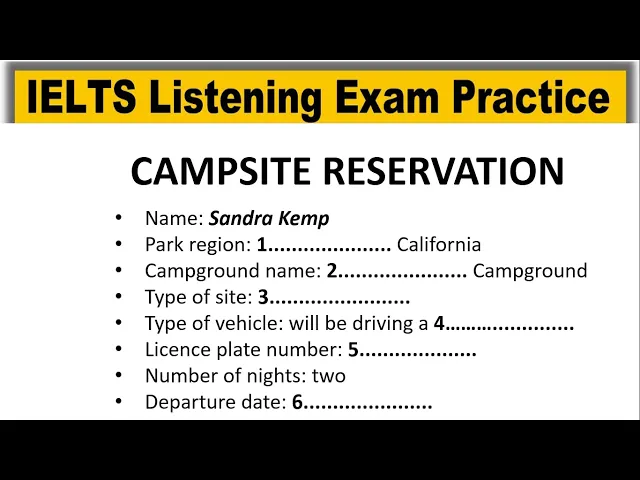
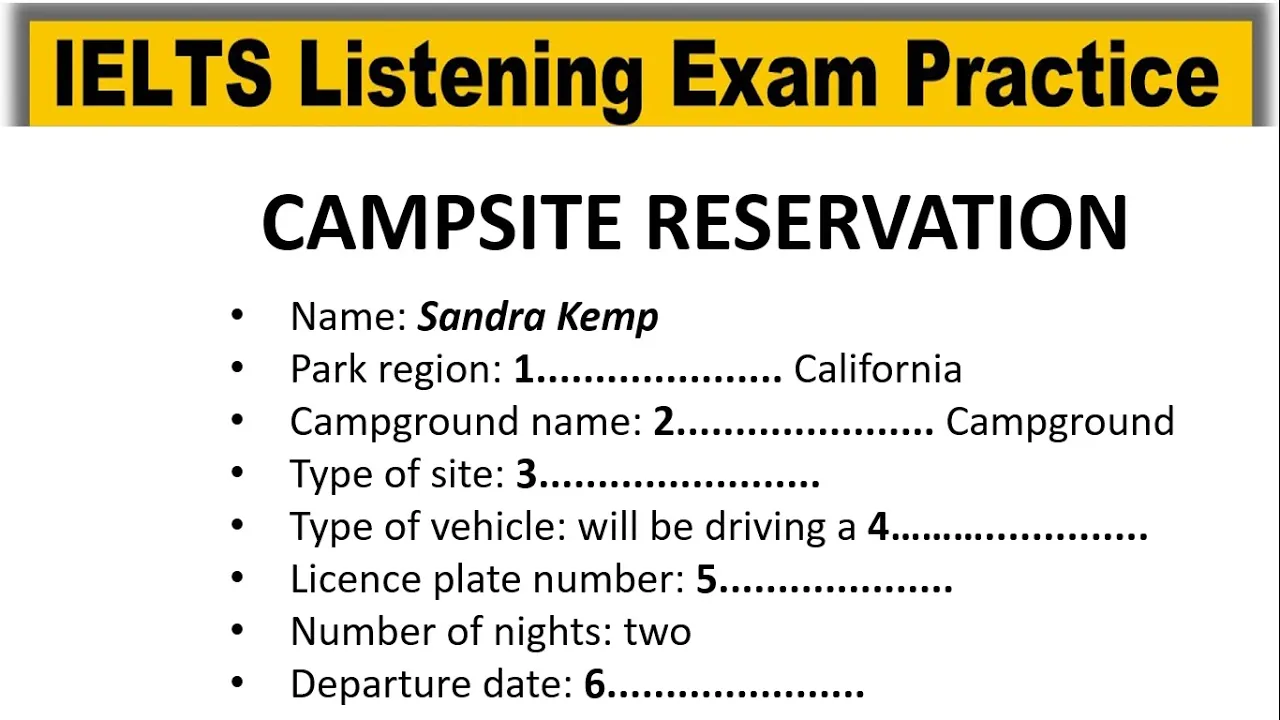
Now listen carefully and answer questions 1 to 6. Nature Park Services, how may I help you today? Hello, I'm calling to make a campsite reservation.
Great. Let me just pull up the reservation form and we can get started. Okay.
First, could I get your name? Sure. It's Sandra Kemp.
All right, Ms. Kemp. I can make reservations for the Northern, Central, and Southern California parks.
Which region will you be traveling to? Is Mount Lagona in the Central or Southern region? Is that where you're going?
Yes, that's Southern. Do you know which campground? Actually, I was hoping you could help me with that.
I've read a lot about two different campgrounds, Sunrise and Mountain, but I can't decide. Mountain Campground has many hiking trails close by. But then again, Sunrise Campground is next to the lake, and my husband loves to fish.
H, they're both really beautiful spots. I guess it depends on when you're going. Really?
Well, we're going in April. The thing is fishing at Sunrise Campground is only allowed from June to September. So, I suggest mountain.
Okay, then that makes it easy. So, we've selected the campground. So, now we need to think about which sort of site.
There are different options. You can stay at a cabin, a tent, or a recreational vehicle campsite. Which type of site offers the most peace and quiet?
A tent site would be your best bet. That sounds good to me. Um, so if you've read about the park, you probably know that some vehicles aren't suitable for the park roads.
Cars tend to get stuck when it rains. If you have a truck, you won't have any trouble. Luckily, we do.
We'll be driving that instead of our car. I hope we don't get any rain, but I'd rather be safe than sorry. Perfect.
I'll just need to get your license plate number. That's Q Y0918. Thanks.
And what about your trip dates? Uh, we'd like to stay for 3 days. Does that mean you'll be staying two nights?
That's right. We'll be arriving on April 10th and leaving on the 12th. Before you hear the rest of the conversation, you have some time to look at questions 7 to 10.
Now listen and answer questions 7 to 10. Now the park is home to some black bears, so you'll need to rent a bearproof food container to lock your food inside for hikes. It's really just a precaution.
We have small, medium, and large food containers for campers. Oh, I'm familiar with food containers, but they can be heavy. Well, the large one is, but if you get the small size, it's not so heavy.
Well, let's do that. I really want something lightweight. Would you be interested in signing up for a guided nature walk on the second day of your trip?
What kind of walk? Well, at 7:00 a. m.
there are three different ones near your campground. There's the flower walk, the bird watching walk, and the waterfall walk. Really?
I love gardening, so the flower walk sounds interesting. My son might be more into the waterfall one, but I can't imagine him getting up in time. Maybe I could go alone.
But could you sign me up? Sure. Now, just a few more things.
Visitors must purchase park passes as well. You have the option of the 1-day pass, which would be cheaper, or the one-year pass, which is a better deal if you plan to go to more parks. Let's go ahead and get that.
I'm sure we'll visit more parks soon. It's a really good bargain. Plus, we donate $5 of the pass fee to one of our three park programs.
You get to choose which one. Park programs. Yes.
Well, we run a youth program for local kids to attend a nature camp in the summer. The other two options are conservation projects. There's a wildlife program and a tree planting program.
Wow, they all sound worthwhile. What should I do? Um, it's important for children to appreciate the outdoors.
Let's go with the youth program. Okay, we just need to review the fee and payment information. That is the end of part one.
You now have one minute to check your answers to part Listening section two. Answer the questions carefully after reading the instructions. Now we will start with questions 11 to 20.
Pay attention to the key words and answer accordingly. Part two. You will hear a radio talk by the director of a theater called the Citadel.
First, you have some time to look at questions 11 to 16. Now listen carefully and answer questions 11 to 16. Today we're pleased to welcome Jan Beeish, who's the director of the Citadel Theater.
So Jan, what does the theater have in store for us in the next few months? Well, at present we've got Comedy Shop which features five comedians doing sketches. It's very popular because some of the people watching the show have the chance to come and join in the sketches.
It's had excellent reviews. Then after that, there's a new play called Seekers. This is a very beautiful story about childhood featuring Abigail Garrick who's one of the country's top actors.
But sadly, there are no more tickets left for any of the performances. We're also putting on The Hidden Box, which is a delightful fantasy about a search for lost treasure. It goes down very well with youngsters, particularly preschool, and actually the whole family will enjoy it, too.
There are still quite a number of tickets left for afternoon performances. For one week only, we've been lucky enough to secure Night Shift, a fascinating new play based on the diary kept by a factory owner in the 19th century. It's quite a disturbing piece with some violent scenes, so it could be upsetting for some people, but it's certainly well worth seeing if you want to get a new perspective on the industry that built up our town.
Next month sees the start of a production called John Dory, a light-hearted show based on stories from the local area. Surprisingly perhaps, it's played to packed houses in other countries in recent months. Even though the audiences knew nothing about the area, they responded to the humor and warmth of the characters.
And finally, I mustn't forget Vital Signs. You may well have seen this at the cinema where it won awards both in Britain and in the US, but this new stage version really brings to life the moving true story of a struggling young singer trying to find success. Before you hear the rest of the talk, you have some time to look at questions 17 to 20.
Now listen and answer questions 17 to 20. And this summer the Citadel is once again supporting the Youth Arts Festival. Can you tell us a bit about that?
Yes. Well, we're already planning a whole range of activities for young people leading up to this year's youth arts festival. And we're looking for anyone from 8 to 21 years old who's interested not just in performing but also writing, directing or doing workshops.
The deadline for applications is the 15th of March. And then we aim to have the schedule for the different activities put together by the end of April. That's just a few months before the festival itself, which will be in the first week of August.
If anyone would like to put on a performance themselves, there's still time to apply. You can download the application form from our website. Make sure you complete all the relevant sections.
You need to briefly describe what happens in the performance. If you want, you can also send a DVD or photos of the performance. You will be expected to provide your own costumes and music.
By the way, there's also a competition for anyone who's interested in actually writing a short play. The winning play will be performed at the festival, directed by Steve Taylor from the theater here, and the writer will have the chance to play one of the roles if he or she wants to. Last year's winning play was even shown on national TV afterwards.
The highlight of the festival will be a production of the experimental play KCAN acted and written entirely by young people. The play is all about communication and each actor writes a sort of madeup language for his or her role during the performance which no one else can understand. We hope it will be a really enjoyable ending to all these months of preparation and that the whole experience will be a rewarding one for everyone who's taken part.
That is the end of part two. You now have 30 seconds to check your answers to part two. listening section three.
Answer the questions carefully after reading the instructions. Now we will start with questions 21 to 30. Part three.
You will hear a student Millie and her professor Mr Fraser discussing medicine courses. First, you have some time to look at questions 21 to 24. Now listen carefully and answer questions 21 to 24.
So Millie, you've scored very highly in your exams this year. You won't have any trouble being accepted into any course you choose. The most popular course available is clinical nursing.
Will you choose that one? No, Professor Fraser, I've thought about nursing, but I have decided against it. May I ask why?
With your skills, you could excel. I'm concerned about the difficulty of the course. Apparently, it's not easy to get the diploma.
Since I may not be able to complete the assignments, I feel apprehensive about starting a course I might not finish. It's a shame you feel that way, but you have other options available. Have you thought about the surgical operation course?
Biology is a prerequisite for that course. I haven't taken that course yet, so I probably won't be accepted. This year we're offering some other alternatives during summer school.
If you complete these courses over the semester break, you may have a chance. They are not that difficult. I'm not willing to put in the effort it requires.
Honestly speaking, I'm more interested in the personal interaction side of medicine. Are there any relevant courses I could apply for? Certainly, sociology is beneficial, especially if you wish to further your studies in pediatric care.
During the class, you will have the opportunity to work with people of all ages, but in particular, young ones. What career prospects are there for me once I've completed the course? Believe it or not, many students who complete the sociology studies go on to work in a different field.
They find it a rewarding and fulfilling career to work with people who have disability and help them improve the quality of life. I see that sounds great. Thank you.
Before you hear the rest of the discussion, you have some time to look at questions 25 to 30. Now listen and answer questions 25 to 30. I'm just not sure what I want to do with my life.
What do you suggest? Would you recommend studying two courses at once so as not to limit my options? Many people have done that, but it's difficult.
Studying one course causes enough stress and adding another course would be extremely challenging. You could try a different subject other than medicine, but I recommend you find the exact branch of medicine you want to study and put your focus on that. The health and social care course is popular.
Though I'm interested in this subject, I am not sure whether I should choose it. Are there enough grants for it? Yes, I guess so.
It has acquired a lot of financial support recently, so your research possibilities won't be limited. Also, I do know that Professor Roads has a good reputation. He's one of the most respected professors in his field.
Oh, yes. I've heard the professor is worldrenowned, so I will definitely go for it. All right, then.
How about occupational therapy? Well, my sister studied this subject last year. She says it's very difficult.
Perhaps it is for some students, but generally it can be easy for a student who majors in medicine. Actually, the textbooks used are published by our school and the writer is a teacher in the medical department. So if a student finds them difficult to understand, he can get quick response from the teacher for clarification which will be of great help in occupational therapy research.
That's really great. And I also heard that the textbook is quite easy to follow, but I'd prefer a hands-on career rather than combine myself to a research role. So I probably will think about other courses.
Whatever you choose, Milton University is the best school for you and I highly recommend it. The lecture theater is kind of old, but last year the Ministry of Education handed out grants to the top universities and Milton was on the list. What's been upgraded?
I heard they developed a new medical facility. Not really, but they are going to do that. Although they did spend a large amount of money on the existing medical department, the entire building was renovated and new equipment was purchased.
I'm still having trouble making a decision. Is there any information on this school's website? Yes, and you will find some details you need to know there.
Some people have found it useful to discuss with graduating students the benefits of studying their subject. But in terms of familiarizing yourself with the content of the course, you could do no better than talking with the tutor and getting to know him or her. Perhaps I'll try that.
It's not that I want to choose an easy path. I know that only through hard work can I excel in any field. I just have so much trouble making up my mind.
I know there will be funding and scholarships available for particular courses, but I can't choose. By all means, discuss your concerns with other teachers. They're all quite busy, you know.
I'll think about it. Thank you so much for your advice, Professor Frasier. You are welcome.
If you That's the end of part three. You now have half a minute to check your answers. Today we'll continue that discussion by looking at dormcancy.
First we'll cover what dormcancy is and why organisms become dormant. Dormcy is a state of inactivity that organisms or living things enter when they need to conserve the resources available to them and reduce their demands on their environment. Most major groups of plants and animals have some representatives that can become dormant.
What is the value of dormcancy? To start with, animals can become one and survive conditions that are stressful in environmental terms. For instance, when lakes, ponds, or rivers dry up, aquatic organisms that can enter dormcancy can survive the drought, while others who cannot do this will die.
Another advantage is that creatures that can become dormant in inhospitable conditions, such as extreme cold, can live in a larger range of places than other organisms. Because they can live where other animals can survive when they are active and looking for food, the amount of competition they have to deal with from other regions is greatly reduced. Let's move on to look at what causes dormcancy.
There are a number of variables, but the ones that are the most significant are temperature changes and the amount of light organisms get. Availability of food, water, and oxygen is also very important. Now, we'll explore some specific examples.
Let us first look at dormcancy in insects. Insects can experience a reduced metabolism, a form of dormcancy called diipause in insects. Diipause is either a reaction to difficult environmental conditions or an unnecessary part of the life cycle such as with butterflies or certain months.
In terms of environment, it's interesting to know that through dormcancy, insects can survive when it's very cold. Another creature we'll look at is fish. Fish share the same main environmental causes for dormcancy as other creatures, but as one might imagine, they are particularly sensitive to drought.
For example, long African fish burrow deep into the mud with low water supply. It surrounds itself with a cocoon and remains inactive while dormant faces two dangers. One is the possibility of starvation which relies on the fat stored in his body to overcome this.
The other is desiccation or drying up which is addressed through a reduction in urine production. Snails are also known to become dormant. Some snails seal off their shell, the membrane of dried mucus, after settling at their place of dormcancy.
Other snails do not have this possibility. They trust the protection of their shell. So when snails have remained outside in their dormcy, they can usually be recognized by a brightly colored shell reflecting the sunlight and so minimizing evaporation.
That is why banded snails usually have young shells in open habitats. Hibernation is probably the most well-known type of dormcancy which occurs in warm-blooded creatures during the winter. We know that warm-blooded animals maintain a regular body temperature.
What's really interesting about hibernates is that they can adapt to extreme conditions by turning off their internal thermostats and hibernating until conditions improve. Let's examine the behavior of a true hibernate, the Arctic ground squirrel. This squirrel digs underground and builds a nest that is insulated.
Once in its nest, it curls into a bowl and tucks in its arms, legs, and tape. Its body temperature mirrors the cold of its surroundings. At this point, this squirrel barely breathes and doesn't react to stimulants in a normal way.
And during this hibernation period, the squirrel loses nearly 40% of its weight. The process of awakening for the Arctic ground squirrel takes about 3 hours. When this happens, there is a rapid rise in the heartbeat and circulation is effective.
The area around the heart warms faster than the rest of the animal. And despite the strain of hibernation, the squirrel's body processes are normal within 24 hours of coming out.