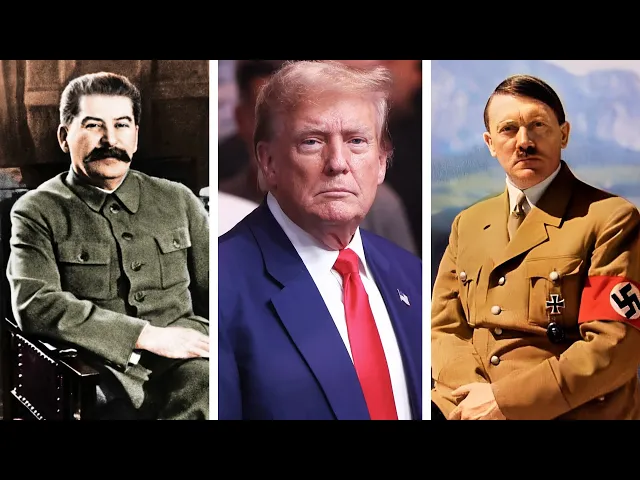
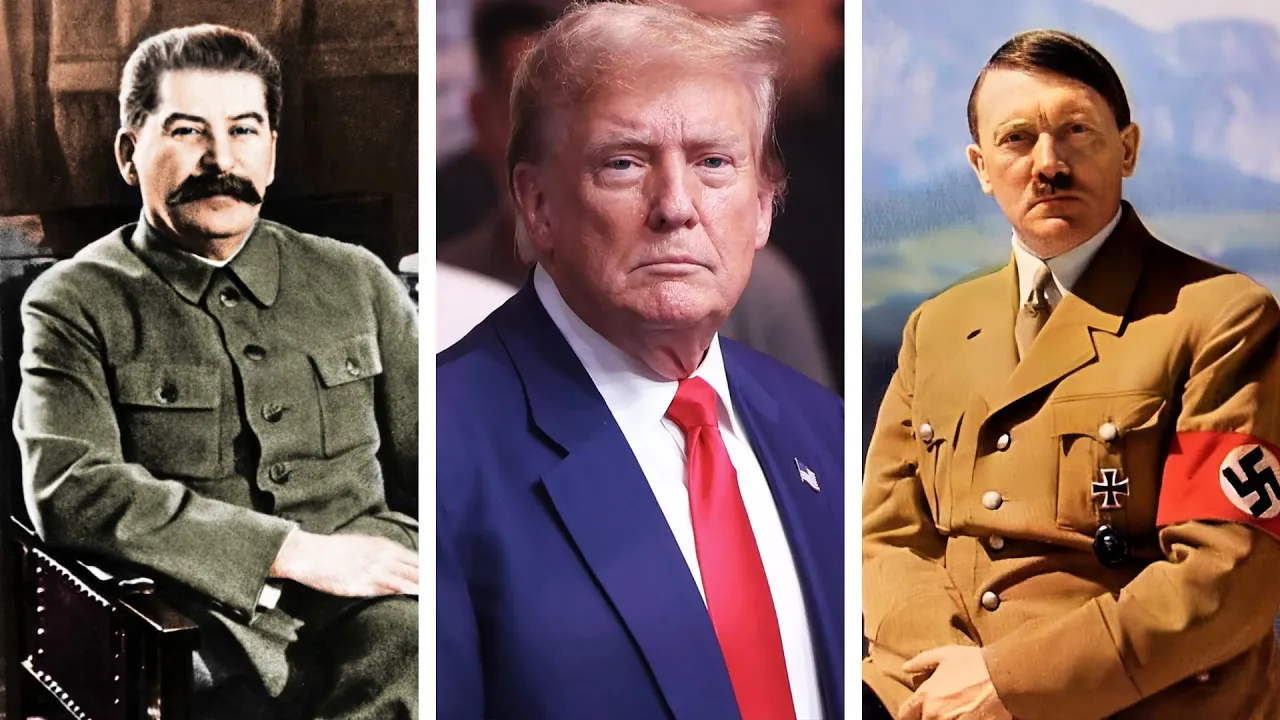
Speaker 1: When we hear comparisons between Donald Trump and infamous dictators like Adolf Hitler, Joseph Stalin, Kim Jong un, the reaction is often one of outrage. How dare anyone make such a comparison? It's offensive.
It's crazy. It's disproportionate to history. But the reality is that comparing political figures to past authoritarians isn't about equating their every action or saying that they're exactly the same.
It's about recognizing patterns of behavior, power grabs, authoritarian tendencies and the undermining of democratic norms. And so today we're going to break down why these comparisons shouldn't be taboo, I guess is the word I would use and how Donald Trump has exhibited traits that in any other era would have raised major red flags. And they raise major red flags today.
Now, before we dive into the details, I think it's worth saying something briefly about the taboo on these sorts of comparisons. Timothy Snyder, who I had on the show, recently laid this out clearly in his substack a few days ago, and he pointed out that many times if you mention a right winger in the same breath as Hitler or Mussolini or whoever you are immediately attacked. How dare you make such a comparison?
There is never a comparison to Hitler. And Timothy Snyder said, quote. But before broaching the subject of Trump and Hitler, I have to say with a word about the American taboo on comparisons.
Anyone who refers to Trump's Hitlerian moments will be condemned for comparison. Somehow that comparison, rather than Trump's deeds, becomes the problem. The outrage one feels about the crimes of the 1930s and 40s 40s is transferred from the person who resembles the criminal to the person who points out the resemblance.
This cynical position opposing comparisons exploits the emotional logic of exceptionalism. Americans are innocent and good. We would like to believe we are not.
We take for granted, like the Germans between the world wars, we would never, we imagine, tolerate the stereotypes German Nazis invoked. We have learned the lessons of the Holocaust. And later, Snyder goes on to add about these comparisons.
Quote, I hope that the irony of all this is clear. The idea that comparison is a sin rests on the notion of the inherent and unimpeachable virtue of the American Volk, who by definition do nothing wrong and whose chosen leader therefore must be beyond criticism. In this strange way, outrage about comparison reinforces fascist ideas about purity in politics.
We should hate the dissenters. We should ignore whatever casts doubt on our sense of national virtue. We should never reflect.
And Snyder finishes by saying, Democracy, of course, depends on the ability to reflect. And that reflection is impossible without a sense of the past. The past is our only mirror.
Which is why fascists want to shatter it. In fascist Russia, for example. It is a criminal offense to say the wrong things about the Second World War.
The reason why we keep alive the memory of Nazi crimes is not because it could never happen here, but because something similar can always happen anywhere. That memory has to include the details of history or else we will not recognize the dangers. So with that out of the way now, understanding it shouldn't be taboo to explore the similarities and that it is valuable in preventing such atrocities from happening again.
Let's figure out what about the authoritarianism of past dictators? And remember, authoritarianism doesn't appear all at once. It sort of creeps in.
What is similar to Trumpism? And we will start with Hitler. Similarities between Trump and Hitler.
Hitler quickly tried to. Consolidate power by dissolving Germany's democratic structures that included the Reichstag fire decree and the enabling act, which gave him dictatorial powers. Trump's attacks on democratic norms have included discrediting elections.
The 2020 election fraud claims that we dealt with for years and still deal with attacking the judiciary and judges. He doesn't like going after and encouraging supporters, in fact, to challenge legal elections and wanting to entirely eliminate government departments inconvenient to him. Hitler used the Ministry of Propaganda under Goebbels to control the narrative, manipulate media, spread misinformation, Trump attacks the press, labels anything critical of him as fake news while using outlets like Fox or whoever is temporarily on his side and social media to shape his narrative and to inflame division.
And of course, there's the cult of personality that surrounded Hitler, who was elevated to this nearly mythical figure who could do no wrong in the eyes of his supporters. And we have Trump's cult like following as following as well, where Trump's base displays that unwavering loyalty. Trump's base ignores any scandal or failure by Trump and accepts any of Trump's claims, including the one that he is the only one who can save America from its supposed decline or enemies.
That's Hitler. Josef Stalin. Stalin purged anyone he suspected of disloyalty, whether in the Communist Party military government through these show trials and mass executions.
Trump has a loyalty obsession as well. Trump has fired or ostracized officials and allies who he perceives as disloyal. This includes FBI Director James Comey, Attorney General Jeff Sessions, close advisers, Bolton, whoever.
And Trump's view of loyalty is a cartoonish and exaggerated view. It's total and complete loyalty. You never question anything, he says.
You never question anything he does. This is why J. D.
Vance didn't want to answer. Did Trump lose the 2020 election? Stalin also used control through fear and intimidation, the secret police creating this atmosphere of paranoia and uncertainty.
Trump loves using fear and intimidation, encouraging violence at rallies, speaking approvingly of rough tactics by law enforcement, threatening those who aren't on his side, either media outlets or voters or those who voted for Nikki Haley of what it might be like if he wins. Stalin also altered historical narratives to suit his needs and to make them look better. He would erase enemies from photos.
He would falsify records. He would spread disinformation to maintain control. Trump loves distorting facts and history, promoting blatant lies.
Revisionist history about 2020. Revisionist history about his handling of Covid drawing on hurricane maps so that he can distort what meteorologists said versus what was convenient to him to self-aggrandizing feed his ego. Those are the similarities to Stalin.
Benito Mussolini. Mussolini's rise to power was fueled by aggressive nationalism, promising to restore Italy to its former glory through Mussolini's fascist ideology. Similar to Trump's Make America Great Again directly appealing to nationalism, saying America is not great anymore.
One saying we've got to keep our country gay. Trump didn't mean that. He meant keep our country great because it's not great anymore.
Mussolini eliminated political competition through violence and through legal mechanisms transforming Italy into a one party state. Trump wants to criminalize opposition, calling for the imprisonment of Hillary Clinton, regularly labeling Democrats as enemies of the state floating authoritarian moves to stay in power, including maybe we won't count mail in ballots, maybe states will find votes for him. Mussolini relied on the Blackshirts, this paramilitary group, to intimidate and attack.
Trump loves those violent factions. Stand back and stand by about the proud boys who have been significantly emboldened by Trump. The commentary in the aftermath of people getting roughed up at Trump's rallies and saying he'll pay for their legal bills.
Very similar vibes. Vladimir Putin. Putin has maintained power in Russia through highly manipulated elections and Trump has tried to do the same.
Putin silences Opposition Eliminates Genuine Democratic opposition. In Russia. Trump has tried to undermine American elections repeatedly, falsely claiming there was widespread voter fraud in 2020.
Predicting voter fraud. Rod in 2024 trying to overturn the 2020 election. It's really the Putin playbook of undermining the legitimacy of democratic elections to stay in power.
Putin goes after rivals. He will imprison, he will exile, he will assassinate those who pose a threat to his rule. Look at what happened to Alexei Navalny.
Facing poisoning and imprisonment, Trump attacks opponents as well. He hasn't imprisoned them. He has called for it.
He famously has smiled during the chants of Lock her Up, whether it's about Hillary or more recently, Kamala Harris. He uses threats in order to show that he will use the power of government to attack opponents. It's the same authoritarian mindset.
He just hasn't been able to get away with what Putin has gotten away with. And of course, I can't skip over Putin cultivating vast disinformation machines through state controlled media outlets like R. T.
that just push pro-Putin propaganda and silence critical voices. Trump hasn't done that, but he does support those media outlets that are friendly to him in the moment while threatening to pull off the air. Those that are not, he said.
MSNBC might be off the air if he becomes president again. He said ABC News should lose its license because he was FactCheck during a debate against Kamala Harris, a debate that he lost badly, by the way. He has taken away press credentials from people like Jim Acosta when he didn't like their adversarial questions and his tactic of repeating falsehoods and getting those around him, including media outlets, to repeat falsehoods.
Very much mirrors Putin's disinformation strategies. And finally, we come to Kim Jong un from North Korea. Kim Jong un is at the center of a powerful cult of personality, where North Koreans are required to show absolute loyalty and devotion to him with his image in quotes, omnipresent in North Korea.
Trump's cult like following is not quite as extreme, but Trump has cultivated a fervent base that showed base that shows unquestioning loyalty, where any criticism of Trump is a betrayal, whether it's J. D. Vance or whether it's a lower level Republican or just a voter at a town hall, he is supposed to have his words treated as gospel, even when there is evidence to the contrary.
In North Korea, dissent is met with brutal punishment, sometimes labor camps or execution. Trump demonizes dissent repeatedly attacking protesters, journalists, political opponents, labeling them as unpatriotic, encouraging violent responses to protests, claiming that those who oppose him are enemies of the state, not on the scale of North Korea. Of course, we talk about similarities not exactly the same, but his attempts to crush dissent and promote blind loyalty are very much like the Kim family.
Kim Jong un inherited power from his father, Kim Jong IL. Continuing the Kim family's dynastic rule of North Korea, Trump's nepotism is not exactly the same, but he would love to do that. He's talked about, hey, maybe one of my kids would run for president.
But importantly, he brought his family into key roles within the administration. Ivanka, son in law Jared Kushner, both of whom had senior advisory positions he has talked about. I was looking at Ivanka for, what was it, UN ambassador or something.
I don't even remember now. He relies on family loyalty to perpetuate his support at the top of the cult. And finally, Kim often uses exaggerated military rhetoric threatening to use the nuclear arsenal to intimidate enemies and project strength.
And Trump has also employed inflated, bellicose rhetoric when it comes to the military, threatening North Korea with fire and fury, calling for militaristic solutions to domestic and foreign policy issues. What about why can't we nuke Europe? What about invading Mexico?
And on and on and on. Trump is not Hitler or Stalin or Mussolini or Kim or Putin. Thankfully, some of our pro-democracy institutions in the US have held better than what we've seen in some of these other countries.
But in order to really understand the dangers of Trump, we have to understand history and we have to know whether there are analogies. And I've just given you a bunch. Did I miss any I know we didn't include Erdogan, Bashar al Assad, new territory, other leaders, past and present.
Did I miss any big one? Let me know info at David Pakman dot com.