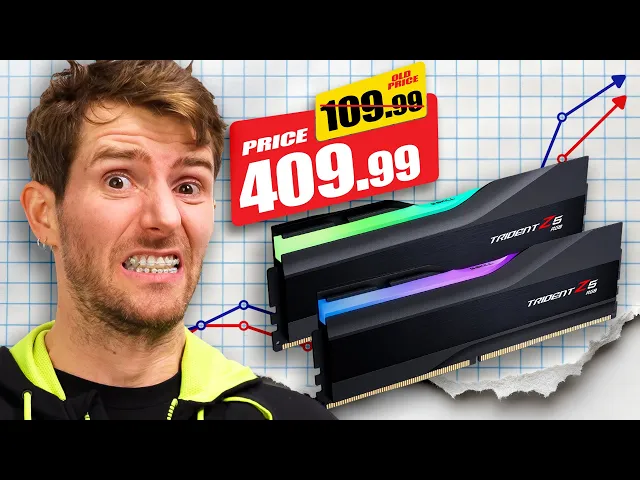
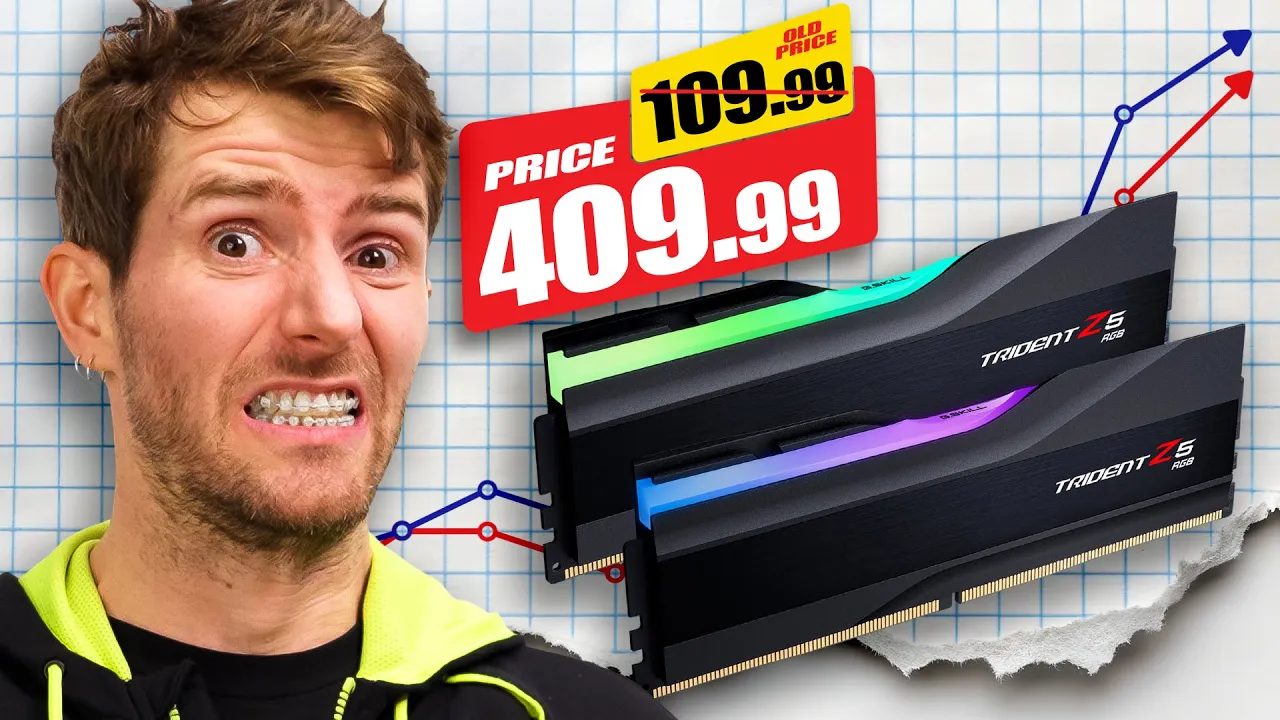
Oh, that'll be $800. >> What? That can't be right.
What do you mean $800? >> Yep. That's probably how I felt for anyone who's fired up the old PC part picker over the last couple of months.
But why, though? Well, part of it is the obvious one. I'm sure by now you must have seen the countless headlines about AI data centers and their insatiable demands for energy and water and yes, computer memory.
And they're using their fire hose of investment capital to buy up so much memory that one of the big three memory makers just said, "Mother the big three, It's just big me. " and then completely sunsetted their entire consumer line outright in an effort to focus on this sky-high AI demand. Separately, SKH Highix announced that they are sold out of production all the way through 2026 and Samsung just increased their contract pricing by 100%.
This means that if the AI bubble doesn't pop, this is going to get worse before it gets better. >> But like, can't they just make more memory chips or build more factories? Couldn't they just download more RAM?
I mean, yeah, they could do those things, but I hate to break it to you guys, there's actually a lot of reasons for them not to do that. Just like I'm not going to segue to our sponsor, Dbrand. Dbrand is doing a giveaway.
All you got to do is order something from their site before the new year quickly and you will be entered to win a Galaxy Z trifold, which currently isn't available in North America. Just visit i amveryshort. com.
Are you tired of boring screwdrivers? Boom. Four new colors of the brand new LT transparent screwdriver.
Plasma purple, cryo teal, molten orange, and carbon black. They're see-through. They're awesome.
And they're probably going to sell out because for a limited time only, if you buy through YouTube Shopping at the link in the video description, you will get 20% off your driver, but only until December 30th. Collect them all or maybe pair them with our brand new bid case and all over print hoodie. To explain why RAM costs a small nation's GDP now, we first need a quick and dirty explainer for why AI models such as ChatGBT, Deep Seek, and Gemini are so darn thirsty for it.
LLMs or large language models are trained by feeding them buckets of media files, often text, images, video, or audio, or depending on the model, sometimes a combination. And in the current ARMS race, the highest quality models depend on parsing through the largest buckets of training data. This training process can take anywhere from a few hours to months for the largest models.
And that's where RAM comes in because RAM is so much faster than an SSD with more capacity than the cache on board a CPU. It's essential, crucial even for large data centers to get as much as possible to speed up their AI development and training efforts. It's also useful for inference, the stage where the user actually interacts with the trained model.
For instance, if you have a long interaction with an AI model, more RAM helps to quickly reference the earlier context of your conversation in order to appropriately respond to your next prompt. If you want a deeper dive into this, I'm going to make sure I link some resources down below. But all you really need for us to continue is more.
It just needs more. And companies like OpenAI are generating billions of dollars in revenue, sorry, funding, which if they want to stay on the bleeding edge, means they need as much memory as they can get. But Elijah, isn't a ton of that memory being installed on AI GPUs or even memory sticks that are for servers?
Why is my Gamer Deluxe RGB 360 nocope kit also getting expensive? Here's the thing. While your favorite PC parts retailer might carry RAM from dozens of different manufacturers, most of them only assemble modules, the sticks that actually go into the slots.
For the little black squares, the actual chips that contain the DRAM dies, there are really only three serious players right now. SKHix, Samsung, and Micron. These giants own the multi-billion dollar fabs that produce those chips and use them to supply functionally every single industry on Earth.
If it has a processor, it probably needs a little bit of DRAM. So, yes, server sticks are separate from your gaming sticks, but at the end of the day, whether you're a typical gamer or an AI company, you're both competing, or more like bidding, on the finite quantity of these chips that can be produced by the big three. And I wonder who can afford to bid more, the individual who wants to play video games or the multi-trillion dollar corporation with no revenue whose stock price will cater if they don't buy more than anyone else in an effort to maintain their tenuous lead.
So, if you take off your angry consumer hat and put on your business monster hat for even a second, it's pretty easy to understand why Micron decided to pivot their internal resources toward fulfilling demand for their hungriest, wealthiest customers. Sucks cuz Crucial was a really good source of quality RAM and SSDs [music] at a decent price. But it's really not the end of the world.
Samsung has zero presence in their DIY enthusiast space either, but that doesn't prevent module makers like Kingston or Corsair potentially pivoting and buying chips from them and building sticks for gamers. Speaking of Samsung, a rumor recently started that supply was so constrained that they couldn't supply their own smartphone business unit with RAM chips. Samsung has come out and said that that isn't true.
But for it to be even a concern for the industry does raise a question. Why don't they just make more? Well, for a couple reasons.
First, as I've alluded to before, the current fabs that are used to make cuttingedge chips have a finite capacity. They already run around the clock with some of the world's most finely tuned supply management and highly trained engineers overseeing their operation. It's not as simple as just adding a production shift or turning the machine up to 200%.
Those are delicate operations and if something goes wrong in the middle of a batch, it could be weeks or even months to build it again from scratch. So, they're not going to change things all willy-nilly. And second is that even if they could boost production to meet demand, both SKH and Samsung have publicly stated they don't plan to because they don't want to.
See, this isn't the first time DRAM demand has spiked. There was a big one back in the mid2010s when affordable cell phone plans went online in India as well as just a more general surge in demand for mobile computing devices. Anyway, in the past, DRAM manufacturers have boosted production to meet these spikes in demand.
Spikes that eventually subsided, leading to an overstock. You see, the same factors that make it hard to ramp up production at a moment's notice also make it kind of challenging to slow it down at a moment's notice. That can be good for consumers since that means cheap gaming memory, but corporate fat cats kind of hate that, especially when it leads to them selling memory at cost or sometimes even below cost.
The third reason is closely related to the first and second. [music] Building a fabrication facility for anything silicon wafer production, whether it's CPUs, GPUs, or RAM, takes literal years. And these aren't the kind of projects where you can just throw twice as much money at them to complete them in half the time.
On top of the building itself, plans need to be in place for seismic activity mitigation, water access and management, power staffing, logistics, good old-fashioned supply of the chemicals, gases, and high purity silicon wafers you'll need. And even if one of these big boys does decide to shell out for another state-of-the-art fab, they would obviously want a return on their investment. So, they would only do it if they expect these prices to stay high enough for them to operate it profitably for the next couple years.
[music] And I'm going to let you in on a little open secret. That's not going to happen. The AI bubble is going to pop.
Maybe not today, maybe not tomorrow, but soon and for the rest of your life. When it happens, demand for memory isn't going to go away, just like demand for new smartphones didn't go away. But it won't stay at this level.
And there is no shovel manufacturer on Earth that is going to build a several billion dollar factory that might not be needed by the time it's completed. So, it just seems that it's all the where the is that coming from? >> From across the Pacific Ocean, Elijah, where I've just learned that uh China will save us from expensive memory.
Well, maybe. Regardless of your political views on China and their technology, CXMT, a relatively new chip fab that was born and raised in the 100 Acre Wood, has just announced that they now have the ability to manufacture DDR5 chips. Great news for folks in China, although maybe not as much for Americans, unless the US and China can sort out their little trade kurfuffle.
With all that said, according to some reports, CXMT is still about 2 to 3 years from reaching the kind of manufacturing output that the big three have. So, it remains to be seen whether they'll be able to make a dent in the current demand anyway, which really sucks because, as I alluded to before, this is probably going to get much worse before it gets better. [music] Remember that bit about how SKHEX has sold through their 2026 production?
What that means is that even if the bubble pops, okay, all those chips are booked and SKHENX is going to do their darnest to make sure that whoever booked them buys them. So if a company like Kingston were to place an order for chips, it's going to be at those current market or bidded prices. And they're not going to sell them to you for the old price just because you're a poor consumer who just wants a decent price on memory.
They're still gonna want to get the money back from paying more for those RAM chips. So, years then back to you, Elijah. Which means not only are RAM dims going to be more expensive, but everything that needs memory will be.
iPhones, Steam machines, smartwatches, cars, and so so much more. [sighs] So, with all of that said, what should you do as a [music] consumer? To be honest, I don't know.
Micron and OpenAI make for convenient scapegoats for lining the pockets of corporate billionaires and politicians and leaving us to struggle both now and when the AI bubble pops. But the flip side is they are just some of the players. And as far as I can tell, everyone is complicit.
And if I'm mad at everyone, I don't know what to do. Boycott everyone that makes RAM. Then what?
What videos will we make about products with no RAM in them? What video games are we going to play? I did find out some good news though that I'm going to tell you.
The Ebola outbreak that is happening in the Congo has just been declared over. I mean, I didn't say the good news was going to be about the RAM crisis, but hey, maybe this will be a good segue to our sponsor, Private Internet Access. What's a VPN?
I'm glad you asked. Basically, a VPN hides your IP address and masks the location of your internet connection via an encrypted tunnel. That's a fancy way to say that when you use websites and services online, they won't know where you are, which in some cases can give you access to content that would be exclusive to other countries.
PIA's network spans across six continents and over 91 countries, which can unlock a lot of new content for you to enjoy. And even better, you can be connected across all of your devices with just one subscription. It works with Mac OS, Windows, iOS, Android, and of course, Linux.
And PIA never stores your data, keeping your connection private and secure. So go check it out at piaavvpn. com/ltt or by using our link in the description to get a special exclusive deal with a risk-free 30-day money back guarantee.
To be fair, we're recording this on December 16th, so if the Ebola outbreak starts again, my information is outdated. But if you guys enjoyed this video, maybe go check back on the video where we talked about tariffs when they were introduced. We talked a little bit how TSMC is actually struggling to hire for their American-based Arizona plant.