Ted Bundy, Jeffrey Dalmer, John Wayne Gacy, and Ivan Milat. All serial killers that are still [music] common household names even though they're from decades ago. But when was the last time you saw a headline [music] about a killer actively stalking a suburb or a patch of rural land?
Depending on your age or how much of a true crime fan [music] you are, the answer might be, you've never seen a headline about it. So, are serial killers [music] disappearing? And if they are, why?
If you're thinking the obvious answer is advances in DNA [music] science, well, that's part of it. But the story goes further than that, from the lead crime [music] hypothesis to chemical castration. In this video, we're going to find out where all the serial killers have gone and what they might be doing [music] instead.
And a warning, this episode touches on sexual assault, child abuse, [music] as well as, yes, murder. And it also contains the names of Aboriginal people who have died. I'm Sana Qadar.
This is criminal psychology on [music] All In The Mind. [music] Before we start trying to understand the psychology and motivation of serial killers, we need to first travel back in time to the 1970s. This is a time of disco, [music] flared pants, and considerable societal and political upheaval.
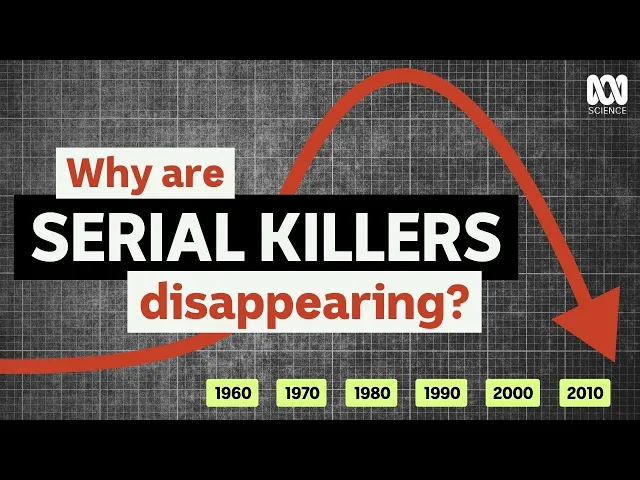
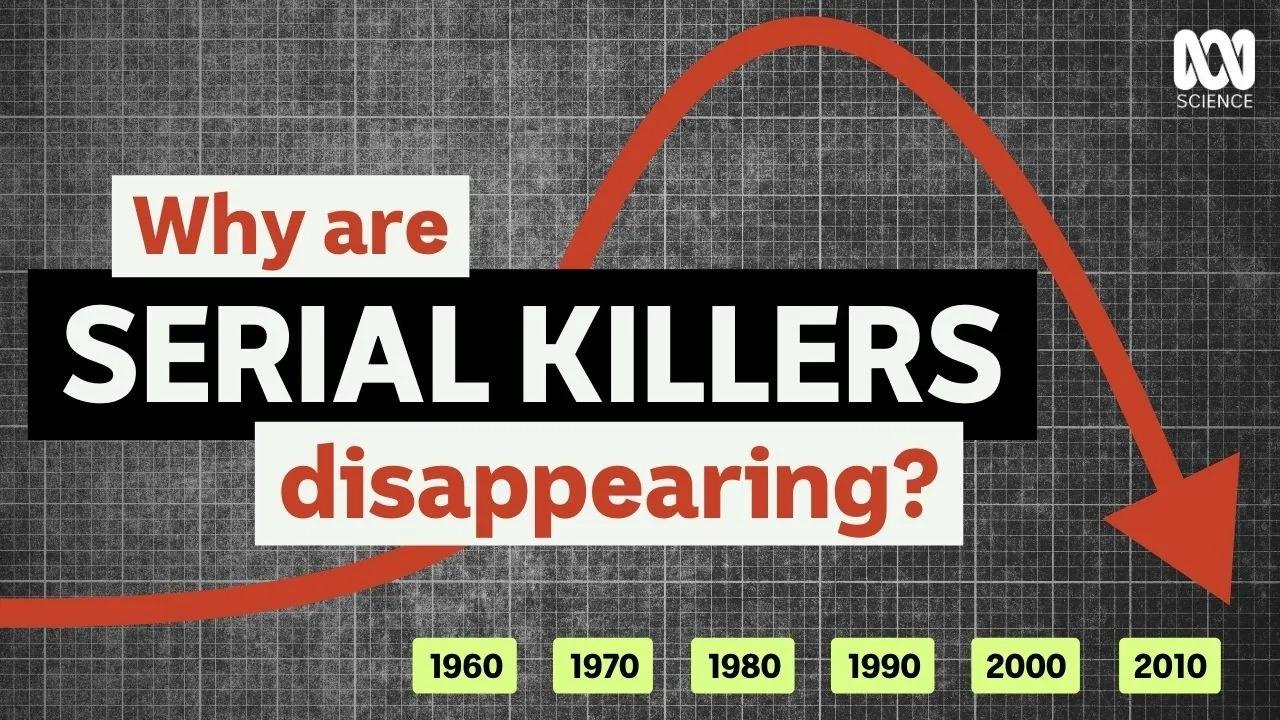
And disturbingly a lot of serial killers. Here is the yearly average number of serial killers in the US for each decade. It exploded in the 1970s and it peaked in 1987 and ever since then it's been dropping.
This falling pattern isn't just in the US. It's also in the UK and Australia. But why?
There are plenty of theories, but before we get into those, let's look at the science and the psychology of people who kill. Two things are important in a serial killer's makeup. One is they have to have a lack of empathy.
And the second, they have to have a desire to kill. For some, killing could also be their job as a hitman, so they do it for money. Or it could be for the thrill of killing itself, for a sense of power.
In around half of all serial killings, the desire to kill is driven by sexual fantasies. Research has found that serial killers who have this sexual desire motivation start enacting their violence very young, like when they're teenagers. But thanks to obvious things like better policing, DNA science, and advances in surveillance technology, police are catching these criminals earlier after their first violent crime and before they've had a chance to become [music] serial killers.
These are the most obvious reasons why serial killer rates are dropping and ones you probably already thought of. But there are some more other, let's say, alternative theories as to why serial killers are disappearing. A research team headed by Professor Lloyd Smay suggested that children in some Sydney schools were subjected to lead levels, which in some cases could impair their mental development, behavior, and learning ability.
Back in the day, lead was in petrol, in water pipes, in paint. It was all over the environment really. And the nationwide ban on leaded petrol didn't come in until 2002.
And that study from 1979 was right. Exposure to lead, especially in childhood, is linked to aggression and antisocial behavior. There's a theory that as lead was phased out, children weren't being exposed to its harmful effects anymore.
And as a result, violent crime across the Western world fell. That fall in violent crime has been most prominent in the US where the homicide rate has halved since the 1980s. The lead theory is a compelling one though experts are split on how much it really explains the drop in murders.
In fact, one group of researchers actually found a bias in the way it's been studied. They noticed that research that showed a link between lead and lower homicide rates were the ones that were more likely to get published. But there is one other alternative theory.
The legalisation of abortion in the United States will without question have an impact on the worldwide abortion rights movement. Women throughout the world will be able to press forward uh in their struggle with even greater determination. The Donohue-Levitt hypothesis is that abortion [music] reduces crime.
This theory, which was popularised by Freckonomics, is that unwanted children are more likely to grow up in difficult [music] situations, which can increase their chances of committing crimes when they get older. But there are some real doubts about this theory and whether it has legs. I think it's plausible that that might have contributed, but like all of these things, I think it's going to have contributed alongside other things.
It's a bit like the lead crime hypothesis. You know, that might have contributed a little bit. But again, I read another paper on that that said basically if it has contributed, it's contributed a tiny bit.
Yeah. Unfortunately, you come across a lot of individuals who have children and want children who still uh mistreat their children or the children are born into really disadvantaged settings. So, you know, just by having abortion available, you don't you stop that happening.
Okay. So, the lead and the abortion theories may not be the answers to why violent crimes, including serial killers, have dropped. That's why they're more in the theory category.
But there have been some more concrete societal changes since the 1970s. And it's pretty simple stuff. People are more likely to lock their doors now, they're less likely to hitchhike and we've now got better child protection services.
These may seem like small changes, but they've made it much harder for serial killers to find potential victims. There is one other angle I need to talk about for why crimes are dropping, and it's a bit more controversial because it's about how we rehabilitate and treat violent offenders. While some treatments can include long-term psychological therapies, it can also include pharmacological treatments like injectable anti-libidinal medications, more colloquially known as chemical castration.
Although that terminology can be a bit controversial, this treatment works by reducing the level of testosterone in a person's body to that of someone who has been castrated. This means it reduces their sexual fantasies and urges. By cutting down those fantasies, you take away the motivation to kill.
Now, it's not quite so simple as they get these shots and they're cured. So, in general with violent sex offenders, you can treat individuals and reduce the recidivism rate. Even with uh with serious violent sex offenders, you have to have a combination of psychological treatment, sometimes pharmacological treatment, but also ongoing support supervision and monitoring.
And with with individuals who've comm committed multiple homicides, you're never going to not supervise and monitor them closely. And there will be some people who just aren't going to be safe to release ever. So far, I've really been building a case for why the number of serial killers has dropped in the last few decades.
And that's true. Remember, we have statistics to back this up. But that doesn't mean that serial killers have vanished entirely.
While there aren't any active serial killer cases in the news currently, that doesn't mean they're not out there. Some can take years to be discovered. Ciara Eilish Glennon was celebrating St.
Patrick's Day [music] with friends at the. . .
Eighteen-year-old Sarah Spiers vanished in January. . .
The disappearance of Jane Rimmer six months later sparked. . .
We certainly have fears that there is a serial killer at loose in Perth. It took police decades to catch and convict Bradley Edwards, who you might know as the Claremont Killer. Edwards wasn't convicted until 2020, but his crimes were primarily in the mid '90s.
He killed 23-year-old Jane Rimmer and 27-year-old Ciara Glennon. He was also suspected in the murder of another woman, 18-year-old Sarah Spiers, but her body was never found, and so there wasn't enough evidence to convict him of that crime. He was also convicted of raping and assaulting two other teenagers.
His conviction took so long because of a series of convoluted events, but then there was a DNA breakthrough which led to his arrest in 2016. Now, I don't want to suggest here that there are serial killers around every corner in Australia, but one criminologist we spoke to estimated there could be maybe one or two active serial killers in Australia right now whose patterns are yet to be recognised. It's thought that they could be targeting people society seems to ignore.
They may be people already vulnerable. They may be suffering homelessness or um drug or alcohol dependent. Sex workers and certainly indigenous women are are vulnerable.
So yes, and I think as a society we we weight life, don't we? We we value life differently and you only look at the Bowraville killings. You have three children under 16 murdered in a small place, in Bowraville.
Now, if that had been on the eastern suburbs of Sydney, three little Caucasian children, it would have made news headlines around the world. You know, the detectives couldn't get any media interest because they were, and I don't mean this, but "just indigenous children". In the picturesque Nambucca Valley on the New South Wales north [music] coast, the small town of Bowraville conceals a sad mystery.
The Bowraville murders happened over a period of five months back in 1990 in the northern New South Wales town. All three children knew each other and all disappeared after attending [music] parties in the same street of Bowraville. But when the families reported the children's disappearances, local police suggested that some of them had gone walkabout.
Why did you stand here and say that you want information from us, when the black people gave you the information? To do this investigation properly, we've got to have you people on side and working with us. A local man who can't be named was [music] the prime suspect for a number of years.
He was charged with two of the murders, but he was later acquitted. And so, no one has ever been convicted in that case. So, we were somewhat right.
Serial killers haven't necessarily disappeared, [music] but their numbers have dropped in the past 60 years. Despite this drop, though, our culture's interest or obsession with serial killers does not appear to be going down. We are still caught up trying to understand the minds of serial killers.
After all, that's probably why you're watching this [music] video. If you want to listen to more episodes of All in the Mind, you can find them on the ABC Listen app or wherever you get your podcasts. And if you liked this video, you can subscribe to this channel for more videos on science and psychology.
Ted Bundy, Jeffrey Dalmer, John Wayne Gacy, and Ivan Milat. All serial killers that are still [music] common household names even though they're from decades ago. But when was the last time you saw a headline [music] about a killer actively stalking a suburb or a patch of rural land?
Depending on your age or how much of a true crime fan [music] you are, the answer might be, you've never seen a headline about it. So, are serial killers [music] disappearing? And if they are, why?
If you're thinking the obvious answer is advances in DNA [music] science, well, that's part of it. But the story goes further than that, from the lead crime [music] hypothesis to chemical castration. In this video, we're going to find out where all the serial killers have gone and what they might be doing [music] instead.
And a warning, this episode touches on sexual assault, child abuse, [music] as well as, yes, murder. And it also contains the names of Aboriginal people who have died. I'm Sana Qadar.
This is criminal psychology on [music] All In The Mind. [music] Before we start trying to understand the psychology and motivation of serial killers, we need to first travel back in time to the 1970s. This is a time of disco, [music] flared pants, and considerable societal and political upheaval.
And disturbingly a lot of serial killers. Here is the yearly average number of serial killers in the US for each decade. It exploded in the 1970s and it peaked in 1987 and ever since then it's been dropping.
This falling pattern isn't just in the US. It's also in the UK and Australia. But why?
There are plenty of theories, but before we get into those, let's look at the science and the psychology of people who kill. Two things are important in a serial killer's makeup. One is they have to have a lack of empathy.
And the second, they have to have a desire to kill. For some, killing could also be their job as a hitman, so they do it for money. Or it could be for the thrill of killing itself, for a sense of power.
In around half of all serial killings, the desire to kill is driven by sexual fantasies. Research has found that serial killers who have this sexual desire motivation start enacting their violence very young, like when they're teenagers. But thanks to obvious things like better policing, DNA science, and advances in surveillance technology, police are catching these criminals earlier after their first violent crime and before they've had a chance to become [music] serial killers.
These are the most obvious reasons why serial killer rates are dropping and ones you probably already thought of. But there are some more other, let's say, alternative theories as to why serial killers are disappearing. A research team headed by Professor Lloyd Smay suggested that children in some Sydney schools were subjected to lead levels, which in some cases could impair their mental development, behavior, and learning ability.
Back in the day, lead was in petrol, in water pipes, in paint. It was all over the environment really. And the nationwide ban on leaded petrol didn't come in until 2002.
And that study from 1979 was right. Exposure to lead, especially in childhood, is linked to aggression and antisocial behavior. There's a theory that as lead was phased out, children weren't being exposed to its harmful effects anymore.
And as a result, violent crime across the Western world fell. That fall in violent crime has been most prominent in the US where the homicide rate has halved since the 1980s. The lead theory is a compelling one though experts are split on how much it really explains the drop in murders.
In fact, one group of researchers actually found a bias in the way it's been studied. They noticed that research that showed a link between lead and lower homicide rates were the ones that were more likely to get published. But there is one other alternative theory.
The legalisation of abortion in the United States will without question have an impact on the worldwide abortion rights movement. Women throughout the world will be able to press forward uh in their struggle with even greater determination. The Donohue-Levitt hypothesis is that abortion [music] reduces crime.
This theory, which was popularised by Freckonomics, is that unwanted children are more likely to grow up in difficult [music] situations, which can increase their chances of committing crimes when they get older. But there are some real doubts about this theory and whether it has legs. I think it's plausible that that might have contributed, but like all of these things, I think it's going to have contributed alongside other things.
It's a bit like the lead crime hypothesis. You know, that might have contributed a little bit. But again, I read another paper on that that said basically if it has contributed, it's contributed a tiny bit.
Yeah. Unfortunately, you come across a lot of individuals who have children and want children who still uh mistreat their children or the children are born into really disadvantaged settings. So, you know, just by having abortion available, you don't you stop that happening.
Okay. So, the lead and the abortion theories may not be the answers to why violent crimes, including serial killers, have dropped. That's why they're more in the theory category.
But there have been some more concrete societal changes since the 1970s. And it's pretty simple stuff. People are more likely to lock their doors now, they're less likely to hitchhike and we've now got better child protection services.
These may seem like small changes, but they've made it much harder for serial killers to find potential victims. There is one other angle I need to talk about for why crimes are dropping, and it's a bit more controversial because it's about how we rehabilitate and treat violent offenders. While some treatments can include long-term psychological therapies, it can also include pharmacological treatments like injectable anti-libidinal medications, more colloquially known as chemical castration.
Although that terminology can be a bit controversial, this treatment works by reducing the level of testosterone in a person's body to that of someone who has been castrated. This means it reduces their sexual fantasies and urges. By cutting down those fantasies, you take away the motivation to kill.
Now, it's not quite so simple as they get these shots and they're cured. So, in general with violent sex offenders, you can treat individuals and reduce the recidivism rate. Even with uh with serious violent sex offenders, you have to have a combination of psychological treatment, sometimes pharmacological treatment, but also ongoing support supervision and monitoring.
And with with individuals who've comm committed multiple homicides, you're never going to not supervise and monitor them closely. And there will be some people who just aren't going to be safe to release ever. So far, I've really been building a case for why the number of serial killers has dropped in the last few decades.
And that's true. Remember, we have statistics to back this up. But that doesn't mean that serial killers have vanished entirely.
While there aren't any active serial killer cases in the news currently, that doesn't mean they're not out there. Some can take years to be discovered. Ciara Eilish Glennon was celebrating St.
Patrick's Day [music] with friends at the. . .
Eighteen-year-old Sarah Spiers vanished in January. . .
The disappearance of Jane Rimmer six months later sparked. . .
We certainly have fears that there is a serial killer at loose in Perth. It took police decades to catch and convict Bradley Edwards, who you might know as the Claremont Killer. Edwards wasn't convicted until 2020, but his crimes were primarily in the mid '90s.
He killed 23-year-old Jane Rimmer and 27-year-old Ciara Glennon. He was also suspected in the murder of another woman, 18-year-old Sarah Spiers, but her body was never found, and so there wasn't enough evidence to convict him of that crime. He was also convicted of raping and assaulting two other teenagers.
His conviction took so long because of a series of convoluted events, but then there was a DNA breakthrough which led to his arrest in 2016. Now, I don't want to suggest here that there are serial killers around every corner in Australia, but one criminologist we spoke to estimated there could be maybe one or two active serial killers in Australia right now whose patterns are yet to be recognised. It's thought that they could be targeting people society seems to ignore.
They may be people already vulnerable. They may be suffering homelessness or um drug or alcohol dependent. Sex workers and certainly indigenous women are are vulnerable.
So yes, and I think as a society we we weight life, don't we? We we value life differently and you only look at the Bowraville killings. You have three children under 16 murdered in a small place, in Bowraville.
Now, if that had been on the eastern suburbs of Sydney, three little Caucasian children, it would have made news headlines around the world. You know, the detectives couldn't get any media interest because they were, and I don't mean this, but "just indigenous children". In the picturesque Nambucca Valley on the New South Wales north [music] coast, the small town of Bowraville conceals a sad mystery.
The Bowraville murders happened over a period of five months back in 1990 in the northern New South Wales town. All three children knew each other and all disappeared after attending [music] parties in the same street of Bowraville. But when the families reported the children's disappearances, local police suggested that some of them had gone walkabout.
Why did you stand here and say that you want information from us, when the black people gave you the information? To do this investigation properly, we've got to have you people on side and working with us. A local man who can't be named was [music] the prime suspect for a number of years.
He was charged with two of the murders, but he was later acquitted. And so, no one has ever been convicted in that case. So, we were somewhat right.
Serial killers haven't necessarily disappeared, [music] but their numbers have dropped in the past 60 years. Despite this drop, though, our culture's interest or obsession with serial killers does not appear to be going down. We are still caught up trying to understand the minds of serial killers.
After all, that's probably why you're watching this [music] video. If you want to listen to more episodes of All in the Mind, you can find them on the ABC Listen app or wherever you get your podcasts. And if you liked this video, you can subscribe to this channel for more videos on science and psychology.