hello everyone and welcome to mr simplifies tutorials in this tutorial we're going to look into what quality function deployment is and we look into detail to understand what the house of quality is and how to populate it with the help of an example one of the most important requirements for success in any business is listening to the customers although this is common sense and common knowledge customer expectations are termed as the voice of customer or voc in most major methodologies like the six sigma methodology quality function deployment is a customer driven quality management and product
development methodology or process in the process of qfd we listen to the voice of customers voc convert their expectations into detailed engineering specifications and put together plants to produce products to cater to their expectations we essentially listen to the customer and work towards fulfilling their expectations and why would we do this because it's a highly competitive marketplace and to stay ahead of the competition any organization must cater to the customer's perception of quality and value however good a company is it cannot continually survive and thrive by ignoring customer requirements qfd is an extensive four-step process
with the following component level one product definition the purpose of this stage of the process is to collect the voice of the customer and translate these into product specifications this stage may also involve a competitive analysis and it is in this stage that we produce a house of quality level two is product development now the purpose of this stage is to identify the critical parts and assemblies the critical characteristics of the products are identified and turned into detailed specifications so it's the part this time process development now the purpose of this process is to identify
the the actual processes involved in manufacturing and assembly these are then used to create a detailed flow diagram level four is process quality control the purpose of this stage is to develop process control mechanisms so it's all about control here and any inspection and testing procedures are developed in this stage now what we are looking into in the rest of this tutorial is level one qfd where the tool we use to produce the product definition is called the house of quality the simple reason why it's called the house of quality is that structurally it looks
like a house with a roof walls and even a basement if you want me to look into the other levels let me know in the comments and i will add them to my pipeline if there's sufficient demand now firstly this is what a house of quality looks like as you can see it looks like a house and has various sections or components like customer requirements goes into a section product attributes goes into a section competitive assessment and so on but instead of getting confused about understanding all of these labeled components now we will look into
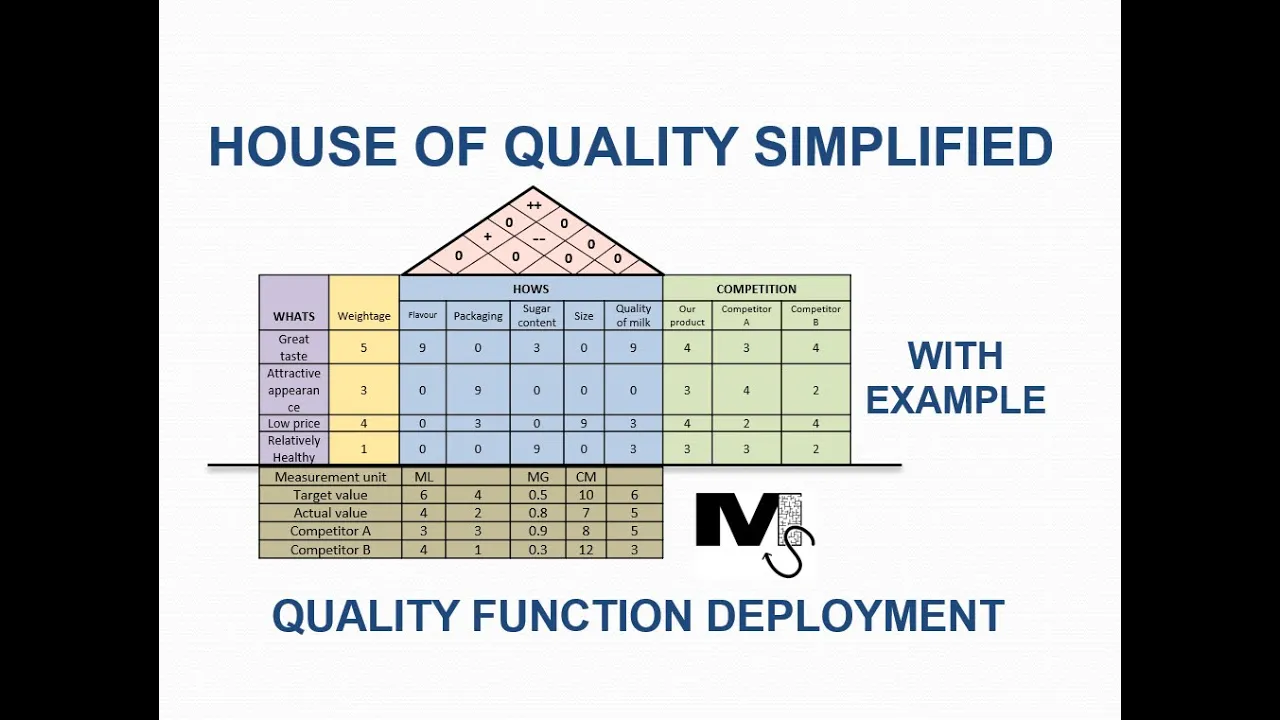
how to populate this house of quality with a simple example and understand these various sections on the way we will of course look at the completed house of quality at the end this one's a blank one now let's start completing this house of quality and the example that we'll be using will be that of a chocolate bar now a company is launching a new chocolate bar and wishes to create a house of quality to an align their product to customer requirements the first task will be to plot the voice of the customer in the leftmost
grid in the house or basically the left wall of the house we're essentially listing out the watts here which is the voice of the customer so those are the watts and that is how we always start building the house of quality because the whole purpose of this process is to align our efforts towards the voice of the customers in most organizations the organ the marketing team would acquire this information the voc through customer service and market market analysis let's keep it simple for this example and assume that the customer requirements are are as shown in
this table here so we have great taste attractive appearance low price and for the chocolate bar to be relatively healthy now the next step is for the team to provide an important rating or weightage to each of these factors we typically provide ratings between one and five with five being the highest and one being the lowest for the example we assume the following logical ratings for a chocolate bar like five for great taste four for low price three for attractive appearance and one for relatively healthy and now we focus on the right of the grid
or the right wall of the house now this is our competitive assessment grid wherein we rate our products or that product against a couple of competitors for the factors enlisted in the voc the ratings are usually gathered by marketing again using a representative group of customers wherein they're asked to specifically rate our product against competing products so a specific group of customers is provided a prototype in our example we've provided ratings as follows these are resumed ratings of course and those are as follows now for the next stage we focus on the top half of
the central part of the house or we can call this the living room now this is where we get some input from product or engineering and outline the product design features that we will need to amend to align the product with the voc we rely on the expertise of the relevant department just like we relied on marketing to get the voc and these will essentially be our house so how are we actually gonna improve the process improve the product to actually align our product with the voc in our simple example the features are assumed to
be as follows flavor packaging sugar content size and quality of milk so these are the qualities these are the house which will actually impact product development for the next stage we focus on the bottom half of the center part of the house this is where we rate how components from the voc relate to the product characteristics or the attributes we've just enlisted the ratings can be nine three or zero depending on if the relationship is strong moderate or weak for instance attractive appearance in the second row in purple will have a strong relationship with the
packaging in the second column in blue and will probably have no relationship with flavor or sugar content so that is how we provide these logical ratings we now move on to the roof or the top of the house now here we map the interrelationships between the individual product attributes themselves now you have to think here if one attribute supports the other or opposes the other we use plus minus and zero here to indicate support opposition or no relationship respectively and the magnitude of the support or opposition is indicated by using two of those markers like
plus plus or minus minus for example increasing the quality of milk will surely enhance the flavor so the relationship here will be a double positive in contrast the relationship between size and packaging can be considered to be a negative as increasing the size could negatively influence the packaging you need more packaging so we essentially look at where two attributes intersect and put an appropriate marker now this exercise helps you balance a dependent dot attribute out when managing any individual attribute and what we do now is we look at the house of quality the unfinished house
of quality as it looks so far so what we have done is we have completed the watts we have completed the house we've provided weightage we've completed the competitive assessment side and the co-relationship at the top now everything under the floor is still pending so that is what we're moving on to to the basement of our house here we calculate the overall importance of each of the product attribute by comparing it with the voice of the customer which we have already collected now this exercise helps you identify how a product attribute should be prioritized or
de-prioritized there are two concepts here important weight and relative important weight to calculate important weight for a product attribute what we do is we add the products of weightage and the relationship value that we have obtained well to clarify this the importance weight of sugar content for instance will be three multiplied by five plus zero multiplied by three plus zero multiplied by four plus nine multiplied by one which is twenty four we calculate the importance weight for each attribute in a similar way and then we add these up on the side to get a value
of 204 for our example now to get relative importance weight for sugar content for instance we divide 24 by 204 and multiply this by 100 and the answer will be a percentage so the relative importance weight for sugar content will be 11.76 and the relative important weight for other factors are also enlisted in that chart there now right at the bottom we have some technical specifications provided by the engineering teams now the data here is the actual measure of the product required to meet customer needs as specified by the relevant department which is engineering in
our case we also compare these values with competitor values and our actual values for our product now the only other role left here is the unit of measure used by engineering if available for our simple example we've just assumed some values here it's important to note that these technical specifications from the bottom may not be of much use here but these are then carried over to be used in level two but as far as the house of quality is concerned this is all that one needs to do in terms of filling it out now let's
look at the full house as we've compiled it the watts on the side then we provide weightage then we assess our competition then we move on to the house then we map out the relationships and then we basically measure our factors like importance weight and relative importance weight and then we also get help from our friends in the engineering department to get the other technical specification details now let's move on to looking at a couple of benefits of using qfd and the house of quality it should be clear from the exercise about that the purpose
the very purpose of this exercise is to first and foremost understand the requirements of the customer and to allocate resources to fulfill these requirements the qft process also helps organizations get cross-functional binds now different departments can perform different tasks but the ultimate goal or objective should always be to meet customer requirements by one and all so running the qft process ensures this ensures that each department prioritizes the same things and towards the same goal it therefore also helps in reducing wastage and ensuring optimal utilization of resources okay so the house of quality is simplified by
that way it looks rather complicated when you look at it on its on the whole all you need to do is separate out the components and start filling it out using the input provided by the relevant departments hope that was beneficial for you hope that was simplified enough i thank you very much for your attendance and as always please like the content on this channel keep sharing keep spreading the word keep subscribing and also please take good care of yourself thank you very much bye-bye





![What is Quality Function Deployment [QFD] or House of Quality ? | Explained with practical EXAMPLE](https://img.youtube.com/vi/Z14MySJQgPs/maxresdefault.jpg)