All right. So, let's look at the following examples. We're going to use the method of cylindrical shells to find the volume of the solid by rotating the region bounded by the given curves about the um spec specified axis.
So, the first example would be this. The region is bounded by y = ex² y = 0, x = 0 and x = 1 and the rotational axis would be the y-axis. So no matter what we have to know how to sketch the region.
Okay. So either you know how to sketch this curve or you can use um you know some online graphing website or graphing program like Desmos. Okay.
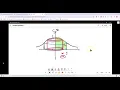
So I know it's fine. So the shaded region is given by you know as you can see from the graph and I'm going to rotate this Oops. So I'm going to rotate this about the y axis and I need both of them.
I need both graph and I am requiring both graphs. So the rotational axis would be the yaxis right? So the y-axis is here.
This is the x axis. So we rotate that and then oh I don't know how to make a refraction. So, I'll just graph it.
Something like this. Okay. Something like this.
So, something like this. Okay. And a solid looks like this.
Okay. So, the solid looks like this. Okay.
Now, cylindrical shell. Cylindrical shell. When we are graphing the cylindrical shell, I strongly suggest that you are drawing a line that is um parallel okay parallel to the rotational axis like this.
So I'm drawing a line and then the same thing happen on the other side and then you draw a cylinder from there. So that's the the cylinder. Okay.
Now I'm going to go back to the original graph the region to copy. So I copy this line. Okay.
So copy this line. Okay. Now on the um 3D I mean the uh cylindrical shell you can see that this is the radius.
Okay. So this is the radius which means this is radius. Okay.
And obviously this is the height. Okay. So this is the height and a cylinder looks like this.
Okay, the cylindrical shell looks like this. Well, not perfect, but that's that's what it looks like. Okay, and here comes the volume or I would say circumference.
Okay, would be 2 pi r which is 2 pi x in this case. Okay, 2 pi x and then a height in this case would be y and y would be our function e to thex². Okay.
And the thickness Okay. Will be delta x because the thickness is right here. Okay.
So from here to here. I'm going to exaggerate this a little bit. Make it really big.
Okay. Make it really big. So this is the thickness.
Okay. So this thickness is delta x. Okay.
Now once we have everything therefore we're going to solve it. So by the method of cylindrical shells we have volume equals integral 2 pi x e to the well I'll just say 2 pi I r a delta x in this case since it is delta x the integral will go from 0 to 1. So x = 0 and x = to 1.
Okay. And [snorts] then the graph tells us that well my r is x my h is e to the -x² dx and then we're going to solve it with a simple use up. So u = to -x² then du du would be -2x dx and x = 0 implies u = 0 x = 1 implies u = to1 I mean it is totally okay for the integral to go from 0 to1 one I mean it is totally fine and then once you uh simplify it if you want to you can keep this but I don't want to to be honest okay so I'll have - one2 well I'll have um e to the u and then one2 the u okay you can verify that and then Continue pi e to the u d u which is e to the u evaluate from 0 to -1 and plug in e to the1 minus e to the 0 which is one of course and you know we can definitely factor out the pi give us 1 - e to the 1.


![Brewing Coffee with a Moka Pot and a V60. [CEREALIZED: Honey Nut Hamed]](https://img.youtube.com/vi/h3sfIoiZANI/mqdefault.jpg)