Uh philosophy has a bad name and i'm not sure about this group but you know in general if you walk around and you say you are philosopher they look at you suspiciously says um because uh now what do you really do exactly and normally the answer is that you teach philosophy so okay that's fine As if like but if you do philosophy as in doing philosophy instead of teaching it however you're really suspicious the reason being that unfortunately philosophy goes up and down so i mean the history of philosophy if any of you has read
anything about it or has been exposed and i might be actually talking to colleagues i don't know and i'd rather not know It goes into waves it's not a history that has a very nice straight line of developments and contributions but it's more like great ideas which then become increasingly scholastic and self-serving it becomes a discourse i talk about your paper you talk about my paper and it's that little problem we move from philosophical problems to philosophers problems nobody cares about and then Society history some scientific revolution a major transformation pushes people back again into
the philosophical problems arena and then you go up again and then it's interesting and stuff and then unfortunately all that interest gets diluted and becomes internal discussion they're up again so until recently we went into a sort of scholastic ivory tower stage Where freelancers uh even these days in fact you see what we publish in specialized journals uh are utterly irrelevant they we made ourselves irrelevant we told the world that all philosophy had to do was to clean up the language and possibly show that some problems that everybody feels are important are in fact misconceptions
so solving problems by eliminating or dissolving problems that was the agenda Once you've done that you clearly are redundant uh you if there were any coherence we should be closing philosophy departments unfortunately that was not the case as in that was not the task of philosophy and therefore we're not closing philosophy department side so what i'm going to try to show you today is that there's plenty of philosophical work that needs to be done in our society information society And at this particular stage of development of human culture any philosophical discourse that tries to retrench
behind some kind of ivory tower is not just pointless which wouldn't be that much harmful i mean there's plenty of pointless research all over the place but it will be irresponsible and then the judgment is harsher as in philosophy we'll be living and philosophy i mean By mean any anything not necessarily done by philosophers professionally but i mean any critical thinking about open problems will be leaving the ground empty to other people with worst messages fundamentalists gurus of all kinds and that's where philosophy has a responsibility not to retrench behind the ivory tower so Speaking
of ivory tower uh there's plenty of you know ivory sort of uh tower in back in the place uh and oxford but the kind of work that we're trying to do at the auction institute is a little bit more engaged with the world and the information revolution and that's what i want to talk about today with you um the line is that you don't have to agree with me but if we disagree we Better know about what we disagree so this agreement is welcome as long as it's not based on misunderstanding so in terms of
avoiding misunderstanding i'll tell you very quickly because i know you know so no patronizing on my side just to be on the same page uh a little bit about the information revolution and then two uh items one uh time has time has changed as in not the Physics time but time as understood by us our age and space in other words our environment so our age in our environment how they've changed and then how that basically one two and three have affected our self-perception how we understand human nature with that uh leading to and that
i hope it will be a matter of our q a and discussion some challenges that the information Revolution our reconciliation of our environment and our our age and our nature at this time and in this environment have led to going straight to something that you know so it's just a reminder uh in case the coffee was not strong enough this is iconic it's wikipedia level everybody knows that's the processing power and how it has Developed more slow etc we're not quite sure whether it will keep going this way because physics has some limits unfortunately but
to the best of our understanding of this is going to go for another while um what is less visible is the other side of the coin how little everything cost uh how much all their power has become so cheap as cheap as this and make sure i don't Fall all over the place suppose you have an archaeological piece of arc of technology in your house and an ipad 2 2010 old stuff that thing was able to process and do we have something to point here yes there's a pointer on the round button in the middle
in the middle it's not very strong so i think it will do um he used an ipad 2 head as an average sort of power in terms of processing power 1 600 million of instructions per second mips which by the time you finish that sentence it's a lot of processing power so every second that goes he had 1 600 million of instructions already processed great make that equal to a hundred dollars that's suppose that that's what the cost to buy this particular power in 2010 well this is down here 2010 and that's The cost on
i've had two processing power this is the cost of that same power back in the years 80s 70s 60s all the way down to the 40s when we started all this wonderful revolution the very top sorry the very top number here that 100 with all those zeros the joke is that only american generals can read those numbers that's dollars that you've never seen in Your life i mean no it's no hsbc kind of dollars it's just beyond belief that in fact is higher than the equivalent in 2010 of the gdp occupate so you start getting
any sense of what you're handing your hands in 2010 we should have been way more respectful of that little gadget where all that power went into generating trillions of billions of fantastic Gazillions of data and by i mean data don't mean information meaning that the conversation on skype also cats on facebook there's all data data data stuff for those of you too far away down there i apologize but uh we were all born outside this particular circle uh the internal circle is 2009 let's see over here if you read as you see the red dot
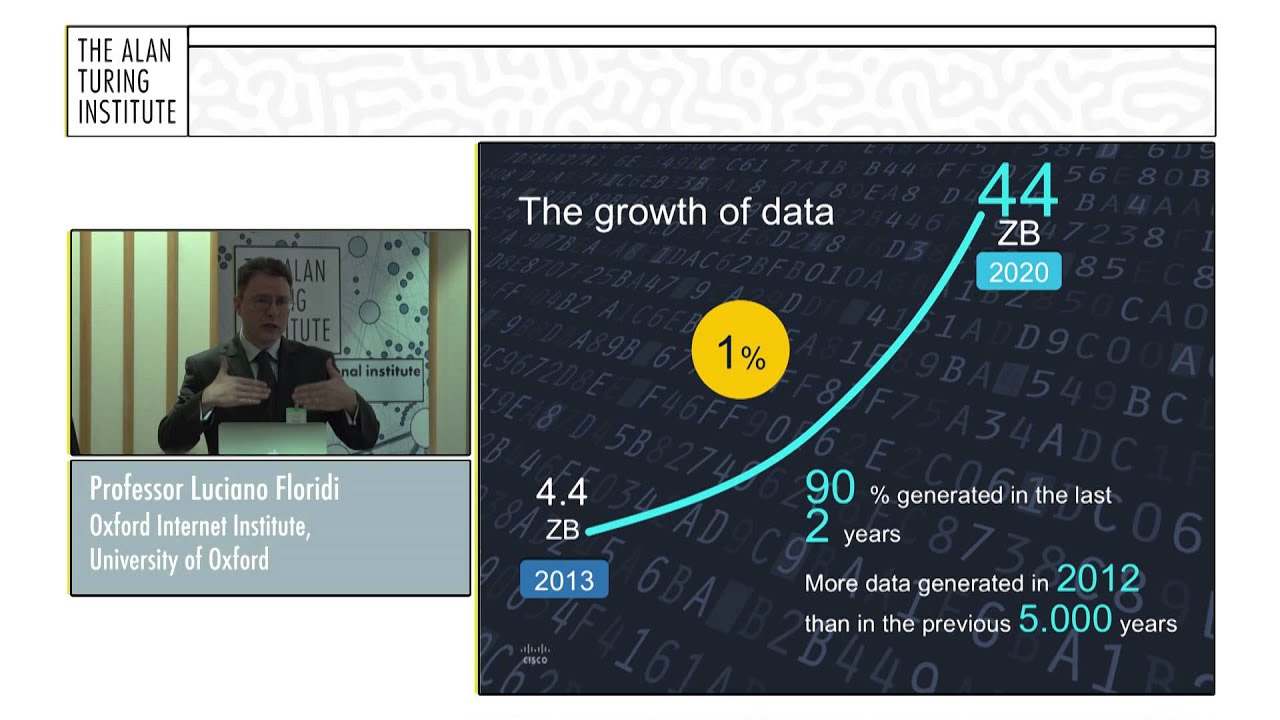
2009 0.8 zettabyte of Data since the day we started scratching cows on a cave that's from that time until 2008 2008 2020 35 00 that that's immense that's 35 times more than we ever generated in the past now suppose that that's wrong by a large margin 50 they're still staggering they're still amazing suppose this is only no it's not 35 000 not 35 times it's only double like Okay that's amazing i mean we produced more data in the last decade than in the whole human history for millennia of course we don't know how much of
that is total rubbish as the same advertisement of the money spent is badly spent you just don't which half the other problem which we not discuss today is that and i haven't seen discuss widely but we should is that all that gray Half circle there is comes with a sort of baby boom retirement sort of label we created all the data we have basically in a decade or two that's all i'm all gonna grow up together get all together and become unreadable together because of support uh failures etc that didn't happen the books which you
know thousands of years to accumulate in Manuscripts but all the data we have the digital ones they all have the same more or less timestamp that is going to go in you know together the is a whole army that is marching in line it's going to cause some problems but we'll see this in the future so there are no limits that we can think of in terms of how this stuff is going to grow apart from Thermodynamic dynamics i said physics is getting a saying about how much you can do with all this intelligence hours
and the only one available in the universe as far as i'm concerned and memory memory as in support the stuff where you put the data this data they don't float in the clouds despite not the phrase of course all this and i'm just preparing the ground so i know you know So bear with me it comes with lots of problems acquisition and storage where you put the data usability once once they're there can i use them when how how quickly security and safety are you sure that i am the only one who can actually use
this data so well i said accessibility as in well no suppose that no they are there but it's very hard to get them accessibility Being also a huge right to be forgotten issue um as opposed to availability analytics for those of you who actually uh deal with this black magic art all this constrained by law and ethics and of course at the bottom of this the usual variable which affects everything in life money because anything you do here will come with a price a price in Feasibility a pricing cost a price in new machines surprising
hiring people are pricing not getting their writing no opportunity cost etc so this is the picture and just to again give you a sense of we could go in many different directions this is one we will not pursue this is all data very old is the only data i could find about the difference between the data forget about information the Economy is being a little bit generous with the world the data we're generating remember those 35 gazillions of things and how much support we are producing in the world that sense of my phone is full
i cannot put more pictures in it so i better erase something if i want to take another picture well that's a planetary issue since 2007 we haven't produced enough support for The data we're generating meaning there's not enough memory where to locate the data with the simple result trivially that on a global scale not you and me can afford more no i just buy another usb no on a global scale either we do not register something because there is no space in the first time the first place we don't produce it is it can't be
put anywhere or Is first in first out those nice emails from two years ago who needs them dale gone never exists in the first place or there's a struggle about who gets what amount of memory and if you are in any department when the ict office says well this project cannot go there because the hard disk is full said oh but it's my hard disk you know how do why don't we kick out that old Project which we don't need so so there's a struggle there that can be manipulated so but that was just as
a way of introduction that's that's where we we've been for the past few years has generated huge uh changes one in time and one in in space which i want to uh sort of share with you the one in time uh is um again you find all this in the book so it's a bit of a self-advertisement Here's a suggestion uh which i i hope is sufficiently um reasonable so textbook material not my own if you disagree with me you disagree with the textbook which is fine but just in case prehistory is defined as any
stage in human development when there is no way of recording the present for future consumption there's only oral Culture grandma said so and that's why i have the recipe but if i forget that's it the recipe disappears nobody knows because there's no written written recipe for that particular thing so it's prayer history and history and hype history they work like adverbs is how you live not at time in terms of magic scale there are still some very few uh people probably in the amazonian Environment which a few uh tribes that live in uh historically they
have no way of writing basically six thousand years ago here in china we developed writing and we moved from pre-history to history now history is a stage where individual and social well-being no you and your society they start getting better also because there is some way of communicating A way of no that problem has been solved by grandpa and it's written here so i can do it again or not those there are no chisels somewhere in marble and then you get somewhere etcetera so individual social well-being has been related to ict but it's not yet
dependent on ict now by dependent i don't mean oh of course we need food and shelter and of course but today in a society like this One and some other european ones and some others in north america and so on the development that what makes it the added difference is exactly ict now if you think that's too philosophical uh here's the counter sort of balance to the speculation any country that can be subject to cyber war is a country that depends hugely on his ict infrastructure if you can be Harmed by a cyber attack clearly
you live in a hyper historical society a society which depends puts individual social well-being on things of airspace or hospitals databases and so on so in a historical context those who live by the digit they die by the digit just to not be memorable phrase from another book um you know that we're moving into a Different stage because there are plenty of attempts failed attempts as far as i could say to make sense of our culture you wouldn't have a cyberculture movement a posthumous movement a singularity rubbish if you didn't feel that oh my goodness
something is really changing here and how do we make sense of all this i did say on record singularity rubbish Just in case um as i will show you later i mean just not bad mounting people it is rubbish in a sort of scientific sense what we really need is of course these attempts are leading somewhere but they are more like false steps like how something is going on something needs to be understood and rephrased and but what we really are facing is a new philosophy of nature where nature And technologies are becoming so intrinsically
related that it's very hard to be so a green person who thinks that the environment is only trees and valleys a new philosophical anthropology which i will discuss today and basically a new political films which i discussed this morning with some colleagues at ucd but there's plenty of work here that needs to be done because we are as we're stepping into a New uh territory now remember that philosophy never rewrites chapters adds chapters to its book so i'm not saying that what has been done so far has to be dismissed i'm saying it's time to
write a new chapter having read the previous ones relying on the previous ones that's a good story we have but no it's chapter 20 time to write chapter 21st century Because that chapter is still missing time in high history space it's a beautiful reference to galileo local hero for people from italy two at least two lessons to be learned uh here one is a very famous uh quotation which describes the the book of nature uh in sort of mathematical symbols and uh no science is reading the symbols I said two but actually three uh are
the points here one a lot of science used to be considered by galileo newton until recently as a description of the world but there's plenty of signs that makes the world builds the world you speak to any poetic as in greek poetesses construction science as in engineering computer science And they don't simply describe the world they're actually building it so i was no sign well of course it is you better better not get a grip but it's not a description of planets is a construction of say ict systems so this this divide already happening which
galileo didn't have second lesson a bit of philosophy mathematics for those of you maybe for the q a funny enough i mean descartes and the algebraic revolution Has already happened a long time ago but galileo still thinks that the books of mathematics is a geometrical book and for anyone who lives in these centuries like it does we don't think this way anymore for us if you ask anyone down the road it says what's mathematics or two plus two another man the numbers they would not say geometry but we were coming from about two millennia or
so or geometry being The queen of all mathematical sciences the shift hasn't happened yet so beautiful point but above all what does it mean to read a book when you actually have a science as i said a moment ago they can actually write the book oh this is this is interesting because that science is no longer a matter of reading what nature has written there not a book but it's actually a way of adding to it And this is what i like to discuss with you now this uh herbert simon a novel laureate in a
variety of topics as well great if you answer but also great economists and so on the beautiful book if you have a chance are the science of the artificial he writes ai is not a science of nature remember the book of nature a description Read the book that's uh say biology for you or a science of culture it's not anthropology but it's a science of the artificial and uh well thank you but so what is that well this is my contribution to clarify the point i'm not sure whether simon would have agreed uh it works
well in english it doesn't work in other languages Ai does not describe the world as say astronomy it does not prescribe the world as a law or other similar endeavors but it actually inscribes the world with new artifacts so what when you have the book of nature written in mathematical symbols what happens if you write a piece of code well you just add it to the book of nature well that's the way you're looking at this So it's not a matter of you know building robots that can read the book of nature because once you
build a robot you actually add it to the book of nature with a new artifact which is a mathematical artifact and such well if this works then then there's a way of understanding artifacts in a way that has been sort of obscured by the debate for the past 50 years on ai ai used to be a debate between two Departments uh coding science and engineering science ai departments from county science they tell you we want to create non-biological intelligence it doesn't matter how stupid but it will be the real thing maybe the intelligence of a
spider but it will be intelligence non-biologically generated the engineering says i don't care about intelligence all i can is that it does So and so this and that which if i were to do it it would require my intelligence but the thing there there it can be as stupid as a toaster it doesn't matter as long as the problem is solved now in this no problem solving versus uh cognition etc what we've been doing meanwhile these two blocks they were still thinking about artificial intelligence and something That you would build and either been a problem
solving or the real thing at some point there is intentions but meanwhile what we did was to transform the environment to make sure that the environment would be stupid dt friendly is our environment which has become ai compatible rather than vice versa that's why google's car can work because there's plenty of data out there Sensors and databases and maps that can fit into it not because there's a shred of any possible intelligence in it so what i like to call the data vacation or enveloping the world that's what has happened really now in robotics an
envelope uh borrowing this from robotics is the 3d space where an arm is successful can operate and think of it what we do in In industrial context is to build a whole environment around the stupid robots you don't unleash robots in this in the street and say build me a car you build a so-called ontology another context an environment around the simple or perhaps sophisticated but still stupid abilities of the machine there so the picture that i'd like You to have in mind to simplify is the dishwasher the dishwasher is the perfect realization of a
robot no stupid mechanism inside you build a whole environment around it to make sure that the stupid mechanism is successful very successful nobody in his right mind would not wash dishes that way in the kitchen this is what we've been thinking about for 50 years No someone like me doing the dishes like me and it doesn't work no well no nice it's not there and this is the future an arm that puts the dishes inside because that's me at the moment i mean someone has to put the dishes inside the ontology and the dishwasher and
that will be a human interface the human interface will come back in a little while so while we were dishwashing the world That's where ai started getting real traction if you think that is all science fiction again uh this digital endeavor for europe collects an enormous amount of data on all possible things they collected data about how much on how many people in europe use a laptop to access internet wirelessly away from home and work for other reasons but to me that's the dishwasher where are they they never left the Dishwasher you're not at home
you're not at work but you are constantly within the environment which has been created to make sure that your safe wireless connectivity works seamlessly between here edu rom etc and that's a lot of people i mean more than 20 of all populations 500 million people here and growing so in the past grandma used to walk Inside a computer now they're inside a dishwasher as well then at some point a daughter stepped out and the computer became something that was in front of her eyes but today her granddaughter is actually back inside back inside a way
that she doesn't really see the computer around here but all those sensors all those things that are working all that communication i will show you in a moment they're all Happening around there so that's the space envelope in the world that we're living in big change in technology big change in our age big change in our environment what about us which is always the question we ask anyway so at the end of the day what has happened to human age and that's basically the topic of the book the fourth revolution is the fourth Because um
oh by the way i'm still on record uh john cell a philosopher has criticized the book not understanding it thinking that i was attributing the fourth revolution to myself if he had read the book before writing the review he would have known that i was not and there is a hero here coming up who is not from oxford i have to say so the previous three Revolutions were put together by freud self-serving advertisement but no smart guy and he said look what i'm doing is something that has been already done before me i'm discovering a
new uh area new scientific endeavor and so on new science that cast a completely different perspective on us the first revolution compared because we thought we were sent to the universe all of a sudden we are moved outside That and of course it makes a big difference in terms of your anthropology i mean who you are who you think you can be how important you are in the universe on this tiny little speck in the middle of nowhere maybe that's not so relevant so we retrenched and uh as well we use a second special stage
which is you know this uh biological centrality we wear the Species you know and of course darwin came and sorry now you have to give up also that centrality and fraud said well look at at least we retrenched into a sort of cartesian centrality of the mind as being transparent to itself rationality say your brain is like a shoebox if you look inside you see exactly what's in it and normally nothing but if it is something you will find it and says well Sorry you have to give up that too uh you you've had multiple
you fighting with each other anyway so these were three revolutions and my suggestion in the book is that we're just undergoing a fourth revolution which i attribute to alan turing and we say look the real difference here is that by developing this all these wonderful science computer science and Icts we're casting a new light on ourselves not because this ai is really intelligent but because it's telling us a different story about who we could be and what we could become so we're not disconnected agents you know pick up any book and there will be this
single agent possibly rational what informed et cetera with interest not at all it's all about networks we are connected And we are kind of information organisms we've always been i mean we live by you know information in terms of expectations fears memories um feelings and so on and we share as sort of information organisms this infosphere which i described before this space of information with other agents you know some biological some non-biological some uh hybrid and that's the kind of Revolution that i explore in in the book so the difference is that in this infosphere
as information organisms talking to other agents of various nature things like this used to be the norm you had a bar code and luckily someone put a bit of english under it but the new bar code of wikipedia is not this this is what you get and what's the Story behind that this is no meant for our eyes as simple as that this meant for artificial eyes for other agents to be consumed so we are generating in this world information that is not for other human beings but it's for machines to read and consume and
register and process and you start thinking last time you had to prove That you were a human being to a machine because that machine was worried that you might be another computer trying to crack that particular sort of code or anything including try just to generate another end entry in wikipedia uh well that sort of movement of saying well show me that you are a real human being by reading this sort of mix text and so on well that's that's The world in which we live it's not made of intelligent agents but it's made of
smart agents that can interact with us different ways so this is the picture that we have there should be no sound i hope because no sound is meant and it's just a little movie to show you how much we are sharing with the rest of the world so this was 92 and there were about a million things Connected with each other move forward and 2003 i have a billion things talking to each other there's no asset these artifacts talking to each other then you start talking about the internet of things in 2009 because there is
a lot of stuff about 8.7 billion entities that are interacting with each other independently of us and of course the story goes on it's Going to be 11.2 in 2013. further down the road keep going thank you and you reached yesterday 14.4 billion 18.2 for those of you far away still 22.9 it ends in 2020 don't worry 22.9 28.4 and down the line all these things that are interacting with each other that's multiplied by billions The effects that you see when you go home and all those little red and blue and green lights but that
is some something talking to something else so by 2020 we'll have about 50.1 billion things talking to each other in this infosphere which we share with them uh it's a bit confusing and unclear to know exactly what that means so here is a fixed picture this is sort of projections By cisco by the way this now you can find it everywhere on the internet so no secret world population 2020 7.6 billion people more or less connected devices 50 billion devices per person about six seven per person now that includes a lot of people who never
made a telephone call in their life so people in this room multiply this by three four five Make sure that basically you have about for each of us there are about 30 entities out there talking to each other behind our back this is what it looks like this is humanity and how many we are by 2020 and these are the devices talking to each other how many they are they will be and in case you know you have a different perspective we are fast disappearing as the communicating Sort of species on this planet if you
come from mars you want to talk about communication well by 2020 this you know make it a hundred percent these are devices and the line is going to go down especially since we hopefully will stop multiplying ourselves whereas this they keep growing so scary maybe maybe not uh but what are the challenges here what what's gonna Make a a real difference and i'm gonna i'm going to list five challenges and these are broad topics and i'm sure we can have the rest of the day to discuss i'm doing fine with time i'm looking at the
boss yes okay first of all this environment is it friendly i mean are we really building this environment in a friendly manner now we had a wonderful conversation over lunch About how unfriendly uh or say less human friendly this environment can be uh and i mentioned already in lunchtime each of us has had the experience of being told well that's the only way we can do it sorry because that's the computer way of doing it and yes i understand i share the pain i wouldn't do it myself but i'm sorry that is the way it
has to be done so how friendly is this environment Sorry how friendly is this environment to the world um coming back to the environment these days and because of the gadgets we have we don't notice this too much but you know growing up and i can see a few people like not my age there was a time when that laptop on your legs was really warm unpleasantly warm and it was so warm you had to have something in the middle because You couldn't just hold that laptop on your legs for more than an hour it
was burning that's thermodynamics that burning is coming from somewhere that's energy energy is consumption consumption is the environment so this is a recent data from the climate group 2008 apologies for recent but they try to quantify the advantage and the disadvantage Caused by ict when it comes to environmental issues and this is what you gain in terms of decrease all that green stuff is not as aware is harm not done to the environment thanks to icts good all this not true but just as a joke when we didn't print books but only digital stuff well
there's no less consumption Good for the forester there but at the bottom we forget that there's a black dark sort of impact remember that laptop on your legs well that comes from somewhere and that's why for example all the energy the green energy produced by finland the whole thing has been bought as a block by google all the energy produced by finland green wise It's going into supporting google warehouses that's why you build warehouses next to a power station because it consumes energy and therefore what we're doing here for the chess players in the room
is a gambit we hope that by decreasing this much while increasing this much the impact on our environment we have enough time For this to be a successful gambit we are losing our pawn as well to win the game if there isn't enough time the pawn will lead to more losses in the end of as a way life as we know it on this planet so it is a gambit and i think is a sufficiently reasonable gambit but i'm not sure that the politicians who endorse this picture see it as such and understand it as
such I was telling you about a human friendly uh point before and uh we moved through the environment but the human friendly idea is is basically summarize i actually borrowed this from a company they had this beautiful presentation and i said well can i just use it so jetty and then we shape our buildings day after they shape us oh that's so smart i mean it's really it's just True i mean there's no determinism in in the kind of technology that we built but once we have built them they really stay there and they stay
there for the next ten generations the the cab driver was complaining about the narrow streets in in in dublin well we didn't put them there for cars but now they're there and then you better negotiate them so how friendly is the is the environment That we're building so against any determinism of any sort or things like the white no magazine editorials what technology wants nothing don't even try that trick with me it's our responsibility don't don't for a moment think that oh it's technology yeah as if it's up to us to shape the next generation's
world and then we complain With us if we screw it up having said that once it is true that once you put it in place well it's very hard to reshape it from scratch why roomba world uh i think that would be memorable this by the way someone who actually attached a little camera on top of the room but i see some roomba roomba is i'm not being sponsored by the way but i do have a roomba and This is a little robot uh that cleans the house for you it's a hoover highly recommended especially
as i was doing the hoover this big this high is like a big sort of thick chicago pizza going around there are several models i have the cheapest one they're very expensive there's a room also for the garden just in case it does the grass but why are on the wall because Recently moving house my wife and i decided to have a new sofa and we decided of all the surface we like knowing what we do we actually decided to have one with higher legs so that roomba can go under it and you start thinking
how many choices of that kind are we are we making today i mean this is a joke so that sticks in your mind but how many roomba worlds are we Building right away and if you have um a paying system where as we had at some point uh in a town where the only way to pay for the car park is through a mobile phone attached to a credit card where just the week before was coins well that's a roomba world because you have cut off a whole chunk of the population has so the complaint
is enormous and the city council has to scrub the whole Project and go back to coins lots of money etc challenge number three we only have five so bear with me make cpd work for intelligence which is not easy because in the couple here analogy is um between sort of spouse spouses and imagine that she being a record better be careful about wife she is super smart but also super lazy And he is an idiot but very active he does everything 24 7 now the question is who is going to adapt to whom the intelligent
lazy to the active but total stupid or the totally stupid but very active to the intelligence of course it's the intelligent lazy that is going to adapt i didn't quite like it the way you do the dishes but that's okay you do them i'm fine and so on so basically You know the idea of making cbd work for intelligence is not trivial because intelligence has the wonderful capacity of being adaptive and stupidity the wonderful ability to be tireless and that's not uh trigger so why is this an issue because recently you might have heard i
hope not but just in case you uh were astonished hearing some famous people from cambridge at the Other place what do they know there about the arrival of a.i i mean and uh they will dominate our lives as a torah nonsense we've got plenty of problems but not this one now this is alan turing that's the lebner price and that's the medal that they give to the libertarian prize the lebanon prize is uh Awarded to any piece of software that will pass the turing test between tests being something just for those of you who haven't
been exposed this very quickly you are in this room you interrogate two entities on the other side of the wall you don't know who is who and by a question and answer game you need to guess who is who who is the machine and who is the human being if you cannot spot it And there are a few constraints such as such amount of time and so many questions if you cannot spot the difference well the machine has passed the test is as good as the human hopefully you picked up an intelligent human because of
course if it is your moronic neighbor you won't see the difference trust me but hopefully you know you have a brilliant guy and a machine and if you Don't see the difference pass the test now the turing test therefore has become a kind of a distraction and a bit of a game and so on when turing introduces the tuning test in his famous paper in publishing mind 1950 he asked a question which is can a machine think and then he adds immediately after too meaningless to deserve discussion that's not a point you don't ask whether
A machine can think you ask can he perform as well as something else that we know can think at that point we know that is passing the test unfortunately on the lebanon prize that's exactly the phrase that they printed on the medal can a machine think so either there's a very subtle irony here and we didn't catch it oh they didn't read the paper I went for the second option who reads these days now this is the same problem multiplied by a few billion dollars in california google you must have read also that google is
buying anyone and anything that does artificial intelligence on a global scale seven companies last time i counted there's audio but we don't have time and I don't want to show it to you but this is the text for those of you too far away it was um an interview that eric schmidt at the time executive chairman of google gave uh it was a meeting at the aspen institute july july 16 2013 this is important 2013. ask will any machine will ever pass the urine test turing was deadly wrong he said oh in 50 Years of
bone or 30 years or whatever he gave a number and it was like not even close but eric uh said well of course many people in ai believe that's why you are you know the executive chairman they're smart you don't say i believe because then i can prove you wrong you said many people believe well is there a problem but yes many people now i believe that we Are close to a computer passing a tuning test within the next five years and i hate aubergine and on record i bet a plate full of aubergine that
is not going to happen in 2018 by 2018 hello i will eat a pla a full plate of aubergine if this is going to happen why that's an easy bet so this is the actual interview the easy bet is based on this this was the winner of 2013 He oh by the way three prizes uh um gold silver and bronze two have never been awarded to anyone the gold and silver but they're both science fiction the bronze is awarded every year to the less worst performing of all the bunch of applications the one that is
less rubbish wins this few dollars it was mitsuku chatbot uh oh some of these have Weird behaviors when it comes to sexual interaction so i you have to be careful um he won the bronze medal for the following conversation and again i really for those of you too far away i try you can try it online uh me um what can someone do with a pair of shoes replied quite a lot of things okay that's fine i don't know the difference Such as or for example a tomato well that starts being weird anything else that
is all i have for right now remember i need to spot who is the computer and who is the machine what's wrong with the following sentence the capitals of france are three leon and mancey how can there be self-help groups so the usual trick of these machines replying to a question with another Question i tried that with one underground or down the examination never works but are you sure well i used to be indecisive but now i'm not so sure thank you computer you are quite welcome what sort of computer and you go on and
on and this is the sort of uh interactions you can have when you say oh that's good news that's all sold when the last 11 price 2014 That piece of uh chunk uh got the third third in line this is a conversation and when asked this car could the car couldn't fit into the parking space because it was too small what was too small i don't know a walking encyclopedia you know because this this is as far as we went 50 years ago in this sort of fake interaction where you can just talk in an
automatic Pilot and i've done this a trillion times at high table when you don't want to listen say what's your topic what are you doing oh it's what's your college you just go through the usual stuff and you're not even listening now of course machines can do that for us but that's why all this came in 2008 whereby we thought that we were getting stupid by the day And machines were getting intelligent by the day is past its sort of headlines interest the end of the year the data deluge makes the scientific matter obsolete no
it makes this article obsolete and it has been obsolete since francis bacon decided that all you had to do in science was to collect data wrong at that time wrong for the past 500 years nobody does science in this way nobody Collecting data and asking questions is the first thing you say to students don't go to the library don't read think come up with a problem and then you check the data and then or is google making us stupid what the internet is doing to our brains you know remember no machine's getting more intelligent well
no what google is doing or things like it's polarizing it's polarizing because the stupid Become more stupid and the intelligent become more intelligent and that's the trouble because if you're smart and intelligent these days with those tools you can do amazing things but you have to be pretty smart but if you are dumb well then you become dumber by the day because of course you know relax the analogy i had in new york during the festival i said look it's like a car you can take the car to go to the gym and Get fit
or you can take the car to buy the milk and get fat so polarization non-neutral is that the mistake also oh it can't suppose no no that's not neutral it means that more will get more and less will get less and that is the real trouble so problem solved not quite because of course these machines being smart but also stupid They need humans as a module sometimes uh so here this is a new york times um article some time ago when during american elections uh twitter started getting problems in the uh disambiguating uh the phrase
big bird because of course nobody was referring to sesame street everybody was talking about the us so government big government and so on but they used Big bird as an analogy and twitter came out with something that everybody knew but was stated loudly that they use graduate students to disambiguate this stuff because they're the only ones who can actually grasp the meaning and make sense of the meaning now at this stage maybe in the future there will be other machines doing it differently for us but what's happening here is that you Have no memory outperforming
intelligence meaning algorithms and big data not basically doing better then you remember last time you played chess and you won against your iphone good old days but synthetic engines namely our computers they need semantic engines like us and therefore we start becoming as we're human inside module within a bigger machine That needs us in our intelligence so what has happened in the past is being a phrase i like to use is that now future is where the past happens again with a twist and we often often work as interfaces remember the arm that i show
you know between the dishes outside and dishes inside well i'm just the interface between a dirty kitchen and our cleaning up System and no hopefully i would like to have a robot there but no if you look at the gentleman or the lady here they are just interfaces between a petrol station and a car and we could not think at the time and we did not have the technology to make sure that refueling a car could be done by a robot but for goodness sake i mean we have robots on mars But we cannot refuel
a car automatically you need a human being to do it to unhook put the fluff and put it back if you think of it for more than one billion cars in the world for i don't know how many pedro stations if anyone invents a system of doing that automatically that's the next billionaire but it's very hard this is a strange robot and all different different models so are we doing are we Going through the same problem with electric cars yes we are have you seen that there's someone who has to plug in the thing no
don't don't do that i mean clearly if we're gonna go electric surely there has to be a way of parking an end of and then you leave it i don't want to be the one who actually plugs in the thing and then one billion cars electric uh and 10 years later just have the same Thing oh if only we had thought but the lady is the same problem she is an interface between a gps and a car and she's also fast disappearing like the gentleman on top never met anyone like that but my grandfather would
have or the lady at the bottom this is something that we often forget in terms of interfaces technologies help us to remove interfaces not in the sense that we're not going to Do it but in the sense that there's no job there for someone to do it for you i don't know about you guys here but sainsbury back in oxford it's me scanning all this stuff all the time so it's me putting the stuff in the dishwasher it's me scanning the chicken at the counter because the job is gone because the technology has gone good
enough to make sure that you don't need a specialized human to do it Anyone can do it therefore the customer can do it therefore it's up to you now and i'm not being paid to scan my own food which leads me to we're still on that particular challenge don't stay with me this is uh recent data about the american job market i i think i i you know where i'm going how are we doing with time continuum Again for those of you a bit too far away i apologize for the graphics a little bit uh
too small this of course as you can tell from the economist the divide i don't know why exactly between services and government uh probably because government provides a disservice i don't know whatever it is the reason but within services and government the if you consider the whole population Of the job market in the states there's 90 plus percent of jobs services and government manufacturing is going down quickly and is already way below 10 percent well remember more than 90 below 10. so just a fraction two three maybe four percent depending is agriculture and someone when
i said this uh recently says oh yeah but no in terms of uh Gdp no no also in terms of gdp agriculture doesn't doesn't contribute much to american wealth and if we could just stop now having that sort of hangout from millennia of starvation in europe as well we could do much better but what's the point here well very few people uh have anything to do with bioware Agriculture just a little bit have something to do with hardware manufacturing and most have got to do with software one way or another this is fine it's a
bit weird uh but well that's what happens and you must have seen this before what happens when you start calculating the effect of computerization on their job market if everybody is in the Software industry more or less no and handling paper and handling information one way or another from airlines to well if you start an automatization of their market that's the kind of a curve you're gonna get some jobs are super safe you don't want to get a massage from a robot it's just not gonna happen so that's going to be safe But do you
care who actually handles your flight tickets i say at the desk well you could care less so those jobs are going to go and basically 47 about 50 percent or less of jobs at risk according to this particular calculation which was known as a study in oxford to make news and so on saying okay well that's an advanced Society maybe maybe so maybe not what is missing from the picture that is more detailed well recently i was in finland for a an interaction with the ministry of transport and interestingly in finland they run the same
analysis but with one variable that the previous analysis hadn't taken into consideration in full which is legislation What if the legislator says yeah that's doable but we don't allow it and you think that that's just the joke imagine the following how many trains no in ireland are going from one place to another as a fixed road can take turns without a driver and the answer is zero to the best of my understanding at least in britain a train is not allowed to go from london to Manchester without a driver on it why because the legislation
i mean you just don't do it how many airplanes are flying from one place to another pilot well this is all doable i mean it's all especially trained i mean no more nothing more trivia than good from a to b on a train well it legislation doesn't allow it so how many cars are gonna drive downtown without Uh a driver say how many cabs are gonna be there well it depends on the legislation because the legislature says illegal that's the end of the problem they will not happen so it's not about technological feasibility it's about
the legal framework that allows that or not once you take that into account this is the american picture same data just a different graph but exactly the same And there is on the left hand side the finished picture which i will say a more european picture where basically brussels and helsinki have been taken into account what happens when the legislators say we don't like this you better have someone on board and we've had two on boards and in fact how many stewards were those three people Except so the future is complicated and when you're told
that jobs will go they will go if technology is left alone but we are also in charge and depending on the legislation they will or will not go it depends it's an open call you may say one day that supermarkets are forced to have people at the counter to scan this stuff and and billy for it and if you do that well plenty of jobs Around the corner change number four and we're getting close to the end may predictability empower freedom remember those were the two challenges we've been exposed to smart technologies are becoming you
know really good at doing things that we do because of our intelligence but also getting good at predicting our freedom and that's one of the two no the pillars of our definition are free Intelligent agents different from humans this is you don't have to read it is a it's a passage from deca that has uh kept hundreds if not thousands of students in oxford awake at night trying to understand it because he says something really odd he says suppose you measure freedom on the most free of all possible agents god nobody can be more free
than god but god Doesn't change his mind it's not a good things i'm going to shave today as opposed to i'm not going to shave tomorrow he's not going to make a difference no so god is rational and it's free so the more you incline towards a particular rational free decision the the more free and rational you are you're just as free and as rational as god couldn't be any better That was the model but unfortunately that is highly predictable we all know that the closer it gets to two plus two the better you get
are saying four because that's the only so if you are very irrational incredibly rational as we were saying lunchtime you're going to come back home with the same toothpaste even if you don't remember which toothpaste you like and uh That's an experience it's rather disturbing so if you're very rational and basically that's what you go through this is a famous case you must have seen it before so just a reminder the target developed now in 2012 this old story developed a whole series of products about 25 which show that if someone buys those products in
their order and their time not only she's pregnant they know at Which stage of pregnancy the the person is months they just forgot that maybe there was a bit too personal uh they sent tokens for their pregnancy and uh the tokens were received by the father of the lady i was hugely upset and complained called target says like are you insane are you crazy my wife and i do we don't know they're having a kid he says no we're not talking about your wife and yourself we're talking about your Daughters and my old daughter is
only 16 i had an explanation and they always said that she was going to tell them sooner or later the target already knew uh the family didn't and luckily that was united states she didn't get stoned or not thrown out the house say okay find one more member of the family but this is the kind of technology that is Available today in terms of challenge how do we make this technology improve support enhance foster freedom as opposed to become a constraint and predictability becomes something that we so carry around our neck as a as a
way this is real stuff is it and of course it always happens in the states since 2008 old news courts have been uh the police and the courts adopting Predictive uh policing and predicting uh measures this is just the data again economy staff no research no nothing else only he knows no it's public domain this is what happens in la when you adopt some predictive policing in other words you start saying well something some crimes have happened there we think they're going to happen again or not what's the probability and so on The place where
they adopted it and the other places where they didn't incredibly successful it does work i mean we are predictable uh especially in large numbers uh the larger the numbers the more predictable we are and funnily enough that's what i was told not that we know the software that has been used to have this predictability of recurrent crimes is the same software That's california that was used initially developed for earthquakes the point being that they wanted to know when earthquakes happen again if they have already happened once and no the mass is the same if some
if something happens how likely is it that it's going to happen again and you change the parameters it's crimes no earthquakes but bingo i mean this human beings is not Earth moving but you have the same solution so the effectiveness tested by the la police is huge and uh to the best of my understanding this has already been adopted in the uk in manchester so it's getting some traction but above all this was the surprising thing and again uh let me just read for you february 2013 so it's still recent but not that recent it's
not Yesterday there's a philadelphia court beginning using computer forecasts to predict future criminal behavior and change therefore the penalty say well this guy is going to do it again unless we really sort of make it sort of stick as well so just a little bit more palliative in case we said no no this is a good guy it's not going to do it again so we can Be more lenient based on what is not minority report based on ordinary forecasting data stuff and yes it's already happened so this is not as where technology helping us
to be free but in us so linking freedom too and because we are very predictable this is where some of the challenges are coming from remember freedom and predictability this is a quick story Of nike with some highlights 2006 apple and nike launched nike plus ipod make a couple of mistakes excuse mistakes in terms of privacy they fix it and then start it again it's running tracker nike starts shifting the branding strategy nike used to be a producer of things but they want to be producers of products that are experience so processes they're not stuff
there's No real money in producing stuff that's that's what china does but experience that's that's the real money so in 2012 nike starts producing the fewer ban that's uh there's more stuff but you still think you know that what's the real money this stuff 2013 18 million users of nike plus online that's that's the real money you've got 18 million people who have money to waste they buy a fuel band and time to waste credit cards probably english speaking has some angled 2014 28 million users of nike nike starts saying that they will discontinue they
feel bad concentrating on consumers experience elementary but what is the consumer experience here behind is the predictability of these Consumers and what you can sell them next time i don't want to pick not picture this into dark tones but unless we are a bit aware of what's going on i think measures would not be taken and finally looking at uh how we do it it's just a quarter past i know some people have to get back if you could just summarize because i think i'd like some time for questions i Know we need to make
technology uh make us more human no less and uh instead of showing you what tattoos look like these days uh or all the kind of funny things you can do to your arm this is real stuff don't buy a hacking or growing a on your uh on your arm implanting things in your brain or you know guiding things around uh basically we may need to make sure That the technology that we are developing as that we are in charge is gonna make us more human no less remember the roomba world well that's that's part of
the the pitch so what can be done in conclusion well i think we need to do these couple of things the two i as you were one plus one but it really is intelligence plans inventiveness we need to be smart and not matters and technologies matter but we need to be intelligent And we need to be inventive about solutions because that's the only way forward so bottom line for the financial among us we need to upgrade our views about you know who we are what the world is like and now we can interact among ourselves
and with the world that's four things us the world interactions among us interactions with the world these are the four lines where we really Need to upgrade our philosophy and it's an a it's a new chapter it's not erasing the old ones it's not burning like hume said the books in the library it's just writing a better chapter for us and for that i believe we need better not less technologies i'm not anti-technology in any possible way we need to have smart technologies absolutely we need to have technologies that regulate other Technologies much better than
they do now you want to have some technology checking that other technology is doing its job properly and we need technologies that monitor other technologies so that everything in terms of what's happening and how something gets regulated is also monitored so that we can step back and have a better life but for that there's a lot to be done and thank you so much for your attention You