The discovery of the sepulcher of the Apostle Santiago, in the first third of the IX century, compelled many Christians to make pilgrimages to Compostela to worship his relics. It had been a few years since construction of the second church in honor of the Apostle Santiago had ended. King Alfonso III, the Great, had provided enough resources to erect a more solid and ample temple than the humble shrine that housed the saint’s sacred tomb.
Its needs had changed. The new building, besides guarding and honoring the relics of the Apostle and his disciples Teodoro and Atanasio, had to take in a greater number of pilgrims coming from the Peninsular kingdoms, as well as from the rest of Europe. These are the beginnings of a fascinating story, a fabulous saga spanning centuries carried out by thousands of people united in their devotion to the figure of the Apostle Santiago, in a remote corner of Finisterre.
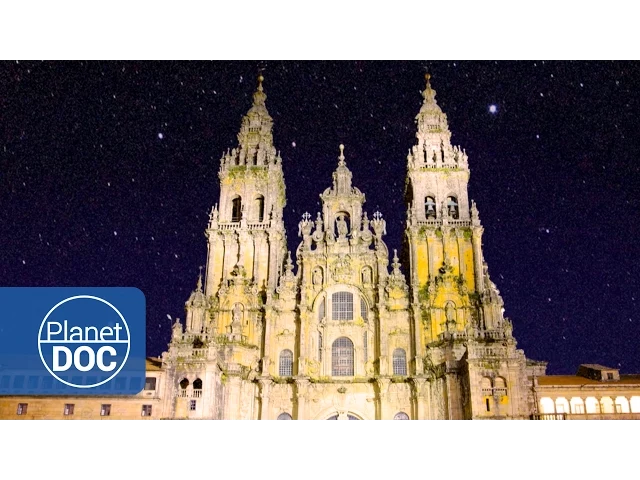
They called it Compostela: the field of stars. Today we can enjoy the fruits of so much effort, the dreams of those who dedicated their lives to the realization of this magnificent work and who were never able to see it completed. Because the present state of the Santiago Cathedral is the result of numerous changes, projects, works, remodeling; in short, an evolving and impassioned architectural and artistic creation developed throughout many centuries.
Its builders traveled the world learning techniques and crafts in the main centers of Christianity in order to bring them to these lands of Finisterre, which back then were so remote from the rest of Europe. Their purpose was not only to construct the most perfect church dedicated to the cult of the pilgrims; they wanted to make Compostela a religious and artistic reference for the world, like Rome and Jerusalem. Under its vaults and towers, within its walls and columns, we will remember many of those stories.
Through its magnificent works of art, we will know who its constructors and artists really were. As we cross its doorway, we will travel back to those years in which pilgrims from all over Europe arrived in Compostela to revere the Saint Apostle and relish the beauty of the artistic treasures of the cathedral. For all of them, nothing could be more thrilling, after carrying out such a long and difficult journey towards the lands of the ends of the earth.
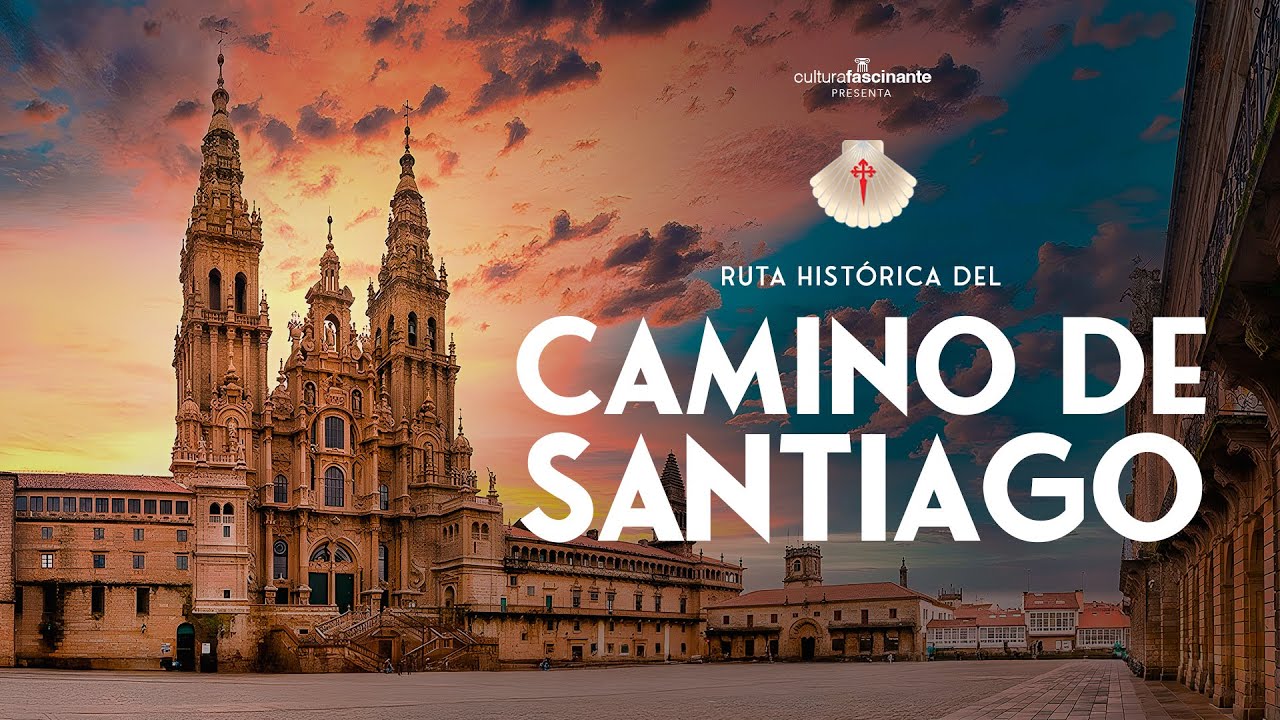
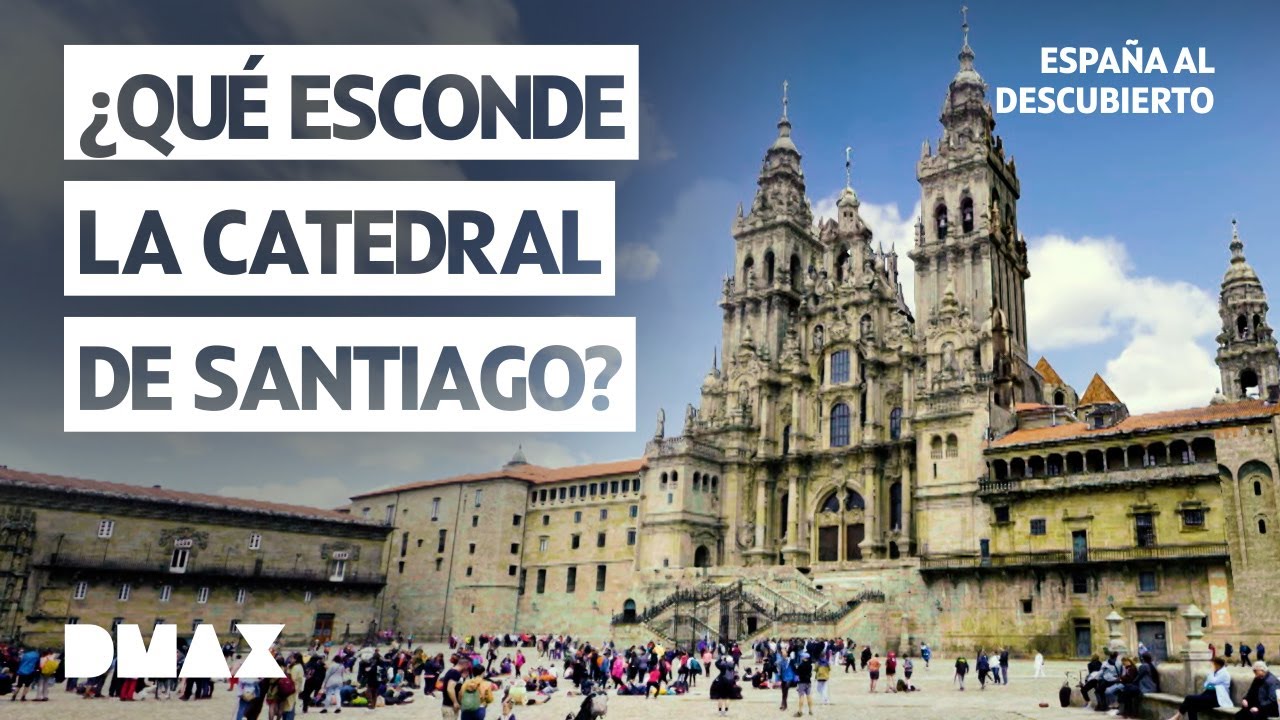
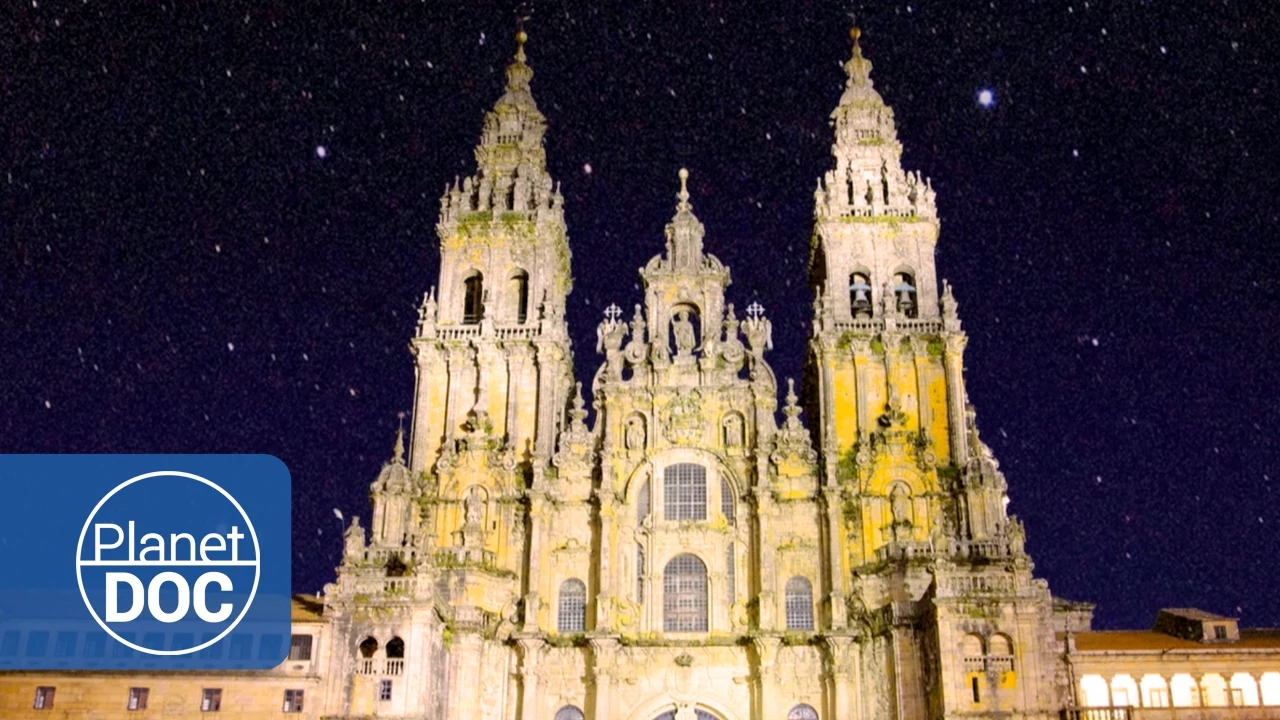
This is the magnificent Plaza del Obradoiro. Thousands of pilgrims from everywhere in the world have been traveling to this point for a thousand years. The perfect mix of touristic-sports adventure and religious sentiment make the Way of St.
James (as it is known in English) an incomparable experience. Even though Jerusalem, Rome and Santiago have been the three great destinations for pilgrims since the Middle Ages, the Jacobean Route to Santiago is the only one that is still traveled the same way today as it was back then: on foot and with little else than a shoulder pouch. It had been a long time since news of the discovery of the Santiago sepulcher had reached France.
Near the end of the millennium and in the fields of Aquitania, stories were told of pilgrims who went to worship the Apostle’s tomb to the far reaches of Galician lands, over in the Finisterre. Those were dark and dangerous times. Travelers from the peninsula spoke of bloody battles between Christians and Muslims.
Terror broke loose when the Saracen army flattened Compostela. Almanzor had destroyed its basilica and other churches and monasteries. The monks who fled were barely able to safeguard a few codexes and objects of great value.
But things later improved. With the Caliphate of Cordoba increasingly worn down, Christians had secured a stable border. Free from threats, the people of the north of the peninsula could rebuild roads, trace new ways and repair bridges, thus normalizing communication with France.
The chronicles spoke of the miracles of the Apostle. They said that they had been decisive in the fight against the Muslims. These prowesses helped increase devotion for the Saint even further.
It was the year 1065, and in the French village of Conques, they had been building a church for 20 years to house the relics of Sainte Foy, adored since the year 866, when a local monk brought them from Agen, the city in which, in the II century, she was martyrized at the age of 12. Works had been suspended and its builders had abandoned the city. Among them was Master Bernardo, who – along with his artisans - decided to travel to Spanish lands.
During the construction of the church at Conques, they had to face an endless chain of technical challenges. The problem was to combine the celebration of the usual liturgy with the demands of the pilgrims to worship the Saint’s relics. They needed more spaces, and by lifting the vaults, they got the space they needed to build tribunes.
This allowed for the transit of worshippers along the upper galleries. To ensure that pilgrims did not alter the liturgy, the lateral naves were extended behind the main altar, thus creating an ambulatory and radial chapels in which they could pray. Construction works like the one in Conques were often interrupted, forcing masters, masons and artisans to look for work elsewhere.
Chances of finding work increased in the different towns and cities, along pilgrimage routes towards western Spain. Because of the increase in the number of pilgrims, it wasn’t strange to find sanctuaries, hospitals or inns under construction. And because of this continuous flow of artisans, builders and artists, new developments, shapes and techniques, both in construction as well as in sculpture and painting, were transmitted.
The Way of St. James was not only a pilgrimage route it soon became a flow of transmission and creation of culture and art. It was the year 1073 - eight years after leaving Conques - when Master Bernardo decided to travel to Santiago.
He had heard that a new bishop, Peláez, wanted to build a new basilica, and he was very interested in participating in the new project. Alfonso VI had united under his crown the kingdoms of Galicia, León and Castilla. Once the Reconquista of the north of the peninsula was concluded and its roads cleared, pilgrims from different regions of Europe headed towards Santiago de Compostela along the four routes that crossed French territory and coalesced in the Navarran town of Puente de la Reina.
From there, one unique way would take them to Santiago. Bishop Diego Peláez decided to build a new church to replace the pre-Romanesque Basilica. After Almanzor’s ferocious attack, the reconstructed temple proved to be too small for the steady increase in pilgrims.
Master Bernardo, recently arrived from Conques, had updated the bishop on the architectural techniques they had been adopting in southern France. The Romanesque building that still stands today would soon get under way. But before learning of the process that led to building the magnificent and legendary cathedral, let’s go further back in time to the origins of this marvelous story.
The excavations carried out under the cathedral uncovered something more than the vestiges of the first temples dedicated to the consecration of the Apostle’s relics. Archeological remains uncovered the existence of a Roman village that dates back to the first four centuries of the Common Era. Many of their materials and structures were reused in the Middle Ages.
But we can still see the remains of the necropolis, some of its walls and part of its mausoleum – that in which the remains of the Apostle and his disciples were found, and which today constitutes the crypt that contains the urn with his relics. We fly over the city of Santiago. From up here, we can see the cathedral and near it, the church of San Félix de Solovio.
Thus according to archeological research, we can imagine the situation in the year 1. Where the cathedral now stands, there would have been a small Roman fortification, and in place of the church of San Félix, a small village of farmers, located on an ancient fort of Celtic origin. These sites remained for four centuries and starting in the V century, they were abandoned.
As the years passed, plant life covered the place, forming a lush mount. The small farmers village was reduced to a simple hamlet in which to gather cattle. And it is in this place where chronicles tell of a hermit known as Pelayo who, as he fasted, observed some lights shining on the ancient Roman citadel.
But Pelayo was not the only one to contemplate this phenomenon some shepherds were also witness to the strange lights. The event reached Teodomiro, the bishop of Iría-Flavia, which was back then the Episcopal See, and today is a parish in the Padrón municipality. Before such news, the bishop arrived at the site and discovered the entrance to a small sepulcher among the weeds.
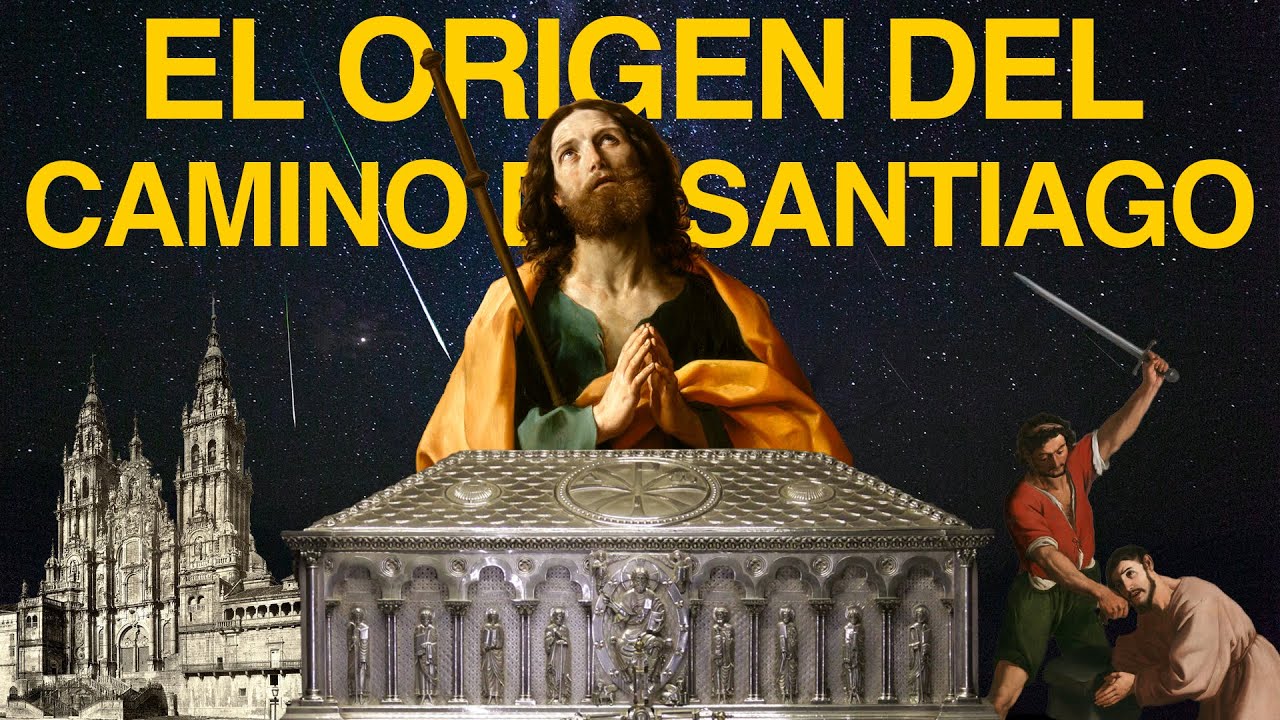
He discovered three tombs a few meters underground: the middle one protected by a slab of marble. Teodomiro did not hesitate to attribute these burials to the Apostle Santiago and his disciples Teodoro and Atanasio. In those difficult times of battles against Moorish forces, the finding proved to be transcendental for the entire Christian population.
Alfonso II, King of Asturias, decided to erect a basic but well-stocked sanctuary. A church was built above the sepulcher to worship the Apostle’s relics, and beside it, the small monastery of Antealtares, to house the community of monks that would look after the so-called Locus Santi Iacobi. Construction was finished in 830 and Bishop Teodomiro consecrated the first Church of Santiago.
Exactly where four centuries earlier a Roman village existed, the primordial nucleus of the future cathedral and city of Santiago now surged. One of the main finds of the 1955 digs was the sepulchral cover of Bishop Teodomiro, a transcendental figure in this story. It was he who revealed the nature of the sepulcher that was found thanks to those miraculous signals.
But, what reasons did Teodomiro have to affirm so conclusively that this tomb belonged to the Apostle Santiago? Various pieces of data had led Bishop Teodomiro to presume that the Apostle was buried in Galicia. In the year 700, Adhelmo - Bishop of Sherborn - and later on, the writings of Beda the Venerable, affirmed that the Apostle’s relics could be hidden in Galician lands.
But he knew that these writings had their base in V-century Byzantine texts known as the Breviary of the Apostles, in which, for the first time, Santiago’s Apostolate in Hispania is mentioned, and especially of his burial in the Marmaric Ark No wonder then that, after listening to the hermit Pelayo tell of the miraculous lights signaling the spot and discovering the hidden Roman sepulcher in which one of the tombs was covered with a marble slab, he identified it immediately as the Marmaric Ark – that which the writings signaled as Santiago’s sepulcher. After the death of Teodomiro, two events took place in the middle of the IX century that would be key to both the propagation of the fervor for the Saint Apostle, as well as to the development of the small Compostelan nucleus. The first – part myth, part reality – took place in the battle of Clavijo.
King Ramiro I’s Christian armies pulled back from the advances of Abderrahman II. Suddenly, the Apostle Santiago appeared on a white horse, causing the Saracen troops to disband and fall in defeat. From this point, the Apostle became the defender of Christianity against the infidels, and king Ramiro I established the Santiago Vow, forcing everyone to hand over their first harvests to the Church of the Apostle every year.
In the late IX century, the Bishop of Iría-Flavia built more solid and majestic church upon the former one, thanks to the help of king Alfonso III, the Great. The new Basilica was consecrated in the year 899. Without altering the sepulchers of the Apostle and his disciples, the temple was erected with three naves and three apses.
Besides this great work, reforms were carried out in the monasteries to improve the lives of the canons and monks. Various buildings were built, such as the chapel of the Corticela, to reinforce the brilliance of liturgical celebrations, as well as others, for the reception and care of the pilgrims, who, evermore frequently, came to worship the tomb of the Apostle and admire the new basilica. Having understood the origins of the sanctuary, we continue the story from where we left off.
It was the year 1074 and Bishop Diego Peláez studied the ambitious project of the French Masters for the construction of the new Basilica. Master Bernardo and Bishop Peláez’s plan not only affected the structure of the ancient temple, but called for annexing some of the surrounding buildings. As was the case in Conques and in other Romanesque churches that received pilgrims, the new Basilica had to be able to both accommodate great multitudes and hold religious services simultaneously.
The old cathedral, then, had to be demolished, to make room to make room for a new one with a Latin cross floor plan, three naves and an ample semicircular ambulatory with chapels around the crypt, so that the faithful could approach the Apostle’s relics without interrupting the liturgy. Unfortunately for Bishop Peláez and Masters Bernardo and Roberto, their wishes were cut short thirteen years into construction. During these years, they only had time to build the three central chapels of the ambulatory: the ones dedicated to the Savior , Saint Peter and Saint John – as well as the walls that connected them.
In the right wall of the Savior’s chapel, we observe an incomplete inscription – if we add the characters that are missing, we can read: ANNO MILENO SEPTVAGENO QUINTO FUNDATA JACOBI. This legend shows us that in the year 1075, the foundations of the cathedral were laid. Diego Peláez played an important role as bishop of Iría-Flavia.
Besides undertaking the grand project of the cathedral, he substituted the traditional Mozarab liturgy for a Roman one, but his zeal to defend the wealth of the church earned him enemies. Accused of high treason for having collaborated with the Normans and English, he was captured in 1088 and, by order of the king, dismissed as bishop of Compostela. Luckily, there are times when history correct the errors of men and presents us with exceptional characters, and there is no doubt that this is what happened in that time.
He had the sensation that everything had gone by too fast. Twenty years had gone by since Diego Gelmírez traveled to Rome to be named bishop. The position had remained unfilled for four years after Pope Urban II transferred him from Iría-Flavia to Compostela in 1095.
As he admired the basilica at Conques, he dwelled in his eagerness to convert Santiago in the second great center of Christianity after Rome. In order to achieve this, Santiago had to somehow emulate the characteristics of the Holy See. The Santiago basilica had to live up to expectation and this trip was allowing him to get to know the monumental works of art that were being created throughout Europe.
Upon his return, he would analyze all this information with the master builders in order to implement it in the new designs. In the year 1101, while in Santiago – after being named bishop by Pope Paschal II - Diego Gelmírez initiated his projects. The first would be the conclusion of the cathedral.
By that time, artisans and builders led by Master Esteban had just finished the apse of the church, adding the final touches to the ambulatory with the two chapels that were missing and with the apse triforium. And they had erected part of the transept building and decorated its four chapels. Bishop Gelmírez had the opportunity to see firsthand the main workshops specializing in Romanesque art in Toulouse, Conques and Cluny.
It was apparent that if he wanted the Santiago church to become that great Apostolic see, it had to be at the vanguard of art. To this end, he patronized continuous exchanges between Compostelan builders and the most advanced constructors of the times. The Way of St.
James had definitely become a torrent of culutral and artistic exchange between Galicia and the rest of Europe. The fruits of this cultural internationalism arrived quickly. At each side of the gigantic transept, two monumental and sculptured façades were lifted, in which two of the three main doors to the basilica were placed.
To the north, the Puerta Francígena, through which the pilgrims finalizing the French way entered. And to the south, the Puerta de Platerías lifted above an atrium that gives access to the Episcopal Palace. The first portico, highlighted for its great beauty in the Codex Calixtinus, was destroyed around 1757, and was substituted by the present Puerta de Azabachería.
Some of its pieces are still conserved in the cathedral museum. The façade of the Puerta de Platerías has lasted until our time, but its appearance was immediately modified: still in the days of Bishop Gelmírez, it suffered the ravages of a fire. The original reliefs were adorned with various pieces from both the original Francígena door and from earlier works.
In the year 1102, Bishop Gelmírez and his entourage transferred the relics of Saint Fructuosus, Saint Cucuphas, Saint Sylvester and Saint Susana from Braga to Santiago. Some of them can still be found in the Chapel of Relics in the cathedral. The so-called “Pious Latrocinium” managed to attract even more pilgrims and wrested importance from the Braga See.
Even though an increasing number of pilgrims came to worship Santiago’s relics, both the Compostelan diocese as well as the Jacobean belief and practice needed new drives. With the purpose of consolidating his plans as an Apostolic See, Pope Calixtus II, in 1120, raised Diego Gelmírez to the rank of Archbishop, thus raising the metropolitan dignity of Santiago’s church above Merida’s. He then launched the writings of texts that spread and consolidated Jacobean tradition.
And thus the Codex Calixtinus was born. The original manuscript is still conserved in the Santiago Cathedral. The text is divided into five books: The first provides an ample list of liturgical texts dedicated to Santiago; The second contains the miracles carried out by the Apostle in the different routes of the Way of St.
James; The third tells of the prodigious events related to the transfer of his body from Palestine to Galicia and how it was deposited in the sepulcher; The fourth, known as the Turpin Chronicle, narrates the coming to Spain of Emperor Charlemagne to free the ways leading to the Apostolic tomb. And finally, the fifth consists of the famous guide for pilgrims from France to Santiago, attributed to the French clergyman Aymeric Picaud. The appendix contains various hymns and poems in honor of Santiago, a basic reference for Western polyphonic music.
These are the moments of greatest splendor for the Jacobean cult. Thousands upon thousands of pilgrims from all over Europe head for Compostela to worship the Saint. Roads are repaired, new burgs and cities appear, hospitals and inns are built… The Way of St.
James undoubtedly transcends its religious function and becomes a torrent for cultural and economic exchange and development between the lands of northern Spain and the rest of Europe. Diego Gelmírez had achieved all of his goals: the construction of the cathedral was well on its way and it was a benchmark for European Romanesque art; its diocese had metropolitan dignity; and Santiago, thanks to its new constructions and to its support of culture, was seen as an open and prosperous city. For some of his fellow citizens, these successes did not stop them from taking cowardly advantage of his age and illness by perpetrating shameful attempts at his life.
But Bishop Gelmírez, accused many times of greed for wanting to enlarge his church and his region, always pardoned those who insulted him in order to take credit for his achievements. Finishing the cathedral was taking longer than expected because of a lack of resources and its vast complexity. It was early in the year 1168 thirty years had passed since the death of Gelmírez and King Fernando II, upon witnessing the unfinished building, entrusted Master Mateo with the conclusion of the cathedral.
One of the greatest difficulties the builders faced was the slope of the ground between the apse and the western end. To solve this problem and finish off the naves, Mateo decided to build a crypt that would help level the ground and serve to support the structure of a new and innovative portico one that would introduce the new Gothic style in the temple. The Pórtico de la Gloria is one of the most beautiful works of the Compostelan temple.
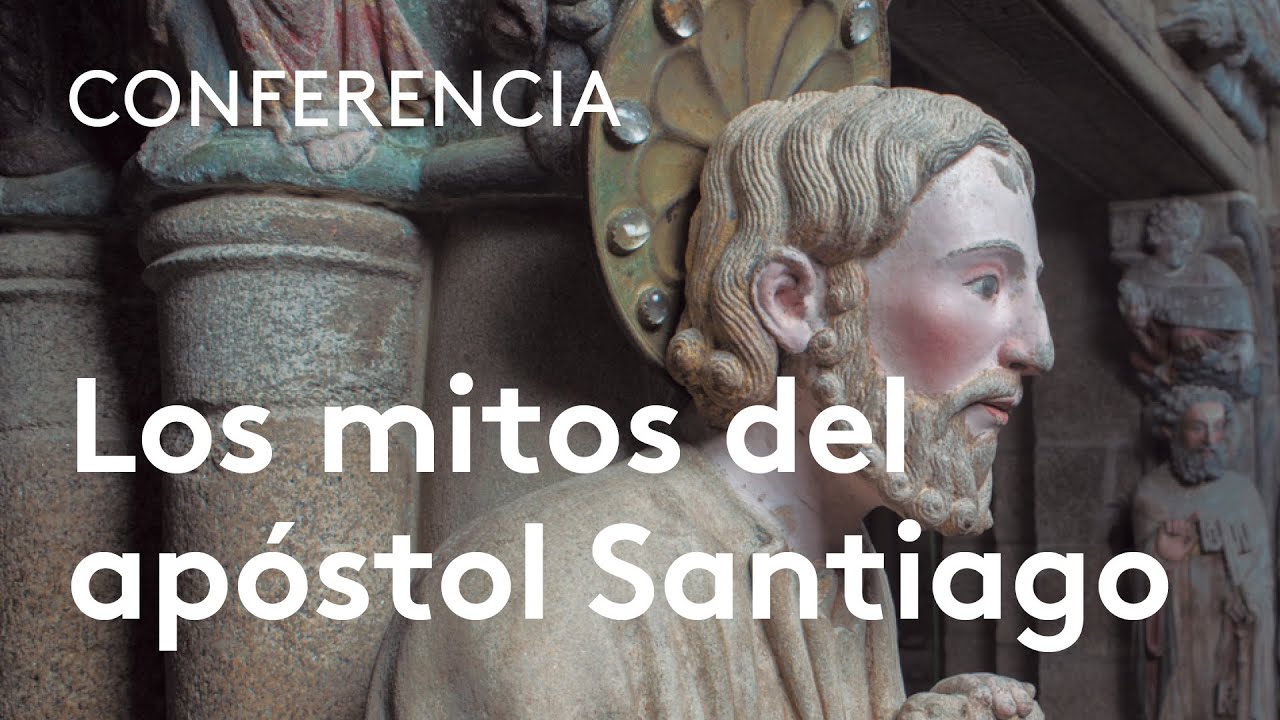
It constitutes the atrium of the cathedral and is structured on three vanes that coincide with the naves of the church. It is presided upon by the seated statue of the Apostle Santiago, who, from his mullion, or central arch column, welcomes the pilgrims. Once Master Mateo finished off the western façade and built the majestic stone choir – which today can be seen in the cathedral museum - the building was finished.
And finally, on April 21 1211, Archbishop Pedro Muñiz, in the presence of King Alfonso IX, consecrated the Romanesque cathedral of Santiago. Today is a very special day. Pope Benedict XVI visits Santiago and its cathedral.
This year, the day of Santiago Apostle falls on a Sunday, and when this happens, the Holy Year at Santiago de Compostela, or Jacobean Year, is celebrated. Taking a cue from the Christian Jubilee that originated in 1300, pilgrims that arrived at the Holy Sepulcher during these Jubilee years would receive full indulgence for their sins. Such a privilege was conceded two centuries after the consecration of the Romanesque cathedral by Pope Martin V, thanks to the dealings of then Archbishop Lope de Mendoza.
The first Jacobean year was in1428, and since 1434, they have been celebrated regularly. This huge event required the repair of certain parts of the basilica that were harmed during the previous centuries’ attacks. The main repair work resulted in the construction of the present gothic lantern tower.
And it is very possible that the idea to hang a great thurible from it was due to the scaffolding necessary to undertake this work, thus giving way to the ingenious botafumeiro. The first reference to the botafumeiro appears in a marginal note of the Codex Calixtinus, written precisely in the dawn of the XV century. It links it to the grand solemnities celebrated in the interior of the basilica.
The Renaissance reached its zenith in Spain in the XVI century and it is evident that the Santiago Cathedral and its surroundings absorbed its influence. This is precisely when the new cloister, substituting the medieval one, was built. The works began in 1509 and in this project some of the most famous Masters of the Spanish Renaissance participated, such as Juan de Álava and Rodrigo Gil de Hontañón.
In it exterior, the palatial Treasure façade and its famous stepped tower were built. Later on, this façade would be completed with the Torre de Vela, inspired by the former. Also in the XVI century, the Plaza del Obradoiro begins to take shape when the Hospital Real for pilgrims and the sick is constructed.
The Catholic Monarchs undergo a pilgrimage to Compostela to thank the Apostle Santiago for their conquest of Granada. Seeing firsthand the great number of worshippers, they promote its construction. Currently, it is known as the Hostal de los Reyes Católicos, and it is one of the most beautiful buildings of the Spanish Renaissance.
Later, the building of the present steps that give way to the Pórtico de la Gloria, built by Ginés Martínez, would get underway. A gallery of ionian columns would lend even more splendor to the plaza del Obradoiro A series of events had caused a reduction in the number of pilgrims to Santiago since the XIV century. The horrifying black plague that decimated the European population, as well as the great schism that divided Catholics in 1378, rang in this crisis.
During the XVI century, Martin Luther’s Reformation caused a whole new schism that fully affected Compostelan pilgrimages: after harshly criticizing this practice, he effectively uprooted Jacobean devotion in central European nations. In 1589, Archbishop Juan de San Clemente was warned that the pirate Francis Drke had leveled A Coruña in response to the failed invasion of the Spanish Armada. The Archbishop proceeded to bury – in complete secrecy – the relics of the Apostle behind the main altar of the cathedral.
The disappearance of the remains of the Apostle worsened the crisis of the Jacobean route. The arrival of the canon José de Vega y Verdugo at Santiago would be a determining factor in the baroque metamorphosis of the old medieval cathedral. In 1656, the cabildo approved a set of ambitious remodeling projects backed by the financing of King Felipe IV.
The purpose of the canon was to superimpose new architectural and baroque ornamental structures on the interior and exterior of the cathedral, while keeping the original Romanesque floor plan. These architectural reforms began in 1658 with the complete remodeling of the main chapel and the construction in the cathedral’s apse and of the Pórtico Real de la Quintana, with the purpose of dignifying the Puerta Santa the pilgrims’ access during jubilee years. The transformation of the apse of the basilica culminated first with the new dome atop the gothic lantern tower, and later with the construction of the clock tower.
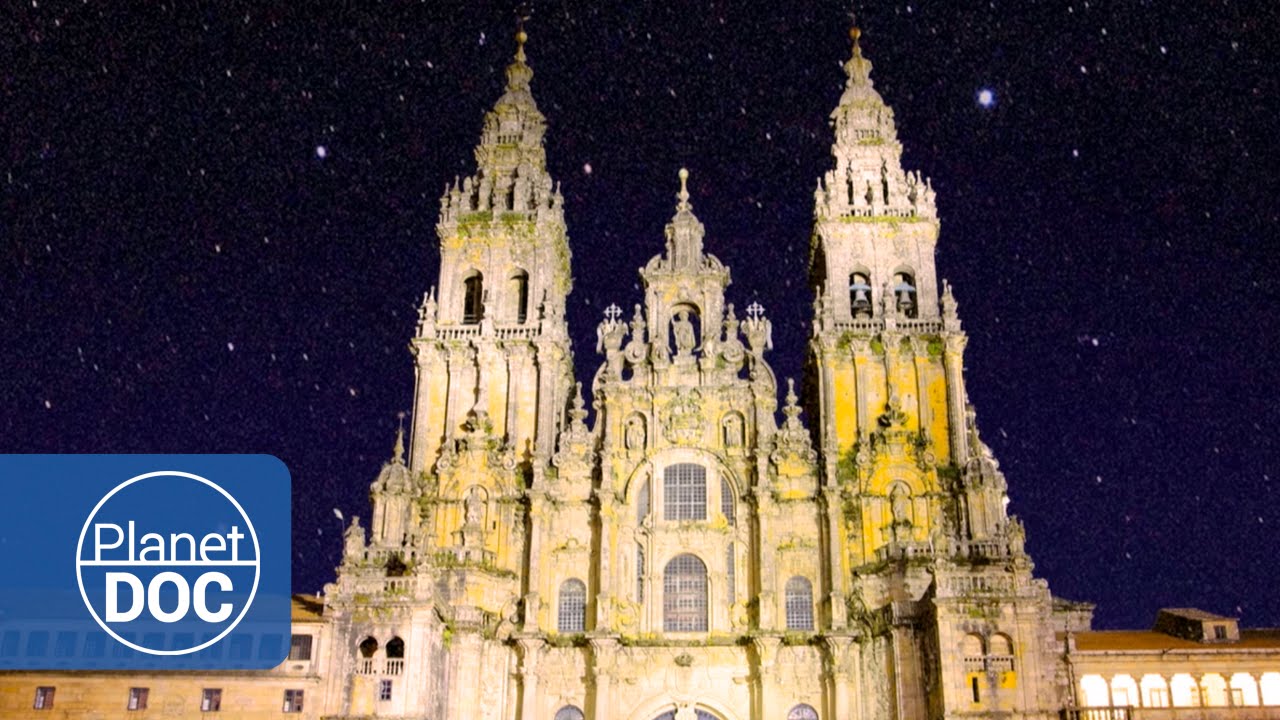
The medieval crenellations became huge balustrades and thus, little by little, Gelmírez’s Romanesque legacy became hidden under a modern baroque cover. But the metamorphosis was not yet complete. The baroque masking needed to be rounded off with a new façade in the Plaza del Obradoiro, and the architect Fernando de Casas was entrusted with the task.
After many proposals, a new façade was finally built replacing the one Master Mateo had constructed. The two medieval towers were raised and their heights were equaled. And in the central body, one of the largest windows ever built so far was opened to illuminate the inside of the cathedral.
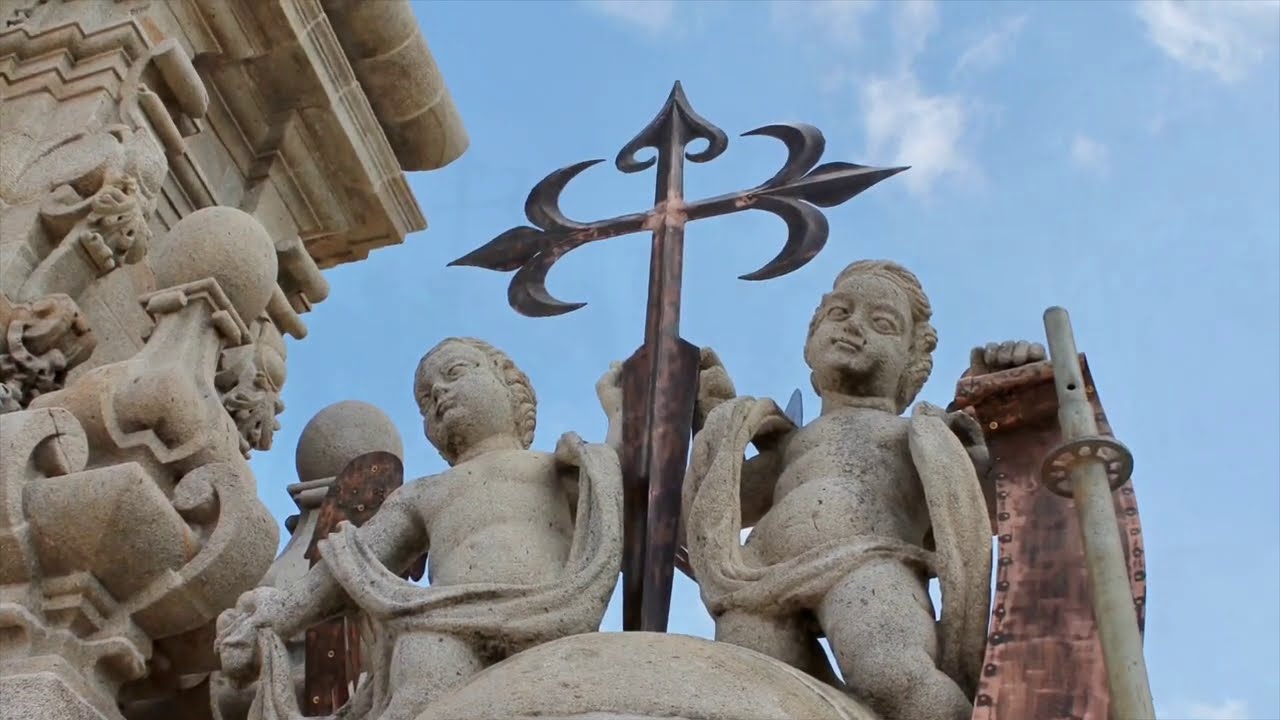
Under a recess, the complex is presided by a sculpture of the Apostle Santiago wearing the pilgrim´s habit. At his sides, two pairs of angels with the cross of the Order of Santiago. Under him, his disciples, Atanasio and Teodoro – also dressed as pilgrims – flanking an urn that represents the Apostle’s sepulcher.
And a star the one the Hermit Pelayo saw where today stands the Temple of the Stars. Although the Way of St. James managed to recapture part of its prestige in the XVIII century, a crisis relapsed with the great social changes of the XIX century.
The low point came on July 25 1867, when only 40 pilgrims attended the Apostle’s festivity. But during the course of the 1879 dig, canon López Ferreiro found the relics that had remained hidden for three hundred years. In 1884, Pope Leo XIII declared their authenticity and extolled the populace to undertake pilgrimages to the holy sepulcher.
The papal document was key to the revitalization of Jacobean faith. Since then – and until today - an increase in the number of pilgrims to Compostela has not waned. The visits of Pope John Paul II and later Benedict XVI in the Holy Compostelan year of 2010, surrounded by a fervent multitude of pilgrims from all over the world, are a testimony to the magnificent vitality the Jacobean cult has today.
But not with standing all the changes, the works of Peláez and Gelmírez, of Masters Bernardo, Esteban, Mateo, and countless others, still remain unaltered and recognizable. In the spaces within its naves, columns, tribunes, chapels and porticos, the spirit of all those who contributed to its erection is conserved.