If you're a software developer, you know that things are kind of tenuous for us right now. The prevailing wisdom seems to be that software development as a career is going extinct, although I think that's largely based on a mis- misunderstanding, and I'll get more into that later. So as I write this, the OpenAI's O3 model was just announced, although we can't look at it yet.
And as always, there have been a ton of claims made about how much better it is at programming and tasks than any model before. I'm skeptical that it's really going to turn out to be that much better, but we should find out sometime in the next few months. 2025 looks like it's going to be a wild year for us.
But no matter how good O3 might be, there are things that experts believe that this generation of AI's just cannot be capable of, both in general and with respect to software development in particular. Today, I want to talk to you about what developers can learn to do that these AI's can't and why and how you can go about learning it. So to get this out of the way, the limitations I'm talking about are based largely on the work of Simon Prince, the author of this book, Understanding Deep Learning, link below.
He did an interview that I've recommended before on the Machine Learning Street podcast: "It really has no way to learn anything new, other than its context vector, which it forgets every session. And it has no way to even remember that. So missing all kinds of parts of the puzzle, I don't see how you could look at that and think of a super intelligence is around the corner.
" Although really the whole interview is worth watching. And the book has been instrumental in informing my understanding of our current circumstances, although it's an $80 500 page textbook with lots of math and a 49 page bibliography. So I wouldn't necessarily describe it as approachable, or recommended for everyone.
In the unlikely event that he's wrong, and that I'm wrong, and then open AI's O3 model is actually super intelligent, then this Chanel is garbage, YouTube will soon be replaced by The Matrix. No job is safe, human life is irrelevant, and all we can do is bow our heads and pray to Roko's Basilisk that it might not torture us for all eternity. More info on The Basilisk below, although you might not want to hear about it.
What could possibly go wron---- This is the Internet of Bugs. My name is Carl, and I've been a software professional for more than 35 years now. I believe that the Internet has way, way too many bugs already, and that AI is in the process of making it much, much worse, and I'm trying to reduce that as much as I can.
So today's AIs have limitations. Today, I'm just discussing the serious constraints they have when it comes to actually writing code. So, One: they can only learn the kinds of things that are in their training data.
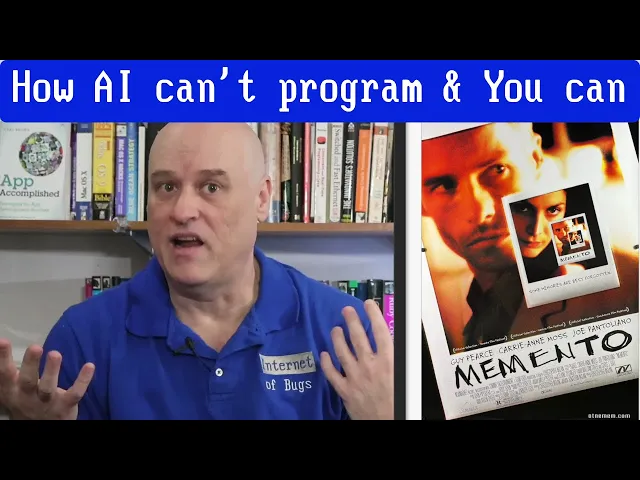
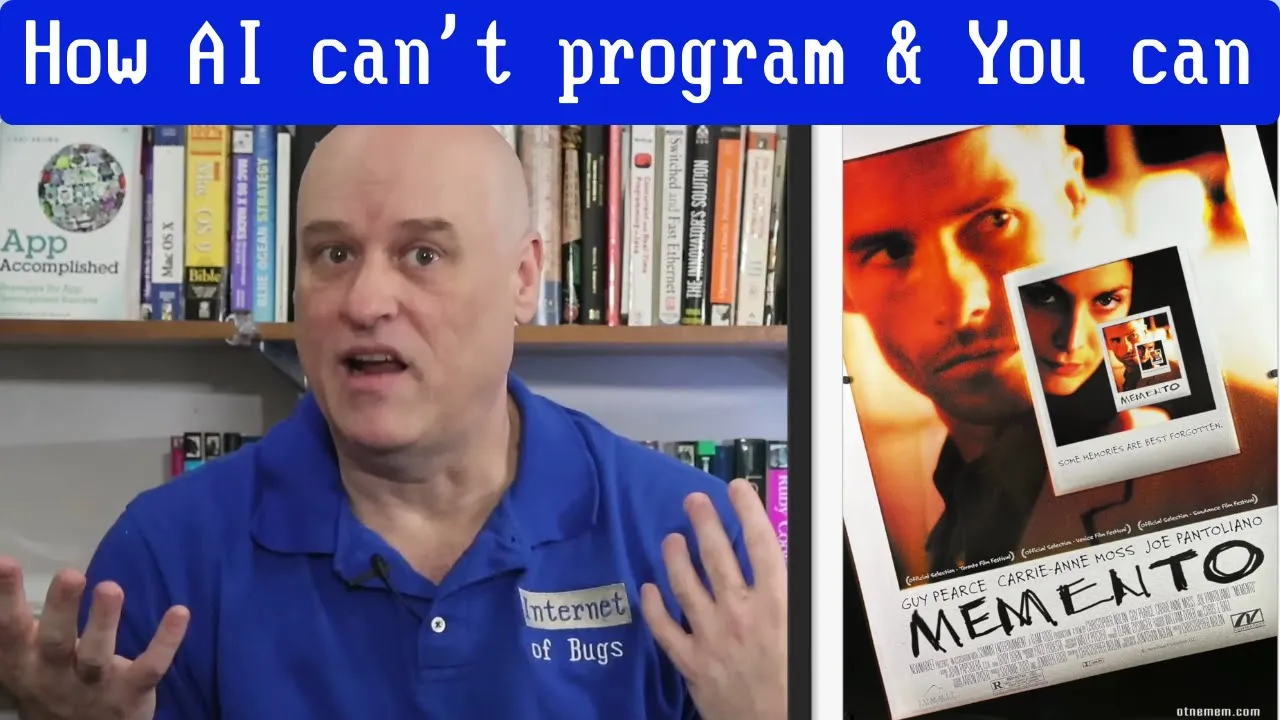
Two: they are frozen in time. They can sort through an enormous amount of information in a short order, but they effectively have no ability to form long-term memories without expensive retraining. If you've seen the movie Memento, they're basically that guy.
They can read a previous conversation as part of a prompt at the beginning of a new question, but that's as close as they can get to improving. How much would you want the Memento guy working on a software that you depend on? Three, they are severely limited in the amount and breadth of context that they can work with.
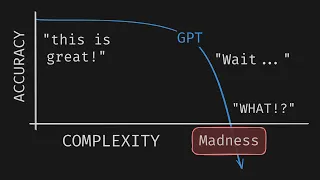
There's a lot of work being done to try to increase this, but there are a number of significant hurdles, including what's called the "lost in the middle" problem, more on that below. But even if all the latest mitigation work were magically succeed, it's nowhere near the amount of context that you or I are capable of understanding as humans. So the things that AIs can't learn are the things that require a lot of context and that don't appear in documents scraped from books and around the internet.
In other words, the things that can't be learned from classes and books, but only can be learned from experience. The good news is, you can learn such things. The bad news is, it's not really a quick process.
But from where I sit, software developers have two choices, either leaning to learning the things that this generation of AIs can't get good at, or watch as the AIs chip away at your job's tasks until there's nothing left for you to do. Well, three choices, if you count "Pray to the Basilisk", but I don't. Here's the thing anout software bugs: with a rare exceptions caused by short-term thinking.
usually for cost-cutting measures by some MBA or something, Non-trivial bugs on the internet aren't intentional and the vast majority of them aren't even found until after they've been released. Those bugs aren't found by the programmers. They're found by people using the software, often in ways and in contexts that weren't considered while the code was being written in the first place.
This is the crux of the matter. The AIs can only ever generate software in the context that they've been given in their prompt, but you can learn to expand your context with experience. You can look in a situation and recognize the kind of things that could cause problems in the future, and unlike the AI, you can find out what your blindspots are and you can learn to compensate for them over time.
With practice and the right mindset, you can develop an intuition for what can go wrong and how to avoid it. It'll never be perfect, but you can get better and better, and it doesn't take that much work to be a lot better than the AI on this kind of thing. Now this isn't the kind of thing that anyone can comprehensively write about as they're way too many variables, which means it'll never show up in a training set for an AI.
The best that we can do is speak about it in the abstract and talk about it by example. So here's an example: Ten years or so ago, I did some time working in Amazon. com's Logistics division.
Among other things, I wrote the storage layer, the narrow player, the storage state machine, the integration test suite, and the core logic for the system that the delivery drivers use to drop packages off on your porch. So early on in the project, I identified we had a potential problem. We were required to exchange time information over the network using "Epoch Time," the number of seconds in some arbitrary date.
This is the way most Unix systems handle time internally. But it's a really, really bad idea to use that on the network. In fact, a group of smart people realized that it was such a problem.
They created a standard way of handling dates over the network that avoids these issues back in 1988, when I was graduating from high school. That standard is called ISO 8601. So I proposed that we used ISO 8601, and I was told that we at Amazon had to stick with the corporate standard.
My intuition, based on the 25-ish years of experience I had at the time, told me that we would have problems, although I couldn't guess exactly what they would be. So I put in some extra code and tests to handle a couple of issues I could think of, and then I just crossed my fingers, 'cause what else I was gonna do? And sure enough, we had problems.
The worst ones were related to drivers who were scheduling their shifts for future dates. The bugs usually appeared when someone was signing up for a shift while they were either on vacation or right before a daylight savings time change. In the event that the time zone that the driver was in when they scheduled their shift was different than the time zone they were being when they showed up for work, their schedule would be off.
And when I left the project, that was still a problem. Hopefully, they managed to get fixed by now. My intuition at the time was good, but it wasn't good enough.
If I thought of the context of shift scheduling while in a different time zone, I could have either tried to compensate or used that as a further argument that we needed to use the ISO 8601 dates. Probably still would've lost that argument, but that's another story. But that's the kind of thing that AIs can't do.
They can't recognize when they need to change their context, they can't imagine how user situations might be different from what they expect, and they can't recognize that a bug now is the consequence of thought processes involved in a decision that was made months ago and use that to improve themselves and their decision making process. In fact, even if the AIs get as good as real humans, as unlikely as I think that is, the AIs probably <i>still</i> won't be able to do that because the vast majority of human programmers I work with can't do it either, including the folks at Amazon that refused to change the corporate standard because they thought it would be good enough. I discussed this some in my "starting a side project" video.
You can go here for more information, but the thing that most programmers are missing and the thing that you can't get in school, is the experience of putting your code out in the wild, seeing what goes wrong, understanding what you could have done if you thought of it, to avoid the problems and then applying that new knowledge in the future. Like I said in that video, most developers only ever work as part of teams, and they only care about the development side, not the operations side. They don't have to deal with the consequences of their decisions, they don't have to wake up at two o'clock in the morning when something breaks, they don't care to learn.
A ton of managers are like that too, and most big companies are structured in such a way that they can get away with that. This is the kind of programmer or co-worker that you've seen that grumbles or complains when a bug report comes in and whose preferred solution is, "I can't reproduce that, so it's not a real problem. " Now, they're bad programmers, and they should feel bad, and if your natural reaction to a bug report coming in is, "I don't want to have to reproduce that," then you're a bad programmer and you should feel bad, too.
Bug reports are an opportunity to learn what went wrong and to learn how it could have done better and to improve, but most programmers are that kind of bad programmer. Most programmers and managers operate on an "I did my part. The rest of it is someone else's problem" basis.
Now, this is exactly the same way that the AIs operate. When asked, an AI to write code, it spits something out and that's the end of its involvement. Once that conversation is over, it's done.
If later somebody brings the AI a bug in that code to look at it, it's treated as an entirely new issue and all the context would have been lost. It can reread through the previous conversation, but that's not the same thing. If you want to be better than AIs can be, you have to avoid that mindset.
There's a blind spot here that most people, even a lot of good developers, have about our work. Unlike the way that AIs generate code, the way that schools teach and test computer science students and especially the way that programming interviews screen candidates, the true nature of the work programming is this: The work does not just stop. In fact, most programming work is not "Done" for years if not decades after the first release.
Even after every member of the original team has long left the project, the work of maintaining that code can continue, maybe for as long as a human generation or more. This is the misunderstanding I mentioned in the introduction. People, even a lot of developers, tend to talk about whether or not an AI can replace a programmer in terms of whether or not the AI can perform some discrete tasks that the programmer does on a daily basis.
But that's not the job, at least not if you're doing it right. A lot of developers, a lot of teams get this really wrong though. A lot of programming is done such that each code change is treated independently of all other code changes.
This is the way that an AI would do the work and it creates a ton of bugs. It's easy to spot if you look from the outside. It's what causes a bug fix or a patch or a new release to have new bugs in it that didn't exist in previous releases.
Now I'm not talking about a new added feature that contains bugs. I'm talking about a thing that used to work, but it doesn't anymore. When done correctly, outside of new features, the number of new bugs in each release should go down dramatically because what we can do, if we try, is understand that a bug we're working on now was caused by, or at least contributed to, some trade-off we had in mind when we made the decision some months ago, and when we not only fixed that bug, we can learn to recognize similar trade-offs when they come up again so we can avoid similar problems occurring in the future.
We actively look for other places that mistake was made and we clean them up before they can start causing problems. In addition, good experienced developers know to consider the future maintenance effort when considering any change. Often, I've had to push back on changes that seem simple to implement because I knew that the cumulative scar tissue of adding many, many little one-off features released after release makes for a very fragile system.
A human can learn that, but it doesn't fit into a StackOverflow answer or a Reddit post or a LeetCode riddle, so the AI's don't have a clue about it and to the extent that it's discussed in blog post or videos like this, it's too abstract for an AI to actually act upon. There's also an additional complication that the AI is particularly bad at dealing with, which is when the environment around our code is changed outside our control and we have to deal with it. It's very common these days for new security issues to be found or for new bugs to be introduced into the operating systems or libraries or browsers that our code runs on top of.
When the same code is last time suddenly starts behaving differently than last time on the same set of circumstances, it must be because something else changed, but often we don't even know what. The first step when that happens the last few years is for most programmers is to type the problem they're having into Google or stack overflow, and hey, I've done it too, but there are times when there just aren't any answers or worse there are answers, but they're all out of date and they're no longer relevant and they just waste your time. Most programmers these days know that sinking feeling of realizing they have a new problem that they can't copy-paste their way out of.
Those are the cases that AI can't help with because the solutions don't yet exist so they can't be found in the training data. But I promise it is possible to learn and fix those bugs. At the risk of doing the "back in my day" thing, I had been getting paid to program for 10 years before there even was a Google.
We did it without Google or stack overflow or AI back then, and it's still possible at least when it's needed. And you learn to fix those bugs by putting in the work of fixing them. And then by looking back on how that bug came about and how you might have prevented it.
If you've got a job right now, you can start by looking around at your job for those bugs that don't have easy answers and volunteering to work on them. Get to know the QA and the operations folks at work. Learn what they're seeing that most of your team is ignoring.
That might work depending on where you are, although a lot of corporate structures make that difficult. In general, the smaller your company and the smaller your team, the easier it will be for you to be able to work on these kinds of problems. I've spent a lot of time at startups and they have lots of opportunities to understand the full product and work on that kind of thing.
People tend to care more also because if the product fails, we're a lot of a job, but startups also have a work-life balance and stress issues though, so it's not a panacea. But it is possible to take on that responsibility even in many larger organizations if you're willing to do the work and put up crap from some people around you. Another quick example: This is a photo of a bunch of empty delivery bags with barcodes on them from my time at Amazon.
Each one of those represents an actual product that I bought myself with my own money and then acted as my own delivery person and delivered to myself as the customer using the system my team was building at the time. I wasn't required to do that. In fact, several people, including my managers, got upset at me about it.
Although since I was spending my own money, the only way they could have stopped me would have been firing me because I went outside my part of the organization and I worked directly with the folks at the local distribution center to set up my accounts and my permissions to be able to do that and I got to know a bunch of those folks in the process. They were thrilled to have someone from development that actually cared about their perspective for once and I learned a ton from working directly with them that I couldn't have discovered otherwise. It made me a much better programmer and it made our system much more reliable.
I don't know of anyone else had Amazon in development who spent their own money to test a product that they were developing, but it was definitely worth it to me. So you probably can find a way if you try hard enough, but if you can't get access or time or permission to work on those problems or just don't want to wait, then your best bet is to build your own project. The easiest way to do that these days is to build what's called a "Software as a Service" or "SaaS" project.
The startup costs are tiny, it's mainly just your time and labor, the only potential risks are legal and in my personal experience those have been quite small. That might not be true for you, it depends on too much on your local laws and your employment contract if you've got one and the only thing I can advise about all that kind of stuff is just to talk to a lawyer and maybe an accountant too. I know that stinks, but these days it might be a good idea for everyone to know a lawyer.
Like I said in my "Starting a Side Project" video, running your own thing-as long as people are using it so you can learn from their bug reports and feedback-is the best way to learn to be a better programmer. I encourage every single programmer to do that, but it's even more important than that these days if you want to be in this profession long term. Being a better programmer is useful and important and I want all of you to get better because the better you all get, the fewer bugs the rest of us will have to deal with, but these days as the AIs get better and better, being a programmer who has experience specifically in the kinds of coding skills that the current type of large language model AIs aren't good at and cannot be good at, is a far more valuable, if not irreplaceable, skill.
So I've got some more videos in the works about starting and building your own software as a service project and now that I've wrapped up my involvement in a data warehouse consulting project that can seem most of my time at the end of last year, I'll be able to devote more time to this channel and post more regularly. So subscribe if you're interested in seeing more on that kind of stuff. Until then, keep an eye out for opportunities to understand how the bugs you see today were caused by the decisions you made in the past or someone else made in the past and seek out the tasks that Google doesn't have good answers for and remember, the Internet is full of bugs and anyone who says different may well be a crappy programmer trying to find an excuse not to have to fix their crappy code.
Let's be careful out there.