If I asked you, "What do you know about the 24 elders in the Bible? " would you be able to explain it? Or would you change the subject real quick?
If you're in that situation, you're not alone. Because for some reason, most churches don't go deep here. They'll skim it, mention it, move on.
But why? Why would we overlook the only group seated around God's throne, wearing crowns and throwing them at his feet? These elders aren't background characters.
They're central to the throne room vision, and they appear again and again during heaven's most critical moments. No worries. We've got you covered.
By the end of this video, you'll not only know who the 24 elders are, you'll understand why they matter more than most of us ever realized. So, let's step into the heavenly scene painted in Revelation 4. Thunder shaking the atmosphere.
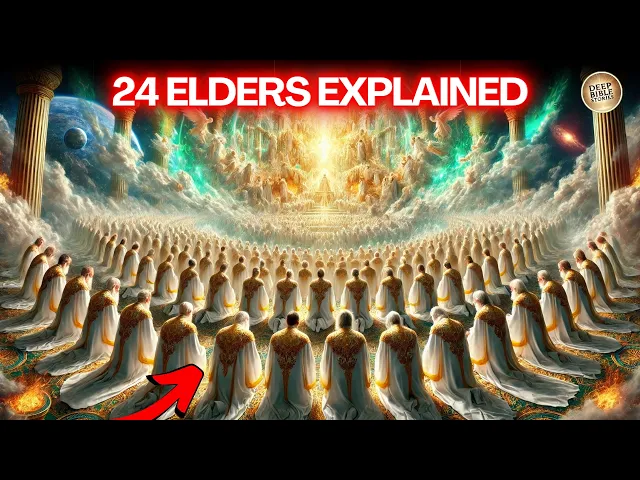
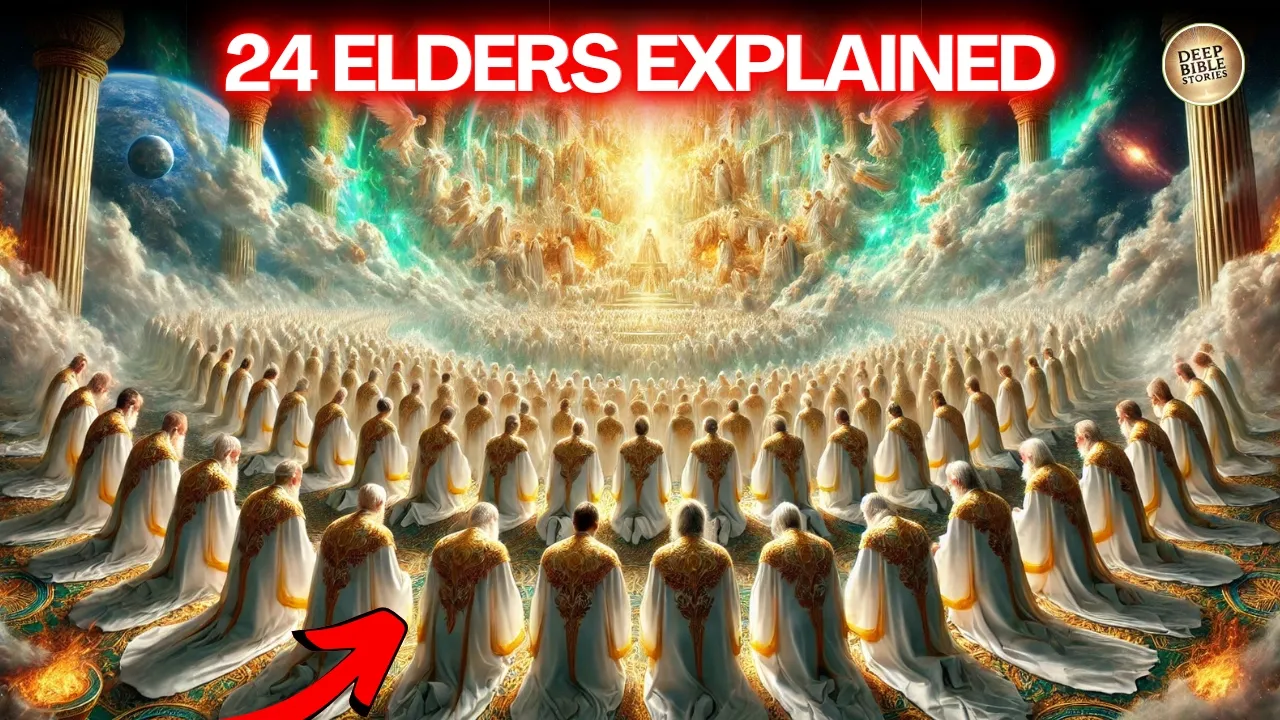
Flashes of lightning radiating from the throne. A sea of glass like crystal spreading before it. And circling that throne, 24 elders dressed in white, crowned with gold, seated in power, yet always falling down.
Who are they? Why are they seated so close to the Almighty? And what does their continual worship reveal about God's kingdom?
and how we're meant to live here and now. Let's begin. He was exiled on an island, alone, forgotten.
But in one sudden moment, John was no longer staring at barren rocks and crashing waves. He was standing before the throne of heaven. Revelation 4 begins with an open door in the sky and a voice like a trumpet saying, "Come up here.
" The next words, at once I was in the spirit. What follows is not a dream. It's not poetry.
It's a revelation, a divine unveiling of the heavenly realm, the command center of eternity, the court of the King of Kings. And at the center of it all, a throne. John writes, "Behold, a throne stood in heaven with one seated on the throne, and he who sat there had the appearance of jasper and ruby, and around the throne was a rainbow that had the appearance of an emerald.
" What John sees isn't chaotic. It isn't random. Heaven is ordered, perfect, structured in beauty, and filled with unimaginable glory.
Lightning flashes, thunder rolls, voices erupt. Seven blazing torches burn before the throne, representing the seven-fold spirit of God. A sea of glass stretches out before him, clear as crystal.
But then 24 thrones surrounding the central throne of God are 24 smaller thrones, and seated on them not angels, not nameless figures, but elders. They wear white robes, robes promised to the faithful in Revelation 3. They wear golden crowns, Stephanos, the victor's crown.
Not a king's diadem, but a crown given as reward. These aren't decorations. They're declarations.
These elders have triumphed. But here's what shatters the image of earthly power. Every time the living creatures give glory and honor and thanks to the ones seated on the throne, the elders fall down.
They cast their crowns and they cry, "Worthy are you, our Lord and God, to receive glory and honor and power. " That's the rhythm of heaven. It's not silence.
It's not stillness. It's worship, constant, contagious, explosive. The 24 elders sit in proximity to unimaginable authority.
But they do not cling to position. They surrender their crowns over and over again. What does that tell us?
It tells us that in heaven, worship is the highest form of power. That authority in God's kingdom does not elevate. It bows.
That the ones closest to the throne are not the ones shouting orders. They're the ones falling down. It turns our idea of greatness upside down because these elders, whoever they are, aren't bored.
They're not passive. They are locked in adoration, completely captivated. Their crowns are not their prize.
They are offerings, gifts, and they keep giving them back. In Revelation 5, the scene intensifies. A scroll sealed with seven seals is brought before the throne, and no one in heaven or earth is found worthy to open it.
John begins to weep loudly until behold, the lion of the tribe of Judah has conquered. The Lamb steps forward, slain yet standing. And when he takes the scroll, all heaven erupts, the living creatures fall down.
And the elders, they each hold a harp and golden bowls full of incense, which are the prayers of the saints. Then they sing, "Worthy are you to take the scroll and open its seals, for you were slain, and by your blood you ransom people for God from every tribe and language and people and nation. " The elders don't just worship, they intercede, they sing, they hold the prayers of the church.
They are active participants in the unfolding of God's redemptive plan. They don't just witness history. They are woven into it.
And what about their placement? They are not on the outskirts of glory. They are around the throne, encircling it, participating in every response, every revelation, every act of worship.
That word around matters. It speaks of honor, nearness, inclusion in divine activity. These are not background extras.
They are part of the inner circle of heavenly operation. Which raises a vital question. Why them?
Why 24? Why do they get this closeness, this access, this authority? That's the mystery we'll begin to unravel next.
But before we move forward, let's pause and ask, would you surrender your crown if you sat that close to glory? Or would you clutch it tighter? Because in the heavenly throne room, true power isn't proven by what you hold, but by what you're willing to lay down.
The scene is clear. 24 elders seated around God's throne. They wear white robes.
They hold golden crowns. They sing. They fall down.
They hold the prayers of the saints. But the question that refuses to go away is, "Who are they? " The answers range from fascinating to fiercely debated.
Some say they're glorified humans, saints who have been resurrected and enthroned. Others argue they're a kind of angelic council, ruling powers who execute heavenly judgment. Still, others believe they are symbols representing the entire church or the redeemed people of God across both testaments.
So, let's trace the arguments. Start with what we know. They wear white robes, a detail used earlier in Revelation.
Jesus tells the faithful in Sardis, "They will walk with me in white for they are worthy. " Revelation 3:4. And again in Revelation 3:5, the one who conquers will be clothed thus in white garments.
Later we see the great multitude standing before the throne in white robes, holding palm branches. The robes symbolize righteousness given, not earned. And they're consistently linked to redeemed humanity, not angels.
Then there's the crowns. The Greek word here is stephanos, not a royal crown, diadema, but a victor's crown. Again, Jesus uses this imagery in Revelation 3:11.
Hold fast what you have so that no one may seize your crown. This links the elders not just to righteousness, but to reward. The kind promised to believers who overcome.
White robes, golden crowns, promises made to the church now worn around the throne. That's strong evidence, but it's not the whole picture. Let's step further back to the Old Testament.
In 1 Chronicles 24, David organizes the Levitical priesthood into 24 divisions. Each division would serve in the temple by rotation, their task, worship, intercession, sacrifices, and maintaining the holiness of God's house. Now, fast forward to Revelation 58.
What are the 24 elders doing? They're holding bowls full of incense, which John tells us are the prayers of the saints. That's priestly work.
They are acting as intercessors standing in the presence of God offering up the cries of the church. Coincidence? Hardly.
The earthly temple, Hebrews tells us, was a shadow of heavenly realities. And the priesthood, a pointer towards something greater, which raises the question, if they are priests, whose priests are they? Are these the redeemed now serving in their eternal calling as a royal priesthood?
1 Peter 2:9. Or are they angelic beings appointed by God to oversee intercession and worship on behalf of the church? Let's bring in another passage, Daniel 7.
Daniel sees thrones set in place and then the ancient of days took his seat. Verse 10 describes a heavenly court convening and the books were opened. In this scene, multiple thrones are prepared, not just one.
And although Daniel doesn't number the elders, it shows that God governs through council, not isolation. That principle is echoed again in Isaiah 24:23 where God reigns in Jerusalem before his elders. Elders, thrones, heavenly governance, it's all there.
Old Testament patterns pointing to a divine council model, not unlike what John sees in Revelation. So angelic or human. The strongest arguments for the human interpretation come from the garments, the crowns, the song in Revelation 5:9.
You have redeemed us by your blood. Now, it's worth noting some manuscripts translate that line as you have redeemed people for God, not us. So the evidence, while weighty, isn't ironclad.
On the other hand, those who argue for an angelic council point to the structure of heaven throughout scripture. In Job 1, the sons of God appear before the Lord to give report. In First Kings 22, Micaiah sees a vision of spirits standing before God offering counsel.
Could the 24 elders be part of this divine order? Exalted spiritual beings assigned roles in heaven's administration? Maybe.
But there's one issue. Angels in scripture are never described wearing crowns of reward or sitting on thrones of rule. They stand, they serve, they fly, they announce, but they don't reign.
Reigning is a human destiny. To the one who overcomes, I will give the right to sit with me on my throne. Revelation 3:21.
So, what are we left with? The best picture may be that the 24 elders are redeemed humans representing the totality of God's covenant people. 12 tribes of Israel and 12 apostles of the church.
12 + 12 old and new. One unified people of God reigning in his presence, wearing the garments of righteousness, casting the crowns of reward. Not angels, not symbols, but the fulfilled priesthood, the royal inheritance of the saints now serving where they were always destined to be.
Could there be more to it? Absolutely. Heaven rarely gives us clean answers.
But what's clear is this. These elders are not distant observers. They are family seated around the father.
And one day, so will we. But before we get there, let's look deeper into the blueprint they follow. set in motion not in revelation but in ancient Israel.
What if the 24 elders are not a new creation but the heavenly fulfillment of an ancient priestly system? That's where we go next. Long before John stood aruck before the throne of heaven.
Long before the crowns, the thunder, the crystal sea, there was a king named David holding a scroll, not of prophecy, but of organization. 1 Chronicles 24 may seem like one of those chapters we skim past, just a long list of names. But buried in that list is a divine blueprint, a sacred design that centuries later reappears in the very court of heaven.
David, nearing the end of his life, does something curious. He doesn't just build a kingdom. He organizes worship.
He divides the sons of Aaron, the priestly line, into 24 divisions. Each division had a chief and each took turns ministering in the temple week by week, season by season. Why?
Why such exactness? Because worship was never meant to be improvised. It was structured, assigned, holy, not out of rigidity, but out of reverence.
The temple on earth was never just about Israel. It was a shadow of something greater. Hebrews 8:5 makes it clear.
They serve at a sanctuary that is a copy and shadow of what is in heaven. David wasn't just drafting a schedule. He was sketching out eternity.
Those 24 priestly orders, they weren't random. They were patterned to reflect the throne room of God. Fast forward to Revelation 4, and what do we see?
24 elders dressed in white surrounding the throne, holding bowls of incense leading the worship of heaven. Coincidence? Not a chance.
The 24 divisions of earthly priests mirror the 24 elders, the priestly representatives in the heavenly court. It's not just poetic, it's prophetic. When God gave Moses the design of the tabernacle, he told him, "See that you make everything according to the pattern shown you on the mountain.
" Exodus 25:40. A pattern, a heavenly original. The manora with its seven lamps reflected in Revelation's seven burning torches.
The holy of holies reflected in the throne room itself. The ark of the covenant now replaced by the one seated on the throne. And the priests reflected in these 24 elders whose garments and service echo the very heart of Levitical ministry.
But here's the twist. The Levitical priesthood came from one tribe, Levi. And yet in Christ, the veil is torn.
A new priesthood emerges, not by bloodline, but by redemption. First Peter 2:9 calls believers a chosen people, a royal priesthood, a holy nation. In other words, the priesthood has expanded, not abolished, fulfilled, not ended, elevated.
The 24 elders around the throne may very well be the heavenly fulfillment of that ancient order. Not Levitical priests, but redeemed humanity. Now glorified, now crowned, now offering not lambs or incense, but prayers, worship, surrender.
Think of the precision here. God didn't say some priests. He chose 24.
He didn't say do your best. He said follow the pattern. He is a god of detail, of structure, of sacred order.
In a world that worships spontaneity, God points us back to a blueprint where every detail speaks. Every division matters. Every elder, every robe, every crown placed exactly where he intended.
And this isn't about control. It's about glory. God's order doesn't limit his majesty.
It reveals it. You see, when John saw 24 elders encircling the throne, he wasn't witnessing something brand new. He was watching the eternal reality that David had only glimpsed.
What the tabernacle hinted at what the temple symbolized. John now saw fulfilled in full radiance. It tells us something critical.
God's throne isn't surrounded by chaos. It's not surrounded by pride, competition, or confusion. It's surrounded by priests, by order, by worship that flows in perfect harmony with his will.
So what does this mean for us? It means that worship is not about how we feel. It's about who God is.
It means our calling as believers is not just to believe, but to minister, to intercede, to bow, to serve. And it means heaven isn't just a destination. It's a calling.
If we are indeed a royal priesthood, then we are not waiting for eternity to begin our worship. We are part of that heavenly order now. Your prayers collected, your worship reflected, your obedience already part of a kingdom whose pattern was etched into scripture thousands of years ago.
The 24 divisions of David's priests weren't the beginning. And the 24 elders around the throne aren't the end. They are echoes, reflections, fulfillments.
And you, you were born into this pattern. So when you sing, when you kneel, when you surrender, you're not just doing something religious. You're stepping into a design that reaches all the way to the throne of God.
Next, we'll ask, what exactly are these elders doing in heaven? And why does their worship seem to trigger movement in the spiritual realm? Because worship in heaven isn't passive, it's war.
What if worship is more than singing? What if it's more than a quiet moment in church, more than hands raised in the air, more than a song with good lyrics? What if worship is warfare?
Because in heaven, that's exactly what it is. Let's go back to the throne room. Revelation 4:5 isn't just filled with beauty, it's filled with motion.
The 24 elders don't sit still. They don't watch from a distance. They move.
They fall. They cast their crowns. They sing songs that shift the atmosphere.
They hold bowls filled with your prayers. And every time they respond, heaven moves. Whenever the living creatures give glory, honor, and thanks to him who sits on the throne.
The 24 elders fall down before him and cast their crowns before the throne. Revelation 4:910. The rhythm is unmistakable.
A glory is declared. Elders fall. Honor is released.
Crowns are cast. Worship breaks out. Heaven reacts.
Their worship isn't an accessory. It's the trigger. It's the response that unleashes divine action.
In Revelation 5, the pattern deepens. The scroll appears. Sealed seven times.
It holds the destiny of the world, the unveiling of judgment and redemption. But no one can open it. And John weeps, not because of ignorance, but because without that scroll being opened, God's plan remains locked.
Redemption stalls. Until the lamb steps forward. And when the lamb takes the scroll, what happens?
The 24 elders fall down before the lamb, each holding a harp and golden bowls full of incense. And they sang a new song. And what follows?
The scroll is opened. The seals are broken. The judgment begins.
The plan of God advances. Worship wasn't background noise. It was catalytic fire.
The elders worship. And the next phase of heaven's agenda activates. It's not just surrender.
It's participation. But look deeper. What kind of worship is this?
It's not polished. It's not rehearsed. It's not about performance.
It's costly. Every time they cast their crowns, they lay down the very rewards God gave them. These crowns are not symbolic jewelry.
They are signs of honor, recognition, victory. And they don't just wear them, they give them back. Because in the presence of ultimate authority, nothing else is worthy of being held.
And that act, laying down the crown, is not weakness. It's not defeat, it's warfare. Because every time the elders fall, they declare that no other power, no other authority, no other agenda deserves allegiance.
Not pride, not self, not control, not fear, only the one on the throne. And what does that tell us? That true worship is dethroning every rival.
That real praise is rebellion against darkness. that when you lift your hands in surrender, when you lay down your rights, when you cry, "Worthy is the lamb," you're not just singing. You are aligning with the very rhythm of heaven.
You are joining the elders in declaring, "No crown I wear matters more than the glory of God. " And it's not just about you. Because the elders don't just sing to God, they intercede for us.
They hold bowls of incense which Revelation 5'8 says are the prayers of the saints. That's your voice, your cries, your groans, your whispered prayers at midnight, held in golden bowls, presented before the throne, offered up as sacred aroma. And who holds them?
The elders. Which means your prayers are not lost. They're not ignored.
They're not too small. They are part of the soundtrack of heaven. The elders are your witnesses, your representatives, your intercessors in the court of the king.
This is what worship does. It lifts your words into glory. It wraps your tears in fire.
It sends your longing into the hands of those who fall before the lamb. Let's get personal. How often do we treat worship like a warm-up, like a filler before the sermon, like an emotional release, but not a spiritual weapon?
If heaven responds to worship like this, shouldn't we? The elders don't wait for a good atmosphere. They don't need a band.
They don't need a perfect moment. They worship because he is worthy. And when they do, heaven erupts.
Angels join in. Creatures cry out. Scrolls are opened.
History moves forward. What would happen if we worshiped like that? Not just in church, but in our suffering.
Not just when we're blessed, but when we're breaking. What would happen if we lived like worshippers? Constant, unshakable, crown casting, scroll unlocking.
Because in heaven, worship is not an event. It's the environment. And in our lives, it should be no less.
Worship isn't a break from the battle. It is the battle. And the elders, they've already shown us how to fight.
Next, we'll bring it all together. What does it mean to live now in light of what the elders do every moment in eternity? The final message is not about them.
It's about us and the calling we've been given to live as worshippers in a world at war. They sit in robes of white. They hold crowns of gold.
They're enthroned in heaven. Yet, every time the glory of God is declared, they fall down. That's the image burned into the throne room of Revelation.
And it's not just a picture of heaven. It's a mirror for us. Because here's the truth.
The elders are not just figures of the future. They're models of how we're called to live right now. In a world that looks nothing like heaven, we walk through a world that teaches us to clutch our crowns, to protect our image, to sit on our own thrones, to build our names, and fortify our control.
But the elders, they cast theirs down. We're trained to ascend. They show us how to descend.
We're told to take up space. They fall on their faces. We're urged to be seen.
They vanish in worship. Why? Because they understand something most of us forget.
Worship is the only response to glory. Not talent, not effort, not self- congratulation, but surrender. These elders don't worship because they lack honor.
They worship because they've received it and they know exactly who deserves it. Imagine living that way. Crowned but surrendered, honored but humble, seated but always ready to fall down when God speaks.
That's not weakness. And that's spiritual authority. That's what a throne centered life looks like.
And that's what our world needs to see because we're not living in neutral times. that this world is spinning in chaos, driven by pride, gripped by fear, starved for meaning. We've built altars to everything, image, identity, ideology, influence, and in the middle of it all, the church has a choice.
Will we compete for space in the chaos? Or will we join the elders in worship that pierces through it? The truth is, we don't need louder voices.
We need deeper worship. We need lives that echo the throne room, not the algorithms. We were not created for passive belief.
We were called into active surrender, to intercede like the elders, to worship like them, to lay down our crowns again and again until heaven becomes our native heir. That's not easy because everything in this world will scream, "Hold on to your crown, protect your throne, keep your seat. " But the elders teach us otherwise.
You want to reign, then bow. You want to overcome, then worship. You want to live in power, then surrender the very thing the world says makes you powerful.
That's what they do. And it's not symbolic. It's strategic.
They're not performing. They're aligning. Every act of worship pulls the plan of God forward.
Every prayer they hold is part of a movement that breaks seals, shakes nations, and unveils the lamb. You may not be holding a golden bowl, but your life is filled with prayers. You may not be casting a literal crown, but you carry pride, plans, control, and every time you lay that down before God, you join them.
Heaven's worship isn't distant. It's your invitation. So, here's the final truth.
The elders show us what it looks like to be human in the highest form. Not by power, not by position, but by posture. crowned but surrendered.
And it's that posture God is looking for today right where you are. Let's pray. Father in heaven, we come before you in awe of the vision you've revealed.
24 elders falling down again and again before your throne, casting their crowns, offering the prayers of the saints, worshiping you in perfect surrender. Not because they're weak, but because you are worthy. Lord, teach us to live like that.
In a world driven by pride, help us to live in humility. In a culture that crowns the self, teach us to cast our crowns before you. We confess we've often clung to our own thrones.
We've feared surrender. We've resisted the fall. But today, we let go.
Let our lives become incensed. Let our worship shake the heavens. Let every song, every prayer, every act of obedience join the chorus that surrounds your throne.
We don't want to just watch heaven. We want to live aligned with it. We don't want to just visit your presence.
We want to reflect it. Make us worshippers who don't wait for comfort. Make us intercessors who don't need a spotlight.
Make us followers who understand that the highest calling is not power but proximity to you. Like the elders, may we be willing to fall again and again until nothing in us remains that refuses to bow. Until the only thing we cling to is your glory, your will, your throne.
In Jesus' name we pray. Amen.