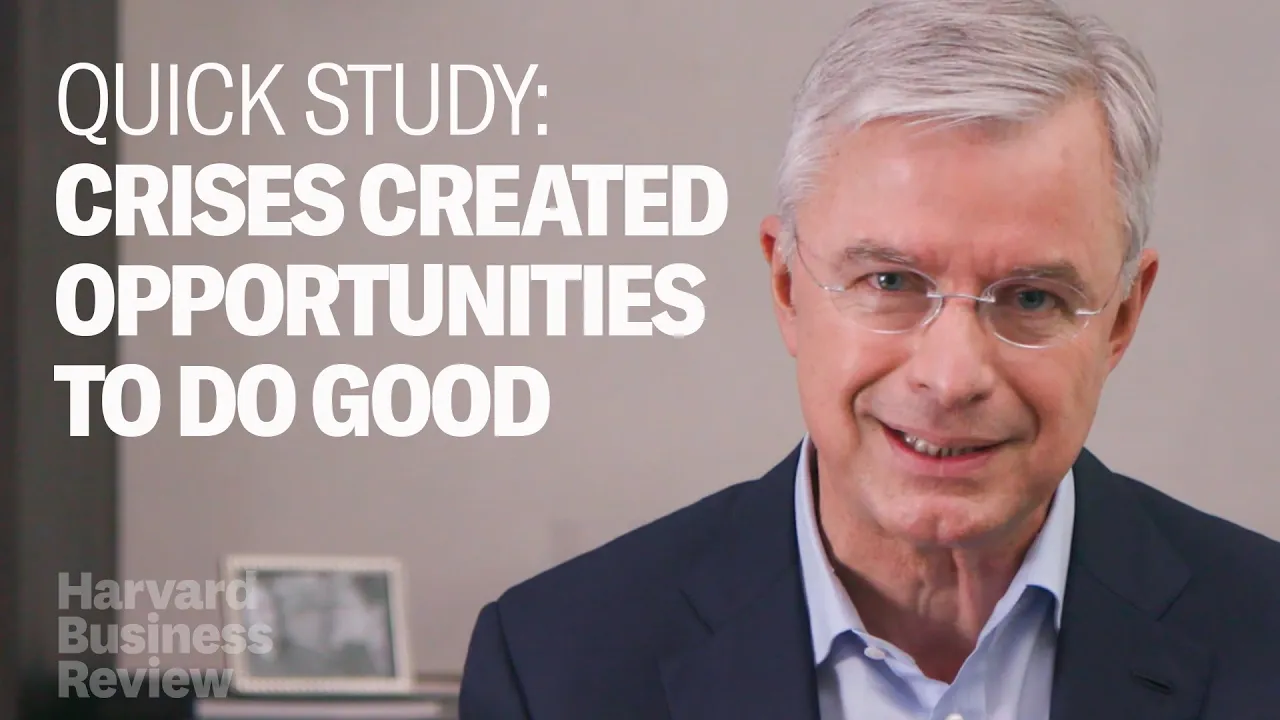
HUBERT JOLY: 2020 has been a particularly challenging year. This said, I find that this has been a year where we've seen some extraordinary examples of great leadership. I think the model of the leader as a superhero who's got all of the answers, [BUZZER IMPRESSION],, that's over.
The leader who is driven by power, fame, glory, and money, [BUZZER IMPRESSION],, that's over. This was a year where we realized that our humanity was essential. And that led to leaders being very centered around their principles and their values.
This is a time when the greatest leaders we've seen, were leaders who were authentic, they're caring, they're genuine, they're transparent, they're vulnerable, in creating an environment where people can be the best versions of themselves. If it was not clear before, it became incredibly clear. People are not just an input to business-- they're the center, they are the heart of business.
So when it was a matter of sheltering in place-- remember these days-- the associates who were working from home, we discovered their entire life. The kids, the cats, the dogs, also the environment in which they lived. For some people, it was really hard also dealing with mental health issues.
So understanding the whole person-- understanding their human needs, their need for truth. So it was critical for leaders at that time to communicate, to be vulnerable and transparent. I've seen many leaders just say it-- this is what I know, this is what I don't know, this is what I'm doing to figure this out.
This is true, outside of a crisis. This was particularly true, during that time. When the environment is challenging, when business gets tough, you see so many times companies first focusing on reducing their headcount.
You see these headlines, company X is hurting-- 10,000 layoffs, share price goes up. I hate this. My approach to turnarounds into leading in a time of crisis, is the opposite of that.
Is to see headcount reduction as the last resort. There's four levers that I tend to focus on. Number one, always seek to see how you can grow the top line.
It's always the first priority. Then, as relates to cost cutting, the first priority is attacking what I call, nonsalary expenses, which are all of the costs that have nothing to do with people. At most companies, that's actually the vast majority of the cost structure.
At Best Buy, we sell probably $10 billion or $15 billion worth of TVs. Because these TVs now are very big and very thin, we break a lot of TVs. What we need at Best Buy is work with the vendors, the supply chain, the associates in the stores, to reduce the likelihood that a TV would break down.
That's a way to cut costs that is good for the customer, and for the bottom line. The third lever is around benefits-- creatively managing benefits. So the big cost in benefits is health care.
If you can work in your organization to improve the health and wellbeing of the associates-- if you're self-insured-- you're going to reduce your health-care costs. And again, that doesn't entail cutting headcount. Now sometimes, increasing revenue, reducing nonsalary expenses, managing benefits, is not enough, and you're going to have to reduce headcount.
But then, you have to be thoughtful about this. At some point at Best Buy, we decided to close our small Best Buy mobile, standalone stores that were essentially mall-based. Now, the associates in these stores were very valuable associates, in whom we had invested.
They are highly skilled. So with turnover, you can actually redeploy these associates. So instead of telling them here's your severance package, we said, well, you can have a severance package, but, frankly, our preference would be for you to continue to work at Best Buy.
And we're going to do our best to find a new opportunity for you at the company. Another example of this is to consider, if your headcount is an issue, is it a temporary issue, or is it a permanent issue? So there's a range of things you can do.
Of course, we've seen many companies furlough their employees, which is a temporary measure. You've seen leaders, in particular, take temporary compensation reduction-- maybe eliminate bonuses, reduce the hours. So depending on the company, there's going to be different approaches.
But the key idea is if the need for cost saving is temporary, then think about temporary measures. This crisis provided the opportunity to pursue this noble purpose, in this idea that you can do well by doing good. After the killing of George Floyd, I saw a moment in time-- which I think is there to absolutely last-- where everybody realized you cannot run a business if the community is on fire.
And so this issue of systemic racism-- this is not just a political, or societal, or moral issue-- this is a business imperative. If the place is on fire, you cannot open your stores. If society breaks down, you cannot have a flourishing economy.
I'm actually blown away by how seriously, from the head and the heart, you see business leaders deciding to do their part to end systemic racism, here in the US. In the corporate world, once we've determined that something is important, we know how to create and implement strategies. The reason why all of the previous diversity and inclusions effort, had not really paid off, is that, I think, most companies were paying lip service to it.
So you're now seeing leaders creating very robust plans, setting goals publicly, to hold themselves accountable. And make the investments, review all of their HR policies, changing their sourcing practices, changing their workplace practices, and taking this much, much, more seriously. I still believe it's going to be a journey, but I'm actually quite optimistic that we have the opportunity to end systemic racism in this country, during this generation.
Division of business today, is very different. This is an expansive view of business and leadership. The mission has changed.
It's not solely shareholder value maximization. It's providing value to all of the stakeholders. The scope has changed.
It's not just about the shareholders and the customer, it's also the community, the environment. And then, the leadership model has changed. It's gone from the superhero to this much more purposeful, authentic, genuine, leader that creates an environment for his team or her team to blossom and do good things in the world.
So a time of significant change, for sure.