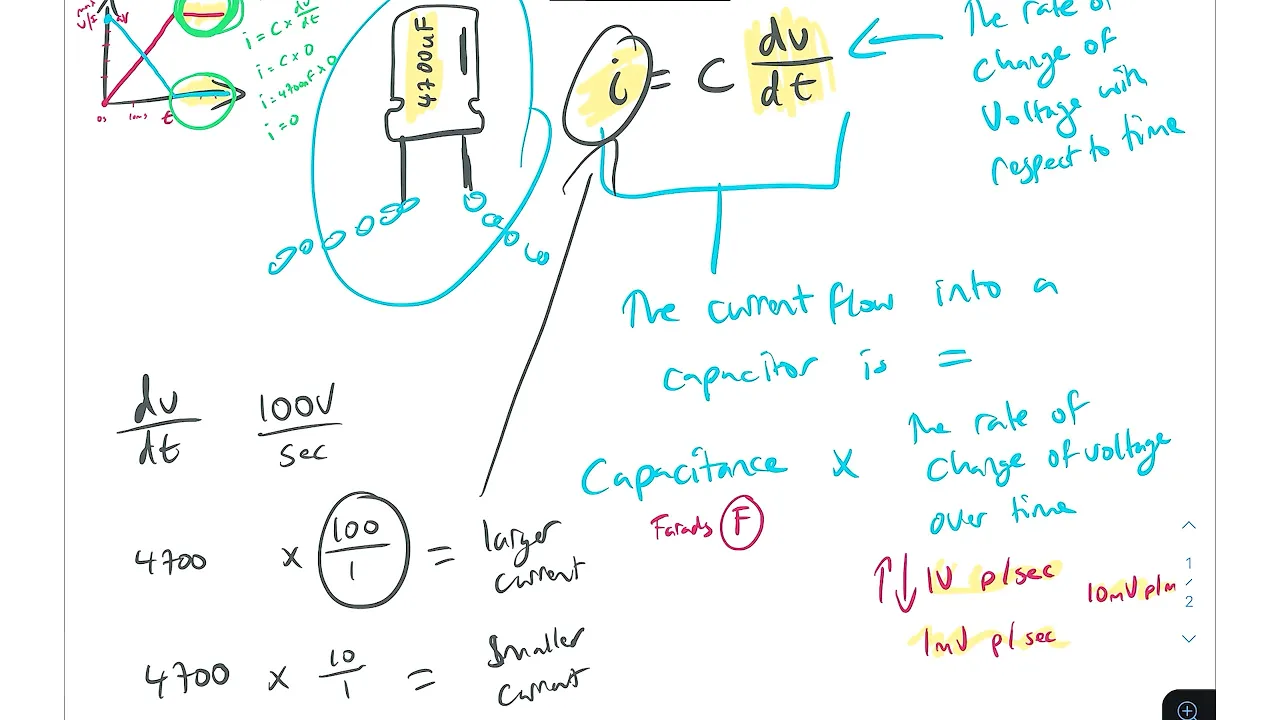
hi everyone welcome back to another video so in this video we're going to be talking about the equation that you've probably all seen which is the i is equal to c times dv over d sometimes you might see it written about the multiplication symbol dv over et and sometimes you might even see it written like this in terms of the delta symbol all of them basically meaning the same thing which is that the current is equal to the capacitance times by the change in voltage over time with respect to time so when i first heard
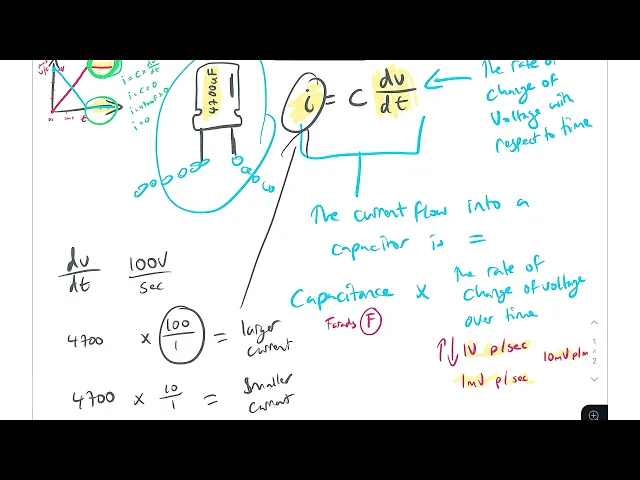
that i didn't know what that meant i don't know if that made sense to you but let's break it down okay okay so we're talking about capacitors right so first let's break down probably the most confusing part of this part which is this what does this actually mean when you see this whole equation it just means the rate of change of voltage respect the time so what does the whole equation mean then what we're saying is that the current flow into a capacitor i this thing looking about current flowing into it is equal to the
capacitance which is this value here multiplied by the rate of change of voltage over time all right so capacitance is obviously measured in farads right so f symbol the rate of change of voltage refers to for example the voltage being applied going up by one volt per second or by one millivolt per second or by 10 millivolts per millisecond right so we're saying that the voltage being applied to the circuit or just the capacitor is going up or down and it's doing that by one volt per second maybe one millivolt per second or maybe 10
millivolt per second etc so what we can say is if this dv that we're talking about over dt which remembers just the rate of change of voltage with respect to time if that if that is a large amount right so let's say i don't know it was a hundred you're saying it's 100 volts per second so the larger that we make this amount what we're saying is that if we have a capacitance value of 4700 micro farads we're saying we're multiplying that by a hundred over one second the larger that we make this value the
larger the current is going to be right so what we're saying there is that if the voltage is changing rapidly every second every millisecond whatever then the current flowing into the capacitor is going to be a large amount this eye here is going to be large what we're also saying is that if this is a small amount so for example you can just do these equations this equation yourself right let's say we take four thousand seven hundred we'll just remove the microphones right four thousand seven hundred and we're gonna multiply it by ten over one
you've removed the second layer so which number is going to be larger we're talking about this is gonna be the current right so four thousand seven hundred times a hundred but this equation here is going to lead to a larger current this is going to lead to a smaller current so what we know is that if the rate of change of voltage is large then the current entering the capacitor is large conversely if the rate of change is slow in terms of the voltage changing then the current flowing into or out of the capacitor is
also going to be low or small so if we was to actually graph this what would it look like on a graph so if we assume that this bottom bit here is time so if we say that we start off at this point here zero seconds and then say 10 milliseconds go through time right we assume that here is voltage max voltage and also current okay so let's start off with voltage first as we start to apply voltage to the circuit and the capacitor gets charged up we're going to see the voltage go up like
this until it reaches its max and then obviously the capacitor is not going to get a higher voltage than the voltage source right so you've got for example 9 volt battery it will reach 9 volts up here and then just level off right so what's going to happen in terms of the current remember the current is equal to the capacitance multiplied by the rate of change of voltage throughout time so the current is going to start off high and start off at the top up here you're going to see the maximum amount of current being
drawn from the circuit when we start then as time goes on the current is going to fall slowly up until eventually it reaches zero current and then levels off just the same as the voltage so once the capacitor is fully charged up here the current flowing through will be zero this is an important point to understand so at this point here the rate of change which we said is dv over dt is equal to zero if you use your calculation we know i is equal to c times dv over dt if we replace dv over
dt with zero that gives us i is equal to c times zero and obviously anything multiplied by zero is zero but let's just say we've got a capacitance four thousand seven hundred nano farads then multiply that by zero and i is equal to zero as we can see here at this point in the circuit here when the capacitor is fully charged and the the rate of change the voltage isn't changing it's zero then the current down here is zero all right guys thanks for watching i hope that helps and i shall see you next one
peace you