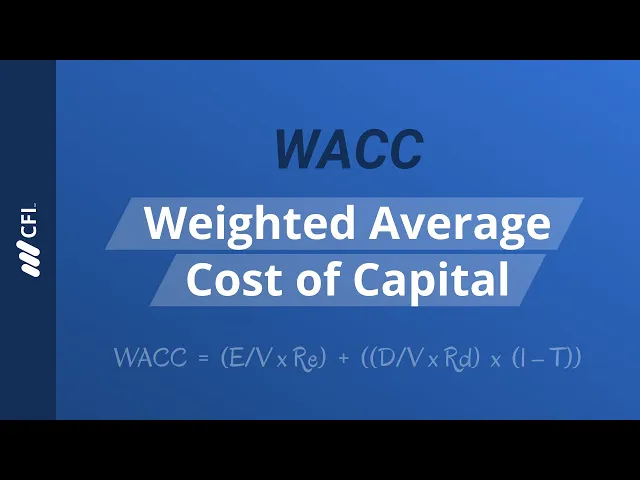
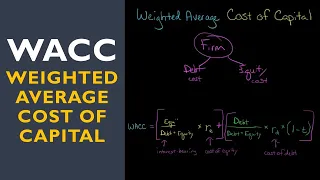
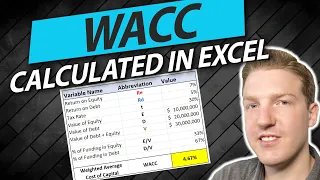
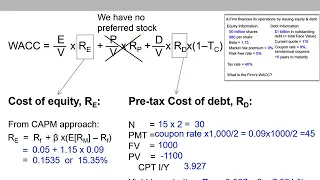
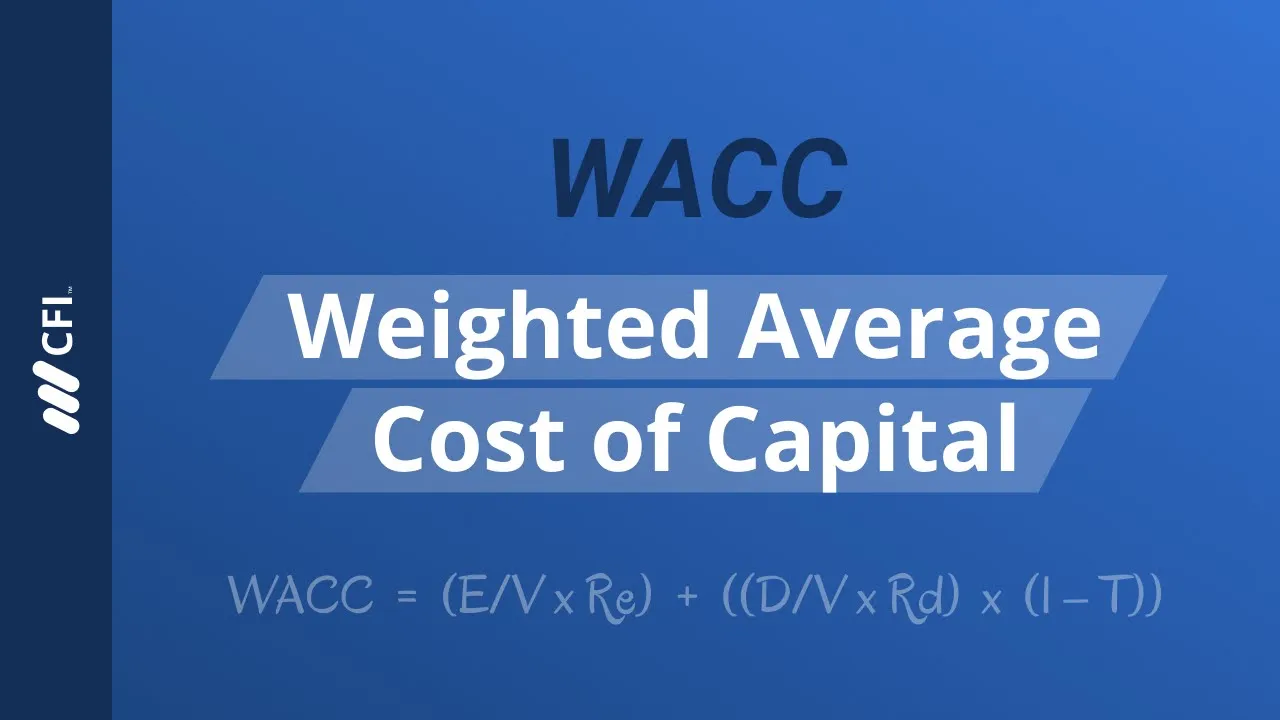
weighted average cost of capital in this session we're gonna estimate the cost of capital it consists of equity funding cost and debt funding cost and then we weight those two based on the capital structure of the company the combined cost is the weighted average cost of capital which is the cost of funding the assets of the company let's look at a breakdown of how this works let's take the weighted average cost of capital for a company and break it down into its various components the first distinction is separating the weighted average cost of capital into the cost of equity and the cost of debt and you can see as the representation here shows that they will be weighted depending on how much of the company's capital consists of equity and how much of the company's capital consists of debt let's start on the equity side we're gonna begin by taking the risk-free rate the risk-free rate is typically a 10-year government bond it's considered to be risk-free because if the government were in a position to default it could technically print the money and therefore not default and is hence risk-free next we're gonna add to that the beta of the stock multiplied by the equity risk premium in that country so for example we would look back at two years of the stock price volatility on a weekly basis we would take the volatility of return and determine what the beta is suppose the beta was one that means the company has the same volatility as the market and we would multiply one by the equity risk premium let's say it's in the United States and the equity risk premium there is 6% then it would be 1 times 6 if the beta were 2 meaning twice as volatile as the market it would be 2 times 6 which is 12% you would take that and add it to the risk-free rate suppose that's 2% then you would have your total cost of equity the debt side of things it's a little simpler you can take the average yield on the debt of the company and then multiply it by one minus the tax rate because there is the tax deductibility of interest but there is no tax deductibility of anything on the equity side if the company doesn't have public debt or any debt that has an observable yield you can look at a similar company that you believe would have a similar credit rating and assess their cost of debt so we get the cost of debt after tax we then multiply the cost of equity by the proportion of capital that's equity and we multiply the cost of debt by the proportion of capital its debt and at the end we get the weighted average cost of capital for the company let's work through a couple examples of calculating firms weighted average cost of capital as a refresher the whack formula is equal to the cost of equity multiplied by the proportion of capital that's in equity plus the cost of debt after tax multiplied by the proportion of capital coming from debt so the cost of equity is equal to the risk-free rate plus the beta times the market risk premium equity is valued as being the proportion of equity capital relative to the total capital of the business and the debt is the same thing the proportion of debt relative to the total capital and then the after-tax cost of debt is the yield of debt multiplied by one minus the tax rate so here's our formula as a refresher so here's the information you've been provided for enternet co and we want you to calculate the cost of equity the risk-free rate is 5% the market risk premium is 4% and the beta is two point three eight calculate the equity return required by shareholders of Internet Co please try this on your own and we'll show you the example so here's a breakdown of the solution we're gonna break this down into simple steps showing the required rate of return it's the risk-free rate plus the beta times the market risk premium the risk-free rate is 5 the beta is 2. 38 the premiums 4% we multiply that out we get 9. 5 2 percent on the equity premium side and 5% on the risk-free rate so the cost of equity for Internet Co is 14.
5 2% now that we've seen how to calculate the cost of equity let's move on to another example where we'll calculate the weighted average cost of capital so consider a different company brick-and-mortar Co it has a cost of debt of 10% cost of equity of 15% a 30 percent tax rate 10 million of debt and 40 million of equity so what is the whack for brick and mortar Co please try this on your own and then look at the example solution we're going to break down the whack calculation into 4 steps here the first step is to fill in all the numbers where we need the proportion of equity and the cost of equity plus the proportion of debt and the after-tax cost of debt so here are all the numbers that go in our equation that breaks down to be an 80% equity structure at 15% cost and a 20% debt structure at 7 percent after-tax cost we can combine that to be 12 percent on the equity side and 1. 4 percent on the debt side after weighting them and combining that to get 13.