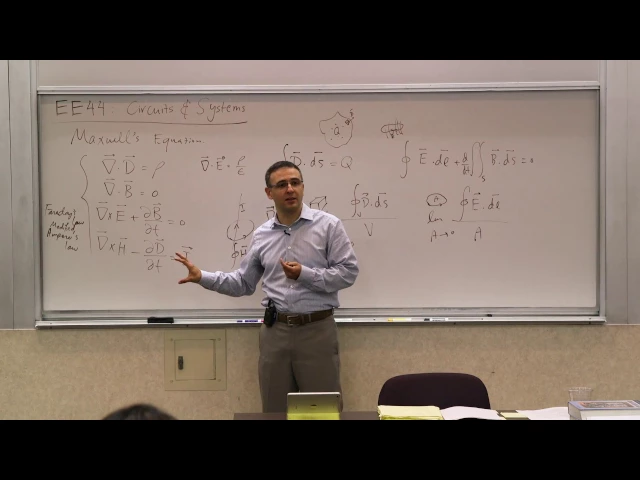
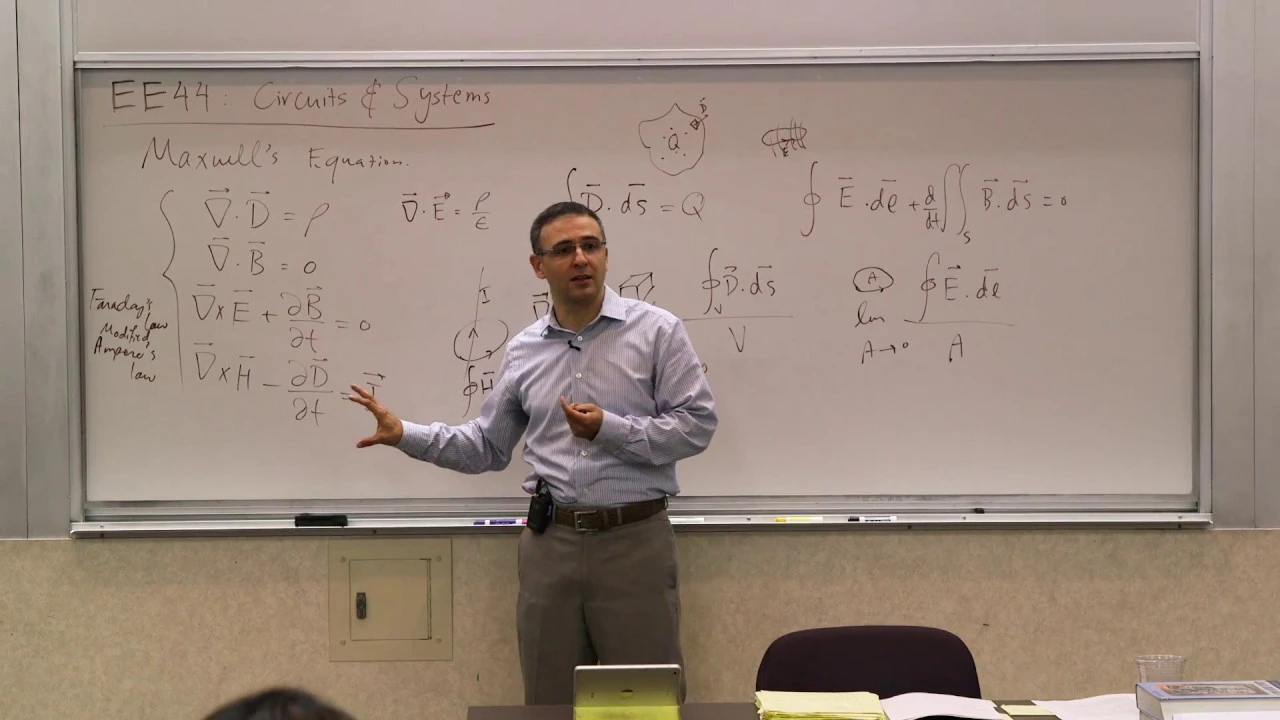
Well, so this is EE44 Circuits & Systems and what we are going to be talking about is the release subject of the fundamentals of mathematical concepts that we will be using electrical engineering and the relationship with the physical world physical underlying phenomena so we'll try to create that link in this class start start to creating that link Now we will be subjects that will cover give you a very quick overview over this subjects are and then what we'll do later on and any will start going for them quickly so we'll start to the fundemantals talk
about the circuit theory and system theory a lil bit. we'll talk about the circuit in the circuit theory i will talk about circuit elements linear circuit, non-linear circuit and then we'll talk about network diagrams we'll talk about node and mesh analysis and then we'll go to time domain analysis same time used that to develop the system theory Anyway, a view aspects the systems have inputs and outputs certain behaviour and how to be model this behaviour we'll use, we'll go and do things like is impulse response, step response and different kind of responses response of sinusoidal
signals and we'll see that the reason will do those things is not that those are particularly important by themselves the way they are important because they can be the basis for the rest of the analysis for any arbitrary inputs and resulting any arbitrary outputs. we'll be talking about lil bit the operator theory and operator analysis we'll do frequency domain analysis transition from time domain to frequency domain in a natural way we developed the concept of frequency and we'll go with the frequency, complex frequency domain we'll talk about the tranfer function poles, zeros i think that's
word and we'll talk about the laplace transform and fourier transform and the applications and at the end of the class we'll be talking about time and transform constants i think time permits Now the point of this thing is as said understanding of the relationship and the mathematical model for the physical world. and how that's applied? Right? Now, we have additional constraint but if you are just in mathematics any structure you make is valid as long as the self consistent Now, physics has its other constraints those structures have to meet the experimental results.