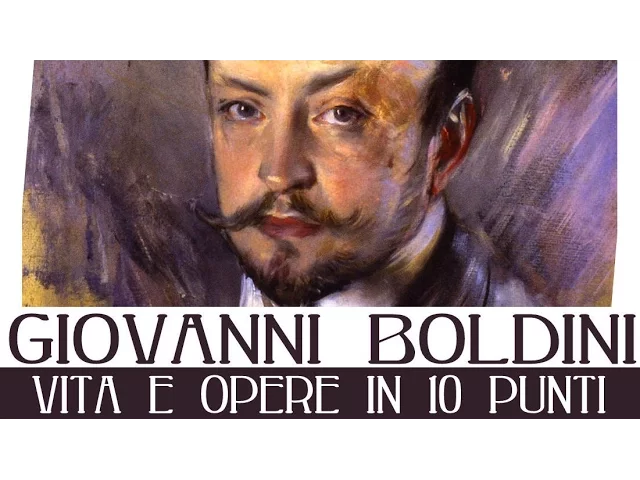
Giovanni Boldini was an Italian painter known for his portraits with which immortalized the most fashionable women of the late nineteenth century Paris. With its elegant style and its delicate brushwork, Boldini was able to capture in his paintings the hazy charm, vitality and romance of the Belle Epoque. Giovanni Boldini able to shine thanks to his talent from an early age, when specializes in reproducing paintings by Raphael.
At sixteen he perfected his talent by attending courses in painting by Girolamo Domenichini in Ferrara. The critical step for his career as an artist performing it in 1862 when he enrolled at the Accademia di Belle Arti in Florence. In the Tuscan city he attended the famous Caffè Michelangelo, a stop for citizens artists and so comes into contact with the Macchiaioli, the group of artists who renewed nineteenth century painting in Italy.
The 1867 is a pivotal year for Giovanni Boldini. The artist moved to Paris to admire the Universal Exhibition and he has the opportunity to see live the works of Courbet, and was fascinated by the French painter's ability to reproduce reality. In his stay in France even he knows the Impressionist painters Édouard Manet, Alfred Sisley and Edgar Degas.
At twenty-eight he moved to London, thanks to his friend William Cornwallis-West that provides a well-equipped studio in the center of the city. in a busy area by London aristocrats. The London experience will help Boldini to enter in European salons to become one of the most popular portraitists The English adventure lasts only one year.
Already in 1871, Boldini was in Florence before moving permanently in Paris since 1872. It is now an established artist, contended by the aristocracy but especially by the noble women of the time. One of the most interesting works by Giovanni Boldini is definitely a portrait of Luisa Casati Stampa, built in 1908.
It is one of the most famous paintings of the "Divine Marchesa" perfect interpreter of elegance and eccentric folly of the Belle Epoque. In addition to beautiful women, Giovanni Boldini also drew passers-by in the street, in cafes patrons and celebrities of the time as the Italian composer Giuseppe Verdi, immortalized in a 1886 painting. With the end of the Belle Epoque and social changes which resulted in the First World War, the artistic activity of Boldini was less intense but there were awards.
In 1919 the artist was in fact awarded the Legion of Honor and the title of Grand Officer of the Crown of Italy, although he had retired from artistic because of a serious and sudden loss of vision. After the death, come when the artist was eighty-nine years, the name of Boldini was forgotten, as if his art was the result of a fad. It will be rediscovered in the early sixties and will be recognized for their role in the history of Italian art thanks to the style of his brushstrokes that will inspire Futurist artists.