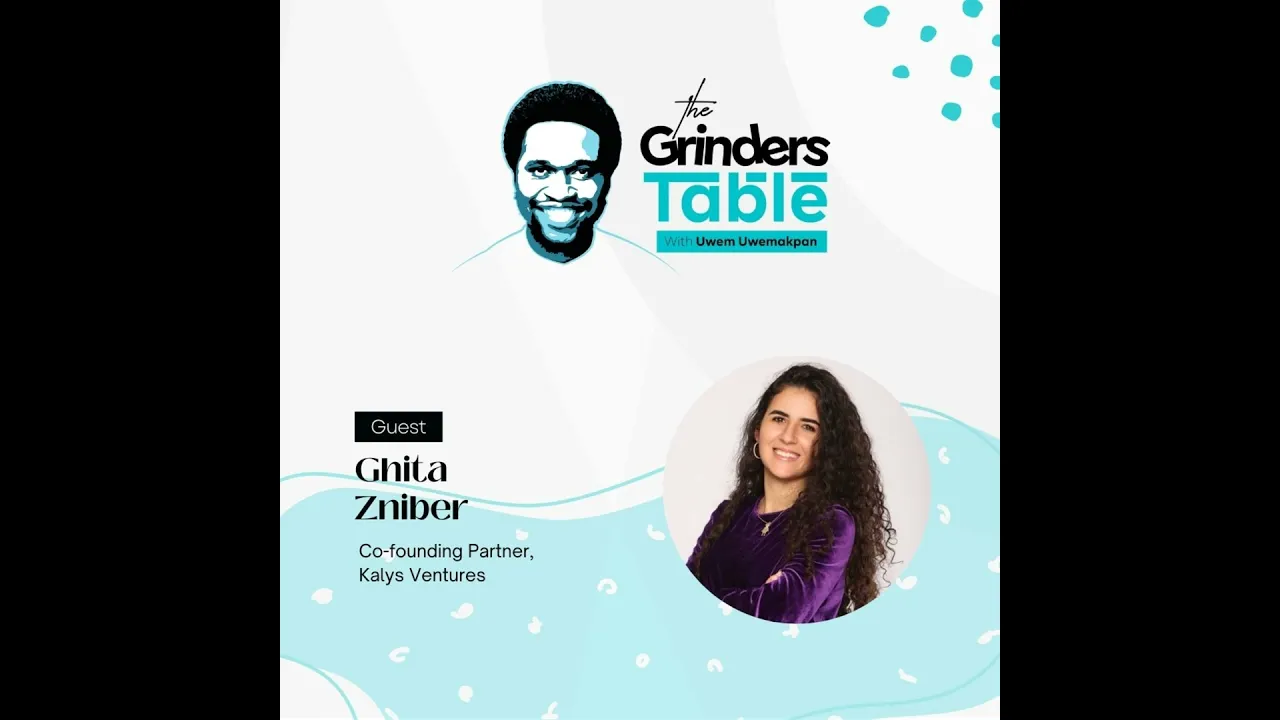
welcome to the grinder table the podcast where we sit with C youth Executives and Founders who are taking their industry by storm to figure out how you can build an exceptional career and business together we'll try to uncover how they both defin the odds and what you can learn from their experience I guest today learned some of our most valuable venture capital lessons on a rugby field in France now she's reshaping African startup investment space through a unique First Flower principle that challenges traditional Venture Capital wisdom but her journey began with a philosophical discussion she had with her father on the dinner table and we're going to go into that but before we go into the conversation I like G to introduce yourself to the audience thank you for this uh very kind introduction I'm very happy to be here with you discussing um you know uh about the African ecosystem and and the the the VC space generally speaking as I always enjoy Also discussing with you out of this podcast so happy to share now our discussion publicly let's say so as an intro I'll would say soita as you said I'm Moroccan I was born and and raised in Morocco before going to France I studied there went to um try to travel a little bit to discover other ways of doing things and what what's happening uh uh in other count let's say then I founded two Ventures then I also launched a venture builder for uh for for a group of investors uh I also worked in some during some some corporate mainly in France then did again some Consulting uh from from from like private Consulting before launching kis ventes so and kis vent is the I guess the topic that we are covering today is uh around ventor Capital so it's a VC fund maybe I can start introducing it oh yeah of course you had in mind we're not only going to be talking about VC we going talking about your journey but yeah talk about vent because it's really important that we we hear about it so K ventur is a fund that U we have launched three years ago with my co-founder based in Morocco so we have decided to um you know at the beginning we wanted to invest only in women but then we decided to extend our investment uh to African startups we can dig deeper about that after we have decided as well to be sector agnostic so very opportunistic about the Investments that we do uh we and we have invested so far in six startups covering uh Logistics Mobility fintech Blu Tech uh hospitality industry and FMC as you can see like very diverse and one of our let's say footprint is really the fact that we are we are really behav giv as you know trying to to be as fairing Partners as we can to our portfolios so very active and helping them as well having access to some local corporates so yeah that's it about K Ventures can we can we can talk more about it after yeah yeah um your your story is actually quite interesting because before this podcast I I typically would do some light research on people that are I'm going to be speaking with and I found out that you played rugby and I was shocked what was play rugby like for you where where did you find that well on the internet I got do some cleaning there but no I'm happy to I'm happy to say I was playing I was playing rugby but for me it wasn't like really public but I guess everything we put online becomes public but yeah rugby was really you know like a lifechanging for me because I played rugby when I um when I joined the you know my business school in France I had to choose a sport and I didn't want to go just um you know to things that I know and things that I could have done in Morocco like soccer or basketball or whatever I wanted to try something new and rugby in Morocco is very for men you know like it's not it's not really for for so I've never you know I have never been pushed to even be curious about that sport let's say so I really the idea was to just do something different but when I started playing rugby I felt that it you know it added more value to to my life than just discovering something new mainly in one thing which is the ability learning the ability to say no and this is something I had like a very hard time with before playing rugby and the main reason was you know when you play rugby whether you're able to attack first and then you're not hurt and injured but if if if you let the other person from the you know the the the other comes first to you and and gives the the gives all it its power to to when when it when it hits you then you're you're really down and and you're injured so I didn't have a choice um um you know my only choice was to learn how to hit first and thus the ability to say no let's say so really like it was it was that teached me that and this helped me a lot a lot in my life so I felt you know because when when you learn how to say no you just give more respect to yourself and and that's very important to everything else it's interesting the lessons we learn from trying things out because I wouldn't have thought that this lesson of learning to say no which is an important lesson you would have got that from rugby so very very interesting and I I know a lot of people struggle with saying no because you want to appear competent you want sometimes you just want to please people sometimes you you just don't know how to say no and this is a really really good lesson yeah exactly exactly I mean sometimes you mix kindness with the respect for yourself you know and and not not all the people you meet know like their limits the same so it's important to you know protect yourself to to to know when to say no when you feel that this is out of you know your your own limit so yeah great learning from rugby and happy that you're that you're uh bringing this out yeah um another thing I found is that you you mentioned that your father was very very influential and you sort of referenced in another conversation a dinner um discussion you had with him can you talk about how that conversation has influenced your journey from you know you know being a student working with other people building Ventures and then now in VC well so I had like many discussions with my dad so I I'm not sure about the one you're referring to but I have some in mind I mean you can like whether tell me the one you have go forone what the most profound one what is one that you always remember yeah so so there there are two things that I can tell about how like my dad really played a very pival role in my life I mean my mom as well because I don't want her to hear this uh podcast and feel that she didn't play any any role in my life but I think that they were both very pivotal in in the choices I did you know uh during the the since I was since I was born actually I guess but I always had like very deep and philosophical conversations with my dad and there were two things that I always remember when I think of him first one is the importance of having values so when I was 12 one day he came he came late and I was so I was I was between 10 and 12 I don't really remember the age but I was really young S Young and it was it was almost 1:00 a. m. uh it was a weekend so like Friday night so I was still awake at 1:00 a.
m. don't judge that their parenting you know what 12 12 years old and she was still awake at 1:00 a. m it it was a Friday I guess so he asked me what are your values and you know at 12 years old years old I don't even know what what EXA what does it mean to have values you know and I tried many words just to give him some answers as like is it to be kind uh is it to not uh not lie is it you know and he said take some time think think about it uh there's no rush just think about it but no one thing is that if you don't have values or if you don't know your values then you will always be lost in your life and you won't have any anchor whenever you need to take very important decisions in your life so you know the kind of decisions where you're L and you don't know what to do when you have values it's always easy for you to find the answer but when you don't then you know you don't know what's what's good to do and what's not and I felt he was right so I really took the time to think about finding my values the exercise wasn't easy because I had you know like to be kind of mature compared to my age and try to test some of my values let's say with the with the word and see what what I feel when I do that or that and so one day I felt I felt happy because you know like okay I have two or three values that are really important for me and when I act different differently from that I just feel I don't feel I don't feel myself so I asked him and my mom for um Sunday we we used to have branches together on Sunday but with my brothers and sisters but I decided to book the branch with them on Sunday just with them without my brother and sister so they they kind of uh kind of didn't like it but that that's that that was fine for me I I was egocentric when I was younger so so so so we just went for that for that brush and I was very proud of of me to to you know be able to share my values with my parents and say do you think that this is that this might be my values and since then because you you asked me like how this had an impact on you know everything else in my life I think that I've been challenged a lot for you know the past 10 years since I started the to become let's say like to enter the professional word let's say from being Junior to Growing more and more I've been challenged a lot whether professionally or personally but every time I was able to find back my path to these to these values so I'm very thankful for that that that was that was the first lesson I learned from him about the importance of having values whether when um you know uh you choose your co-founder or when you invest in in in in a startup what's what's the kind of investor you want to be for them when you choose your husband because I'm now married since last year when you choose your your life partner also what's important yeah values are very very important to me and um and then it helped me a lot since since I I I I found them let's say thank you for sharing that no you that was really really good and true because values sort of are your guard rills that help you well the the concept of right and wrong is different for different people but they sort of guide you on how you behave when people are there and when people are not there so I I really loved that you shared on your values when did you realize that supporting entrepreneurs was your true calling and that's also a great question um because I said I said earlier that I I Was Myself uh a Founder at a certain stage where I decided to uh you know discover out what what would it be to uh do your your thing and build your thing and work for it uh so I knew I knew that I didn't want I didn't want to work within a company that was one thing I was sure about when I started doing my internships and you know interacting with the corporate word and there was one thing that was ton between like all my my previous managers they were all say all saying you're so hard to manage really that was something they were all saying and the reason why is because I've always wanted to do not only what they were asking for work but really to have this 360 Dee view point of view regarding a problem for example if I had to only work on on digital marketing we'll always go and see how this the solution that we use for digital marketing can also be used for the HR side or for the logistics or so I always like to see to not only uh look at the problem from one side but really from the whole uh value chain so when I understood that especially when when you enter a company as a Junior need to I mean what is expected from you is to stay focused on one thing and to do it well when for me I was more looking for um you know something that can give me the ability to uh uh work on a broader space let's say so that was the first conviction that I that I had is that I I didn't want to follow you know like an adventure in in the corporate world but I wasn't sure if this would be right after my graduation tion or maybe 3 years or 5 years after my graduation and then like I kept this idea in mind and I remember that when I went to China for for an exchange program I met a teacher there like a professor there and I shared with him that point of view the fact that I wasn't you know when I was seeing some friends that were sure about the fact that they wanted to do marketing or Finance or whatever I was kind of frustrated to not be able to say do 100% love uh finance and I would like to grow into that industry and be the best one in finest but I wanted to be able to manage like and master let's say all the the competencies let's say because I I wanted to be a generalist let's say so he told me he told me that I was a generalist so that that was when he you know he did my let's say psychological analysis L said he said you're just a generalist but you're a generalist that feels more like in pain than embracing his ability of being jist um so when when he told me that it was just like I learned something something new but at the same time I felt that I wasn't the only one being like that and so since that day I started being embracing the fact that I was a journalist and being okay with my ability to not only look at a problem from one perspective but really from different perspectives and when I started embracing it I started seeing the power of it meaning that some you know in in a lot of companies you're not looking for always for specialist but you also need that person who's able to understand every specialist but not being like as good as that specialist but at least you're sure that the person the jist will be able to to like align everyone with the the global strategy of of the company so when I when I really understood it I felt the difference also on the personal level that was the second the second conclusion that I I learned and the third one that helped me understand that I wanted to work with entrepreneurs the third and most important one I think most impactful one as well was so I told you that I I have launched two Ventures right yes and during my second Venture I was in parallel at J Berkeley in the US where I spent one year and there I also had like another class called leadership for innovators and during that class I learned that thing where I wasn't the leader but I was the first follower and the Nuance between both is is quite interesting when you want to do like vure Capital because the leader is the founder so imagine there is a you're in the club you're you're in club night club there is some music no one is dancing on the floor uh and then you have the P the first person that goes and dance in the floor so this is the entrepreneur but no one follows him and then the moment you have a second person coming uh coming on the floor everyone follows so I I understood that moment that I was really a first follower and it made a lot of sense to me because since once I was young like even at like you know primary school I was always um you know going and spending time with that one person that no one likes to spend time with I always go and find like the you know the the the the one person that that that is like outlier or outstanding or out of you know not very common let's say not not the person that everyone can follow I always like spending time with these kind of of people um and and it hit me because when I had my own Venture I couldn't see myself you know having this this ventor for the next 10 years when at the same time I was talking to other entrepreneurs that had like this light in their eyes you know that you see in entrepreneurs early stage entrepreneurs or even growth or like whatever the stage but you see in their eyes that they are really passionate about their their adventure and they want to spend the next five to 10 years doing only that and this is something I didn't have but I was having this lights when I was with these entrepreneurs when I was adding value to their experiences through the Venture Venture Builder I told you about that I have launched before being into VC or even when I worked in a CVC in France as well I I met a lot of entrepreneurs so this this this thing that I was seeing in their eyes gave me also like the winning to do everything to support them and and and and help them grow and move to the to the next stage this is really the moment where I understood that one I was I didn't want to be in like working in in a company where I had to do one specific thing second um I was a journalist and which means that I was curious able to have interest in different Industries and also in different let's say specialities in terms of departments and third was that I I was more passionate and and and more I won't say passionate but I was driven by helping entrepreneurs instead of being myself entrepreneur even if the fund is on itself an entrepreneurial uh Adventure let's say because it's it's the first fun that we have launched but we have the diversity of being being able to look into different Industries and and and be very operational uh for our co-founders so I think um yeah I think that was the logic I followed uh to conclude that I I I I prefer being like the first supporter of of entrepreneurs than than myself entrepreneur all working into um within within a corporate there's so long no no no but there's so much on P here and thank you for sharing there's so much and again I like that you touched on something generalist I know the the world always optimizes for specialist but again you sort of expanded on the fact that you you also need generalist people that know a bit of every other thing and I can bring everything together and I really appreciate that you touched on it because I I've met so many people that worry that oh I know how to do many things right but I don't feel like I'm good enough because I don't know how to do one thing extreme well I'm not a specialist in this and it just shows that even as a generalist there's so much good you could do and there's so much impact you can make and on your first Fallout philosophy that that is so good that that's so great but I'm curious though how do you then implement this philosophy into actual investment decisions with khis Ventures the philosophy of being journalist you mean no the first follower the first follower philosophy the the the first follower philosophy so the the thing is that we have something in common uh with my co-founder which is um the fact that she's also she has also the entrepreneurial mindset they say um plus she she has been working Investment Banking since like for 25 years and she has her bank uh Investment Bank for 15 years now which means that she has this visibility on you know like uh metrics and genit economics about the major players in each industry which gives us like the ability to see even if it's an early stage company if the metrics are going the right way or if the the vision is let's say optimized to narrow the the the the metrics of the leaders of the market let's say this is from really like a figures perspective okay uh from from from from from a very personal perspective and this is something known in the market I think about us is that we and maybe it's it's also common for other funds but for us it's it's really important to make sure that we do have you know a great personal relationship with the founders it's very important because this is how you build trust and with that trust you're able to say okay I have in front of me a Founder that is able to call me when he has his test time because this is also very important especially when you invest in Founders early on in their Journey it's important to make sure that you're able to be there at the right time so like I would say that we we I won't say that for all the Investments we did we were the first ones to to invest there are some Investments where we came at the SI stage or at the pre- series a stage but we also had and these for these I think that the only thing is really the relationship with the founder and uh being there for them being able to help them with other like having hard discussions with other co-investors help them bring to the table other co-investors so be really present supportive even if uh like like whatever the situation of the company is so that that's that's the first one on the support level but on an investment level we we we also do it sometimes when there is no lead I mean We Don't Mind Investing even if there's no lead because we see clearly how we can help the entrepreneur we can take it to the level where he he will be he will become good enough for uh for bigger investor or investors or more advanced investors before coming but we obviously see prior to that we see the potential of of the founder and because we are able to be hands on with him and and be present for him we know also that we will be able to take him to the next level even if he is not confident enough at the beginning we can we can take him there this is how it materializes and I I I tell people that it's easier to invest it's actually harder to do the support work so you can make all the promises and all but when it gets putting your hands in the weeds and working with the founders there are very few investors that can do this very very well yeah yeah I'm not saying I'm not saying that we are doing it well but we do everything we can that that's for sure uh the impact is there for the startups as well I mean we we see great impact on the operations on on on the business on like different levels of uh of uh ass when you assess a company but uh but yeah I'm not saying that uh you know like just by like you know I just want to be like humble here you know not trying and saying that we're making the you know startups to grow to the ser3 level or things like that we're not there yet getting there well we were getting there exactly yeah having a partner in business is actually like marriage right and in the last two years where um the capital markets have struggled I've seen so many relationships and I mean business relationships struggle because when there are money problems every other thing all the problems begin begin to look so magnified how have you managed to maintain a good relationship with your partner at the fund and sort of see eye to eye even on issues that you disagree with yeah yeah that that's that's an interesting question and and also think that as you said like finding the right co-founder is not easy I've been there in some other like in other Ventures where the choice of the co-founders was whether like too uh too fast or um not you know with not the right the right processes or like a lot for a lot of reasons it didn't work but for for this one I think that the first thing was really the alignment in terms of again values with with my co-founder that was really really important meaning that even sometimes you know if I see a startup um I can take it to um you know like different stages of the discussion and maybe I can come at the end and share it with the with my co-founder because I know that we will be automatically aligned on a lot of things and vice versa the same thing goes for her she can like do a lot of things and it's that important for us to always be up to date like about everything every decision every partnership we make because we know that you are driven with the same thing and also very aligned on the way we work as well as the way the decision we take so that that's really important the alignment in terms of values trust also if you trust your co-founder you're able to you know you trust that when I say trust it's not in terms of um you know management of the treasury or things like that but really trust on the fact that you know that your co-founder will always care about you and you will always care about your co-founder and that both of you want the same thing which is going the you know like elevating each others and that's very important so I will always care more about her than than I do care about myself when it comes to taking decisions related to to the management of the fund and the same thing again goes for her last point is the importance of being how do you say it how can I say the word you know when there's a problem you know like we won't say it's your fault or it's my fault you know it's always it's our fault always whatever the mistake is it's it's Global it's us it's not like individual and that's very important because it's it's in this kind of moments where you feel that you know like there's this uh strong relationship and Trust as well that makes you confident about the rest of the of the journey because it's in the hard moments that you see exactly how the other person will react you know like if she will take the first advantage of the first disagreement or first problem to take you down or if she will be you know like uh also I won't say supportive but you know like when when when you do you have the word when you have it no no no but yeah I think you you got the idea so that that was that's um yeah that that's um that's what what what's important my wife often tells me that it is me and you against the problem not the other way around and and and that that does make a lot of sense you're right Life Is Right I'd like to get into your head and your partner's head on how you see Africa what exactly is your thesis on Healthcare logistic education and all the sectors that you prefer to invest in Africa so I think that as I told you like I had the opportunity to uh move spent some time in China uh some time in France because I I'm I'm there since 2017 some time in the US I spent one year and what I saw there is really the interest that these countries have towards Africa and as a Moroccan who grew up in in North Africa because I'm I'm Moroccan as a just said I grew up in in North Africa for me every time I was hearing like people in China for example during some meetings uh regarding China and Africa relationship trade all that I felt that I had like a lot of Legacy when it comes to to Africa because I'm I'm I'm from Africa and I felt that they were you know like um they were they were thinking about how they can you know make a maximum of the opportunities in our continent that is growing and and have a lot of potential when I'm locally based I don't see it as much you know so I felt that something was missing and that I had to dig deeper on it so that that's when I went to Congo Congo bra been I spent six months there because again you know like just like they told told me when I was in in Congo when I told them that I was also African they asked me where are you from I said I'm from Morocco they're like no no no no Morocco is not Africa you know because for them like we were kind of you know a little bit more developed so they weren't positioning Morocco as as part of Africa and for me it was exactly the same vision that I had for me Morocco wasn't really representing like the struggles the real struggles of of a lot of African countries and I had to stay in another like sub Saran Africa to to see these struggles let's say that were obvious when I was there which is like the the access to clean water the the access to energy we were just sitting and that was normal to lose the electricity at uh work uh when you're at at home things like that so so when I saw these problems and when I saw also that opportunistically and business-wise a lot of you know very developed countries were seeing um the potential of Africa plus when I also went to the US and and and saw the the ability of technology to really disrupt some uh uh Industries and have a lot of impact for me I also saw the opportunity for Africa let say to leave frog this word is very used I guess when you talk about Africa but really to live frog some uh gaps between the continent today and the other places in the world in the next years but at the same time as a controversion when you look at the numbers the GDP of Africa is equal today to GDP of France we're talking comparing like a whole continent with one country country that's huge that's huge and it shows that the Gap is very important mainly on our ability to Value the product that we have because the only difference is really uh you know their ability to um import let's say the products that we have in Africa and add value to it trust for them and and you know like create increase the value of the of the products um so and because of that because we're not able to do that we're not able to give the right education to our population the right Health System to our population the right uh food system to our population so this is kind of related so whether you're able you're able to have an impact on the way Industries can work you know like industry 4.
0 to to make production more efficient and like as an impact or as a result you can also increase Revenue revenues of local companies which means that you're also able to increase the job uh offers that you can you can give to people the salaries that you can also give which also mean direct impact on the consumption and you know like this is the whole macro macro lesson let's say that we can we can we can uh talk talk about uh but that's not that's not the objective but anyway that was just to tell you first why we have decided to focus on on Africa why are was seeing the opportunity even if uh when you talk about liquidity it's not the the the you know the best markets right now and when we talk about the level of fundraising I'm sure you've seen the latest report of Park um which said that African fundraising was at $3.