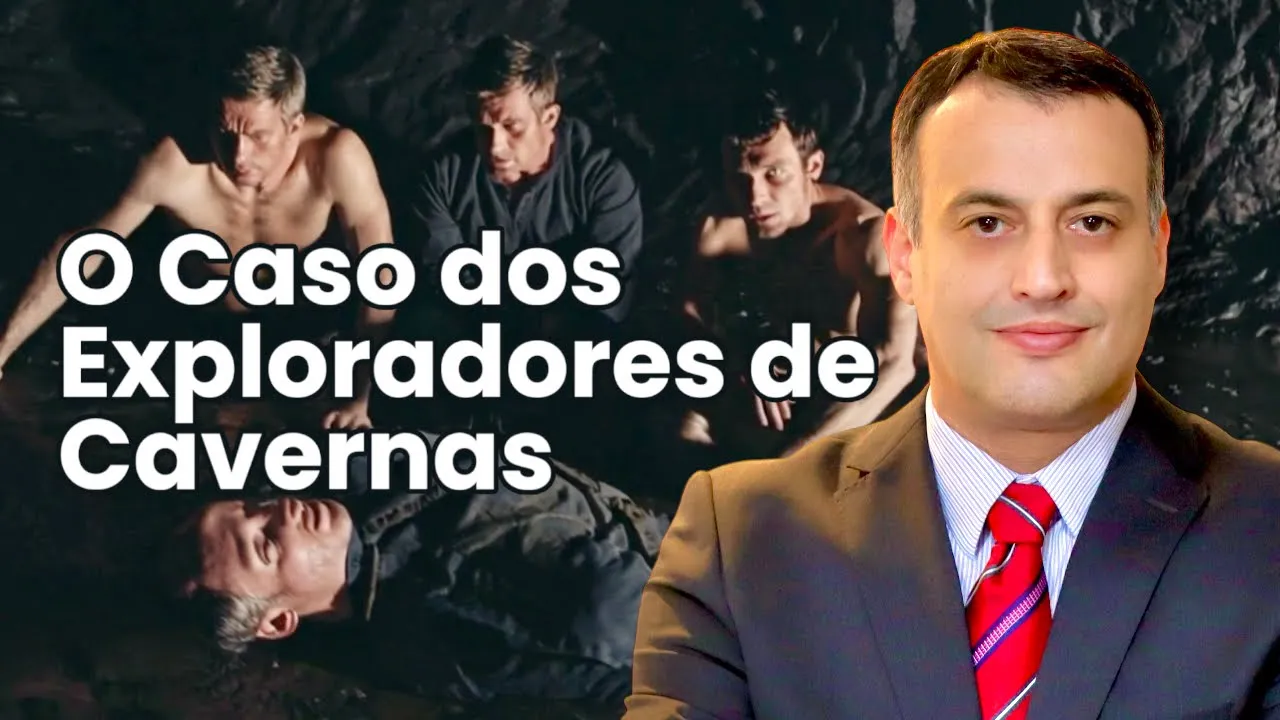
Hello everyone, how are you? I'm professor Leandro Cordioli and today I'm going to talk about the book that is perhaps most important for the training of jurists here in the Americas, possibly also in Europe, because professors like Herbert Hart and John Finnis debated and studied with this great Harvard professor, professor L. Fer.
Today we are going to talk about nothing less than the Case of the Cave Explorers, that famous case in which five members of a speleological society were locked in a cave and had to kill one of the explorers to feed on that person's body and manage to survive until rescue. Don't forget to subscribe to the channel and activate the bell to be notified of future videos that I should upload — including about Cave Explorers. In reality, I believe that no one can call themselves a law student, lawyer, judge or prosecutor if they have not read this book.
Both in the United States and in Latin American countries, and even in Brazil, all law universities use this little book. And I think the most famous translation we have in Portuguese is this one by Professor Plauto Faraco de Azevedo, published by Editora Sérgio Antônio Fabris. The one with the green cover — all the students went through that wonderful and unforgettable activity at the beginning of college, in the subject of Theory of Law, or Introduction to Law, or even Philosophy of Law — in which this situation is debated in which four explorers had to kill a fifth explorer in order to survive until they were rescued, feeding on the body of this innocent person.
In reality, this case is based on a real story, which is not specifically about a speleological society — a cave exploration society — but about shipwrecks. This true case occurred in the 19th century, when the ship Minunenete had sunk, and some sailors were left adrift in a small boat. The youngest of these sailors, a 17-year-old, ended up drinking seawater, even though he was warned that it could cause him illness.
He began to feel sick, to become weak, and the other older sailors, when they believed they were about to die, decided to take the youngest man's life and feed on his body. Later, they were rescued and taken to trial, due to having committed the crime of murder. Well, this true story inspired our professor L.
Fuller, a professor at Harvard, to write The Case of the Cave Explorers, which will bring the main legal and moral points of this true story — but placed on a fictional plane, in a future society, from the year 4300 after Christ, called Newgarth, in which there was a society of people who liked to study caves and venture inside them. So, a speleological society. Five members of this society decided to enter a cave, but the cave entrance collapsed and they were buried at the bottom.
They managed to make contact with the outside world and discovered that it would take a long time for them to be rescued. There were already some teams abroad making efforts to rescue the cave explorers. However , according to medical prognoses, they would probably not be able to be rescued in time due to the lack of food.
Then they would probably starve to death before being rescued. As a result, a great moral and legal dilemma occurred: is it worth it, or is it fair to kill an innocent person so that more people can survive? Or better: should we kill one to save four people?
Think about your conscience: would you kill one innocent person to save as many people as possible? Well, the first point we should raise here: it’s not a question of self-defense, right? Because self- defense is a fair and proportionate reaction to imminent aggression.
Therefore, it is not a case of defending oneself from another person's aggression, but rather of killing a person — or rather, sacrificing the life of an innocent person — to feed on that person's body and manage to survive until rescue. So, one of the cave explorers who had the idea of sacrificing an innocent person proposed that a draw be made, so that whoever lost the draw would be sacrificed to save others. This way, at least, not everyone would die — but at least four could survive by feeding on his body.
That was Roger Wetmore. But, by an ironic twist of chance, before carrying out the draw, he gave up on carrying out the draw and killing an innocent person to save the others. However, the other members of the speleological society carried out the draw and drew a straw in the name of Roger Wetmore.
Although he did not participate in the draw, he was finally chosen to be sacrificed and save the others. The four members sacrificed Roger Wetmore, fed on the body and managed to survive until rescue. As soon as they were rescued, the four explorers were arrested, put on trial and sentenced to hang in the first instance.
This little book, The Case of the Cave Explorers, will deal with the appeal — or rather, the appeal — that the four explorers made to try to reverse the sentence condemning them to hang and try to be absolved of that conviction. After all, they had gone through a traumatic, exceptional situation, and they would not have been able to survive if they had not killed this innocent person and fed on the body. At the same time, what good would the sacrifice of this innocent person be, if now, after being saved, they were also condemned to hang?
Another point that might be worth mentioning here is that famous case of the Uruguayan rugby team that crashed in the Andes — the plane that crashed in the Andes was trapped in the snow, and they also had to feed on human bodies. However, it is a completely different morally and legally situation. I remember, now, recently, a film came out portraying this circumstance, this tragic situation.
And even at the time, the Vatican absolved them of any sin, saying that, in this specific situation, feeding on human bodies was not a sin. And what's the difference? The specific difference is that the Uruguayans did not kill innocent people to feed themselves, but they ended up having to feed themselves, because it was the only food available — from the bodies of their friends and family members who had died in the plane crash.
So, it's one thing to feed on a human body in an exceptional situation - obviously, this is legally and morally reprehensible, but, in an exceptional circumstance such as a shipwreck, a plane crash in a deserted place, surrounded by snow, or even in the case of being locked inside a cave, perhaps there would be a moral and legal justification, even if it was a repugnant act. However, a second thing — and yes, more serious — is killing an innocent person to feed on their body. After all, how do you choose who will die?
And, furthermore, doesn't each one of us have a specific value as an end in itself, as Kant said? In other words, doesn't each one of us have the dignity of the human person? Who will be chosen to be sacrificed?
So here we already have some points that are neuralgic, morally and legally, that distinguish this brilliant situation proposed by L. Fuller to introduce students to this wonderful world of the study of Law. In other words, first: it is an intentional murder, it is a murder of an innocent person, it is not self-defense and these are exceptional circumstances.
How could this situation be resolved if the law said that anyone who commits murder must be sentenced to death, and the law left no room for judges to adapt to exceptional circumstances, mitigate the sentence or modify anything in that regard? In such exceptional circumstances, the first-instance conviction case of the four surviving cave explorers was brought to trial on appeal — to the Newgarth High Court on appeal — and the five Supreme Court judges had to decide whether to acquit or convict the cave explorers, upholding the first-instance sentence . So, sometimes, on a superficial first reading of this text, people don't realize it, but the first thing you should pay attention to when reading The Case of the Cave Explorers — there are even digital versions in PDF, Professor Plautus' own version is available on the internet, here's a suggested reading — is that there are five judges.
A first of them is the Truepenny — that's the chief justice. The second judge is Foster. The third judge is Tatting.
The fourth judge is Keen. And the fifth judge is Handy. One of the first wonderful things that this Cave Explorers Case presents to us is that, in Law, one plus one does not always equal two.
After all, we have five judges here — and none of them agreed in their decision. Each one decided in a different way, using different grounds — or rather, some condemned, others acquitted, but everyone used different grounds for their decisions. And, in the case of a judicial trial as important as this, the result of conviction or acquittal is the legal and moral basis used to decide.
After all, in the future, when there are the same or similar facts, if the same foundations can be applied, the same conclusions should be reached. Then the first judge to rule, Truepenny, the president, says the law is clear. So he will stick to the letter of the law — it will be what we call legal positivism, or better yet, legalism.
After all, the law says, according to him: whoever kills must be sentenced to death. Therefore, there is no room for the judge to decide outside the law. So, even if the situation is exceptional and causes some popular commotion, it is up to the judges to sentence them to death — and, subsequently, recommend that the Executive Branch commute the sentence, that is, reduce the death penalty to a life sentence or a reduced sentence.
However, it is not within the power of judges to decide outside the law. Soon, President Truepenny sentences the cave explorers to death. The second judge to rule is Foster — and Foster's decision is to acquit the cave explorers.
The basis is that, due to the fall of the cave wall, the cave explorers were no longer in a situation of Civil Status — a state in which the Law of society was in force — because they were separated from society. Therefore, they found themselves in a state of nature situation, where other laws, and not civil laws, were in force. Therefore, they could not be condemned for that action they carried out outside civil laws .
What's more: he says that the cave explorers signed a new social contract, in which they agreed to submit to a draw and, if drawn, to sacrifice to save others. Therefore, these rules of this state of nature — not the rules of society — should be in force. So while President Truepenny condemns on the basis of legalism, Foster absolves on the basis of the state of nature and the new social compact that the cave explorers have made within society.
Furthermore, Foster also says that, in this specific situation, it is an exceptional situation, which is not the situation that that law — which provides that anyone who kills another person will suffer the death penalty — was designed for. After all, these are exceptional circumstances. We could classify this — and I think it's the best possible argument for the case — even, I'll tell you: like equity in Aristotle or Thomas Aquinas.
If you check out my YouTube channel, you will see a lot of videos about equity. Take a look at these videos and think about whether this Case of the Cave Explorers would not be exactly this circumstance of equity, in which the letter of the law no longer matches the truth of the law. The next judge — for me, the worst of all — to decide this situation, I even ask you to think to yourself: is this possible?
—it's Judge Tatting. Why do I consider him the worst of all? Because the judge is obliged to decide.
He must study the case, he must study the facts, he must study the Law — and decide, convicting or acquitting. He cannot omit to decide a situation. The worst decision of all is a decision in which the judge is silent.
In this case, it is not fulfilling its function. If he is not convinced of the facts or if he is not convinced of the law, study more — or, when in doubt, acquit the defendants. Now, omitting is the worst of all situations.
And in this specific case, as you will see, this even leads to the cave explorers being sentenced to death. Therefore, Judge Tatting refrained from ruling, saying that the arguments presented by his colleagues were not convincing enough. He criticizes the arguments of the president and the other judge, and says that, as he cannot know what the law is in this situation, he abstains from judgment.
So, for now, we have one convicting, one acquitting and a third judge failing to judge the situation. The fourth judge, Judge Keen, also condemns the cave explorers, but his argument is a little more sophisticated. He says that the judge must apply the law — he then supports a version of legalism.
He says that the judge's role is not to create the law, but to apply the laws created by the legislator. However, he proposes that, if the judge allowed, in these specific circumstances, the homicide, what would happen to the Law? Murder would no longer be prohibited, because, in all future cases in which the same circumstances were put into consideration, at trial, it would no longer be prohibited to kill an innocent person.
Therefore, judges would end up bringing consequences to the Law itself, modifying the Law to allow homicide in these specific circumstances. And, in view of these consequences for the Law, Keen proposes that the judge's role is to apply the existing law, not to create new laws and create this legal confusion and consequences for the Law. Therefore, he condemns the cave explorers.
Finally, there is also a judge who I find somewhat criticizable, because he bases his judgment on public opinion: he says that 90% of the population was moved by the situation of the cave explorers and would acquit the cave explorers. This argument has some appeal when it comes to, for example, trial by popular jury, right? So, popular sovereignty — there is indeed an appeal here.
However, should the judge, every time the population calls for a conviction or an acquittal, bend to what the population demands and not submit to the technical criteria, the evidence, the facts and the Law? Would the Judiciary not be manipulated by popular opinion — given, for example, the outcry that television or the internet itself can cause, and, as a result, bring more injustice? Well, in any case, Handy decides that the cave explorers must be acquitted, in the face of popular outcry and a pragmatic fact: that, in this specific circumstance, they had suffered from extremely exceptional circumstances and would not have survived if it were not for this murder.
So, how can adverse conduct be demanded in these extremely exceptional circumstances? Well, in conclusion, the final trial, with the decision of that judge who decided to abstain from judging, ended up with two votes for conviction, two votes for acquittal — there was a tie. And, given the court's rules, as there was a tie, the first instance sentence, sentencing the cave explorers to death, was upheld.
The four cave explorers were sentenced to death by hanging. So, returning and summarizing the arguments of the five judges: Keen and Truepenny decided in a legalistic way, by the literal application of the law. Foster, in a way, presents a jusnaturalist current — but in the sense of contractualism, or rather, an Enlightenment jusnaturalism, a jusnaturalism of the 17th and 18th centuries, in which cave explorers find themselves in the state of nature and not subject to the rules of civil law in society.
For example, a jusnaturalism — we could say here — of Hobbes, right? If you want an example of this jusnaturalism. It is not exactly the jusnaturalism of Aristotle and Thomas Aquinas.
In fact, for Thomas Aquinas and Aristotle, I can tell you: it is always wrong to kill an innocent person, even in these circumstances. There is also Handy's opinion, which is a form of legal realism, in the sense that the Law — or the judge — must always take public opinion and the social context into account. As I said, this is a bit risky, as public commotion can often lead, for example, to a lynching.
And, as a result, if the population cannot lynch, should the judge lynch because that is the public outcry? So, certainly, the judge has a role in deciding technically, based on facts, evidence, legal arguments and the law. Therefore, public opinion may not always be the fairest decision.
At the same time, This is interesting, because this argument appeals to this issue of popular sovereignty — which is the case of the jury trial itself. But I can also put it another way: I often see criticism of the jury for often deciding in a non-technical way. So, this is exactly one of the problems of Law: there are no arguments for just one side, but you must learn to decide and move in the face of the best arguments, seeing the situation from different perspectives.
And this is one of the biggest gains from reading The Case of the Cave Explorers. And finally — for me, the worst of all judges — Judge Tatting, who decides not to judge because, for him, the Law does not present clear arguments and rules to decide the case. He is failing to fulfill his legal duty.
In the worst case, if he was not convinced of the conviction, he should then acquit the accused. And, due to their omission, the four cave explorers were sentenced to death, because the trial was two acquitting, two convicting, and, as there was a tie, the first instance decision was maintained. And, to conclude, I would just like to tell you that, if you haven't yet studied The Case of the Cave Explorers, ask your Legal Theory teacher — or better yet, demand your Legal Theory teacher — to make a mock jury about this wonderful case, this clash and these arguments.
And, really, when you are led to reflect on these issues, you begin to learn the wonders and subtleties of Law — in which, as I said just now, 1 + 1 does not always equal 2. In this situation, brilliantly illustrated by L. Fuller, we can see that there are several arguments and several positions that are equally good, equally fair — even though there are some decisions that are worse than others.
Therefore, Law is not a science of a univocal answer, of a single fair answer, normally. Because in many situations, there may be more than one fair answer. However, you can usually see what is best and what is worst — and often you can even rule out the worst situations.
In fact, many times, what seems fair initially ends up being unfair when you start to reflect on it. This is why appeals are normally judged by more than one judge — by at least three judges or more — to the extent that this debate between author and defendant, or appellant and appellee, and between the judges themselves, brings us even closer to justice. I hope you liked the video.
Don't forget to like and share with your friends. A big hug and a good week are the wishes of Professor Leandro Cordioli.