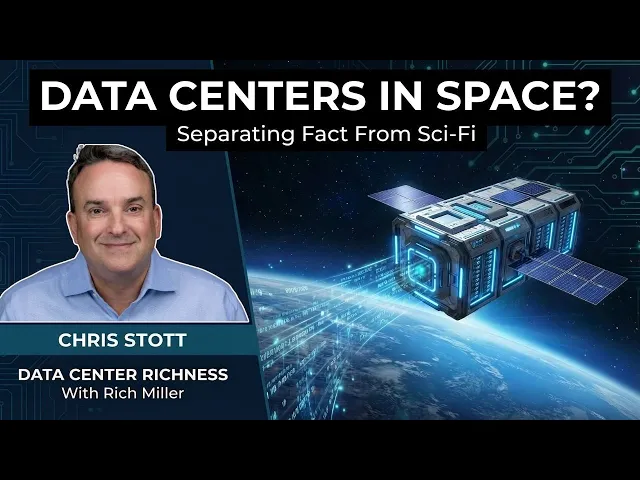
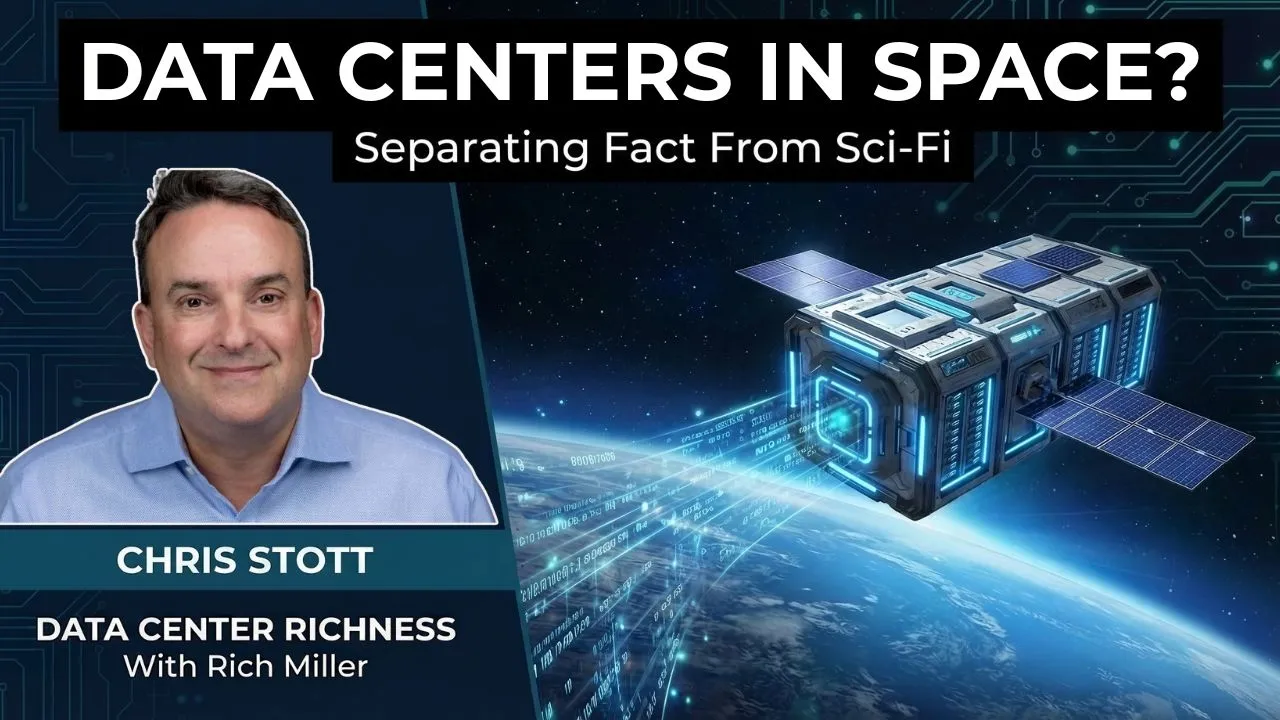
Data centers in space are a hot topic. Hypers scale data center builders like Google and Crusoe are planning space-based facilities. And so are tech veterans like Eric Schmidt, Jeff Bezos, and Elon Musk.
All these headlines have folks wondering, are data centers in space a pipe dream or are they the next big phase in digital infrastructure? To find out, I sought out someone who has actually deployed data storage on the moon. Christo is the executive chairman of Lonear Data Holdings, whose mission is to provide data storage in outer space, including on the surface of the moon.
On today's show, Chris shares about Lone Star's missions to the moon, what's involved in deploying IT infrastructure in space, how data sovereignty works above the Earth, and the future growth prospects for data centers in outer space. This was a really fun conversation which I think you'll enjoy. Let's get started.
Welcome to Data Center Richness. I'm Rich Miller and I've spent 25 years telling the story of data centers, cloud computing, and AI infrastructure. In this podcast, I'm sharing conversations with the innovators building our digital future.
Now, here's our show. Chris Dot, welcome to Data Center Richness. >> Oh, Rich, thank you very much for having me.
I really appreciate it today. I'm really glad that you're able to to talk with us because there's a been a lot of excitement about uh data centers in space and so uh I thought it would be a good starting point for our uh viewers would be to talk to someone who's who's been there and is is doing it. Uh so maybe a good uh starting point would be to say what has your data center journey been?
We always ask our guests to share a little bit about how they have got into this business and to this point in in their career. >> No, no. Well, thank you.
Great question. You know, hey, I love to talk about myself, but yeah, I was kidding. No, really, I've been working in the space and satellite communications industry for 30 years and the data center industry for the last six years of that.
But to me, I just see it as the same thing. It's just data. It's moving ones and zeros, moving code around the world, moving content around the world, processing it, delivering it.
I've worked in launch vehicles in McDonald Douglas and Boeing. I've worked in the deep space network and Tedra systems at Loheed Martin. I've done orbital spectrum work around the world and built companies that that do amazing things there.
And it was a group of customers that came to us and said, "Help, we need help backing up our data. We need to do it in a way that's under data sovereignty primarily and also in a way that's secure and accessible and that's what led us to doing data centers in space. >> Let's talk a little bit about Lonear Data and what you guys do.
What was the initial idea and uh maybe tell us a little bit about your mission so far. >> The initial idea came from customers and you know it was it was like 99% perspiration and inspiration all that kind of good stuff but it really was back from the customers. They came to us and said help.
Every time a customer has said help, you always stop everything you're doing and listen. And that's what enabled us to put together an incredible team. Uh from Dr Mark Mtosian as our CTO, former Google, former ISAI and many other companies to Carol Goldstein, our CFO, former Morgan Stanley satellite finance and so many others.
Steve Eley, our company CEO, former Virgin and Airbus. Jim Burns Monte our chief engineer out of Honeywell Drper before joining us. because you put together an incredible team to answer that question for the customer.
And the customer said, "Look, please help us. " This is just after the not Pettia virus got loose, the one that was been written about so many times. Uh it's Sandworm by Andy Greenberg all the way through to uh Nicole Pearl Ross.
This is how they tell me the world ends. And it's just this value of data, the thing that data centers create and manage and operate and store that. And by the way, I you know, we're talking on a laptop.
I look at that as a data center. I look at these things as personal data centers. Prove me wrong.
Power, coms, processing, signal, storage, data center. Same thing with this thing on my wrist. Same thing with that huge socceriz stadium building, right?
That multi-killow gigawatt building that's out there, megawatt building. And it's all about data. And these customers said, 'L we're operating in these different countries.
There's this thing called data sovereignty. When we started the company, 101 countries had data sovereignty. Now 140 countries have it.
Now states within our own American Union have it too, right? And it's how do you protect this most valuable commodity that the human race creates and data? And the idea is to back it up on an independent network out in space away from all the trouble on Earth.
even though this is where it has its all value, but it's a way of just leveraging technology in a way we've never done so to provide a unique solution that we've never had. >> The interesting thing is your your first uh mission there was the the whole idea of yeah, we need someplace to put our data. Most folks wouldn't say the moon, but uh you guys have decided to uh to go ahead and uh demonstrate the the possibilities there.
uh tell us about the the lunar missions and u and how those went and and what your plans are now. >> That's it. Our goal is to disrupt not so much disrupt the data storage industry but to disrupt disasters and we thought what's the best place to go store our data if we could you know ideally what's you know what's what's the trade statist trade here and we look at the moon as simply earth's largest satellite and we all come from the satellite communications industry and data center industries and so we said okay that would be an amazing place to do this can we do that and so we set out to loot the software, the hardware to get the rockets to the moon, which we did with a company called Intuitive Machines, to get the launches through them and SpaceX to do our spectrum findings at the ITU to get the hardware built storage from Faison on our last mission.
The CPU was from Microchip. It was a Polarify FPGA built for us by a company called Space Build. But the idea that we would build it and test it and fly it.
Let's do the hardest thing first. So, we tested our software first on the International Space Station. We put the first space uh data center, softwaredefined data centers on the space station in 2021 and 2022 because software is always the hardest thing.
Uh we've been going to space for 60 years. You know, it's hard. It's rocket science.
It's really extreme environments, but it's a known known. And so it's taking chips and processes and storage and more importantly the software to operate them and do that first. We tested that on space station.
We did everything from blockchain to a cryptocurrency to disaster recovery. We did that taking over a server on board uh made in space 3D printer, you know, partition a drive and off we went. We did that with Canonicle Abuntu.
They were brilliant to work with. And we took that same level of software back to two Luna missions. One was a streamlined version which we flew first in February 2024 on America's first return to the moon since n since Apollo 17.
And in 1972, it's our first time back. And we did that with a commercial company, Intuitive Machines. It's an incredible way to go back, right?
And that worked wonderfully. We transmitted documents there in flight and again from the surface of the moon doing checks and restore, restore. We actually set up a copy of the Declaration of Independence as the first document transmitted off planet.
I'm a very proud American citizen despite my funny accent. And then we brought back a copy of the Constitution and the Bill of Rights. Thinking what would be the good things to test, right?
And I had a whole bunch of things on board there for the state of Florida. Fantastic test of disaster recovery or as we call it resiliency as a service because this is one step different from disaster recovery. This is a whole other option of a very very remote server and storage backing everything up.
A very unique, secure, accessible under data sovereignty. And then we took that same set of software and more data. This time not just Florida but eight other governments.
We were testing delay tolerant networks, knowledge graphs for an AI company, Valkyrie intelligence. Imagine Drgons had a song on board. Microsoft's Bethesda games had Starfield on board.
We were doing everything on this last mission and hardware and software. And that flew in at end of February, beginning of March 2025. And here we are going into 2026.
And all of that testing laid the ground for us to launch our first fully commercially operational mission. And that is launching this October out of Vandenberg's space with a company called Sidus are building it for us. We're going to fly on their lizat.
It'll be polar orbiting around the earth and it's fantastic. And then we go back to the moon after those missions and we keep going more and more into space. The the demand we're seeing is incredible.
But then we're doing data storage under data sovereignty backup and restore restoration and restore right and then there's others doing AI training and inference and all of a sudden when everyone said we were crazy rich oh you guys crazy data service on the moon like hey well we did it made it happen and it worked and you know we've had them in orbit we've had them on the moon and our next steps are firmly out to just grow into every location we can in space because space as a data center region is uniquely suited to serving data needs for the planet. And if anyone has any questions, oh my gosh, satellite communications for the last 60 years have been doing this. And what we're doing is adding storage and processing to that same equation.
Sorry, I could talk for hours on this. I love it. >> No, I feel free.
I because I think it's a fascinating subject. Uh my father worked in the in the communication satellite industry, so I know a little bit about it. You know, one of the things as you mentioned before is it is an extreme environment.
Uh it there are significant differences from operating a data center, a terrestrial data center as we have to call them now. Uh that most of our uh our listeners are familiar with. Yeah.
Obviously that the satellite industry has been doing technology in space for a long time. In terms of looking at data storage, um what are the the key challenges, the key things you have to look uh look at and solve for that might be a little different than operating a data center here on Earth. >> It's really interesting, isn't it?
It's almost like a flip flip side of the same coin. And we look at a data center as a satellite and a satellite is a data center. Both have gray space and white space.
Gray space for power, thermal communications, white space for the racks in a data center. On a satellite, we have power, communications, and thermal management, gray space. And we call whites space payloads.
And a colleague of ours said, "Why do you call it payloads? " Because they're the load that pays, right? And what we've done for the last 60 years is put huge amount of electronics in space, solar power them, and make money out of them.
But it's interesting, a very good question, Rich, because when you go to space, things do change. you're in vacuum, so no convection, no no fans because there's no air to blow around and cool anything, right? So the these questions keep coming up and they should come up and the people asking them are right to ask the questions.
What about thermal management? What about radiation? And those are questions that we've been challenged with and we've been facing on our test missions and anyone flying in space though has those challenges.
So we're drawing on 60 years of sunk investment and sunk knowledge in space of how to manage thermal management. And what kind of thermal management are we talking about? Well, you put up a satellite, a geostationary satellite, 36,000 km up.
You are in sunlight 23 hours and 45 minutes a day on average. The side of your spacecraft, your satellite that faces the sun is in positive 250 degrees Celsius heat. Now the side that's facing away apart from albido from the earth and but the side that's facing deep space is arguably at about minus 140 to 200 centigrade.
So you got a hell of a temperature difference on the same piece of equipment that's normally made out of metals and carbons and all sorts of other things. So how do you handle that thermal management? Because you're up there for 15 to 20 years on these big birds.
And the key that we're drawing upon is that thermal management. How do you keep things cold? How do you remove heat in space?
Even when you're in space with that huge big great big ball of fusion which is actually powering the big ball spot on my head right here, right? And that's massive fusion power up in space, right? And that's the challenge.
Thermal management and the electronics create heat, but so do human beings. Actually, one of the biggest creators of heat in space are humans, right? I mean, that's the most amazing thing on the space shuttle, space station, and and Drgon capsules and everything else.
Humans create a lot of heat. It's amazing how many BDUs we give off. But how do you manage that heat?
It's through conduction and use of radiators. It's a known and knowing. You just got to scale it up for what you're doing.
Same thing with radiation. Yes. Oh my gosh.
Radiation's a problem. You sort of even some flights recently from Airbus had problems with radiation coming down from a solar flare. Radiation's an issue, but against an issue that we've been handling in space for about 60 years.
You do not take it for granted. You don't take it lightly because it depends where you operate in space. Are you within the Van Allen belts?
As in like think of for the people just thinking about this for the first time. The earth has like a shield. It's created by our magnetic core.
And it's like a shield like in Star Trek in the movies. It actually prevents a whole bunch of solar radiation and deep space radiation hitting the planet. So where are you flying?
Are you in low Earth orbit about 400 miles up? You in mid mid Neo mid-Earth orbit about 14,000 mi up? or you're in geo 22,600 miles up or 36,000 km up and there you're right in the middle of those Van Allen belts.
It's one of the worst radiation environments that we know of as a species. Second worst is the surface of Mars. You've got nuclear powered rovers running around in helicopters flying on Snap commercial snapdragon chips.
And that's the thing. There's a sunk well of knowledge and data that we can draw upon, but thermal and radiation. But here's the thing about that thermal coming out of the sun.
Once you've put your infrastructure up there, and yes, it's expensive, but the cost of going to space are radically down. Thank you SpaceX always, and thank you the others coming on board, Rocket Labs and Blue Origin and others bringing the the price down. Um, once you've got your infrastructure up there, your data center in orbit, your operational costs are staggeringly different to what they are down here.
The view that you have of every nation in the world is incredible. The space law that comes into play, amazing. Space is the most regulated of all human activities.
when they let me out, I get to teach international treaty law a couple of universities and and legal programs and I love it because it's like reading the rules of monopoly before you play the game, right? But it's so regulated which means you can actually do data sovereignty under different licensing and nations. It works really really well.
It's the first thing we asked with our customers and our regulators before we even began this journey. Can we legally do this? Because the hardest thing about getting to space is getting permission.
And so before we want to go disrupt disaster for the entire planet, can we legally do this? And the answer would have been yes. And then everything else was just engineering.
Well, just engineering, but engineering. Well, let's uh let me ask a little bit about that because you talked about data sovereignty as one of the uh motivators for your your clients who have been interested in this without a university lecture necessarily. uh maybe give us a a short overview of how data sovereignty and and the ground rules work in space compared to here on Earth.
>> Great, great question. And the way this works is very similar to maritime law. You know, you see a ship on the high seas and they have the flag on it and you see in the movies they're changing flags trying to change registry and all these things and whose law applies to that ship on the international waters on the high seas.
Space is very very similar but with a twist. Space is like the high seas. It's like international waters.
But when you put something into space, you have to be licensed to do so. You don't get on that launch pad without a license. And the country that licenses you is responsible for you.
They don't own space. There's no sovereignty on the moon. You can't claim it as yours.
But you are under continuing regulation, jurisdiction, and supervision. That's as far as the university lecture goes. But the fun part of it is when an American spacecraft goes to space, it's under American law.
But the thing is, if it's carrying a box of electronics for another country on board, and they always do, that box of electronics, like a data embassy, is under that nation's law and licensing. So, you can condense the entire planet onto one spacecraft with the proper work on licensing and the proper work on hardware, and all of a sudden, you have data embassies in space that work incredibly well and meet data sovereignty. And so from a physical perspective, you just have to have all the hardware segmented uh so that there's no data crossing paths.
>> Exactly. Yes. So like having an American rover or sorry an American lunar lander land on the moon and it has an American rover and a Japanese rover.
That Japanese rover is under Japanese law. The American rover is under American law. Right.
So people think, "Oh, there's no law in space. " Sorry. Go ahead.
I'm sorry, Rich. >> No, I was I was going to say it's it's fascinating. uh because you know over the years we've we've seen a lot of these uh uh small initiatives for data center operators to create data havens out on uh you know platforms in the North Sea or something like that.
And uh >> sorry I'm pulling faces. I'm like from an international treaty law point of view I'm like I don't know. I'm sorry.
Space law works. That's all I can say. Well, that that's thanks for explaining the difference as as that uh that's important and and very interesting to me.
Um in the last couple of uh months uh maybe the last year there's been a lot of headlines with different parties that are thinking about doing u data centers in space at a different kind of scale. Obviously with with satellites and with you know some of the early work that you guys have done there's there's hardware you're flying in space it's really complicated um but you know it's it's not like a hypers scale data center and now we have folks like Google Cruso folks who who done things at tremendous scale here at earth uh who seem to be talking about much more ambitious uh types of uh you know initiatives in in terms of the volume of work they want to do in space. >> Oh, it's brilliant.
It's so exciting. And why? Because it's a logical application of physical attributes to an existing market that needs the service, right?
The reason why they're doing this and I would even say that Starlink, SpaceX's Starlink, Musk is a genius on this. It's already a data center in sky in the sky. It's a distributed data center.
Each satellite has so many Linux servers on board and they're all connected. It's amazing. And Amazon's getting ready for Amazon Leo, Lightseed from Teles, One Webb.
Oh my gosh. Uh, Relativity Space with Eric Schmidt doing theirs. StarCloud doing theirs.
Google with Suncatcher and Planet Labs. Wow. Yes.
And for certain applications, definitely. Look, this won't replace terrestrial data centers. It will augment them.
It will complement them. It will make them better. And we're backing them up on a completely independent network.
No broken cable fibers, no tapping, hacking. incredibly line of sight stuff. That's what we do.
We do storage. And then that's like one flavor. We see other flavors coming in.
People like Axiom doing work on space station where they're taking a lot of data and edge processing that to send the results back so you can do more science. Superb. And you've got people like StarCloud and the Googles and Planet Labs and all these other guys doing AI training and inference.
Yes. Because they then got access to that free power. It's free, not the capital cost.
You got to go out and build everything, right? But you're not paying someone else's power station. You get that big power station up in the sky to do it for you.
Same thing on cooling. Traditional cost of a data center, power, cooling, and communications. Space changes that equation.
So, it's an incredibly good application to a market need that just works better for everyone in that system. It's not going to replace things on the ground. That's a big deal.
It's going to make them better. It's like an incredible catalyst. It's like a machine just to make it home.
Same way we use satellite communications to connect the entire human race. There's now no longer a place on the entire planet that you can't get broadband. Literally, you could be literally at the South Pole or the North Pole and you're getting broadband.
It's incredible. That's from satellites which just moved data around and now we're just adding some processing on board and we're doing the storage and they're doing big processing. But my goodness, but the thing is too, it's super smart because if you think of how long it takes to build a new data center down here on the ground in the US versus the UK versus Europe versus Asia, etc.
, etc. , you can put these things up once you've got the designs done, you've done the testing, you can put these things up in two to three years and you keep adding to them in a modular way. So all of a sudden you can actually maybe keep pace with exponential change on some of those topics like AI training and inference.
But for storage, our goal is, like I said, disrupt disasters and we want to be the world's data bank. We want to be the safe spot. We're going to have different levels of security in different orbits and how we do this from the moon to lunar orbit to all of the Earth orbits like the one launching this October because then we're just backing our data up away from the storms, the floods, the fires, the wars, the hacking, the human errors.
And people say, well, you know, I said, well, you know, it's like having a bank. It really is. Data is more precious now than money.
Well, data is technically is money, right? Digital planes flying around here. Um, data is money today.
And you don't have physical cash on you. You have your digital data, your digital money. We're a digital bank.
And we're just saying we're putting that bank where it can meet the needs of every single nation, every single country legally. Doing it in a place where it gets free cooling, free power, we're vacuum capped, lonear, vacuum capped, right? And we're doing it in a way that works just cuz we can.
>> One of the the questions I wanted to ask uh is about uh you the free power is is a a compelling offer. I think it's one of the things that's got a lot of folks interested in it. You know, are there particular challenges?
I mean, how big an array can you deploy? Are there are there, you know, challenges in terms of of how large you can go there? Do >> you know there's always going to be a challenge in terms of, you know, how big the array arcing, what you make the array of, how does it stay, you know, how big is it title change?
Even gravity has title change when different parts of the atmosphere you're in the earth. Well, the sun beats like a heart on mourn the cycles and we have sun cycles. And when it does that, the earth beats the earth's atmosphere beats correspondingly.
The heat hits the earth from the sun and the atmosphere expands. Oh, there's lots of different system trays to figure that out. But again, the great thing is we've already done most of it, if not all of it.
The International Space Station just got a new set of solar panels which are amazing. Built by a company called Redwire. incredibly thin, incredibly good, so much power, and the batteries are getting so much better.
And that's the thing, everything's there. We've just now got to deploy it, make it happen, and do it in a way where you're good custodians of what you're doing. And then it goes back to the regulations.
So people launching these things don't get to launch unless they get permission from governments. And the governments that give the permissions are the ones that have the good law, the enabling law, rules and regulations which are predominantly western and Japanese. And why?
Because of good courts, good financing, good insurance, and again 60 years of having done this quietly while everyone else is off enjoying their lives and stuff. We've been putting things in space and making them work, right? And so it's drawing upon that and then drawing upon the incredible richness of the data center industry, these modern-day cathedrals that power our civilizations, which are incredible machines in themselves.
And what we're doing is backing them up, making them safer, d-risking everything, allowing them to do more. And the same thing with space-based data centers. It just lets them do more.
This is just a tool in the toolbox. Fire was a tool. Is a tool.
a rocket engines a tool which we've had for 60 years. AI is a tool and that tool does something amazing for us. It gives us as human beings time.
We only live once. Time is the most precious asset that we have. You can't it's the only asset you can't buy more of.
So by having more data centers, more processing, more of everything that we need as a technological species and backing that up so we don't lose that technology. That's the key. >> On the backing it up, let's talk a little bit about uh Lonear going forward.
You mentioned maybe that the you mentioned the different uh orbital heights and and maybe deploying across all of those as well as the the moon. What's the vision for Lone Star? Uh and where does it go from here?
>> Uh thank you. Yes, our next launch this October out of Vandenberg Space Force Base. I used to work there years ago back at McDonald Douglas.
It's great to be able to go back and that's our next mission, a multi-year mission, commercial class data storage. And then we're in discussions with several satellite operators, hyperscalers, and more to go and fly with everything we can in every Earth orbit and head back to the moon as well with those big Earth moon lrange point data vault satellites. It's going to be incredible.
Our goal is ultimately that people go, "Yeah, of course, of course I have an iPhone. Of course I store my data in space. Where else would I store it?
" Right? And what we're saying to people is there's a 321 of storage. You know, you have your primary, your secondary, your tertiary.
Please, you know what we're finding out is we're turning into the primary source because where we back it up, it's immutable. You can't there's no executable code. It's it's a lovely reference point.
So when you go into your backups here on the ground, if you've had a cyber attack or anything else, we become that mirror. We become the primary backup, which is a surprise to us. We thought would be number three or four.
and the way things are woing in the world on cyber and everything else. It it's the right product at the right time, but also more importantly driven by customer demand. The customers tell us what they want and we deliver.
And that for us is that's that's our goal going forward. >> Well, listen, I I appreciate you taking a few minutes to to fill us in and talk about all that's going on with data centers in space. If folks are interested in learning more about Lonear, uh where can they go?
Look for us at lonear luna. com and look for us on LinkedIn and we might even get adventurous and have an Instagram soon but we're kind of I don't know right. So I mean we're very cyber security focused but that's why we love having these conversations.
>> You can go to the moon but not the Instagram. >> Exactly. No the moon's fine with us.
By the way that is the coolest thing with our team. We have mission control here at the Maritime and Defense Hub in St. Pete Florida and it's so cool.
This is a JF Honeyut mission control presidential medal of freedom winner for saving Apollo 13. He's on our board of advisers and Jay was uh one of my first ever boss at NASA when he was the center director at Kennedy Space Center. H also my boss at Locky, too.
You see a theme there. Um to walk outside at night and be able to look back up at the moon, but instead of going, "Oh my gosh, it's been since 1972 since we were last there. What's the hurry?
What's what's going on? " Right? to go, "Hey, yes, we've been there, not once, but twice, and we've done it commercially, and we're going back.
" And this year, in a couple of weeks, you've got the first Artemis mission to do what Apollo 8 did. An incredible crew. Um, don't normally talk about this, but my wife, of course, is a retired NASA astronaut.
She spent 104 days up on the International Space Station, two missions, space walker, uh, last ever mission of the space shuttle Discovery. So these are people who are absolute friends and their families and to know that we're going back finally going back to claim that ultimate high ground for free peoples in the world cuz there's someone else with a data center on the moon doesn't get much coverage and that's the People's Republic of China. They've had their data center on the moon since January 2019.
Nuclearpowered and running away 24 hours a day. They've got one in orbit too already. So there's a bit of pressure there, bit of a race, but then again the free peoples of the world are catching up and it's an incredible moment to be alive because we have these amazing tools and and the idea of putting all the data centers in space, well the newer ones for certain things like storage and AI training and inference, yes, but we'll need the ones on the ground too and they're going to keep growing and doing amazing things.
This isn't a oh my gosh, them are us. It's all of us together. A high-tech solution for the highest tech of industries, data, data centers, serving our fellow humanity and in a way that is going to be amazing or you know the quote Dave uh from gosh was it Dave?
No, Frank Lorman Dave I get confused but 2010 a space odyssey something wonderful little quote at the end of 2001 but a little quote in 2010 as well. something wonderful is happening and this is just this expansion and the use of technology to make all of our lives better. It's a little surprising though.
I get it. But people like, "Oh, data centers in space. " We're not putting huge buildings in space.
But yeah, it's pretty cool stuff. >> Pretty cool stuff indeed. Uh well, thank you, Chris, for for taking the time to uh to talk to me about it and best of luck.
Uh, and uh, I will be watching closely to see how how this all goes. >> Thank you very much. And and please come to the website, come see us.
That launch in October. We'll have a tracker on the website so you can look up and see it go overhead. >> If you enjoyed the show, please take a second to hit that like button, but also to subscribe to Data Center Richness.
This is something that's free, only takes a second, and helps us build a following here and support all of the work we're doing to help people understand the data center industry. And understanding data centers is going to be more important than ever in 2026. So, as we begin a new year, we're going to have a series of forecast stories over on our Substack.
If you don't know about the data center richness substack, you can just follow the link that's in our show notes and see all of our content over there. And if you're listening on audio on your favorite podcast player or service, please take a look at our YouTube channel and check that out. We're going to be doing some interesting things and doing more content on YouTube this year because we think it's really important that not just members of the data center industry, but the general public have a deeper understanding of the data center industry and all of the issues that are presented by the growth of our use of digital services in just about every way in our daily lives.
So until next time, thanks very much for watching. That's it for this week on data center richness.