Welcome, curious minds! Do you know the story of Túpac Inca Yupanqui, considered the Alexander the Great of America? Was he really also, as some claim, the discoverer of Oceania?
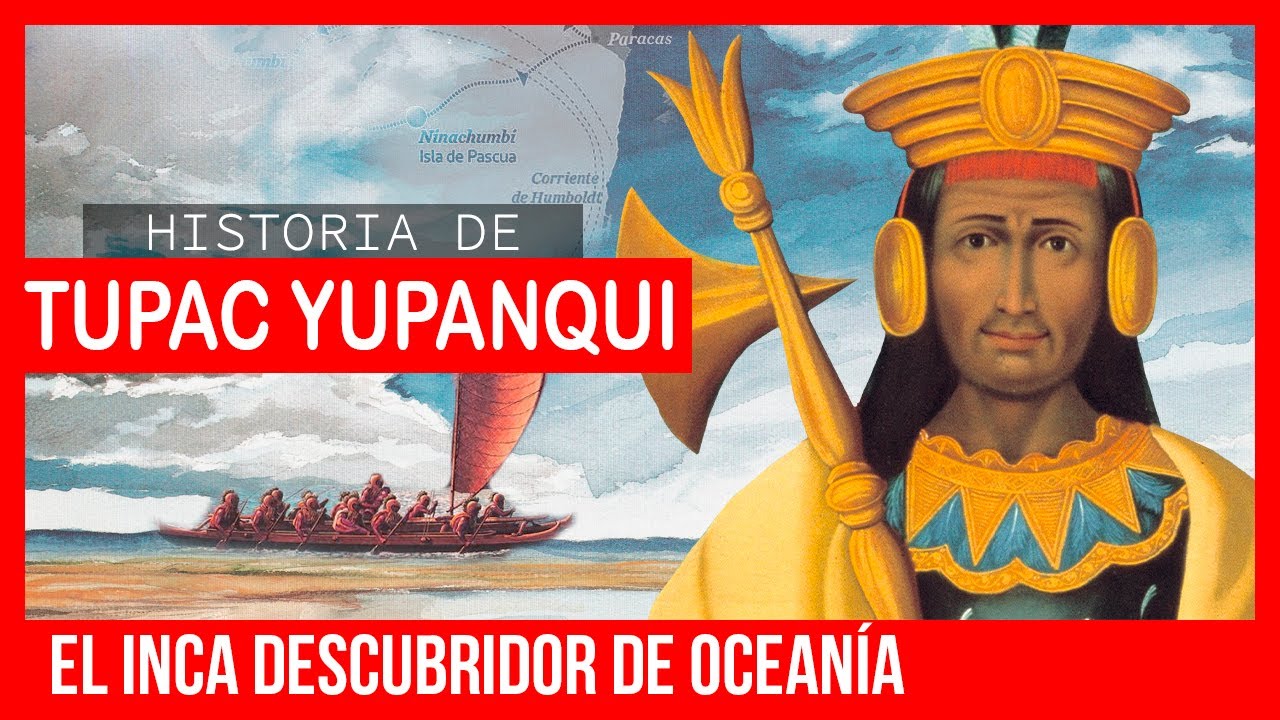
Among the many legends of pre-Hispanic America, there is one that was collected by several Spanish chroniclers from the 16th century and later about a great fleet and a great ocean crossing. That of the tenth Inca of Cusco and second emperor of Tahuantinsuyo, Túpac Inca Yupanqui. Theirs was the time of the Incas' heyday, and that is why it was called "The Shining One.
" Why do some historians also call him “the Alexander the Great of America”? We won't need to tell you: you will understand it yourself after watching this video. Túpac Inca Yupanqui – who, for brevity, from now on we will simply call Túpac Yupanqui – was born around the year 1440.
He was the son of the first emperor, Pachacutec, and his wife, the coya Mama Anahuarque – coya was the title received by the main wife of the emperor. Inca sovereign. In Cusco he grew up and was educated, and while still a teenager, Hatun Auqui, that is, crown prince, was invested.
He also received the appointment of Apuquispay, general in chief of the Inca army, which he would lead throughout his life in eight wars that allowed him to conquer the territories of his neighbors and expand the Empire to its maximum limits. To the north it reached Quito; to the south, to the Maule River, in present-day Chile. To the east, to Paititi, perhaps slowed down by the dense jungle.
But. . .
and to the west? Did you stop where the Pacific Ocean wet your feet? Before continuing, we must make a clarification: the history of the Inca Empire is full of shadows, inaccuracies and gaps.
Because? Mainly because the songs, cloaks, tables and quipus with which that people transmitted their history from generation to generation only related the specific events that seemed worth remembering, without worrying about being exhaustive in details such as chronologies or the dynasties. Not to mention that successive leaders could order that facts they did not like be removed from the historical records.
The Inca sources from which later European chroniclers drew were confusing for them, who reinterpreted them with intuitive precision, that is, at their free will, which is why their historical chronicles frequently turn out to be contradictory to each other. And many of these contradictions persist among current historians and textbooks, depending on which sources they give more credibility to. In this video, therefore, you must apologize if any date, place or character does not match the version of the story that you know.
Ours are not better, just different. Returning to Túpac Yupanqui, the first campaigns of the very young military leader took place in the north of Cusco, first in Hatun Xauxa and, later, on the Bombón plateau, until culminating with the conquest of the territory of the Huaylas. He then attacked the Chimu, whose capital, the walled city of Chan Chan, surrendered after Túpac Yupanqui ordered the course of the Moche River, which supplied the city with water, to be diverted.
He then subjugated the Chachapoyas, in the current Peruvian department of Amazonas. Many members of this culture joined the ranks of the Inca army as halberdiers. He also defeated the Tallanes and the bracamoros, in the current department of Piura.
And he managed to subdue the Cañaris, inhabitants of a territory that today would extend mainly through the Ecuadorian provinces of Azuay and Cañar. After settling in the area of Tomebamba and Quito, and after capturing Puná Island, Túpac Yupanqui traveled to the coast of Manta, in the current Ecuadorian province of Manabí, aboard a type of raft that he had not seen before: the huampu , which, if it was very large, was called marcca marcca huampu. These were rafts capable of transporting up to 50 people and making long journeys.
Those impressive boats caught the attention of the commander-in-chief of the Inca army so much that, very interested, he began to ask the locals questions about them. According to the Spanish explorer and humanist Pedro Sarmiento de Gamboa in his work 'History of the Incas' in the 16th century, when Túpac Yupanqui asked some merchants who had arrived by sea, sailing under sail, where they came from, they They responded that “from some islands called Auachumbi and Ninachumbi, where there were many people and gold. ” “And since Túpac Yupanqui – the Spaniard continued narrating – was of high spirits and thoughts and was not content with what he had conquered on land, he decided to try the happy fortune that helped him on the sea.
” It should be mentioned that Sarmiento de Gamboa was not the only chronicler of the 16th century who left testimony of this story that we are beginning to tell you; the religious Martín de Murúa and Miguel Cabello de Balboa also wrote similar stories. Continuing with Sarmiento de Gamboa's narrative, Túpac Yupanqui, as he knew that the merchants tended to be very chatty people, did not completely trust the information they had given him, and he called - always according to Sarmiento de Gamboa's story - a man named Antarqui, a necromancer who was said to be able to fly through the air. Antarqui offered to go there first as a scout.
So he flew over the waters of the ocean, saw the aforementioned islands, populated by people with great wealth, and returned to tell Túpac Yupanqui that what the merchants had told him was true. It is curious and intriguing that the crown prince continued to be more interested in the mystery of the islands than in how that necromancer was capable of flying – especially considering that if he solved this second mystery, it would be very easy for him to clarify the first. Most likely, given the context, Antarqui “flew” only in a figurative sense; That is, he visited those lands on a mental trip caused by the consumption of hallucinogens.
In any case, the crown prince focused on preparing the maritime expedition. As the Peruvian historian José Antonio del Busto explains in his book 'Túpac Yupanqui, discoverer of Oceania', this was a mountain man, he was very little familiar with the sea. However, encouraged by having been able to conquer Puná Island, he decided that he would sail across the ocean.
He was 25 years old at the time, he was in command of the army and he was going to inherit the Empire. If he decided that they should expand westward, across the ocean, no one had more authority and resources than him to try it. Young, greedy and bold, he felt called to accomplish a feat and gave himself completely to preparing it.
Among their motivations, the ambitions of territorial conquest and the simple taste for adventure were also joined by a certain religious curiosity to find out where the Sun, the Moon and the stars slept when they set on the horizon. Furthermore, according to Del Busto – creator of the theory that Túpac Yupanqui discovered Oceania – it would be possible that he also wanted to find the marine mansion of the creator god Huiracocha or Viracocha to meet him in person. Túpac Yupanqui ordered the gathering of a large number of rafts and embarked on them, in the words of Sarmiento de Gamboa, “more than twenty thousand chosen soldiers.
” This is probably an exaggeration, because that would have meant not only that he found at least 400 large rafts just to carry the men, but also that his initial army must have been gigantic. Because if, as he claims, more than twenty thousand “chosen” soldiers embarked, it is likely that those who had some sailing experience were chosen. And the proportion of people with that profile in an army of soldiers raised mostly in the Andean mountain range could not have been very high.
Due to reflections like these, Del Busto estimated that Túpac Yupanqui's expedition was ten times smaller: 1,500 soldiers and 500 sailors aboard 133 medium or large rafts; so that, in each boat, an average of ten warriors and five crew members would travel. To this, Del Busto added another fifteen rafts with supplies and their respective sailors. In total, no more than 2,200 participants in about 148 rafts.
What was still a huge fleet, never seen in 15th century America. When did it sail? It is not known exactly.
The best chronological clue provided by ancient chronicles is that the heir of Túpac Yupanqui, Huayna Cápac, had just been born, who decades later, upon the death of his father, would become the eleventh and penultimate Inca of Tahuantinsuyo. Huayna Cápac's mother, by the way, was Mama Ocllo, Túpac Yupanqui's sister on her father's and mother's sides. It was tradition for Inca monarchs to marry brothers, and Túpac Yupanqui followed the custom.
In fact, their parents were also brothers. With Mama Ocllo, Túpac Yupanqui had only a few children, but it is believed that he fathered more than 150 with his other wives and concubines. From this information about the birth of Huayna Cápac, it can be inferred that the fleet left around the year 1465.
It was a military expedition, not colonization, and Túpac Yupanqui put one of his brothers in command of the fleet, Tilca Yupanqui. What were the rafts like? Well, they were made of.
. . Exactly, balsa wood, an American tree that can reach up to 30 meters in height and is characterized by having a white, soft and very light wood with high buoyancy.
The Spanish chronicler Agustín de Zárate left us a description of those boats in his famous work 'History of the discovery and conquest of Peru', printed in 1555. He says the following: “These rafts are made of long, light poles, tied on top of others. two poles, and the ones on top are always none – that is, odd –, commonly five, and sometimes seven or nine, and the one in the middle is longer than the others, like a cart's pier, where the rower sits.
; so that the raft looks like an outstretched hand, whose fingers are shrinking, and on top of that they make some planks to avoid getting wet. There are rafts that hold fifty men. (.
. . ) They navigate with sail and oars, because the natives are great sailors of them.
” In case you are wondering, each trunk measured between 75 and 90 centimeters wide. On the balsa wood logs that extended from stern to bow – as Zárate described, in the likeness of a hand stretched out with its fingers together, the middle being the longest – two or more logs were placed crossed from port to starboard. to give consistency to the whole.
These were made of mangrove or lampa wood. Although Zárate said that those horizontally crossed logs were located below the raft, most ancient drawings place them on top, so that point is not clear. What historians do agree on is that a cover of reeds was spread over the group of trunks as a floor on which to step and stay dry, since the water that fell on the raft was filtered through that kind of mat.
All the trunks were tied together with ropes made of henequen – a type of agave – which were very resistant, although they had to be checked frequently since they were so tight to encircle the trunks that they could break due to the wear and tear of a long journey. According to the descriptions of the chroniclers, the large rafts could measure 25 meters in length – that is, in length – by 7. 5 meters in width – that is, in width.
In total, almost 190 square meters of surface, a little less than half a basketball court. As we have already mentioned, they were capable of carrying 50 people or, in the case of merchandise, between 60 and 70 barrels, according to Agustín de Zárate. But on a journey as long as the one undertaken by Túpac Yupanqui, it is logical that the carrying capacity of the rafts would not be used to the maximum, since that would have harmed navigation.
For those of us who are not familiar with the nautical world, imagining ourselves on board a raft like that one – so flat, without keel or gunwales – in the middle of the strong waves of the ocean, can seem very dangerous. Isn't it terrifyingly easy for a wave to capsize a raft? Well it turns out not.
Judging by what we have been investigating, it is the opposite: although they could suffer strong pitching and rolling, those rafts could not capsize. Del Busto stated that there is not a single known case of capsizing, and there were many European sailors who, over the centuries, marveled at the safety offered by these rafts. For example, the 16th century chronicler Miguel de Estete wrote: “They are ships very safe, they cannot be flooded or upset.
” And the Galician Andrés Baleato, lieutenant of the Royal Spanish Navy who was director of the Lima Nautical Academy for two decades, explained it in a little more detail: “The blows of the sea do not enter the masts, nor do the waves that bat between them has the strength to reach the load because the entire body of the raft follows the alteration and movement of the waves, which makes it practically 'untiltable'. Furthermore, they had the advantage that they could be repaired on the high seas, simply by readjusting or replacing the henequen ropes to keep the trunks in place. Of course, they had to carry a good supply of that type of rope from the beginning.
Speaking of provisions, those they set out with would probably be fish, dried meat, tubers, and roasted corn; Furthermore, during the journey they would catch more fish, as well as octopus and squid. They would carry fresh water stored in large hollow reeds under the raft and collect rainwater in containers during the journey. Additionally, it is possible that they chewed coca leaves to reduce hunger and thirst.
The sail of the raft was quadrangular and its mast was bipod. Only some of the larger rafts would also carry a second mast, with a sail half the size of the main one. The candles would be made with thick cotton threads.
The cabin that presided over each raft, with a gable roof, was located behind the main mast and occupied at least a fifth of the deck. In it the crew slept and protected themselves from the sun, rain and waves. It is unknown what the actual raft of Túpac Yupanqui looked like, but it is likely that it had a larger hut subdivided into several rooms.
The first European sailors who saw this type of raft were fascinated by the great maneuverability they enjoyed despite not having a rudder. How did they achieve it? Their secret was the guaras, planks, usually six, which, distributed between the stern, the bow and the center of the boat, always between the largest trunks, made it possible to maneuver the raft.
Each of the guaras measured about three meters long, forty centimeters wide and three fingers thick. By sinking them or removing them from the water, they allowed them to turn, increase speed or even sail against the wind. How was that possible?
Because the guaras took advantage of sea currents in the same way that sails benefited from the winds. If there was no wind, the guaras allowed those who knew the behavior of sea currents to continue advancing. Okay, now we know what that fleet was like.
Now, the key question: what was his destiny? Del Busto proposed two hypotheses: America and Oceania, although he opted for the second. But let's start with the fact that they did not reach other continents.
According to the Spanish chroniclers of the 16th century, there were few casualties among the expedition members: the vast majority returned alive after a journey of more than nine months that led them back to the port of destination, after having found the islands of Auachumbi and Ninachumbi. The name Ninachumbi refers to fire, so it could be a volcanic island, like Isabela Island, the largest of the Ecuadorian Galapagos archipelago, a probable destination for a fleet leaving from the coast of Manta heading west. However, the Galapagos were not inhabited at that time, which would contradict accounts of the wealthy people who lived there.
Del Busto speculates that perhaps, after seeing that neither the gold nor the people promised by those merchants he had interviewed were found in that place, Túpac Yupanqui headed north and reached the Pearl Islands, in Panama, whose island main, Terarequí, would be Auachumbi. At that time Terarequí, also called Isla del Rey, was known by maritime merchants from the equatorial region, who reached it without leaving the coast of the American continent. One of the greatest mysteries of that adventure is that of the black people that Túpac Yupanqui encountered on his trip and who, according to different chronicles, took to Cusco as prisoners to show off during the great victory parade he organized upon his return.
In the story of Pedro Sarmiento de Gamboa, he stated: “Tupác Inca sailed and went and discovered the Auachumbi and Ninachumbi islands, and returned from there, from where he brought black people and a lot of gold and a brass chair and a skin and jaws of horse. . .
". How strange, right? So much so that Sarmiento de Gamboa himself recognized how incredible his story sounded, with these words: “I insist on this, because to those who know something about the Indies it will seem like a strange case and difficult to believe.
” Who were those “black people” that Sarmiento de Gamboa spoke of? There were no black-skinned people in Tahuantinsuyo, and it was not until six decades later, in 1527, when the Incas saw the first African, who landed in Tumbes with the expedition of the conquistador Alonso de Molina. The reaction of the locals upon seeing him, recorded by Pedro Cieza de León in his work 'Discovery and conquest of Peru', was one of astonishment and disbelief: they could not imagine that such a dark person existed, so they offered him water “so that “he would wash his face and hands and thus lose his blackness.
” Perhaps they were descendants of Melanesians, the darker-skinned inhabitants of Oceania , some of whom reached the Panamanian coast sailing with the equatorial countercurrent and settled in Cuarecuá, in front of the Pearl Islands. Vasco Núñez de Balboa came across them in 1513, and their existence was recorded in chronicles such as the 'General History of the Indies' by the 16th century historian Francisco López de Gómara, who wrote the following: “Balboa entered Cuarecuá, but found no bread nor gold; However, he found some black slaves of the local chief. He asked where they had them from and they couldn't tell him or understand other than that there were men of that color nearby, with whom they had war very often.
These were the first blacks seen in the Indies and I still think that no more have been seen. ” Therefore, if Túpac Yupanqui encountered black men on his trip, unless he really reached Oceania, the most likely place he arrived at was the Pearl Islands, the islands closest to Cuarecuá. Perhaps those black men were taken there by the islanders after capturing them on the mainland.
Túpac Yupanqui also returned with skulls and skins of strange horse -like animals . At that time there were no horses in America, so perhaps they were from manatees captured on the Atlantic coast of Panama. From the Pearl Islands, Túpac Yupanqui could have returned to his port of origin, on the coast of Manta, in a couple of weeks, following the route that the merchants of the area already knew, on a cabotage voyage – that is, , without losing sight of the coast – during which they were able to make stops to collect the gold, silver and precious stones that, according to the chroniclers, the expedition members also carried on their return.
Because, although on the Pearl Islands there were, pardon the redundancy, pearls; It is very unlikely that they would have been able to find significant quantities of gold and silver there, unlike on the Colombian coast. Okay, so far we have talked about the hypothesis that Túpac Yupanqui's fleet remained in American waters. But.
. . is it possible that the young adventurer, as many defend, managed to reach Oceania?
To do this, after setting sail from the coast of Manta, they would have headed towards the Galapagos, passing them to the south and leaving them behind without stopping there. Next, the rafts would have taken advantage of the Equatorial Current to continue sailing very far to the west, towards the seas of Polynesia. After a month and a half of sailing, they would have traveled around 2,000 nautical miles and would still be halfway to the islands of eastern Polynesia.
Since, in the South Pacific, currents move counterclockwise , it is possible that Túpac Yupanqui also traveled in that direction. According to the historian José Antonio del Busto, on the island of Nuku Hiva, belonging to the Marquesas archipelago, in French Polynesia, there is an ancient legend about a leader named Tupa who arrived from the east at the head of an army and many men. However, the island that Del Busto believes could have been Ninachumbi was not Nuku Hiva, but another island in French Polynesia, Mangareva, the main island of the Gambier archipelago.
Later he arrived at Auachumbi, which would be none other than Easter Island or Rapa Nui. The order of visiting those two islands could not be different, given that the winds and sea currents only allow travel from Polynesia to Rapa Nui, not the other way around. If the Peruvian historian's hypothesis were true, that would mean that Túpac Yupanqui's fleet followed the entire South Equatorial Current on its outward journey and Humboldt's fleet on the return trip.
But on what basis did he defend it? Let's start with Mangareva. That island already had a dynasty of kings before the 15th century, and a local legend survives about a chief called Tupa, a red man who arrived from the east with a fleet of boats of a type they had never seen in Polynesia.
In the middle of the 20th century, the renowned French ethnologist Paul Rivet proposed the Oceanic Theory, according to which the population of America was carried out by four migratory waves: those of the Mongols and Eskimos – through the Bering Strait – and those of the Australians and the Malayo-Polynesians, who crossed the Pacific Ocean. Well, according to Rivet, in Mangareva's oral tradition, "the description of the ships, the name and description of their leader, the direction from which the fleet came. .
. everything evokes the expedition of Túpac Yupanqui. " And he added: "Nothing prevents us from admitting that the Inca could reach the Gambier Islands in four months.
" According to another legend of that island, that foreign chief called Tupa, owned “a wonderful boat with which he opened a permanent channel to the island. ” That channel would be the strait called Te-Ava-nui-o-Tupa, which means “Great Channel of Tupa” and which allows you to cross the atoll that surrounds Mangareva. The wonders that that chief called Tupa brought with him, such as fabrics, ceramics and metal ornaments and tools, caused such amazement among the islanders that his visit continued to be told in the form of legend for centuries.
And they even continue to perform a warrior dance in his honor. After spending time in Mangareva, Tupa, according to oral tradition, left to return to his country, “where the sun rose and there was a dense population governed by powerful kings. ” In addition to supplies, Tupa may have been able to take some of those Melanesian men with him?
? Melanesians, who, as we already mentioned in the case of Cuarecuá, although they were not as dark-skinned as the Africans, would appear black to the eyes of the Andeans. Next stop: Easter Island.
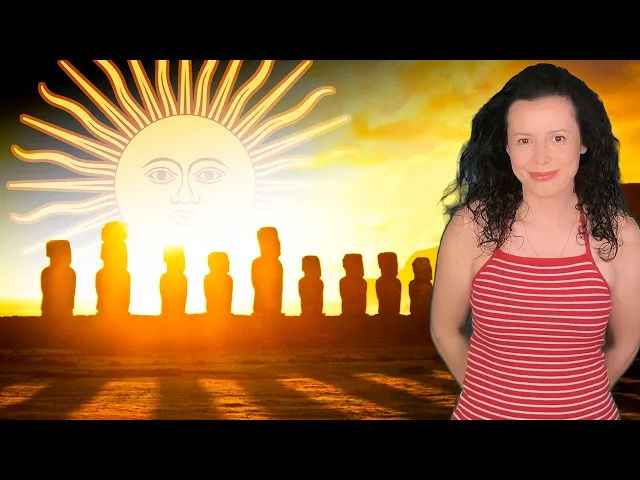
Could the current Chilean Easter Island, called Rapa Nui in Easter, be the island of Ninachumbi where Túpac Yupanqui arrived? Ninachumbi or Ninachumbe can be translated as “island of fire”, which could match Easter Island because it has several volcanoes, although inactive, or perhaps because of the flames of the bonfires of its inhabitants. In the south of the island, the presence of the Ahu Vinapú stands out, an enigmatic construction made with large stone blocks whose façade facing the sea is very similar to the style of Inca constructions such as Ollantaytambo, the palace of Inca Roca in Cusco or the fortress from Sacsayhuamán, not so much for its shape as for its construction work, with precise cuts and practically perfect joints.
The Sacsayhuamán fortress, precisely, was being built during the time of Túpac Yupanqui. An ahu, by the way, is a ceremonial platform on Easter Island where ancestors were worshiped. Moai were usually placed on top of the ahu, you know, those enormous monolithic statues with a humanoid appearance that always looked towards the interior of the island and served to.
. . Well, the truth is that it is still not very clear what their function was.
The most widespread opinion is that the moai were a representation of the ancestors of the island's inhabitants, who would have sculpted them so that they projected their supernatural power towards their descendants. But there are theories for all tastes. In 2018, For example, a team of researchers from California State University discovered that in areas of the island where there are no moais there is no fresh water, a very valuable resource, but there is fresh water in the vicinity of the moais.
So, based on their discovery, they launched the hypothesis that the moai were used as signs so that people knew where they could find water. Although, in our opinion, perhaps it would have been enough to place a wooden post instead of 200 tons of volcanic rock. If the hypothesis formulated by Del Busto about the passage of Túpac Yupanqui through Easter Island were true, of course no memory of his name was preserved there.
The only indication that it could have been like this, apart from the aforementioned façade of the Ahu Vinapú, is the mention, in the Easter legend of the kind maiden Uho, of a prince whose name meant "Son of the Star King", which Del Busto linked to the Inca, a title that comes from Intip Churin, which translates as Son of the Sun. Continuing with this hypothesis, Túpac Yupanqui would have set sail from Easter Island heading south until entering the minor current that circulates from west to east. Then, once close to America, the Humboldt Current would have led the fleet northward , until it returned to its starting point on the coast of Manta.
In total, according to Sarmiento de Gamboa, Túpac Yupanqui's ocean voyage lasted "more than nine months, others say a year. " After his return, he ascended the throne when his father, Pachacutec, died around the year 1471, although it is likely that he shared the tasks of government with his father for many years before his death. Once crowned with the mascapaicha – a woven cord inlaid with gold threads and feathers that was wound around the head – Túpac Yupanqui continued with his campaigns to expand the Empire.
In the east, he occupied the region of the Paititi River, the current department of Madre de Dios, where he subjugated the Opataris, the Manaris, the Manosuyos and the Chuncos. Later he took his troops south, until reaching the Maule River. Why didn't they continue to progress further south ?
Because they encountered the Mapuches, an indomitable ethnic group that defended their lands with ferocity. Although initially the army of Túpac Yupanqui managed to defeat them in battle, the great resistance that that town showed against the Inca advances convinced the monarch that continuing south would be too dangerous than swimming a triathlon in the Seine and he decided to return to Cusco after leaving a garrison. on the Maule River as the southern border of the empire.
Túpac Yupanqui died in the town of Chinchero around the year 1485, at about 45 years old, due to an unknown illness. Although, as in the case of Alexander the Great, there are all kinds of hypotheses about his death. One of the most popular is that he was poisoned by one of his wives, Chuqui Ocllo, jealous because the emperor had chosen Huayna Cápac as his successor instead of one of his sons, Cápac Huari.
The mummy of Túpac Yupanqui was preserved in the Inca capital until 1532, when the Quito generals Quisquis and Calcuchímac burned it. But his descendants from the panaca Cápac Ayllu collected his ashes and hid them in Calispuquio. The ashes of Túpac Yupanqui, the Alexander the Great of America, remain hidden to this day.
And you? What do you think was the fate of the maritime expedition of Túpac Inca Yupanqui? The Galapagos and the Pearl Islands, in America?
Or perhaps they reached Polynesia and Easter Island? I would like you to tell us below, in the comments. And if you want to know more interesting stories, subscribe to our channel.
Thank you very much for being there, curious minds! See you in the next video!