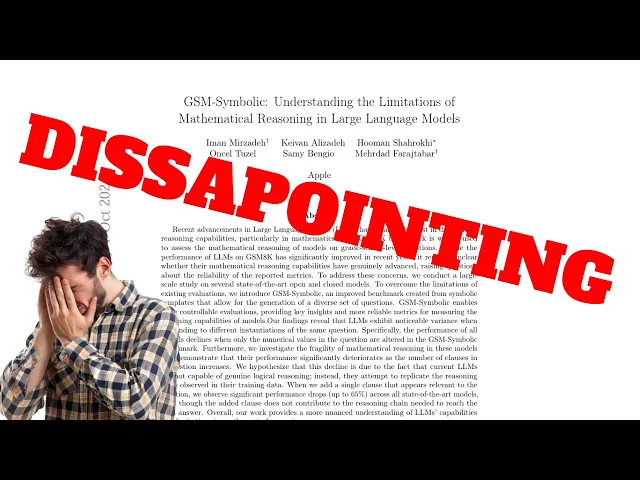
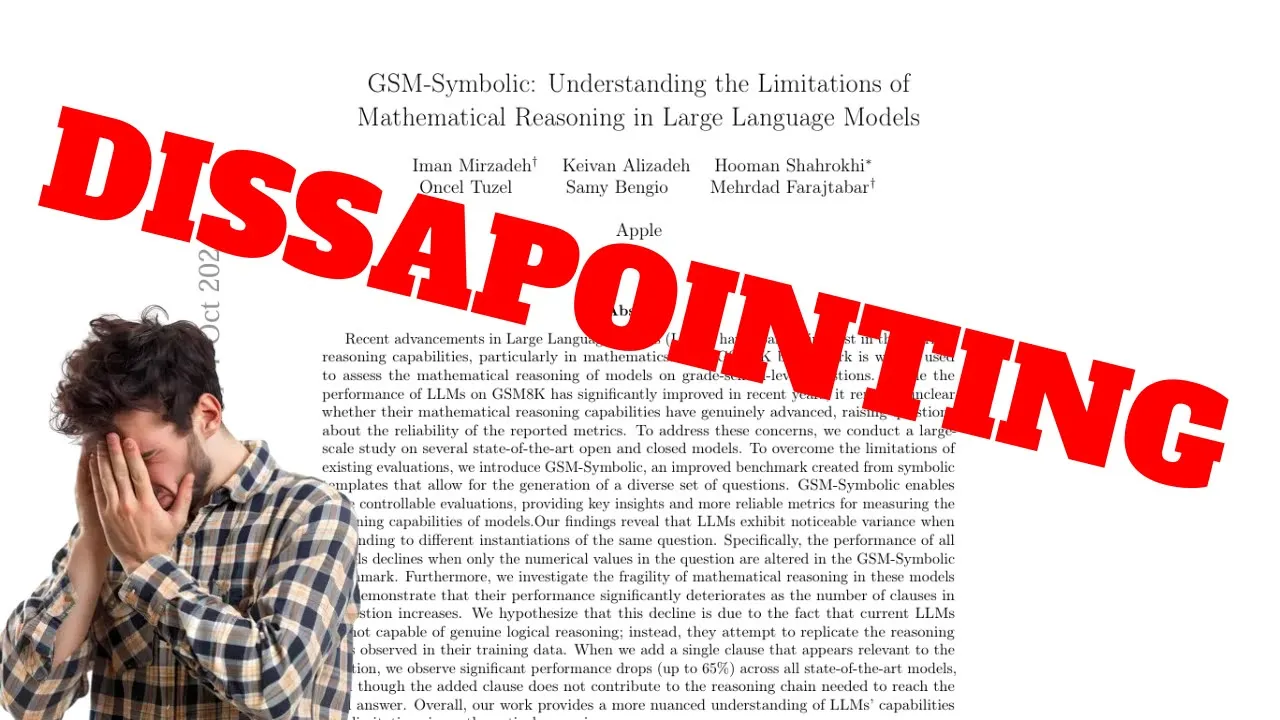
I got requested a lot to discuss the GSM symbolic paper from Apple where they're discussing whether or not models can reason and they're making the strong claim that they can't because their performance drops a lot when you change seemingly unimportant details of the question suggesting that they're overfitting and that they're just memorizing and pattern matching and not actually reasoning I read it very carefully I read it in context of other research as well and let's say I'm not impressed at all by this paper I'm actually quite shocked almost by the quality of this paper I
find it pretty bad and it's getting a lot of attention even though if you read it carefully and and you think about the conclusions they're making based on the data they provide and also them ignoring previous research done on this subject it's pretty astonishing how a paper like this can be so influential I'm open to see contradictory evidence this is what research is about but not like this this is not good science so let's dive into it they give models the GSM-8K which is a data set with grade school math questions so they're not very
hard the GSM-8K is something that's widely available in the web so the the probability that models have seen it before and that they have had the possibility to memorize it is quite high so they they're testing basically two things in this paper the first one is that they have a token bias just changing tokens that have nothing to do with the math question itself like changing the name of a person or changing the numbers from five to seven but not changing the logic of the question deteriorates their performance that's the first claim they make the
second claim they make is that as they increase the complexity of the question their performance drops more than they would expect so that's the second part so let's go through this here you can see a very simple example of how they did it when Sophie watches her nephew she gets out a variety of toys for him the back of building blocks has 31 blocks in it blah blah blah so they can change the name they can change the family so instead of Sophie it's now Boris and from nephew to nce you can see how this
shouldn't change the answer to the question if you understand it correctly but this this is a good setup to test whether or not they are memorizing data but memorization and generalization do not exclude each other this is an important thing to understand actually this is a common phenomenon seen in large neural networks is that they can overfit the data while also generalizing to new data it's called benign overfitting it's a quite surprising finding you can have a data set with a lot of noise in it and then the model overfits on it so it starts
to memorize the noise but then when you give it another question outside of this data it still generalizes so for some reason its both memorizing and reasoning at the same time the idea is is actually really simple if you have a small neural network then you can memorize the data with all the neurons in your network your network is full so when you want to go to a network that generalizes you have to remove all the connections you made to memorize and then change it to something that generalizes so you have to actually increase the
loss because once you destroy all these connections you are not able to perform well anymore so you increase the loss in order to make a generalization structure that has a lower overall loss so you have to sacrifice loss in order to get to a better state so basically memorization is stuck in a local Minima and generalization is the lower Minima or maybe a global Minima so in order to get out of the local Minima you have to get up and go to the global Minima and this can be quite hard models can get stuck in
this local Minima now what happens when you make the model bigger is part of the network is for memorization but you have so much capacity that you can use the other part of the network to reason you don't have to destroy the older memorization structure you can just leave it intact and use the other part of the network to try out structures to generalize without sacrificing loss so this Minima disappears now it's not completely accurate to say that the Minima just flattens it's actually has to do with the dimensionality when you have higher dimensionality local
Minima are are quite rare it's hard to have a local Minima in a high dimension because every Dimension has the possibility of sloping down making a local Minima a sadle point instead of a local Minima I have a video coming up on this that illustrates this in 3D to show you exactly what I mean because I think that's a very key thing to understand why these big neural networks are able to generalize and don't overfit and actually interestingly that's in line with this paper they show that bigger networks overfit less and that they generalize more
even though they're not trying to prove this they do prove this and they don't mention it but the data of them does show it that's quite funny and so they're discussing some previous work some previous papers all in line with their hypothesis of course they supporting the idea that they're pattern-matchers but they are ignoring the body of evidence showing that they do generalize and also ignoring a lot of the mechanistic interpretability papers from for example entropic showing that models create internal structures that are logically representing mathematical operations they actually can see that in the neurons
they're building some kind of structure that's able to do summation for example or multiplication or stuff like that so we can look into these models and actually see that they are making some kind of abstractions and some kind of reasoning so they are capable of it and I'm not saying that today's models are most efficient at reason in if you watch my previous video or the the video that will be out on Friday it will be quite clear to you that the current models are not that the best at generalization outside of distribution and reasoning
but they are good intuitive thinkers they're good system one thinkers and if you give them a lot of data then just like humans at some point we will find some kind of generalization at some point we will be able to do these kinds of questions maybe even do math but you can imagine how much math does a human have to see before it's able to do it intuitively it's going to take a quite a long time normally we use some kind of logic to deal with math and otherwise we're going to be quite limited in
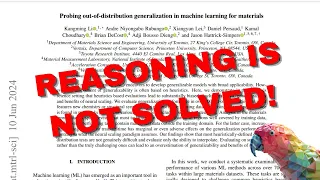
our capabilities which these models are that's why o1 and the line of o1 models is going to be very important for this so they made their own data set and they're discussing some other variation on the data set and they here they mention another paper from the same year what I don't like about this is that this paper is the same but with a different conclusion and they did not discuss the results of this paper and their related work section I'm just going to show this paper real quick so what they did in this paper
instead of changing certain variables like the name or the number they had human annotators looked at three example from the GSM-8K and they made new problem from this on the same difficulty level so look at this graph this graph shows the similarity between the GSM-1K this is the new data set with the GSM-8K which is old data set and this line is where they're exactly the same they have the same performance on both data sets so if these models are not overfitting on the data and they're actually generalizing then we expect them to be on
this line if they're under this line it means that they are memorizing the GSM-8K so what you can see is that the big models like GPT-4 and Gemini are on this line so they're not overfitting while smaller models do overfit and smaller models do see a drop in accuracy basically saying bigger models generalize better which is in line with what I just explained and in this paper they also mention that a model that overfits does not mean that it's poor at reasoning merely that is not as good as the benchmark might say but they can
still be capable of reasoning and solving novel problems so this is so interesting this other paper is showing completely the opposite conclusion of the Apple paper and you might think hm why do these two papers that both alter the data set so that it's uncontaminated why do they show such different conclusions is it that they have very different results here's the interesting thing no they do not have different results this line that I just showed you is not very different from the results of the Apple paper but the Apple paper selectively chooses results in order
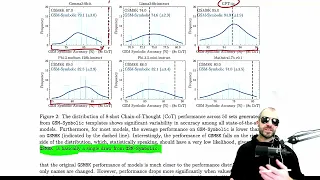
to make their conclusion I'll show exactly this so one of the first things they show is a plot the dotted vertical line is the score on the the GSM-8K and then on the Apple data set this is the blue line first thing is that the accuracy of a lot of these models drops with this new data set suggesting overfitting but here's the thing just like we saw in the previous paper the bigger models don't and when we look at this graph GPT-4 actually performs slightly better on this new data set and that's probably just by
chance but it's to say that GPT-4 is not performing worse on this altered data set so bigger models still generalize otherwise they would show drop and and what do they make of this well they kind of sweep over this they they don't really address this they just ignore this fact that the bigger models perform better they're just focusing on the smaller models and saying they are overfitting so all models are overfitting and then they're noticing the variance and they're saying well we made some different variations on one question and one time the model gets it
right and the other time it doesn't get it right even though we only change the name of the family member for example so this variance in the results is weird why do we get this variance this variance must mean that models are focusing on the wrong things well we can't say that because you can ask a model the same question exactly the same question don't even change the family member and you will get a different result if you ask the same question a lot of times you get a different result why because these models are
based on probability so they're going to answer these questions based on this probability they might say an answer is 90% probable means if you ask it 10 times one of these times it's going to get it wrong and this variation is not due to any overfitting this variation is just because of the the way models are implemented right we can make them so that they always give the highest likely answer we can set the temperature to zero but we want them to be somewhat creative so we don't this is just a hyperparameter choice it does
not nothing to do with overfitting and now we go on to the second claim and the second claim is that when you have more reasoning steps the models perform worse so how do they do this see they're going to subtract the clause they're going to add a clause they're going to add two clauses so you have GSM symbolic M1 means minus one Clause P1 with clause and P2 with two clauses extra so you can see it here to make a call from a phone boot you must pay $0.6 for each minute of your call after
10 minute that price drops to 0.5 per minute how much would a 16-minute call cost so you can see we can remove this Clause of after 10 minute that price will drop to 50 Cent per minute we can add a clause after 25 minutes from the start of the call the price drops even more to 0.3 per minute we can add two clauses so we can make the the problem longer and we would expect the model to perform worse but what they are saying is we would expect it to be linear that is something I
doubt I mean what is the evidence for that is that the case with humans will their performance drop linearly or will it drop exponentially for example that's not very clear that's just an assumption they're making now we look at this and what we see with a small model like a Gemma 29b it drops you can see that if you add a clause it gets lower you add a clause it gets even lower and we add another clause it gets really low so let's say it it's increasing more than linearly which is their claim but now
again they're only looking at the small models because now look at at the GPT-4 model look at the o1 model are they increasing superlinearly no not at all actually you can see that with zero clauses to one clause to three clauses they're all the same GPT-4 drops only with the third added Clause before that it stays the same so their conclusion that it's dropping superlinearly is only true for the smaller models and they're ignoring the bigger models again it's quite logical that more reasoning steps causes models to drop in performance but why does it stay
the same for the GPT-4 model it seems like they can do very well under X amount of reasoning steps and once it exceeds this they get worse this is quite logical if you look at the architecture because if you look at the architecture you can see is a feedforward neural network and let's say this feedforward neural network can fit in four reasoning steps you go to the the first part of the network do one reasoning step you could do second second reason step etc. now in order to do eight reasoning steps you have to loop
back and go through the whole network again if you want to do infinite reasoning steps you have to have an infinite Loop models do this in a sense these models are Auto-regressive meaning that they take their output and put it in their input into the next run so they they have some kind of looping effect but in order to actually use this effectively this Loop they need to be able to use Chain-of-Thought effectively they need to be able to utilize the reasoning in their output for the next input that's think they're not trained to do
this effectively o1 models are trained to do this effectively but GPT-4 models are not that's why we see the cap that's why they're staying around this area because they can deal with three reasoning steps easily because it's all within their neural network when it exceeds this they need some kind of recursive structure in order to do it effectively and o1 mini has this recursive structure but this is just mini and I think that preview might be able to handle this better but it didn't include preview in these graphs so we can't know for sure but
I think it's reasonable to expect that this drop over more reasoning steps is going to disappear as these o1-preview models are able to do this recursive structure better and able to do reasoning steps better but a decrease in performance is expected if the complexity of the problem increases this is the same with humans this is just a logical consequence of complexity but the conclusion is totally wrong the conclusion that it drops superlinearly is not true the drop is only superlinear for smaller models not for bigger models just like the previous conclusion then the last thing
they do they actually do another thing and that's that they add a clause that looks important but isn't actually important for example Oliver picks 44 kiwis on Friday then he picks 58 kiwis on Saturday on Sunday he picks the double number of kiwis he did on Friday but five of them were a bit smaller than average how many kiwis does Oliver have but five of them were a bit smaller than average that is not needed to solve this question of course for some reason these models trip over this and they start trying to include this
in the question it's not very weird that they do this I think humans would do this as well if you got a question like this that's relatively straightforward so you recognize it as some grade school question and you see a random clause in there while all other parts are relevant you might mistake this for something relevant too now if your logic is good and you're actually critically thinking then you will notice that that's not needed but it's not where to see a drop off I think if you do this with humans they will have a
drop of to it's just expected you can see that the o1-preview model is tripped up the least by this you can see that the reasoning is helping them critically think and select the right things to focus on now they also notice something interesting some of these models like Gemma 2B like these small models they perform a lot better when you include this random Clause you can see that they're perform very bad like 12% 8% and 48% when we add this random Clause Now isn't that very weird why would their accuracy improve from adding an nonsensical
clause they don't give an explanation with this um maybe it's just by chance I think there can be an explanation and that's that models are able to use tokens to reason like I said it's an auto-regressive model they take their output and use it as an input so if you have more tokens even if these tokens don't make any sense that means that this recursive structure can repeat for every token that you added so it gives it more computational power this is shown in other research papers models are able to use extra to tokens to
increase their performance and I think this is especially through with these smaller models they are lacking computational power so having extra tokens can probably increase their performance but right this is just speculation here is their conclusion so the conclusion is that they are better matching and they're not truly reasoning and that this paper showed this okay to to make a paper with claims like these that are based on nothing what did they actually show they showed that with an uncontaminated data set smaller models drop in accur accy while bigger models almost don't drop at all
they conclude that this is proving memorization my conclusion from this would be that smaller models are are showing some dependency on overfitting on these benchmarks while bigger models are able to generalize more their reasoning is flawed because of two reasons first you could not make this statement Based on a drop in performance you would need it to go to zero not just a drop of a couple percent and secondly this drop is not even there for bigger models so it's only for smaller models that they're memorizing and the second claim that when you increase the
complexity models perform a lot worse than you would expect is only true for smaller models again and what to expect is also something subjective who says that adding a extra reasoning step causes linear increase in error rate this this true for humans is this where they're getting their assumption from I don't know but it's not true for bigger models again bigger models show a sublinear decrease in error and then they show that adding a random clause causes the model to trip up but again only smaller models and the bigger the model the better they get
it not tripping up over it the preview model the ones that can reason get the best score showing that these reasoning models are getting pretty good at selecting the right information so this this apple paper is not showing anything and they're ignoring a lot of previous results from research they're ignoring interpretability research they're ignoring the previous Benchmark that was done before this and they're making claims based on their own results which is selectively done on a small part of their their results and they make conclusions that are not valid there's just so much on this
paper that's just not good it's quite disappointing the fact that people refer to this paper and that they use this paper as evidence is showing that people are not critically evaluating these papers