(upbeat drum music) - We develop midshipmen morally, mentally and physically, and we graduate leaders to serve the nation. (upbeat violin music) So when a Midshipmen comes to the Naval Academy, one of the first things that they memorize is how many times a day they should say. .
. - [Group] Beat Army! - We have a ton of resources to help our students to succeed here.
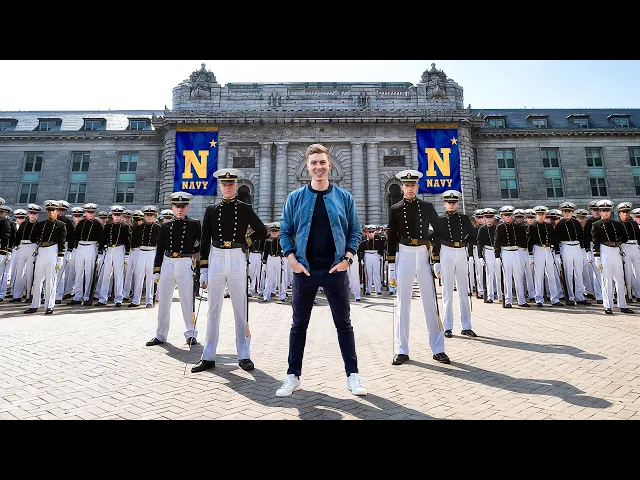
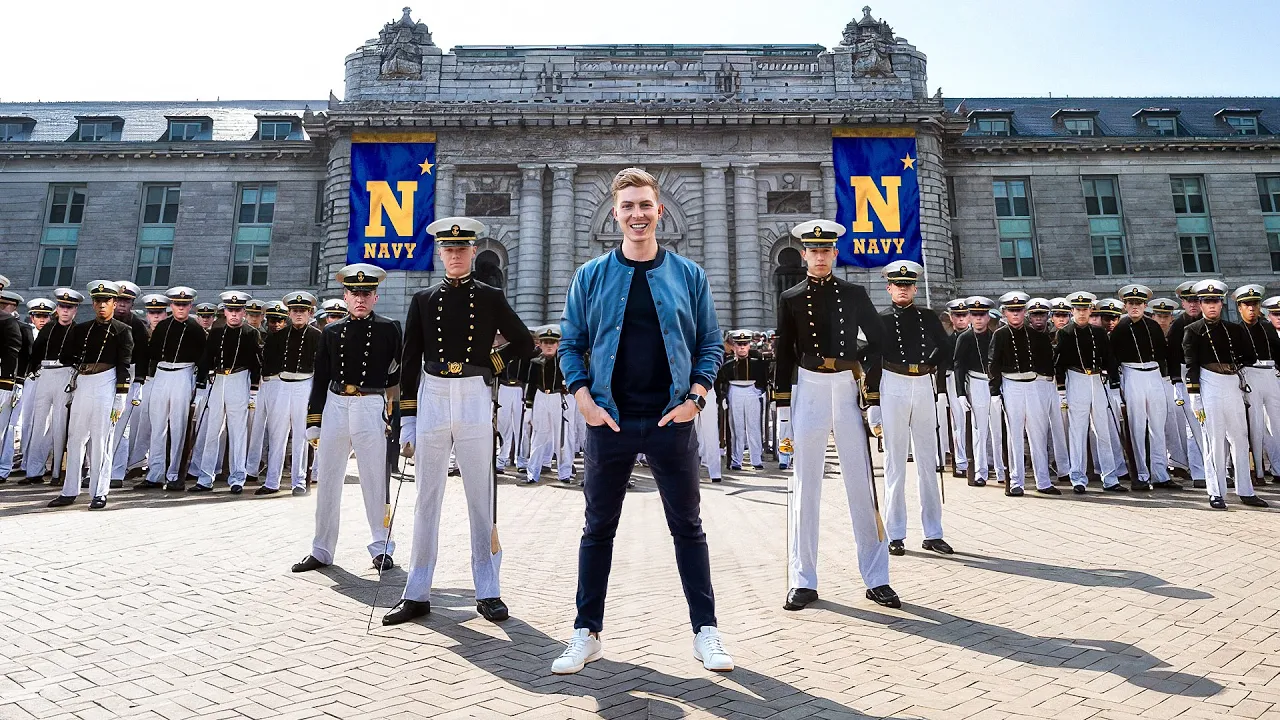
- Today, I'm here in Annapolis, Maryland to bring you inside the gates of the United States Naval Academy. Not only is it one of the most prestigious colleges in the country, but it also serves as the training grounds for future officers in the US Navy and Marine Corps. We'll be doing a deep dive into the traditions, the facilities, the midshipmen, to learn what goes on here at one of the nation's most iconic and historic military service academies.
(group cheering) - You always feel that sense of home and that sense of belonging right back where you came from. - It's a great spot to be if you're an athletic fan. - And everyone here at the Naval Academy is about the people.
And our graduates are very successful in finding jobs and satisfying future careers beyond here. - Just to see the brigade of midshipman as a whole was something I'll never forget. - It's currently 7:55 in the morning, and I'm standing here on the T-Court, one of the most iconic locations on the Naval Academy yard.
And in just about five minutes at precisely eight o'clock in the morning, the American flag will be raised and the national anthem will play. All military members are required to stop activities, come to attention, and salute the American flag. Now, for all the midshipmen here at the Naval Academy, starting every morning by honoring the American flag is a reminder of why they serve.
And for me, it's a tradition I never get tired of seeing. (bright trumpet music) (upbeat drum music) Flag's been raised. Morning classes are now in session.
Our day here at the Naval Academy is now officially underway. - Mission of the United States Naval Academy is memorized by all midshipmen. We develop midshipmen morally, mentally and physically, and we graduate leaders to serve the nation.
- [Personnel] So these newly commissioned officers will now go on to serve our country, some in the US Navy, others in the US Marine Corps. - The Naval Academy does a couple of different things. It provides an undergraduate education like all colleges and universities, but we're also preparing midshipmen for the job that we know that they're gonna have as soon as they graduate, and that is gonna be to be a naval officer in the Navy or Marine Corps.
And we do have a rank structure. Our freshmen, we call plebes, and that is they are learning how to become basically trained midshipmen and be a member of the brigade. - Plebes have a lot of very specific rules that they have to follow that are different from the upper class.
Some of them include chopping, squaring their corners, and they're not allowed to use the curved pathways here. - Sir, beat Army, sir! - Ma'am, go Navy, ma'am!
- By the time they're sophomores, we call them youngsters. They're third class midshipmen. By the time you're a junior, a second class midshipman.
You've been through the cycle two years now and you're preparing everybody else underneath you. And by the time you're a senior, a first class midshipman called a firstie. You are responsible for the entirety of everybody underneath your command, their performance and their wellbeing.
The brigade has a very clear structure to it. There's one brigade of midshipmen, that is everybody from there where it's split into two regiments. Each regiment has three battalions for a total of six, and each battalion now has six companies for a total of 36 companies.
Within a company, you have four platoons. Each has a platoon commander. Within a platoon, you have three squads.
And that is really our smallest defined unit, is a squad. No more than 12 midshipmen with a senior squad leader. You have some fire team leaders, some youngster mentors, and then of course the plebes.
- Companies are like the best part about the Naval Academy. They become your family over the course of four years. You stay with the company that you're in for the rest of your time at the academy, and you train with them.
You do everything together, so you really become a family. - We do have a lot of traditions here at the Naval Academy. It's just part of what creates the feel of the naval service.
The climbing of a Herndon monument tradition is a big step to end the plebe year. - [Announcer] Don't get distracted! Don't get distracted!
- And there's a specific company that will put lard all over this monument and is up to them to take the dixie cover off the top of the monument and put the normal combination cover on top. - Bring it! - Once they do this, then they are officially plebes no more.
(crowd cheering) - My class actually has the longest record on time. Four hours, five minutes, and 17 seconds. Plebe year is really, really hard, and it's nice to have one final challenge as a class that you get to do together with everybody else around the monument.
A very clear ending where there are no more plebes after those covers change over from the plebe cover to the midshipman combination cover. - Traditions are such a cornerstone to the Naval Academy. They really help boost morale and they just bring a sense of belonging to the entire brigade of midshipmen as well as the alumni, so that when you come back, you always feel that sense of home and that sense of belonging right back where you came from.
- Right now, I'm standing on the steps of Bancroft Hall, probably the most iconic building here on the Naval Academy. It's where the entire brigade of over 4,000 midshipmen eat, sleep, and live. Spanning a massive 1.
4 million square feet, Bancroft Hall is the largest single dormitory in the world. Now you see those fancy doors right there? Well, tradition goes that only graduates of the Naval Academy may enter Bancroft Hall using the front door.
So I'm gonna find a side entrance and then I'll see you inside because this building is truly something else. Upon entering Bancroft Hall, you immediately find yourself staring up into the massive rotunda. Up the large center staircase will bring you to Memorial Hall, which honors Naval Academy graduates who have lost their lives in service to their country.
Now, because this building is so large, it's probably more appropriate to talk about it in terms of acres instead of square feet. 33 to be exact, including 4. 8 miles of passageways, known here as P-ways, that connect the eight different wings and five floors altogether.
And with the 1,639 dorm rooms and 4,663 beds, it makes sense that Bancroft Hall is the largest dormitory in the world. I'm standing in the hallway of 20th company, one of 36 companies that make up the brigade, each with roughly 130 midshipmen equally comprised of the four classes. Now, if you look behind me, you can see the dorm rooms lie on each side where midshipmen are required to live for the four years that they're here.
And I believe we're gonna get a tour inside to see what dorm life is like here at the Naval Academy. - [Midshipman] Hi, welcome in. - Thank you.
- These are the Bancroft Hall rooms. (upbeat rock music) This is a standard three-man layout. So there's three people living in here.
Our room is currently in the Bravo inspection standards, which is no gear adrift, beds made with hospital corners, six inches. - Yeah, so it actually looks pretty spacious. This is three men you said.
So are there four, five, six? - How much does it go up? - Yes.
- So we have two mans, three mans, four, and up to six mans. The six mans end up having two bathrooms. - Well, is this rare to have this absolutely gorgeous view of T-Court dribbling walk?
You got two windows, corner office here. - Yeah, it's one of the firstie perks of having a good view, being able to have a fridge, all the small furniture that make it a little more homey than a normal like military academy dorm. - So I've always been fascinated by the different uniforms you get to wear as midshipmen.
We got 'em laid out here. Can you give us a quick run through? - Yeah, so this is our summer whites.
This is our formal uniform for the months of May to October. So we're about to transition into our SDBs. I'm currently wearing our working blues, which is our daily working uniform, only really worn to class.
This is our parade uniform. So these are used for formal parades. We then have our choker whites, our commissioning uniform.
So everyone's excited to put those on. - Yeah, the iconic one. - Yes.
- And we sometimes wear them for more formal events as well. And then we have our NWUs, the Navy working uniform. This is, we only wear them on tactical Thursdays here, but obviously, in the fleet, we'll wear them a bit more frequently.
And then our service dress blues, our SDBs are our winter service dress uniforms. So in the beginning of October, we will start wearing those for the wintertime. And then, lastly, is our blue and golds.
- Track suit. - Our track suit. - So we get to wear these after 18:30 at night.
More comfy uniform we can wear to dinner or the classrooms for tutoring, things like that. - So with over 4,000 midshipmen all living in the same building, that means you need a lot of support with things like laundry. It might not be the first thing that comes to mind when you think Naval Academy, but tucked away in the basement of Bancroft Hall is the services division, which play an integral role in every midshipman's life.
And when you take a look at the numbers, well, it's pretty mind blowing. The laundry and dry cleaning service washes and cleans 1. 5 million pounds of clothing every year, the tailor shop alters 160,000 uniform items, and the barbershop gives 25,000 haircuts in a single semester.
However, the one service I found particularly interesting is one you might not expect. This is the cobbler shop, one of the hidden gems at the Naval Academy where they can repair your boots, your shoes, purses, backpacks, and other items for both midshipmen and faculty and staff. Now, from what I've been told, it gets pretty busy down here, especially with all the physical and military training.
The wear and tear on your favorite pair of sneakers, well, it's a lot. Well, I'm here with Carlos, who's a cobbler at the Naval Academy. Been working here for over a decade.
If you had to guess, how many pairs of shoes do you think you repair here a year? - Re-sole about 3,000 or so. - 3,000.
- Yes. - And I see all of these machines everywhere. - [Carlos] Yes.
- Can you touch on a few of them? - Yes. Well, we got the heel machines over on this side.
We got the interstitial on that side and the press over there. We got the main machine, the finisher over there in the front. - And what we haven't mentioned yet is, how many people are on your staff?
- Me, just me. - Just you. - Yes.
- Well, I'm sure the entire brigade is super appreciative of all that you do. - I hope so 'cause I try to do the best I can do for 'em. You know, if they need me, I'm here.
- Now in addition to being a training ground for future officers in the US Navy and Marine Corps, every single midshipman who throws their hat in the air on graduation day also receives a Bachelor of Science degree. Academics play a vital role here at the Naval Academy, and both the curriculum and the academic facilities are what we're gonna check out next. - We have small class sizes, we have a ton of resources to help our students to succeed here.
And everyone here at the Naval Academy is about the people. Everyone is focused on the development of the young men and women here to be future leaders for our nation. - The professors here are so willing to help you.
Everybody wants to see you succeed. Yes, the academics are hard, but the teachers here work so diligently to make sure that you understand the material that you're learning. - Our academic program is largely divided into three schools.
We have a School of Humanities and Social Sciences, the School of Mathematics and Science, and the School of Engineering, Computing, and Weapons. And then we also have a Department of Leadership Ethics and Law that has classes and a Department of Seamanship and Navigation. - [Student] One, five, zero.
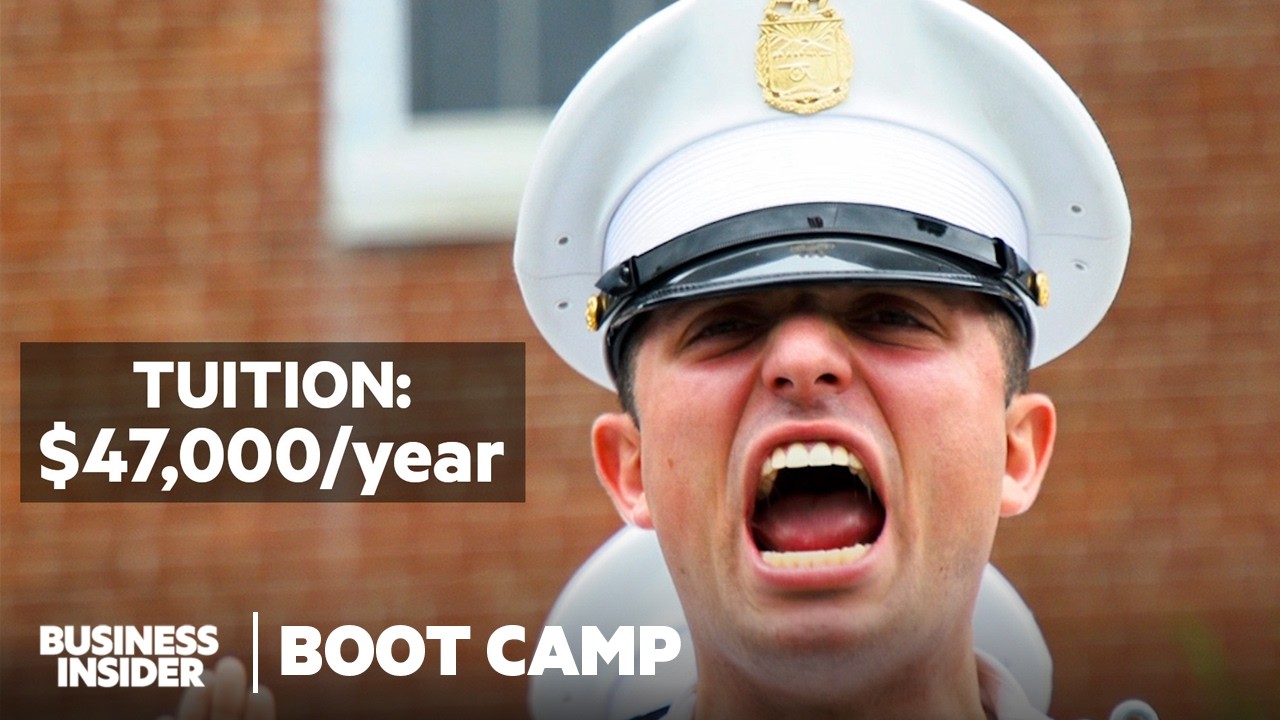
- Many benefits to the education here. The free tuition is definitely the first thing that certainly the parents think about when they're thinking about the Naval Academy. It's actually a step beyond the free tuition because they're paid when their student's here and they have a guaranteed job.
So we hire all of our graduates here, but even while you're here, you're getting a skillset that really translates well into any future career. And our graduates, even if they don't choose to stay in the service beyond their service obligation, are very successful in finding jobs and satisfying future careers beyond here. - Now hold up just a second because I wanna thank SoFi for sponsoring the next section of this video.
As a veteran-led organization, SoFi proudly supports both current and former military members with their financial goals. I've actually been using SoFi myself for the last couple of years and have had nothing but good experiences with them. If you've served in the military and have considered buying a home, you've probably heard of the VA loan, a benefit most military members are aware of, but don't know exactly how it works, myself included.
That's where SoFi's VA home loans come into play. They'll help walk you through the entire process, making it easier for you to qualify for lower interest rates with zero down payment, will help you save on fees, and will ensure you have access to a dedicated mortgage loan officer to answer any questions that you have. Now what I'm most excited about is that SoFi is giving away up to $50,000 to help pay the rent or mortgage of one of our military heroes for one year.
I mean, that's pretty sick. Now to enter, you can click the link down in the description below or head to sofi. com/WinVA and follow all onscreen instructions to view your VA home loan mortgage rate.
It takes just minutes to enter and explore your options and it won't affect your credit score whatsoever. So with that, a big thanks to SoFi. And now, let's get back to the video.
(upbeat guitar music) Welcome to the Naval Academy's Robert Crown Sailing Center, home to what I think is one of the coolest classes midshipmen get to take during their time here. So this is the Naval Academy after all, and people wanna know, do they actually learn to sail while they're here? - Absolutely.
So during plebe summer, every midshipman comes to the Naval Academy before the academic year to start what we call plebe summer. And during that time, they learn how to march, drill, and everything else to include learn how to sail. So they spend 12 hours on the water in our boats, learning basic points of sail, how to attack, how to jive, and they learn that from midshipmen who are most recently graduated from the Naval Academy.
- And there's a lot of crew fields in the Navy. Some might not actually go to be on ships, but why is it important to start with that foundation and learn how to sail while they're here? - So our theory is if every marine is a rifleman, every sailor should be a sailor.
So we teach them basic fundamentals of how to sail and it's life skills that they can take with them. It's followership, how to take orders. - Now while the sailing center provides an introduction to seamanship, the maritime opportunities midshipmen have doesn't stop there.
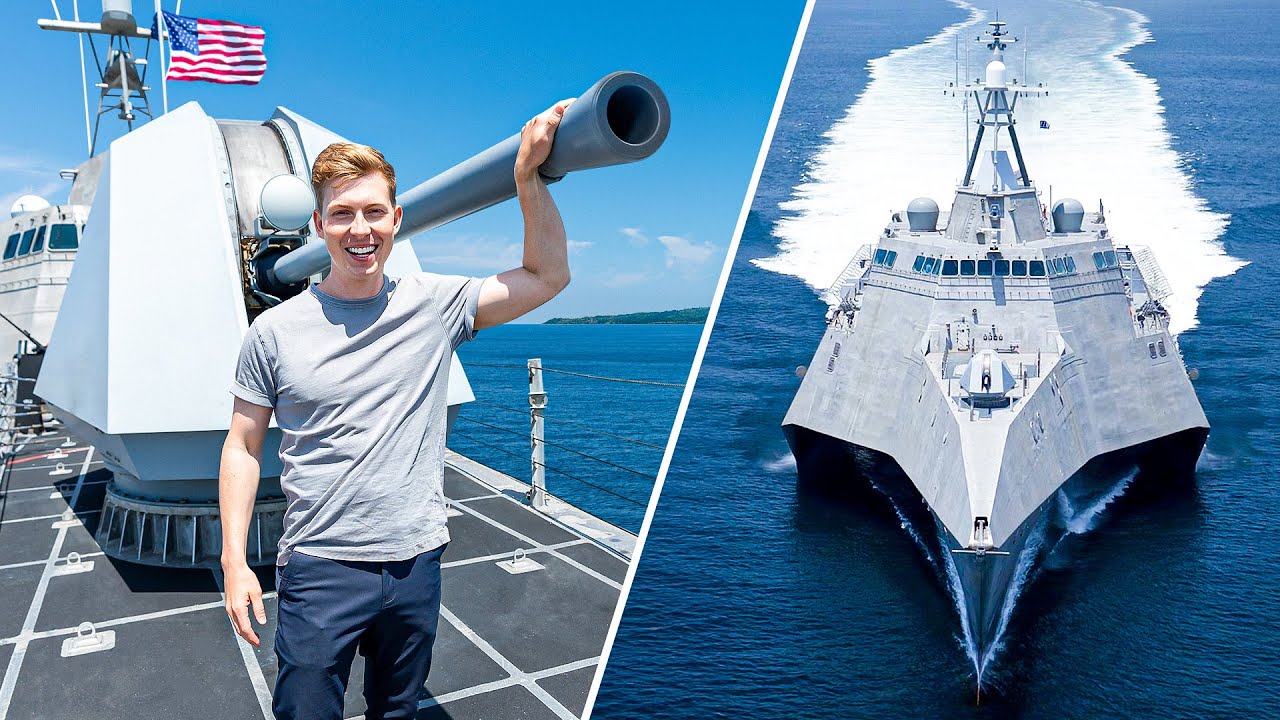
The Naval Academy also operates a division of 108 foot yard patrol craft known as YPs. These vessels provide at-sea training in a realistic environment, teaching midshipmen naval tactics, communications, and other maritime procedures, which many will then go on to use upon entering the active duty fleet after graduation. So there aren't many colleges where part of your curriculum is actually going underway on a ship like this.
For those who are watching and haven't experienced that, what is that like? - It's honestly one of my favorite parts of the Naval Academy. I remember my plebe year going out on the water and I was always so excited to be able to do that and come out here and actually get experience out on the water.
- Now one thing I learned quite quickly during my visit to the Naval Academy is that traditions play a massive role in both the midshipman experience and the morale of the brigade. Just take the Beat Army culture, for example, something that around here is a big deal. Can you talk about the Beat Army culture here at the Naval Academy?
- [Announcer] Here's what we've been waiting for, Carter. And here come the midshipmen of Navy from Annapolis. And from West Point, the Black Knights of Army.
- Army is our closest friend, 364 days a year. - [Sam] And that one day? - That one day is the Army-Navy game, and then all bets are off and game on.
- [Announcer] And the FA-18 Super Hornets overhead and the Chinook and Apache helicopters out with their team. - The Beat Army culture is infused in everything we do. - [Group] Beat Army!
Beat Army! - So when midshipmen comes to the Naval Academy, one of the first things that they memorize is how many times a day they should say beat Army. - In the end, we have, you know, teams that become national champions, but in the end, if you didn't beat Army, it's still considered a losing season.
- We do an extra pushup to beat Army, we do an extra sit-up to beat Army, and it's a rivalry that just goes since our founding. That's who we wanna beat every year in every sport. - [Group] Beat Army!
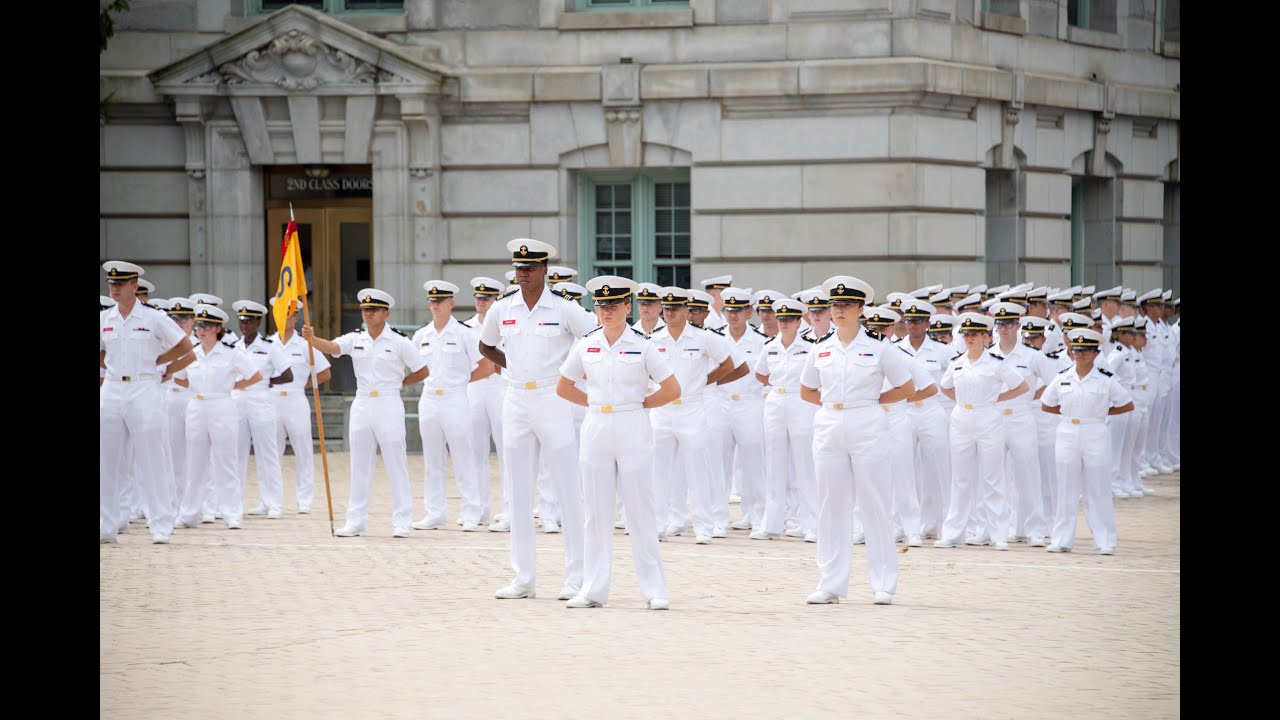
- So it's definitely clear that traditions play a huge role. However, one of the most time honored traditions is one we've yet to talk about, and it happens at lunchtime. It's called noon meal formation, where the entire brigade assembles in front of Bancroft Hall to march together to eat.
- [Leader] Ready, execute! - [Group] Sir, you now have 12 minutes till noon meal formation! Brigades goes outside T-Court at 12:05!
- So what you just heard is what's known as chow call, where the plebes line up on each side of the hallway and recite things like the time until the noon formation, the menu for the noon meal, the uniform of the day, and a lot more that I can barely make out. They start at 15 minutes out from formation and recite it every minute up until five minutes. Then it's hurry up and get out to the T-Court before the call to attention is made.
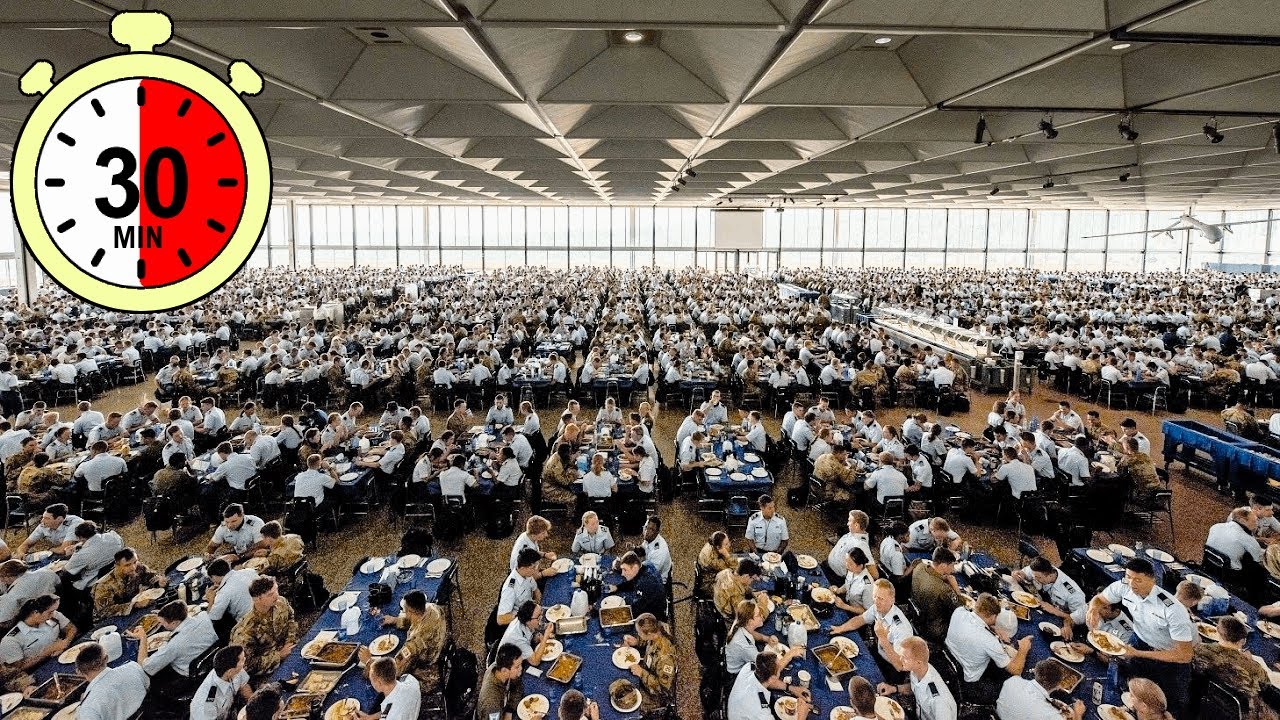
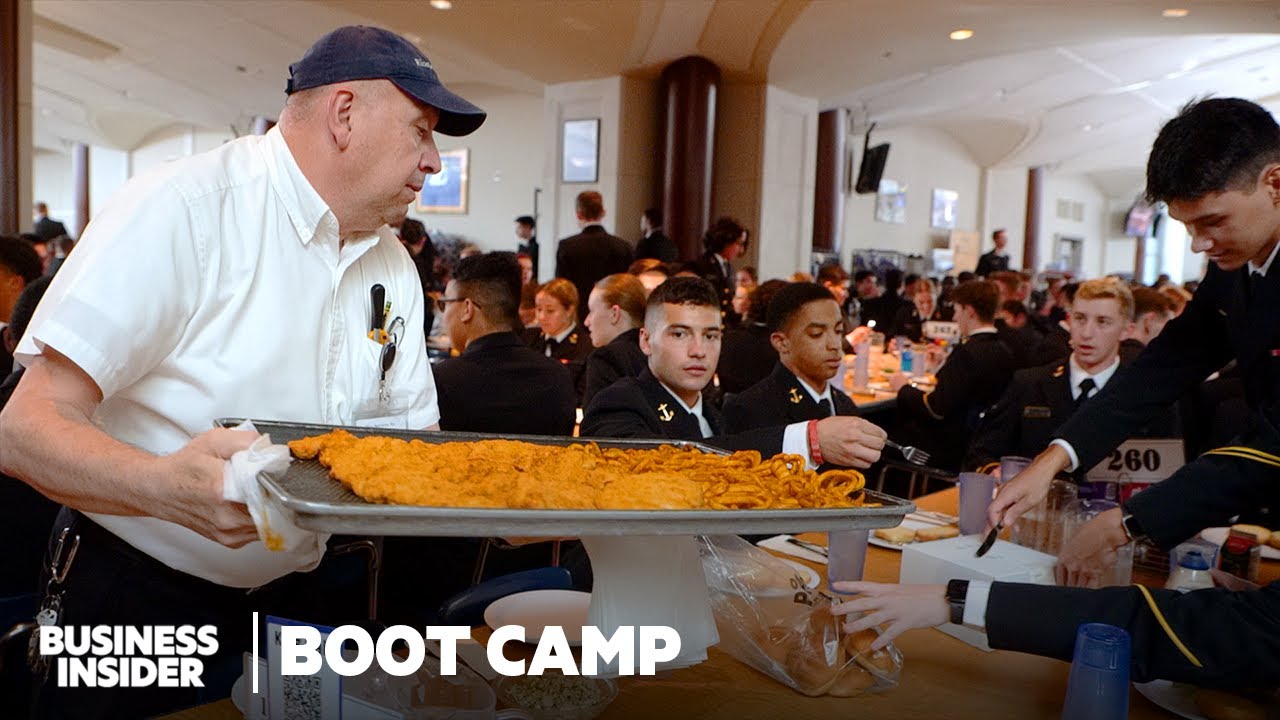
(upbeat trumpet music) ♪ Baba bing, bada boom ♪ - Welcome to King Hall, the Naval Academy's 55,000 square foot dining facility that serves the brigade of midshipment for breakfast, lunch, and dinner. Every day, the team of cooks and wait staff serve 13,500 meals for the roughly 4,500 midshipmen seated at the 392 tables spread across the dining hall. - Everybody kind of funnels in through the two main doors, walks down the stairs, comes down the big stairs here, immediately knows where their company area is and where their table's gonna be.
- So we just sat down, everything is very hectic, and apparently, they, eat, finish, get outta here, and onto the next classes in like 15 to 20 minutes. And crazy operation, very efficient, and a lot of hungry midshipmen. - And it's definitely enough time to be able to sit down, eat, have a little conversation with your squad or whoever you're sitting with, and then get right back out to whatever the next thing you need to do is for the day.
- [Sam] So we've covered both academics and the importance of military training here at the Naval Academy, but there is one final pillar that remains crucial to the Midshipman curriculum. Welcome to Navy athletics. ♪ All eyes on the way I thought ♪ ♪ When I walk into the room ♪ ♪ Wind blows underneath the soles ♪ ♪ In my brand new pair of shoes ♪ - The physical education curriculum here at the Naval Academy is super important to the development of leaders.
Being at the Naval Academy, we have three semesters of swimming, we have a combatives class, everybody has to box, everybody has to wrestle. And we also have a personal conditioning class in there as well. So it's well-rounded.
Naval Academy has 36 intercollegiate sports. We range from everything with 36 and we have sailing, rifle, crew, triathlon. It's a great spot to be if you're an athletic fan.
(crowd cheering) The physical readiness test, which we call the PRT, it's given every semester while you're here at the Naval Academy and you're expected to pass. The PRT here at the Naval Academy consists of a mile and a half run, two minutes of pushups, and a plank hold with a max score at four minutes and 20 seconds. - Now outside of the mandatory PE classes and intercollegiate teams, the Naval Academy also offers a dozen competitive club sports, including lacrosse and the midshipmen pistol team.
There's also more than 70 extracurricular activities available for midshipmen to explore their personal interests, develop additional skills, and build connections with their fellow classmates. One of my favorites, The Masqueraders, an all midshipmen drama and theater club, and one of the oldest clubs here at the Academy. - Masqueraders were officially found in 1907.
And so it's the oldest extracurricular activity here on the yard. But we trace our roots back to 1846 where an early performance happened in downtown Annapolis that actually was derailed after a little too much celebration. (Sam chuckling) - And so why is it important, I mean, to have a club like this on the yard?
You know, people, I don't think Naval Academy think this is something midshipmen can do, but they can. - Right. No, I think it's a really important club because it gives them an outlet outside of their typical STEM technology-focused education to do something else, but also to explore the human side of being an officer and explore what other people's views are by enacting that on the stage.
- Now what I think is probably one of the coolest perks of the Naval Academy is its proximity to Downtown Annapolis. In less than a mile, you'll find yourself in the heart of historic downtown with more restaurants and bars and activities than you can possibly imagine. (inspiring music) As you walk the cobblestone streets, you see Navy flags outside the houses, Navy alumni who've moved back and now call Annapolis home.
It definitely feels like a college town. But one of the biggest traditions that takes place here in Downtown Annapolis happens before the start of every football season and I think perfectly sums up the relationship this town has with the Naval Academy. (inspiring music) - To feel the community next to you and to see the way that they lined up to support the brigade of midshipmen was just so special.
And that feeling of community around you and the energy and the excitement for the first home game, but also just to see the brigade of midshipmen as a whole was something I'll never forget. (light piano music) - Welcome to Navy Marine Corps Memorial Stadium, home to Navy midshipmen football, and one of the most historic college football programs in the country. And there have been some pretty big names that have come through here, including quarterback Roger Staubach, the 1963 Heisman Trophy award winner and two-time Super Bowl champion.
Now if you've never been to a Service Academy football game, the atmosphere, it's electric. ♪ I was created to be a legend ♪ ♪ Cosigning myself when I need credit ♪ - And the pre-game festivities rival any of the top football programs in the country. ♪ I'm trying to go ♪ ♪ I don't need to race ♪ ♪ Swallow your pride if you need a beverage ♪ - It's a great way to see the brigade as a whole come together for Navy football and to cheer them on.
(group cheering) - Fire! (crowd cheering) (upbeat electronic music) - Now I can't think of a better way to close out this video than with the men, the myths, the legends themselves, Bill and Benny the goat, the official mascots of the Naval Academy midshipmen. We've also got the goat handlers here who are in charge of tending to their every needs.
Now let's bring it in. I say that we let Bill close this one out. Couldn't have said it better myself.
Thanks for tuning in. We'll catch you next time.