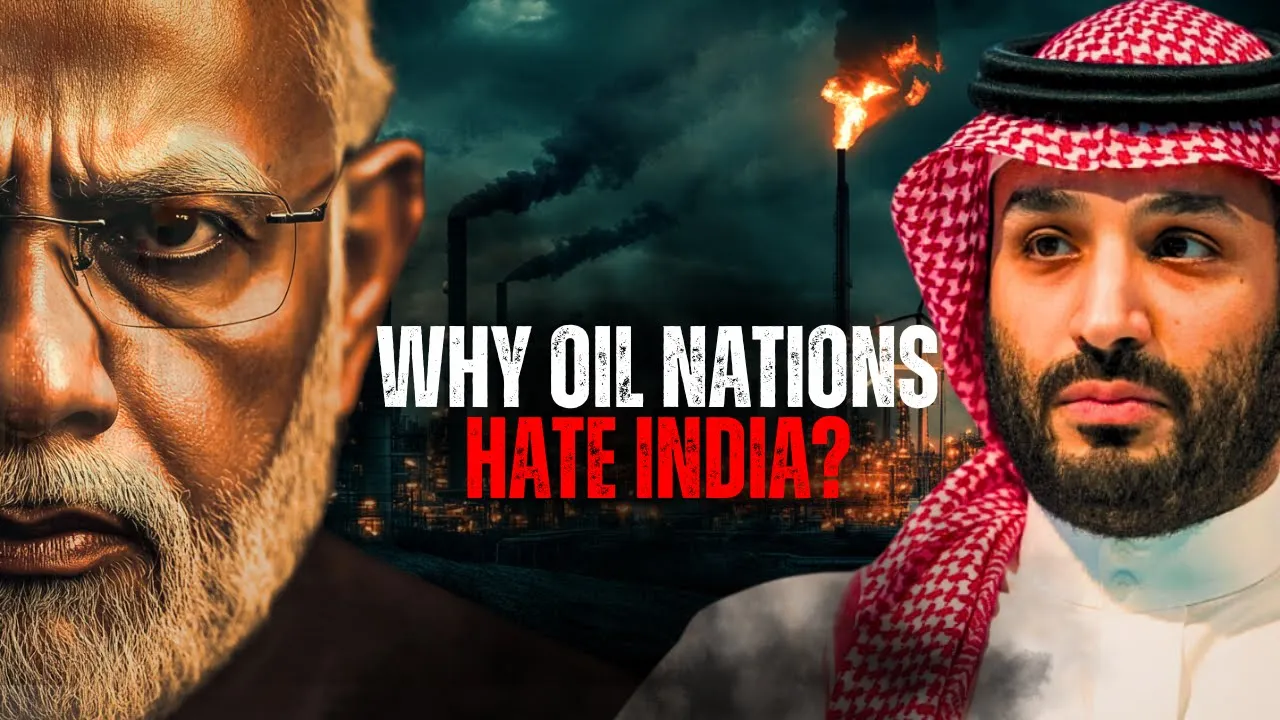
You know, once a cunning man said, "He who controls oil controls the world. " And every time we forget it, the oil mafia of the world reminds us by choking the global economy and by throwing nations into chaos. World is completely turned upside down by Russia's invasion of Ukraine.
Russia says it's cutting oil production in retaliation to a price cap. Of course, the supply crunch translates into higher oil prices, and that's something with broad economic impact. War between Israel and Hamas has ignited new fears of wider consequences in the Middle East.
Oil prices have crossed $85 per barrel. You and I are paying more at the petrol pump. That means more inflation, less savings, less investments, and of course, less growth.
In 2022, Russia cut off Europe's gas supply that sparked a wave of inflation so bad that it reached every corner of the globe, including India. Then in 2023, OPEC raised oil prices during the Israel Hamas war and it pushed India at the brink of a recession. And this isn't just happening now.
It has been happening since the past 70 long years. Oil producing nations have weaponized energy to dominate the world whenever they want. The organization of petroleum exporting countries imposed its boy and within a year raised prices more than 300%.
Electricity bills are soaring. We're at a moment in history now where energy has become a weapon because they're basically showing that they hold the cards or or more precisely they hold the oil here. Russia has dethroned Saudi Arabia as among the biggest suppliers.
So that is how significant Russia has become. The higher the price of oil, the more power Russia has over Europe. And every time they show their power, India becomes their victim for no reason at all.
Now, if you think this is just another geopolitical issue that doesn't affect you, look at this. Every time the cost of oil spikes, it directly burns a hole in your pocket. In 2022, during the Ukraine crisis, crude oil prices surged to $120 per barrel.
As a result, inflation in India shot up to 7. 8%. Now, to control this inflation, RBI increased the interest rates.
So, how does it burn a hole in the common man's pocket? Look at this. In May 2022, if someone had taken a 30 lakh loan from SBI for 10 years at a 6.
65% interest, their monthly EMI would be 34,294 rupees. But after the RBI rate hike to 8. 9%, their EMI shot up to 37,841 rupees, which is a hike of 3,547 rupees every month.
And over a year this means 42,564 rupees extra spent on EMIs. And when millions of Indian families spend more on EMI, they go to restaurants less often. They buy less clothes and the consumption in the economy slows down which pushes us into a recession.
So oil is the lifeblood of the Indian economy. But the problem is that India does not have oil. And every time India suffers a setback, all of us think if India has oil, India would race to become a developed nation.
Right? You know what guys? I have some great news for you.
India has actually found oil right here in our land. But this oil is not coming from our ground. It's coming from sugar.
Yes, sugar. The same commodity which was going to waste in our warehouses. It is now turning into the white gold for [Music] India.
India dominates the world sugar market. [Music] So the question is how on earth can we make oil with sugar? Why is sugar suddenly being called the white gold of India?
How will it push India towards the dream of a vixit bharat? And what are the biggest opportunities for entrepreneurs like you and me? [Music] This is a story that dates back to 1973 when the world suddenly woke up to a war that shattered the economies all around the world.
This was the Yonipin war between Israel and its Arab neighbors. Egypt and Syria are at war with Israel today for the first time since the 6- day war of [Music] 1967. So in retaliation for the western support of Israel, Saudi Arabia and its allies suddenly cut their oil supplies and they used oil as a weapon to show the world that nobody can oppose the oil cartel.
And you know what happened? Suddenly the oil prices shot up by a staggering 400% overnight and it plunged the entire world into an absolute chaos. So every nation that imported oil from America to the UK to India, we all were choking under the pressure of the oil cartel.
The Arab-Israeli war of 1973 sent an energy shock reverberating around the globe. 1973 when an OPEC oil embargo led to an international shortage and rocked the global economy. At the height of the embargo, half a million people were thrown out of work.
And amidst all this chaos, one country that became a victim of this power move was Brazil. Back then, every drop of oil that Brazil used was imported. So, when the oil price shot up by 400%, Brazil couldn't afford to buy oil.
As a result, factories in Brazil shut down, inflation spiral out of control, and gas stations became battlegrounds for desperate drivers. On top of that, 4% of Brazil's gross national product was dependent on sugar that they then exported to America and Europe. And since both these countries were also choking, they stopped buying sugar from Brazil.
So, Brazil was left with no oil and millions of tons of unharvested sugarcane stock. So, everybody thought that just like Venezuela today, even Brazil would starve due to oil crisis. But suddenly in the next few months, everybody was surprised to see that Brazil did something so groundbreaking that they suddenly started producing oil with sugar cane.
The question is how? Well, as it turns out, they discovered the power of something called ethanol blending. 30 years ago, as the price of gas rose, Brazil bet on a greener alternative when they began to distribute ethanol.
Motorists in Brazil fill up their tanks with ethanol. It is available at nearly every fueling station in Brazil and is roughly half the price of gasoline. To tell you about it, when sugarce is processed to make sugar, the juice is boiled and crystallized.
After each round of sugar extraction, a dark thick syrup is left behind. This is called molasses. And the byproduct of the first round is called amolassis.
And when this process is repeated again, the leftover of the second round of extraction is called B molasses. And after the third, what's left is called sea molasses. And instead of letting this sea molasses go to waste, Brazil discovered that sea molasses could be fermented and distilled to produce something called ethanol.
And you know what? This ethanol, just like petrol, can be used directly in your cars with just a small modification to your engine. In fact, it's better than petrol because it is cleaner.
So it causes lesser pollution and emits 90% I repeat 90% less greenhouse gases as compared to petrol. And the best part was that unlike petrol which is finite ethanol was infinite for Brazil because they could grow sugar cane every single year. And because of this breakthrough discovery, Brazil asked its auto companies to innovate leading to the creation of something called flex fuel vehicles.
These vehicles could run on pure ethanol, pure petrol, and even with a blended fuel with both ethanol and petrol. And this innovation transformed Brazil's economy so well that they could survive with less oil imports. And fast forward to 2023, over 83% of new passenger vehicle sales in Brazil were flex fuel vehicles.
And ethanol replaced over 40% of the entire country's gasoline consumption. And today, Brazil produces 33 billion L of ethanol annually, saving Brazil 12 billion every year in oil imports. This is how Brazil found an alternative to oil.
And with other alternative energy sources, they almost became energy independent. And looking at Brazil's success, major economies like the US and EU, they all have started to implement similar strategies. The US is blending 10% of its gasoline with ethanol and EU is already at E7 as in they blend 7% of ethanol in gasoline.
And this has had some major benefits for all these countries. If you look at the monetary impact, you will find that Brazil has achieved forex savings of $260 billion while having kept 135 cr tons of CO2 equivalent emissions out of the environment. So this is incredible, right?
But the question is, what does this random Brazilian story have to do with India? Well, as it turns out, even India is in a very similar situation as that of Brazil back in the 1970s. You see, just like Brazil, even India imports 85% of its fuel.
Just like Brazil, India also has 8 million tons of surplus sugar. And just like Brazil, India adversely gets affected simply because the oil nations like to flex their muscles. And most importantly just like Brazil even India is now aggressively pursuing ethanol blending.
And this is what Nitan Garary sir told us in our podcast. Sir ethanol blending you were extremely bullish on ethanol blending. In fact, I just read that E10 and now we looking at [Music] E20 bioaviation sustainable able fuel.
So this brings us to the question, what exactly is India doing and how are we planning to become energy independent? Well, India is focusing on building two golden assets for itself. These assets are 1G ethanol and 2G ethanol.
Now listen to this very very carefully because this information has a wealth of opportunities for you. To get expertise in ethanol, we looked into the annual reports and DRP of India's largest player in ethanol production which is a company called True Alt Bio Energy. And here's what we found on ethanol's value chain.
When sugarce juice is processed to produce sugar, three types of molasses are left behind. As we discussed, A molasses which is still used for sugar production. B molasses which contains less sugar but can be used for ethanol production.
And C molasses is where yeast is added to convert the sugars into alcohol through fermentation. This alcohol is then distilled to produce fuel-grade ethanol that is clean, renewable and efficient. If this is very very clear to you, let's look at the cost of production and see how it can help us substitute petrol.
People, the average raw material cost from B and C molasses is about 47 rupees. With added chemical labor and production cost of 8 to 10 rupees per liter, the total cost price of 1g ethanol per liter comes to about 56 rupees. Now, if you compare this with petrol, petrol's cost price in India comes around 45 rupees.
But due to numerous excise duties and other taxes, the retail price comes to around 105 depending on which region you live in. Now most people will say, "Bro, if petrol cost and ethanol cost are almost the same, then how is ethanol better than petrol for India? " Well, here's where what you need to understand is that 1g ethanol gives us two superpowers.
First is the stability of fuel prices. Look at this. We imported 232.
5 million tons of crude oil in 2024. And if we could only blend 20% this year, this could reduce our imports to 186 million tons next year. And this will save us over 2 lakh cr rupees in forex reserves.
You know how much money that is? This money can help you build 10,000 km of fourlane highways, 2,000 hospitals, and you can practically fund the entire group of Apollo hospitals for 12 years with the same money. And look at this.
Over the last 10 years, we've already saved 85,000 cr worth of foreign exchange merely due to ethanol blending initiatives. Secondly, whenever oil price fluctuates, we are less exposed to the risk of inflation. Right now, because we depend on global markets for oil, any changes in the global prices affects us directly.
But by blending ethanol, we can reduce these price shocks. So if the price shoots up from $80 per barrel to $120 per barrel, our petrol price would shoot up from 100 rupees a liter to 120 rupees a liter. But with 20% ethanol blended, the price will shoot up to only 108 rupees.
Now most people would say, "Bro, how is this 12 rupees making a huge difference? " Well, you should actually go and talk to a cab driver and you will know that these 12 rupees change the way they live, the school that the kids go to, and even the number of meals they have. That is how crucial fuel price is for India.
This is one of the reasons why the government is so bullish on sugarcane that the Indian government pays the highest price for sugar cane in the world. So Indian sugar farmers will never stop production. And because of all these factors, Nathan Gkirki came up with a concept of E20 which is a blend of 20% ethanol in every liter of petrol that we all consume today.
And since the government absolutely loves ethanol, the GST on ethanol meant for blending was lowered from 18% to 5% under the ethanol blended petrol program. And to make this even better, India is also preparing for something called 2G ethanol. And you will be shocked to know that in the next few decades with 2G ethanol, the cost of petrol could be brought down to 30 rupees also.
Yes, petrol could cost us as much as a freaking sneaker bar. Now this is still under process. But let us tell you what Indian companies are working on for future generations.
This 2G ethanol is not from sugar cane juice but from waste like rice straw, wheat husks and sugarcane bugs. Right now all this precious raw material burns which then causes massive air pollution and we all have seen it in Delhi. India alone produces 350 million tons of agricultural waste.
But if we utilize it, the raw material or biomass can be acquired for just 11 to 15 rupees per liter. And then conversion cost like chemical, electricity and labor would cost around 8 to 10 rupees per liter. And then there are these special enzymes that are needed for this process.
The cost of which range between 25 to 30 rupees per liter. So initially the cost of 2G ethanol will be 44 to 55 rupees which is again similar to 1G ethanol. Right?
But here's the magic. At scale this enzyme cost of 25 to 30 rupees vanishes because once bought they can be produced again and again because they're just special bacteria and if this enzyme cost vanishes the cost drastically drops down to just 5 rupees and 2G ethanol can just cost 25 to 30 rupees per liter. Can you imagine that guys?
This is how India can have its own oil at 30 rupees a liter. This is why I say in future oil could cost less than the cost of a sneaker bar. This is what companies like True Alt are aiming to achieve in the next few decades.
So everything is fantastic, right? So the question is can India race to become an energy superpower? Well, here's the catch guys.
Unfortunately, every great story has great challenges. So let's try to understand this. When we did our ground research, we also understood that there is a lot of skepticism around the release of harmful chemicals during ethanol production.
And if these chemicals are released untreated, they could cause harm to our environment. and we don't want to make it worse. But as it turns out, ethanol is so magical that every byproduct of ethanol is a revenue generating asset.
And here's where you could find a huge business opportunity. For example, when molasses are distilled to produce ethanol, a dark thick liquid called spent wash is left behind. This byproduct could cause an environmental hazard.
In fact, if dumped untreated, spent wash can seep into water bodies, damage aquatic systems, and contaminate our drinking water. And if you burn it, it can cause massive air pollution. Similarly, while everyone says that ethanol is clean, it actually releases tons of carbon dioxide, which is a greenhouse gas.
So the question is, what do we do with all this harmful waste? Well, fortunately, like I said, every single material that comes out of ethanol is used and can be used to generate revenue. Look at this.
Spent wash is used to extract methane, which is then processed and sold as biog. The remaining concentrated spent wash is burned to recover potach which is then processed into fertilizers for agricultural use. Then carbon dioxide is compressed into dry ice for refrigeration and it is then sold to companies like Coca-Cola for carbonating soft drinks.
So you see the waste can actually be used to generate revenue. And here's where the future gets exciting. The future lies in the three big big trends in India.
And obviously it requires the blessing of the godfather if you know what I mean. Firstly, ethanol has a huge scope in aviation with something called SAF or sustainable aviation fuel. This is the next big thing to achieve net zero emissions.
This is basically a fuel that can be derived from biomass and it is the only viable solution for reducing emissions in the aviation sector because your hydrogen or EVs work on roads but they can't work for the skies. And SAF alone could contribute around 65% of the reduction in emissions needed by the aviation sector to reach net zero CO2 emissions by 2050. And here's how it works.
Just like fuel grade ethanol is made and combined with petrol, SAF can be blended with conventional aviation fuel. And since the chemical and physical characteristics of SAF are similar to those of conventional jet fuel, they can be safely mixed together in the engine. they can use the same supply infrastructure and they do not even require the adaptation of special aircrafts or special engines and then the Indian government has said that by 2027 1% SAF should be used by aircrafts in international flights and by 2030 it should touch 5%.
And per 1% blend of SAF it creates a demand of 14 cr L of SAF. So for 5% this will create a 70 cr liter demand by 2030. Secondly, we have another major trend which is the rise of flex fuel vehicles mobility% ethanol offers opportunity for true energy self-reliance as India offers competitive manufacturing ecosystem.
These vehicles like I said they can run on 100% petrol, 100% ethanol or any blend in between and flex fuel vehicles have already transformed Brazil's energy landscape and India is next in line. And here's where it gets very very interesting. With ethanol blending mandates, auto manufacturers like Marauti Suzuki, Hyundai, Mahindra, Tata and Toyota, all of them they are gearing up to introduce flex fuel vehicles to the Indian market.
Marthi has begun to start working on flexif fuel model. It's not your conventional petrol or diesel vagonar. It is a flex fuel vehicle.
We're also looking at flex. Marcy might be the first one to get a flex fuel engine. And finally, the last trend is of CBG or compressed bio gas.
Just like ethanol is an alternative to petrol, like SF is an alternative to aviation fuel, CBG is an alternative to CNG. And it is also made from organic based materials such as agricultural residue. So with the same input material companies like trualt are creating many products to suit different needs.
And just like flex fuel a portion of CG consumption will include CBG from 2025 onwards. This share will go up to 5% by 2028. And the Indian government is so bullish on this that the government is integrating CBG production plants to the energy grid called the city gas distribution network.
And the government is also providing financial support to build pipelines and scale operations. So what a fantastic story isn't it? India will embrace ethanol.
We will become a superpower and petrol prices will come down to 30 rupees. So this is amazing now right? Well again before we get too optimistic we must look at the challenges that can prevent this dream from coming to life.
And just like solar, EV and the manufacturing sector even in ethanol we have some very big industrial challenges. The first challenge is water usage. You see, producing one liter of ethanol from sugar cane can require up to 2,500 L of water mainly for irrigation.
And if not managed sustainably, this could contribute to water shortages particularly in droughtprone regions like Maharashtra and Karnataka. Secondly, the use of food crops like sugarcane for ethanol production can lead to food security concerns. In fact, in 2021, some activists raised concerns in India about excess sugar cane being diverted to ethanol, potentially leading to sugar shortages and increased prices.
And finally, global factors like the fall of oil prices or increased adoption of EVs will impact demand for ethanol. In fact, in 1986, oil prices tumbled and in Brazil within a year ethanol vehicles became uneconomical as compared to petrol vehicles. And just like this, even in India, the rapid push for EV adoption could reduce long-term demand for ethanol blended petrol.
And if the government helps companies overcome all these hurdles, India will make its own oil and save billions of dollars. This is how we can escape from the grip of the oil cartel. And this brings us to the final section.
If you're an entrepreneur in India, what opportunities can you leverage in this space and what businesses can you start? Well, firstly, the flex wheel vehicle market presents a massive opportunity. And with India pushing for 20% ethanol blending by 2025, major automakers like Marati, Suzuki, Hyundai, Mahindra, Tata, and Toyota, they're gearing up for flex fuel vehicles.
So, there's a clear demand for ethanol compatible fuel stations and vehicle conversion kits. In fact, you can even set up retail outlets dedicated to ethanol blended fuels or provide retrofit solutions for existing vehicles to run efficiently on ethanol blends. Secondly, when it comes to SAF, since airlines in India must blend at least 5% SAF into their fuel by 2030, this opens up a huge business opportunity in storing and transporting SF to airports.
And you can build SF storage facilities or even create efficient transport systems for fuel delivery. And thirdly, when it comes to compressed biogas, entrepreneurs can partner with gas distribution companies to integrate CBG into pipelines or supply CBG to transport fleets, logistics companies and cab aggregators looking for cheaper and cleaner fuel options. These are the opportunities that I feel could be the next big thing in this sector.
And now you tell me in the comments what are the challenges that India will face while it embraces the ethanol revolution. And more importantly, as we embrace this revolution, what are the biggest business opportunities that you see in this sector? That's all from my sector today, guys.
If you learned something valuable, please make sure to hit the like button in order to make YouTube happy. And for more such insightful business and political case studies, please subscribe to our channel. Thank you so much for watching.
I will see you in the next one. Bye-bye.