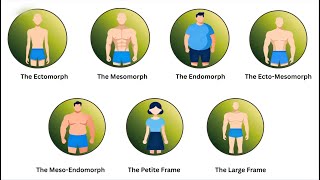
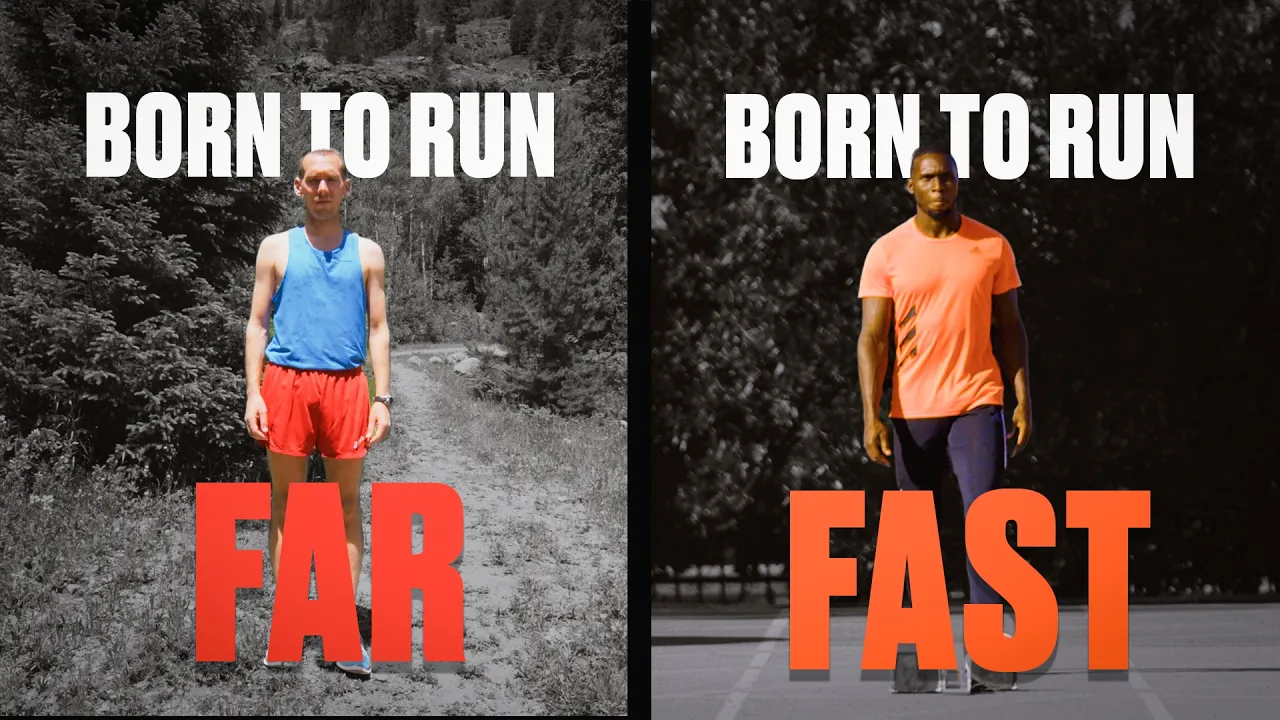
Do you have the right body to be fast? The hard truth is your parents set your speed potential. And look, we know that's not some hot take.
I mean, you all point it out to us all the time. But what are the specific physical traits that are supposed to make you fast? Scientists have measured it all.
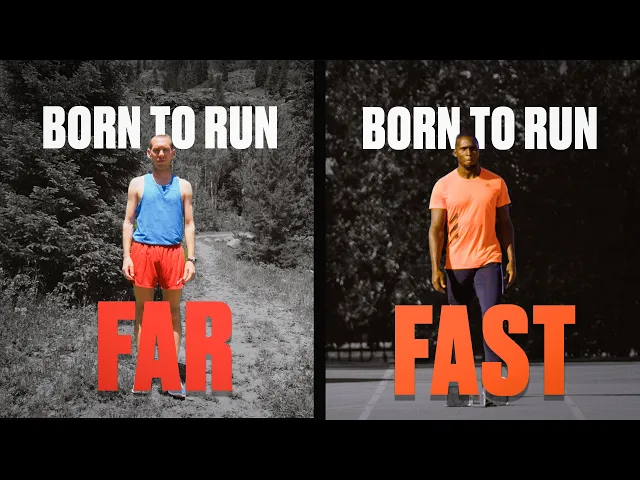
Leg length, muscle fibers, bone structure, and even the so-called speed gene. So, let's find out if you have what it takes to be fast. Some people are born to run far and some people are born to run fast.
If your race is measured in minutes or hours, you need muscles that refuse to die. Thin, relentless fibers built for a slow burn. But if you want to be fast, you need something radically different.
You need muscles that burn like dynamite. Every skeletal muscle in your body is actually a mix of two different primary fiber types. Slow twitch and fast twitch.
Slow twitch or type one are built for endurance. Great for distance events, but not for raw speed. Your fast twitch fibers or type two are what make you fast.
They drive explosive acceleration and top speed, but they fade quickly. These are the fibers that win the 100, the 200, and the 400. Now, here's what supposedly determines your speed potential.
Everyone is born with a different ratio of these two fibers. And the thinking goes, if you were born with, say, 70% fast twitch, you're a sprinter. You won the genetic lottery for speed.
But if you landed on the other end with 70% slow twitch, you're an endurance athlete. Or are you? It turns out that your percentage of fast twitch muscle fibers has almost no connection with your sprinting ability.
In 2025, a landmark study decided to figure out what really makes an elite sprinter fast. And what they found, well, it went against everything we've been told. There was no significant connection between a sprinter's performance and their genetic percentage of fast twitch fibers.
What they discovered is that the key to speed isn't the number of fast twitch fibers you have. It's about how much physical space they take up inside the muscle. It's about their size.
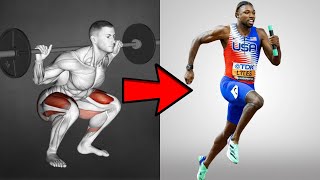
And that's the crucial difference. Because while you can't change the number of fibers you were born with, you can absolutely change their size. Proof of this comes from one of the most powerful athletes in history.
[Music] The shot put, like sprinting, is a sport of pure explosive power. Look at the power as he literally exploded across the ring. And when scientists put Gunther's body under the microscope, they found something that seemed to defy logic.
Genetically, he had the muscle profile of an elite endurance athlete dominated by 60% slow twitch fibers, which means that based on muscle fiber type, he should have been a distance runner. So, how did he become one of the most powerful athletes in history? Through years of specific explosive training, his smaller number of fast twitch fibers grew to be almost three times larger than his slow twitch ones.
The result, those few explosive fibers ended up dominating almost 70% of his total muscle area. He wasn't born with the right muscle fibers for his sport. He built the right body.
[Applause] [Music] So, you can change your muscles, but what about your bones? It seems obvious that being born with the right leg length means you've won a part of the genetic lottery for speed. It's simple.
Longer legs are an unfair advantage because they cover more ground with each stride. There's just one problem. Long legs don't make you faster.
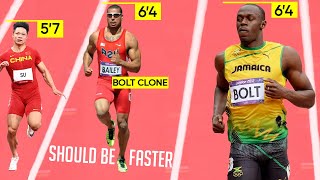
Scientists studied elite sprinters and found absolutely zero connection between leg length or leg to height ratio and speed. Now, I know what you're thinking. Didn't Bolt prove longer legs are the advantage?
Well, here's the thing. Longer legs can cover more ground per stride, but you pay a triple penalty for that extra length. The first and most obvious is at the start.
Accelerating and controlling longer legs is harder. Think of it like swinging a sledgehammer versus a regular hammer. Longer legs mean there is more distance between ground impact and your joints.
So, you need more force to stay stiff or they compress and you slow down. At top speed, all sprinters get around 90 milliseconds on the ground, and longer ankles create a mechanical disadvantage. Your muscles have to work harder to generate the same ground force in that split-second window.
What made Bolt legendary wasn't his leg length. It was doing what biomechanics said was impossible. He trained relentlessly to turn his disadvantage into the most unbeatable weapon in sprinting.
So, yes, you have the right leg length. So does everyone else. Bolt proved what matters is training for the body you have.
Now we get to the big one, the source code. You can't change or train your way out of your DNA. Because deep inside your genetic code, scientists have found what they call the speed gene.
Its real name is actn3. And its job is well, let's get a simple explanation from the code itself. Hello there.
I'm ACTN3 and yes, some folks call me the speed gene. So, how do I make you fast? It's simple.
My job is to provide the instructions to build a structural protein called Alpha-actinin 3 that sits at the Z disk to cross-link actin filaments, increasing the stiffness of the myio. Whoa. Okay, hold up.
Way too much detail, dude. Just keep it simple. Sorry about that, folks.
What I do is all about reinforcement for your fast twitch muscle fibers. Never had much use for those slow twitch type. Think of it like this.
The protein I code for acts like adding steel beams to your muscle's internal scaffolding. So when you fire those muscles with everything you've got, bang, that reinforcement cuts the wobble. So more of your effort turns into speed instead of useless vibration.
Now, which version of me you have depends on the copies you inherited. The R version of my instructions tell your cells to build those steel beams. Full reinforcement.
The X version has what we call a stop code on basically a big old stop sign that tells your cells don't build Alpha-actinin 3 here. So they don't you get one copy from each parent. So you can be RR double reinforcement, RX single reinforcement or XX which is no reinforcement.
And that's the code folks. So, it seems like if you want to be a world-class sprinter, you need to be an RR [Music] or at least an RX. Except that's not the whole story.
XX athletes can still be world class because the body has a backup plan. Fast twitch fibers compensate by up regulating a different protein, alpha actin 2. The muscle becomes more efficient and more fatigue resistant.
Here's the proof. Scientists studied the genetics of elite sprinters from Jamaica, an epicenter of sprinting dominance. Even in this hyper elite group, they found that 2 to 3% of the sprinters were XX.
It's a small number, but it's not zero. In another study, scientists documented an elite long jumper with a near Olympic gold distance of 8. 26 m.
His genotype XX. So, let's be clear. Does having the perfect RR gene give you a statistical edge?
Yes, the data is undeniable. A 2024 meta analysis found that power athletes, including sprinters, have about 50% higher odds of the RR genotype than non-athletes. It's a real statistical advantage.
But here's the catch. After reviewing the performance of 346 elite sprinters, it turns out that this gene explains less than 1% of sprint performance. So, how many people have this so-called unfair advantage with at least one copy of the RAL?
about eight out of every 10 people watching this video. What about the ultimate two copyr advantage? Roughly two and a half billion people.
Two and a half billion people. Clearly, that doesn't guarantee you'll be fast. Your body isn't a simple machine controlled by one switch.
The NIH genetics database identifies more than 150 genetic variations linked to athletic performance. And that's just what we know right now. The idea of a single speed gene is a massive oversimplification of what it truly takes to be fast.
So where does that leave us? To be an Olympic level sprinter, you have to win the genetic lottery. That's a fact.
As we said at the start, your parents set your speed potential. The truth is, for most people, that potential is way higher than they realize. And almost nobody ever really finds out what that ceiling is.
Every single day, an athlete who maximizes their potential beats someone with better genes who doesn't. And here's the thing, there's a whole universe of success that isn't competing at the Olympics. It's winning a state championship.
It's making the team. It's feeling what it's like to be faster than you've ever been.