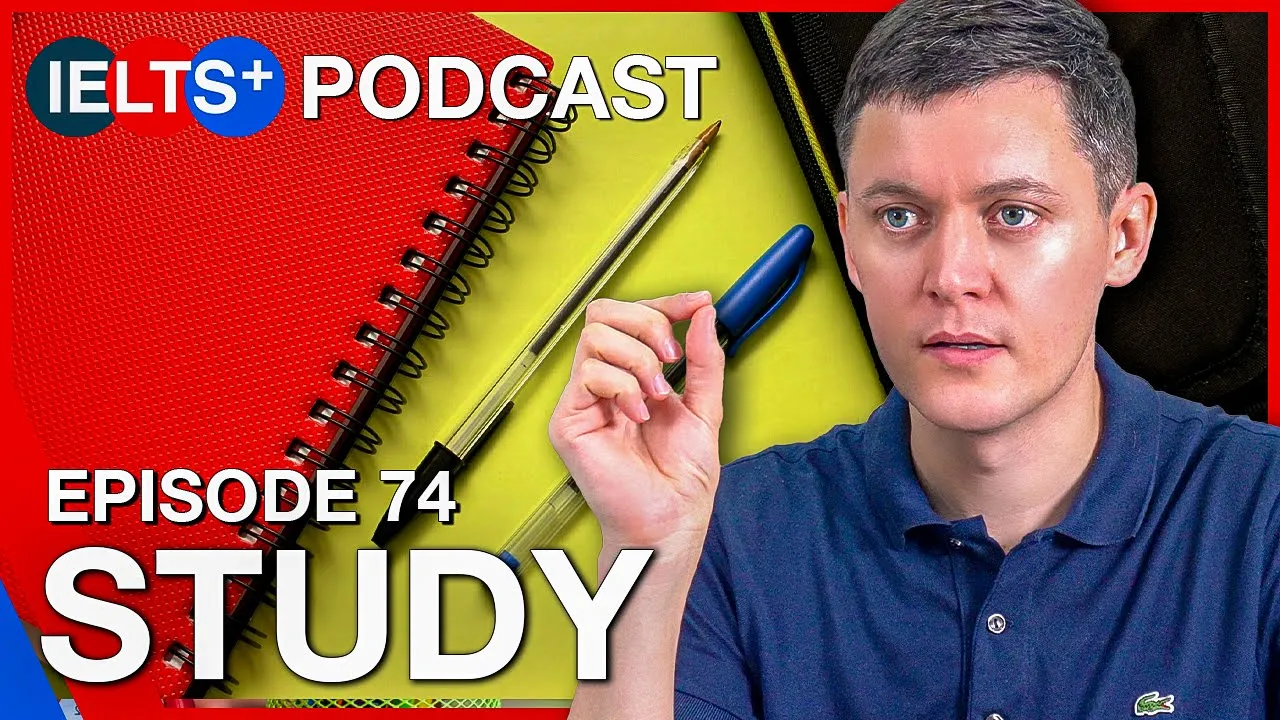
Good day to you IELTS students and welcome back to another episode of the IELTS Plus English podcast. And today we're going to talk about [Music] study. Well, this has to be an area that I'm comfortable talking about.
I don't study myself much nowadays, but I'm certainly helping plenty of students with their studies. So, I thought, you know, we're talking about study. Let me give you some study tips.
So, this is of course it's specific to the IELTS test and I just want to give you I have lots of tips and it depends on the student but I'm going to give you three tips that I think every IELTS student should be following to prepare for the IELTS exam. And this is kind of this is focused on speaking just because this this podcast is focused on speaking. So, I've just prepared a few tips I want to give you.
Number one, when it comes to I I think a lot of students like to focus on vocabulary because it feels like you learn vocabulary and it it goes into your head, you start using it. There's a very clear process of achievement that you can, you know, when you've learned vocabulary because then you're able to use it. So, people like to develop their vocabulary.
That's great. What I want to say to you, the tip one is be picky. Do not just take on any vocabulary you see around you.
That's so important. The reason it's important is you'll take on all this vocabulary, but because there's so much, you will default to the voc your basic vocabulary in your head when you're speaking. So to give you an example of this with my my student nowadays, a particular guy who's working on his IELTS, he uh he tried to take on so much and I I just noticed it wasn't coming out in his answers at all.
So I said, "Okay, pick three general use highlevel vocabulary. " And you you've heard me talk about this so many times, you know, like a word like consequently. pick three and make sure they come out in your next mock test or your next practice.
And then next week we'll do another three. And I tell you what, you know, once you've got 10 or 20 of these vocabulary that's seen as high level, but you can use them in every topic, your speaking will be transformed. So be picky with your vocabulary.
Next tip is to benchmark. Now there's a number way number of ways you can do this. I would say to you if you are let's say you're aiming for a band seven or a band 6.
5. I think there's a lot of people doing that. Six band six band seven.
I don't think you should be benchmarking band 9. I don't think you should be watching loads of band nine uh tests and trying to follow them and and take on all of their language. I think you should be benchmarking the level that you are aiming for.
So for most people I would say find band seven mock tests on YouTube and watch them and just see what what patterns are they using. How are they better than you? What mistakes are they making?
Analyze them and take on what you feel is good language and and good strategies. Um I do like benchmarking. I think it works in every aspect of study and it links to the first tip because when you're benchmarking do be picky with the language that you're taking on.
Final tip, tip three is I'd like you if you're not doing this, this is very important to record yourself doing mock tests or simply answering questions the same as I do. I I want to do this. I want you to do this for a few reasons.
And I ideally I'd like you to video it, not just audio record. The reason I want you to do this is I want you to see your demeanor. How are you?
Are you hunched? Are you very quiet and shy? Are you, you know, open and and good posture and speaking well?
That's very important. And then use the benchmarking from part two, your tip two, and compare yourself. You know, where where am I better than them?
Where am I worse than them? What are my weaknesses? You need to get the examiner's perspective of your English.
That's really important to understand yourself so that you can continue your development and and know more about your strengths and weaknesses. So that's it. Three tips.
Number one, be picky with your language. Number two, benchmark. Number three, record yourself.
Ideally, video. So, I've said a lot. Let's move on and let's get into today's topic, study.
Uh, question part one, question one. What are you currently studying? I am currently studying.
Well, I'd say I'm I'm currently studying health and fitness. Now, that doesn't sound like something you study necessarily, but I I do have a program with my personal trainer. I am studying how to use equipment, how to have a better diet, um the correct exercises to do for certain parts of the body.
So, I think I can call that studying. Next question. Do you prefer to study alone or with others?
I think I prefer to study alone. I I've tried things like study groups. Um, and I wasn't a big fan because I I just get distracted.
I like talking and if I'm in a study group, I'd quite like to have a chat. So, I think the best thing for me is to isolate myself um and to to work alone and and really have deep concentration by myself. Good.
Okay, let's do part two. So, let get my two minutes ready. Today's part two is describe a study technique that works well for you.
Okay. Well, I'll be honest. I'll tell you my exact study method today.
This is not for IELTS. This is just me. This is when I have to study something.
This is what I use. So, I will talk about that. Okay.
My time starts now. I'd like to tell you about the onepage method. In 2012, I started going to university.
And I think during those four years in university, I developed I really worked on my study technique. I I tried to learn ways of studying. I experimented with various methods.
There are so many methods online. But I came across this technique, the onepage method I'll call it. and um it worked perfectly for me and from that point on that's how I always study.
So let me tell you a little more about the one-page method. This is where let's say for example you have a a textbook uh and you need to revise this textbook. You you start by of course reading the textbook and then condensing it down to however many pages you need to.
So let's say a whole textbook. You might condense it down to 10 to 15 pages. And then once you're happy with that, you you put the textbook aside.
You don't need that anymore. And you have your 10 to 15 pages and you condense that down to maybe two or three. Same process again.
You put those 10 to 15 pages aside. And now those two to three pages, your goal is to condense it down to one page. Now through this you are comprehending the lang the language or the content better.
You're revising and it it becomes this one page where you understand everything and that one page is enough to remember the entire textbook. Um now you can do anything you want with that page. You can turn it into flashcards or anything like that.
But for me, it was just I needed that page and on exam day, I would bring that with me. Okay, I should explain there because if I say on exam day, I bring that one page with me. It sounds like I'm going to cheat.
What I was going to say was I bring it with me. I sit outside before the exam, go back over, really try to uh picture that whole page and then of course chuck it out and go into the exam. Just to clarify, uh it's very important.
So yeah, that's my method. How about you? And actually, I didn't ask you a student question.
So let's make that our student question today. What's your study method? How do you study?
I've told you mine, the onepage method. How about you? How do you study for anything?
Excellent. Let's go to part three. And part three, question one.
How can students manage their time effectively when studying? I think that students really have to be disciplined. Um, and they have to make sure, well, they have to find their way of studying.
I think that's the most important thing because what I noticed is that some people are really good at studying sort of 30 minutes, take a break, 30 minutes, take a break. That's terrible for me. I need to do threehour sessions and then take a more significant break.
Um and so I I like to do two or three three-hour sessions a day. Um when there's exam season it would be three probably. Um so students have to find their way of studying and as I said they do have to be disciplined and they have to make sure that they are studying in the way that they need to whether that means in a study group or alone.
Uh they they have to make sure that they are in the right environment for managing their their time effectively not not letting it be managed by others. Okay, not a great answer there. I didn't love that.
I think I was a little bit mixed around with ideas. So, let's try and do better on this one. Part uh next question.
Do you think there is too much pressure on students to study hard? Yeah, I think it I don't know. It depends on the country.
Um but certainly on the whole there is a lot of pressure. students get a lot of assignments. Particularly, it's it's awful when it's exam season and you're still getting assignments or assignments are due.
Um, I think during exam season, you should be entirely focused on revising and getting ready for an exam that tests your semester or whatever it is. Here in Korea, absolutely, I can say that there's too much pressure. Um, I think it depends on the age, but you see high school students just they really suffer from stress during their final exam season.
It's an awful time. There's a lot of competition and too much pressure to get into university. Okay, that was a better answer.
Very clear structure. I was happy with that one. Much more uh uh, you know, direct and to the point.
Last question. How has the way students study changed over the years? Um, I would say that the the best way to answer this is to talk about technology.
In the past, of course, there wasn't the kind of technology we have today. I just 10 years ago there was still pime we were primarily using pen and paper whereas nowadays I I can see maybe the majority of students have iPads. I myself use an iPad and I think that's allowing us to organize things better and to use certain softwares to assist us.
It's easier to make flashc cards. So mostly we've gone from pen and paper to technology uh and and that's having an enormous effect. I think the next step we're seeing and and I haven't seen this in terms of study so much but in university I mean but certainly there must be a lot of use of AI nowadays and that's helping us summarize and and collect things together and get explanation.
So AI must be having a huge effect on study. Well, I think that was a longer episode. Um, if you made it this far, well done.
I really appreciate it and I I I hope that this episode had some value for you in thinking about your own ways of studying. Next week is much easier. I'm just looking here.
It's television. Now, I don't know about you, I I'm not a massive fan of TV, but I've certainly watched plenty and and I've got lots I can talk about. So, I'm looking forward to that.
So, study incredibly hard this week and I look forward to seeing you next week to talk about television.