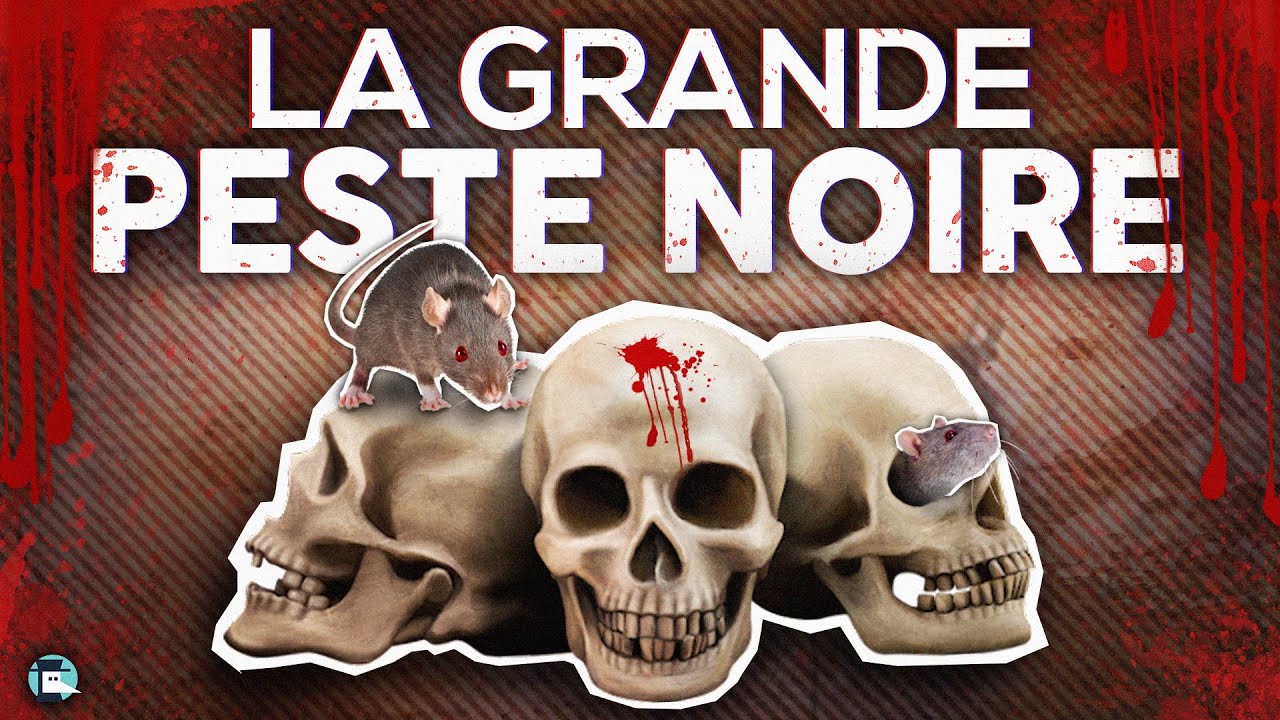
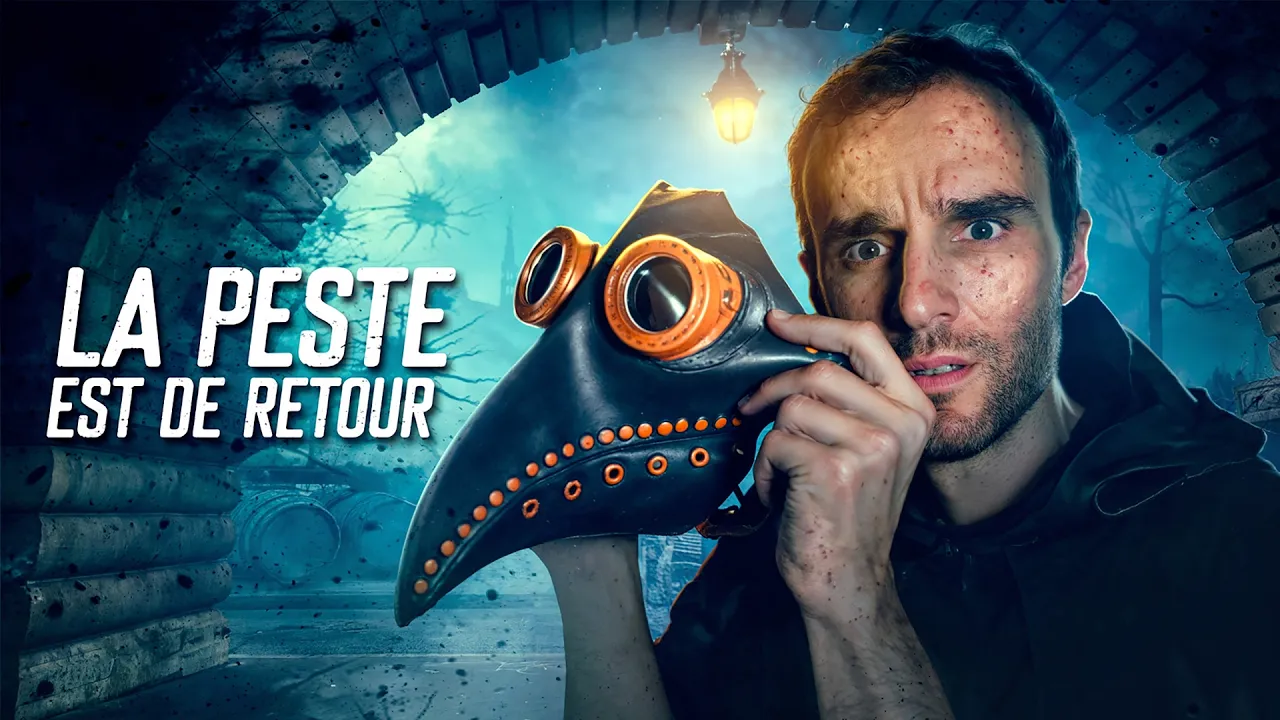
The plague. Damn, it's a scary disease! Apparently, it would be a re-emerging disease as well.
No, no, I don't want to. Basically, this means that the plague does its big comeback. And I don't really like that.
So today we're going to talk about the plague. What is it ? What does it do?
How do we catch it? Where does it come from? All of that, actually.
Hi everyone, it’s Nozman. Does the plague freak you out too ? Write it in the comments, I think yes.
We immediately have a very gloomy image when we think about that. We imagine disgusting streets, the doctors with their super creepy protective masks, foul smells everywhere, bubo on the skin, in short, this disease which is caused by the Yersinia Pestis bacteria still killed half of Europe in the Middle Ages. So at this level, in the list of epidemics, it's not bad.
And the worst, as I said, is that with a good dose of bad luck, it's not impossible that this disease happens to contaminate one of you one of these days. It's unlikely at the moment, but it's a surprise. In fact, we all think that the plague is a thing of the past.
We all have this in mind, we imagine super old nasty epidemics, but you're actually wrong. Since 1990 for example, it has been even 50,000 cases which have been declared in 26 countries from Africa, Asia and America. 1990 isn't that old, you know?
So that sends it to 200 million the number of people who died from the plague since Antiquity. And the worst thing is that a priori, there are chances that it doesn't get better. Why ?
Because no luck, according to the WHO, as I said, this disease would be re-emerging. Once the bacteria is in your body, you will have initially fever, fatigue, headaches, but also buttons from hell. This is precisely the famous bubo.
The bubonic plague. These bubos will make you regret all the pimples in your life. In addition to being super painful, these fucking bubo, this inflammation is caused by the multiplication from the plague bacillus directly in one of your lymph nodes.
So these are the ones which have an important role in your immune system. So, without treatment, you have a 30-60% chance of dying. Because of the final passage of the bacteria into the blood that causes sepsis which sometimes completely changes the color of your skin, Its becoming a bit rotten in fact.
And that's will simply sign your death warrant a few days after the start of the infection. We don't want the plague, really. But that, what I just said with sepsis, it is if you're lucky.
Because if you don't have no luck, if the bacteria is directly deposited in one of your blood vessels, well actually, you could immediately start with the last stage, which is dying. This is a variant of the disease called septicemic plague. It is the rarest, it’s a bit shiny, but it is the most violent.
And I'm not even talking to you about it pulmonary variant: pneumonic plague. This one is the third form of the disease. And how can I tell you, your life expectancy with this one, we count it in hours.
And sometimes no more than 24. And during these 24 hours, what is the program? You will start by having difficulty breathing, a cough and raspberry-red spit.
And which obviously ends always death without treatment. So really, I told you it's scary, the plague is no joke. So we understood that you should avoid catching it.
But, how do we catch it? Specialists of the time thought that the plague was transmitted via small contaminated particles, like in contaminated water or even polluted air or via foul smells. That was the miasma theory at the time and has since been refuted.
That’s why the doctors of the time had this famous mask in the shape of a bird's beak, a mask that really freaks out, I feel. In this mask they could place aromatic herbs, spices, mint, all that in order to keep bad odors away because they thought that it was responsible for the illness. You breathe these bad smells, presto, you get the plague.
Actually it's in the second half from the 19th century that the miasma theory started to disappear to leave room for theory by bacteriological infection. However, at first glance, the germ responsible for the disease, it seems to have nothing to freak out about. First, it has a standard shape for a bacteria, and in addition, it's not even humans which it aims at first.
And now, I'm going to tell you about the fabulous journey of this Yersinia Pestis bacteria. You'll see, it's crazy. So the target of this bacteria, at first, it's the fleas, especially those of rodents like rats.
By multiplying in the fleas stomach the bacterias will form a plug which will prevent blood to reach the stomach and it will have the effect of starving fleas. It's really not very nice and above all it will kill them. But not right away, not right away.
It will rather push the fleas to want sting the rat they are on, sting them thoroughly to eat as much as possible. They will sting it again and again in the hope of being satisfied at a moment. And by dint of sting, the rats end up catching the plague bacillus and they will end up dying too.
The problem is that once the rat is dead, there may still be fleas remaining which are hungry and which need to find food. And if there are no rodents nearby, well they can accidentally bite another host, like for example a human. A human who can find himself then with the bubonic plague, or even more rarely septicemia.
Even if once a flea has passed this form of the disease to a human, they rarely can, but they can, evolve into pneumonic plague, therefore the most dangerous. It's a lung infection which allows Yersinia Pestis to pass the vector. Because to transmit this form of the plague, therefore pneumonic plague, the only transport way it needs, is your aerosols, drool, spittle, etc.
Top top top ! Really, it's not good. Transmission modes which therefore allowed this bacteria, not very impressive in appearance, to become one of humanity's greatest murderers.
I think you have heard of the Black Death. It was in 1347 that everything degenerated. That year, merchant ships full of plague rats have landed in European ports.
And at the time, hygiene was very bad, so bad that this merchant ships, dead rats, bubonic plague and serial deaths sequence repeated in many other ports on the continent. And the result of all this is that approximately, in only five years, it’s definitely 30 to 60% of the European population which would have been decimated. It's huge.
Especially since it was only the first wave of a pandemic that lasted almost 500 years. And what's more, this extremely deadly pandemic apparently started thousands of kilometers away of Europe. At first, we thought it could have started on the port of Kafa in Crimea, because it is from there that the first merchant ships full of infected rats went from.
In fact, during the siege of the city, the Mongols would have wanted to take advantage of the plague which spread through their ranks by throwing away corpses above the city walls. This somewhat hardcore strategy, I grant you, is suspected to have contaminated this very large commercial crossroads. But in fact, a priori, the very beginning of the plague would come from elsewhere.
But then, where does it actually come from? To go back to the first cases of the plague, you have to go to Kyrgyzstan, in Asia. A priori, it's there that we found the skeletons of the very first victims of the Black Death, individuals who would have died some time before the start of the epidemic in Europe.
And we know that because researchers have managed to analyze the genetic material of the bacillus of the plague that had killed them. This allowed scientists to compare DNA with other ancient strains, medieval or even modern and above all , to understand that it was the strain which was the origin of all cases in Europe. Besides, it would come from a groundhog which is one of the main disease reservoirs there.
Groundhog are cute, that’s dumb. But ultimately, there are traces of plague even older than that. There has been DNA evidence of the bacteria which were found in human skeletons dating back 4000 years.
And also, there were many others epidemic episodes in history, such as The Plague of Justinian which caused damage in a large part of the Eastern Roman Empire between the sixth and the eighth century, but also more recently, the one that started in Hong Kong at the end of the 19th century, which is actually the pandemic, still responsible for cases today. Yes, I did say “cases today”. So, don't panic either.
This last edition of plague, health impact level, it has nothing more to do with the previous ones because in the meantime, science has been there, especially researchers Alexandre Yersin and Paul-Louis Simon. Guys, thanks. Because if the first gave his name to the bacteria by discovering it in 1894, the second, he understood the role of flea in disease transmission.
Small scenario, It’s always a pleasure. It is 1897 in India and while the plague wreaks havoc there, this French epidemiologist arrives. His objective is to understand how the disease spreads.
An investigation that will quickly put rodents in his sights. And this because of numerous dead rats found just before the start of each epidemic. Even if during his experiments, he will quickly realize that contaminating them by digestive were very complicated.
On the other hand, by cutaneous, well that, he did it really well. Because if this observation put him on the track fleas accustomed to perforating the rodents skin to suck their blood, it now had to be demonstrated. A manipulation he did later by enclosing in a jar a sick rat with a healthy rat imprisoned in a cage and a lot of fleas.
The cage is important because only the fleas were small enough to cross the bars and the contamination of the healthy rat would necessarily mean their role as vector. And as you can imagine, it didn't fail. the role of the flea in the spread of the plague bacillus has finally been proven.
But after that, it's simple, everything has changed. In fact, once the threat has been identified, it was a little easier to get protected from it. So, they started to set up the first measures thought out to protect against rats and fleas.
So today we have insecticides and antibiotics especially. So it's not the same story. But it's clear that antibiotics in the fight against the plague, they really helped a lot.
It really helped us. Tell yourself that from the beginning of their use in the 1940s, mortality associated with the plague is approximately fell at about 10%. 10% is good, compared to 60% before, it's still better.
Actually, when administered early, fluoroquinolones, tetracyclines and streptomycin, so these are the main antibiotics against the plague, can even prevent you to die from the pulmonary version, therefore the nastiest. It's still cool, it works well. There was also a developped vaccine against the plague, but it has been judged not super safe by the authorities.
We just hope one thing, that antibiotic resistance don't get too involved. But the problem is that since the 90s, it started. That's a big problem when we know that some think that this bacteria would simply be impossible to eradicate.
The thing is, the Yersinia Pestis bacteria has another super power, that of being able to survive discreetly in the environment. It manages to do that thanks to its ability to persist in animal reservoirs. And not necessarily just rodents.
In fact, it would even be able to infect your cat, but also to survive in the soil. An ability that researchers think it manages to obtain thanks to amoebae. So these are very small microorganisms super common in soil and water that feed on bacteria in the four corners of the planet.
Researchers did a study on this. They actually fed amoebas with the plague bacillus and some have found that amoebas could not digest them. And worse, in certain species, the bacilli were even capable of replicating.
It's a discreet presence which allows to restart epidemics in areas where we thought it has disappeared for longer. This is what happened in Algeria in 2003, where the plague made its comeback after 57 years of silence. But that's also what happened in Jordan in 1997, in Libya in 2009 and in 2013 in Russia and Kyrgyzstan, where the disease had been extinct for decades.
That's a lot of places, huh? I don't really like that. You can add to that global warming which favors fleas, deforestation that destroys reservoir habitat.
Or precariousness from certain countries which can sometimes lead to health surveillance not hyper optimal. And you get the ingredients which are suspected of being behind epidemic recovery in the world. Moreover, the United States also has the right to a few cases of plague each year.
But it's Madagascar which is the most affected country before the Democratic Republic of Congo and Peru. And that to the point that from October to April, in the highlands of the country, where there is the main epidemic areas, they even have the right to a plague season. Yes, it's like the flu, except that, well, it’s the plague.
It is a seasonality which can be explained especially there by the start of the rains, which pushes infected rodents to enter the houses where grains are stored for example. In total, it's even 280 to 600 cases per year which would be declared on the island of Madagascar, in an area which would become more and more extensive. It's an increase in cases and affected territories which led the WHO to classify this disease as re-emerging.
So, even if an episode of 21st century version of black death is unlikely, all that, It’s still scary. But hey, in any case, I think it was interesting to know a little bit the story of the plague. For the moment, France is spared, but hey, we can only hope that the search continue to help everyone a little.
In line of sight, in particular, current development of a vaccine which this time would be safe for health. In any case, I hope that you liked this video. I would like to thank the bacteriologist Florent Sebbane and the biologist Renaud Piarroux for their help during the writing of this video.
Thank you so much. As a reminder, that's it, our Fractal comic, it's right there, is available in store since September 26, so it's been a few days already, if you're interested, discover lots scientific stories, experiments or even anecdotes about the channel, about my life, well it's available in the Fractal comic that we just released. I really hope you’ll enjoy.
Fractal, It is a good method to support us. I tell you as usual see you soon, see you next time, because science doesn't wait. Bye !