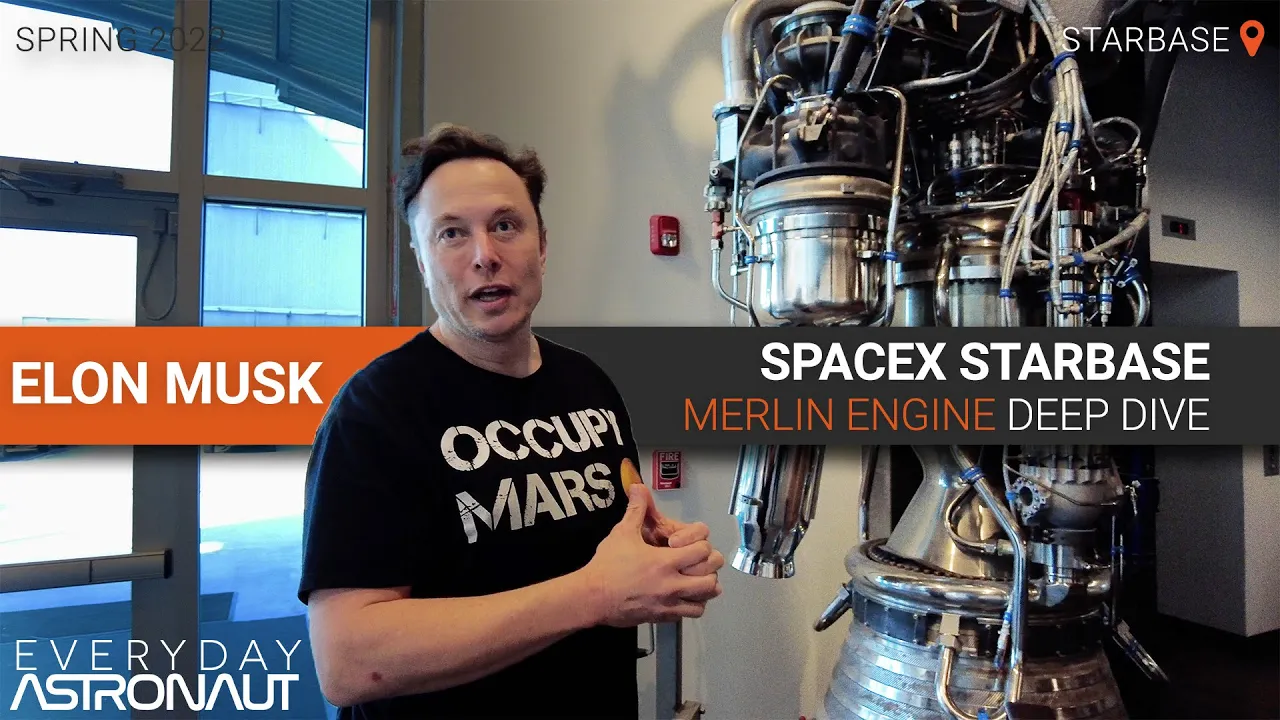
Hi, it's me, Tim Dodd, the Everyday Astronaut. Welcome to Starbase, Texas. Today, we're getting a history lesson and a deep rundown on SpaceX's incredible Merlin engine with Elon Musk.
This engine is one of the most reliable rocket engines to date and it's at the heart of SpaceX's current workhorse, the Falcon 9. If you wanna know how SpaceX's Falcon 9 rocket compares to their upcoming Starship rocket, don't forget to check out my video about exactly that. It can help be a good refresher on all the things we talk about here in this video with Merlin and in the next video where we talk about Raptor engine with Elon too.
And fun little note, we just finished manufacturing our first 1:100 scale metal model rockets, and this is our Falcon 9. These are high quality, highly detailed and very durable display pieces. This is the first of hopefully many, 1:100 scale model rockets.
So head on over to everydayastronaut. com/shop to check them out. Okay, let's dive into SpaceXs Merlin engine.
Okay. Well, I mean maybe since you've done like that long piece on Russian rocket engines, which was pretty impressive, then maybe we could start off talking about rocket engines, perhaps. Definitely.
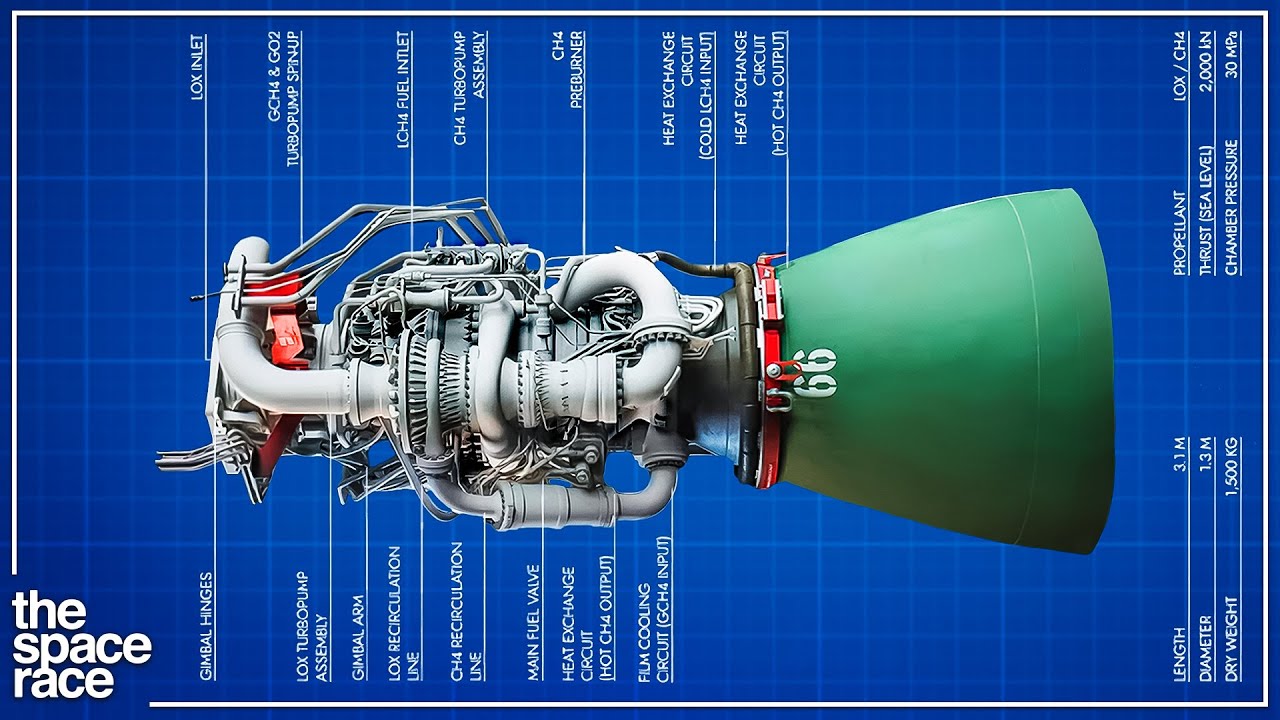
This is the right room for it. So this is actually an early Merlin engine Merlin 1C, so I think it's maybe interesting to look at the difference in complexity of Merlin versus Raptor. So in the case of Merlin, you have gas generator cycle single shaft with the LOx pump, the production pump here, the fuel pump here and the turbine here.
So it goes cryogenic more or less room temperature, hot on, and it's a single shaft and the inducer and the impeller of the oxygen pump and the fuel pump are combined. So you don't have a separate inducer impeller. So this is basically about.
. . This is about a simple as you can make a pump fed engine.
Like there's, I don't think there's any simpler way to make a pump fed engine. That's intentional because when we started out, we were trying to minimize the probability of going bankrupt. So, the simplest possible pump fed engine was what we were aiming for.
You even were your very first ones, Merlin 1A was an ablative chamber. Yes, exactly. It was regeneratively cooled.
So that was another simplification step. Um, yes, I think that it was a mistake to do the ablative because that's fundamentally goes against the reusability concept. So I was not a fan of ablative.
Tom thought that perhaps, it would be less risky to go ablative because he had some experience with ablative engines at TRW. But the tricky thing with ablative is as the chamber pressure rises, the erosion rate increases. And so, it gets much harder to avoid erosion with an ablative chamber at high pressure.
You're pretty hard limit on your. . .
How high of combustion pressure it can have. Yeah. I mean, just think of like, you've got like a fast moving river or something.
If you have a fast moving river you're gonna have much more sheer force and that's gonna just erode a river bank fast and same thing here. If you've got a lot more pressure, the rate of erosion's gonna be much worse and it also run away with you. Like, if you get a little bit of a.
. . .
Like a chip almost? If you get differential erosion and you start basically creating a rut that rut will accelerate. So it's not stable.
Is it because the surface area increases as it like erodes? So there's more exposed and it just compounds basically? I think it's [a] surface area thing, and also somewhat of a, kind of a venturi effect.
You basically get accelerating flow through the channel. I'm speculating here. For practical purposes, the problem is that if you start cutting a groove, that groove accelerates, it runs away from you.
So ablative actually ended up being heavier, more complex, and more expensive than regeneratively cooled for at least a booster engine, which is high pressure. And this is the, actually the first, regenerative approach that we tried which is in this case---this is ancient history at this point. It's a mold copper liner in the chamber, with a plated, sort of high strength mostly nickel cobalt jacket.
So we actually plated, literally electroplated, the outer jacket on. It took ages like a week. It was like a crazy way to do it.
As opposed to what's normal now? I'm not familiar with how you normally would combine the two as opposed to electro plating. What's a more.
. . ?
Well electro plating, you're literally building up one molecule at a time, right. So this is--- to make a high strength thing with electro plating, is very inefficient. Like we're just very dumb at that point.
I mean there are lots of ways to create an outer jacket. Electro plating is probably the worst. Alternatively, you could have you know, castings, stampings, but the things that, where you get much closer, you're not trying to blow it up one molecule at a time, you're, you're doing a casting and then you would machine away a casting where you have a stamping or forging or something like that.
That's much faster and that's how we do it today. And then the nozzle was spiral wound steel tubes. I always wondered about that.
And is that supposedly easier because as the diameter changes, you don't have to worry about the individual channels changing their shape? Or what was the thought process there? Yeah.
So, because the diameter is increasing you can't just have straight tubes. So what was done in the past was to expand a tube. So you'd like hydroform tube.
So you'd take an extruded tube and then you'd hydroform it. Like you'd basically put it under very high pressure in a dye and puff it up. So that would have variable diameter.
And so like an engine, like the RL-10, where they would hand do it, they would've to probably do it thicker at every, like all those different points. And as it got skinnier, that would probably be a very labor intensive process to make I'm sure. Well, I thought at the time we can avoid the challenges associated with having a variable diameter tube, if we spiral wind.
You know, it's basically like how you might make a wicker chair or something like that. Now this ended up being an expensive and painful thing, and a lot of challenges with this joint here where you go from the mold copper wall to the two wall. You've got a hot gas seal there and that gave us a lot of trouble.
And this is the regenerative manifold here? Um, yeah. So.
So what was. . .
I guess. . .
Why did you end up moving away from like a spiral around like that? Because it at least looks cool! Uh, it was.
Well, we basically, before Melin, moved to having the chamber and the jacket be the chamber and the nozzle be mold copper with a steel jacket. And we just welded, all the parts. So we did not have a hot gas seal that was problematic.
So in [Merlin] 1D you just made it all one piece-- or two pieces then to come to one. We, essentially, we welded the copper liner inside together and so there's no hot gas seal. That's the important part.
And overall, it ended up being, all things considered, lighter and lower cost and higher and better, basically in every way than the Merlin 1C. Now remind me, there's always a rumor that the reason your first Falcon 9, when it took off kind of like a 45 degree turn. There's two rumors, there's two theories.
One was that the spiral actually induced some kind of torque to the engine that you hadn't noticed, and the others of the gas generator was tilted in a way that induced a little bit of additional roll. What's the actual answer? I think we didn't quite zero out the.
. . I think we had a little bit of an angle on the engines.
We thought we were at zero and we weren't. Gotcha. Yeah, there's a calibration error.
Okay. Okay. You have no idea how many people have speculated that it's, you know, like the gas generator was that an angle and that induced, you know, additional torque and all this stuff.
The toque from the gas generator, and there's a little bit of toque from the spiral on nozzle, is quite low. It's not enough to rotate a big rocket as big as the entire Falcon 9. But it is enough to be problematic if you're in vacuum and like for the upper stage, if you had nothing to counteract the roll torque from the.
. . Although for the upper stage, we had just a, we didn't have this issue.
Anyway, this is like maybe a bit too much history of the Merlin 1C since this was kind of a blip in time. And we moved on from this to the [Merlin] 1D which was higher thrust, more efficiency, easier to build. It certainly gives you a sense for how much simpler this engine is than Raptor is mostly what I was getting at.
Just having a single shaft turbo pump, only one turbine, having the inducer and the impeller be a single piece is just dramatically simpler than Raptor. You know, we can go from here to. .
. Can help point out real quick though, how the pintle injector on this is right at the very top of the chamber, obviously. How does that get.
. . ?
I never understood how that gets controlled. Oh. So a big improvement we made with the Merlin 1D was to have phase shut off for the pintle injector.
So that's actually another great simplification that the injector itself serves as the [oxygen] and fuel main valves. So it's sort of like a lawn sprinkler. So like, you know, if lawn sprinkler is like down but you turn on the water that causes lawn sprinkler, the head to pop up and open the sort of.
. . Serrations almost or whatever.
Yeah. And then when you lower the pressure it goes back and shuts itself off. So, this is not a great analogy, but so the Merlin 1D, which is really, I mean, we're probably on like the seventh version of Merlin, I don't know.
But we were able to combine the injector with the fuel and [oxygen] main valves by having it be a phase shut off. It is probably helpful for viewers to see what a pintle injector. .
. 'cause like nobody knows what a pintle is. Right, right.
I know. Yeah. I'm thinking of where I'm gonna find one <laugh>.
Cause I don't, if there's. . .
. There's good pictures. I'm sure there's pictures online.
Oh yeah. If not I'll draw it. It's the same basic principle as like the lunar module descent engine.
Yeah. That's right. So, it's a single element injector.
You can do it either way, but you've got either like a sheet of oxygen, liquid oxygen that's coaxial with the injector. And then you've got holes that go sideways. You've essentially got, you've got like a fan.
That's. . .
Almost like a, like a mushroom, or like a shower head and then with sprays going through it. So they mix well. Yeah.
So like. . .
But you've got basically a knob, like a cylinder. There's a coaxial sheet. That's going.
. . Pretty much straight down or does it cone out a little bit?
It's a coaxial sheet. It's going along the side of the. .
. You've got a cylinder. .
. It's just a cylinder that pops out. Then, then you've got a coaxial sheet of you know, in our case, liquid oxygen.
And then you've got a fan, like a series of holes going sideways. So you've got sheet going down, coaxial sheet, going down, then you've got fuel going sideways, and it's sort of 360 degrees. And the sort of joke with the pintle engines is like the fuel oxygen mixing occurs when the sheet hits the fan.
This is an old joke. Oh God. <laugh>.
So now this is a very--- This sounds like it wouldn't mix well because it's such a course interaction. And when you got such a course interaction, you would think, "Okay, it's really. .
. You're not gonna get good mixing of fuel and oxygen. " But actually you do because you get this kind of recirculation zone.
So it sort of creates this kind of turbulent recirculation zone in the center. That gives the fuel and oxidizer more time to react. Yeah.
You want to sort of really shake it up, you know? You have like the crazy martini shaker situation. So especially with a liquid liquid engine, 'cause liquids are much worse at mixing than gases.
So it's like somewhat counterintuitive, but pintle injector still gives you pretty good mixing. You can get better mixing with some other objectives. So you probably lose, I don't know, a couple percent of efficiency with a pintle injector, but it's pretty small and then you don't have any issues with combustion instability.
Oh really? A pintle injector is naturally stable. Cool.
Yes. We never had any combustion instability issues, which is also often big problem with liquid. Yeah and a good thing for deep throttling, which is obviously important for you guys too.
Um, yes. Although we don't use deep throttling kind of the way that the lunar module descent engine does. We don't actually need super deep throttling but it is certainly a way to achieve dethrottling.
It's just, we don't happen to use that way. We just basically turn down how much power we give the turbo pump. Right.
Gotcha. Still a cool engine though. It's amazing that this is only what, 12 years ago, basically.
Then 12 years you went from this to uh. . .
I mean, this is a much simplified version of Raptor. The actual flight version is much more complicated. We can go see the flight version.
In the next and final video in this series we go really in depth with Raptor 2, So stay tuned! Thank you, Elon, for all of your generous time. Thank you, Ryan Chylinski from Cosmic Perspective for helping to capture and share this incredible conversation.
And I have a huge thing to my Patreon supporters for helping make this possible. If you wanna help me continue to do what I do head on over to patreon. com/ everydayastronaut.
And while you're online, be sure and check out our awesome web store at everydayastronaut. com/shop, where you can find shirts like this, the RD-171 rocket shirt and lots of other really cool stuff. Again, including our brand new 1:100 scale metal Falcon 9 model rockets.
These are seriously awesome. But we also finally have our brand new dress wear with really cool little aerospace patterns. They are incredible and some other brand new merchandise.
So head on over to everydayastronaut. com/shop. Thanks everybody.
That's gonna do it for me. I'm Tim Dodd, the Everyday Astronaut, bringing space down to Earth for everyday people.










![[2022] Elon Musk Explains Updates To Starship And Starbase!](https://img.youtube.com/vi/3Ux6B3bvO0w/maxresdefault.jpg)

![Starbase Launchpad Tour with Elon Musk [PART 3 // Summer 2021]](https://img.youtube.com/vi/9Zlnbs-NBUI/maxresdefault.jpg)