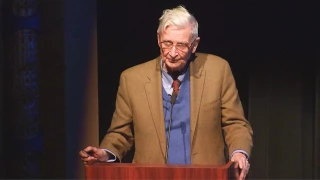
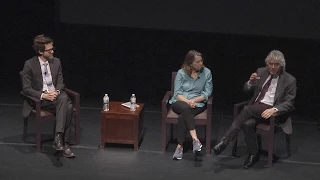
Good afternoon. Welcome to the third and final of the 2010 Prather lectures. I'm Jonathan Losos, professor of organismic and evolutionary biology here at Harvard.
I know many of you have been to one or both of the previous talks, so I won't go over the same ground as the previous introductions. Rather, I'd like to talk about two aspects of Ed's career that haven't yet been mentioned. The first one is Ed Wilson the educator, and this one to me is very personal because 30 years ago, I arrived here at Harvard as a callow youth with very vague, ill formed ideas about evolution and biodiversity.
And on my very first morning of classes here, I sat in this very lecture hall in the front row, as I will be sitting today, to take the core course Science B-15, evolutionary biology, taught by none other than Edward O. Wilson. And as you may imagine, this course was a brilliant synthesis of evolutionary biology and biodiversity, and it was captivating.
It was so captivating that every year in the 18-year run of this course, Ed filled this lecture hall with undergraduates. It was one of the most highly rated courses among the students. This course had a very great effect on my own development, and I think it's no exaggeration to say that because of that course, I have followed the course that I have and am here today.
And in fact, I can tell you I know that I am not the only student who took Science B-15 or served as a TF who is in the audience today. Many others were similarly affected by this course. It has had a great impact on many people who have either become scientists or at least have a great appreciation both for evolutionary biology and biodiversity.
I can tell you it's a great thrill to be back in this lecture hall again, seated in the front row, and soaking up the wisdom and insight of Professor Wilson. Now, my second point concerns the books that Ed has written, and we've heard about a number of them. I just want to, as an aside, mention Ed's most recent book, Anthill, his first novel.
I just want to tell you that I'm three quarters of the way through it and it's a great book. It's a great novel and I highly recommend it. If you don't believe me, check out the review in the New York Review of Books two weeks ago by Margaret Atwood or pick up the New York Times on Sunday where it will be reviewed by Barbara Kingsolver, and you'll see the book is getting great reviews and it's well worth reading.
But despite that plug, that is not the book that I wanted to talk about. The book I want to talk about is one that has not yet been mentioned. It's Ed's autobiography, Naturalist, published in 1994.
This is a book that I highly recommend to all of my students for two reasons. The first is that it lays out Ed's remarkable career as a scientist. I'm sure that all of us in this room to some extent have an appreciation of what an incredible career Ed Wilson has had, but at least for me, it was not until I read this book that I fully appreciated the magnitude of the contributions he has made to science and to society.
And so I just want to briefly tell you what I got out of reading this book. In addition to becoming the world's leading authority on ants, Ed has played a major role in the following contributions in our field-- the discovery of the role of pheromones in ant communication, the development of the theory of island biogeography, the study of the evolution of eusociality in insects, sociobiology, basically creating the field of conservation biology, and advancing our understanding of the evolution of human culture. Now, I think most people in this room, most scientists, if at the end of their career could claim any single accomplishment like one on these lists, we would be very satisfied that it was a career to be proud of.
The fact that Ed has had all of these contributions is really, truly remarkable and humbling. I recommend this book to this audience for a second reason, however. It provides a gripping historical narrative of the development of biology here at Harvard from the time of the discovery of DNA to the resurgence of organismal biology.
As many of you know, the latter half of the last century was a tumultuous time in biology, both across the country and very particularly here at Harvard. And if you'd like to read a wonderful history of the development of the field, particularly here at Harvard with some great stories, this is the place to go. And in fact, if you want to understand how we here in the biological community at Harvard have gotten where we are, this book really is a must read.
As I said, Naturalist was written in 1994, and Ed has hardly sat on his laurels since then. In fact, in the 16 years since then, Ed has published seven further books and has developed a number of additional important ideas, such as the concept of biophilia, the biophilia hypothesis, as well as forging the rapprochement between the evangelical Christians and the environmental movement towards protecting biological diversity. In his talk today, Ed is going to talk about the subject of another one of his books and another of his important ideas, that of consilience, the concept of bridging the gap between the humanities and the scientists.
Ed, it is a great honor to have you here at the Prather lecturer for 2010. [APPLAUSE] EDWARD O. WILSON: And it's a great honor to be introduced by you, Jonathan.
You are carrying the banner high here at Harvard. Now we're back to the first slide that I'm going to be showing. Tonight I'm going to talk about what I consider to be a new frontier in science, but equally a new frontier in the social sciences and humanities, and of course this is a controversial notion, but that's what Harvard is supposed to be all about.
Although it's widely assumed that there are many ways to account for the human condition, in fact there are only two ways to account for the human condition. The first comes from the natural sciences, whose practitioners set out more than four centuries ago and with considerable success to understand how the material world works, and all will agree they preempted that particular enterprise. The second way to account for the human condition is all the other ways.
Since the 18th century, the great branches of learning have been classified into the natural sciences, the social sciences, and the humanities. Today, we have the choice between, on the one hand, trying to make the branches of learning conciliate, that is, coherent and interconnected by cause and effect explanation, or on the other hand, not trying to make them conciliate. Surely universal consilience is worth a serious try.
After all, the brain, mind, and culture are composed of material entities and processes. They do not exist in an astral plane above and outside the tangible world. The most useful term to capture the unity of knowledge is surely consilience.
It means the interlocking of cause and effect explanations across different disciplines, as, for example, between physics and chemistry and biology, and more controversially, of course, biology and the social sciences. The word "consilience" was introduced in 1840 by William Whewell, the founder of the modern philosophy of science. It's more serviceable than words like "coherence" or "interconnectedness" because its rarity of usage since 1840 has preserved its original meaning, whereas "coherence" and "interconnectedness" have acquired many meetings scattered among the different disciplines.
Consilience, defined then as cause and affect explanations across the disciplines, has plenty of credibility. It's the mother's milk of the natural sciences. It's material understanding of how the world works and its technological spin-offs are the foundation of modern civilization.
The time has come, I believe, to consider more seriously its relevance to the sciences, social sciences, and the humanities. Now, I'll grant immediately that belief in the possibility of consilience beyond the natural sciences and across the great branches of learning is not the same as science, at least not yet. It is a metaphysical worldview, and a minority one at that, shared by only sciences and a few philosophers.
Its best support is little more than an extrapolation of the consistent past success of the natural sciences. Its strongest appeal is in the prospect of intellectual adventure, and given enough modest success, the value of understanding the human condition with a higher degree of certainty. Now, I believe that it's a matter of practical urgency also to focus on the unity of knowledge, and let me illustrate that claim with an example as shown here.
Think of two intersecting lines that form a cross and picture the four quadrants that are thus created. Label one quadrant Environmental Policy, the next Ethics, the next Biology, and the final one Social Science. I got ahead of myself.
Let me see if I can go back. There we go. Continuing on, each of these subjects, then-- I just listed them and there they are-- has its own experts, its own language, its rules of evidence, its criteria of validation, its many endowed professorships at Harvard.
Now if we focus on more specific subjects, as noted here, within each of the quadrants, we see how general theory translates into the analysis of practical problems. And we understand that in each case, we somehow have to learn how to travel clockwise from one subject to the next. In a single discussion, maybe in a sentence or two in the discussion, it's necessary to travel the entire circuit.
Now move through concentric circles toward the intersection of the disciplines. As we approach the intersection where most real world problems exist, the circuit becomes more difficult, the process more disorienting and contentious. The nub of the problem, I suggest, vexing a great deal of human thought is the general belief that a fault line exists between the natural sciences on one side and the humanities and humanistic social sciences on the other, in other words, very roughly, between the scientific and literary cultures as defined by C.
P. Snow in his famous 1959 Rede lecture. The solution to the problem, I believe, is the recognition that this boundary is not a fault line, it is not a permanent epistemological division, it is not a Hadrian's Wall, as many would have it, needed to protect high culture from the reductionist barbarians of science.
What we are beginning at last to understand is that this line does not exist at all. It is instead a broad domain of poorly understood material phenomena awaiting cooperative exploration from both sides to the ultimate benefit of each of the great branches of learning. During the past several decades, several borderland disciplines-- like the mind of an overly bright and eager Harvard undergraduate, this machine seems to be racing ahead of my-- the truth of the matter is that at those noontime lectures that were mentioned by my introducer, my problem was to make the talk interesting enough to keep them from picking up that morning's issue of The Crimson.
At any rate, the borderland disciplines. We're back to them. I think this is self explanatory.
Most of you will be familiar with these as intermediate disciplines, and they themselves are synthetic in nature, drawing from several preceding and better established disciplines. From the social sciences side in this cooperative effort of exploring the borderland, the social sciences are moving with cognitive psychology and biological anthropology and biological investigations of the foundation of political and economic behavior, which are beginning to take hold. To an increasing degree, cognitive psychology and biological anthropology are becoming consilient, for example, with the four disciplines shown on this slide, and in fact, they're anastomosing with them in cause and effect explanation.
Other disciplines have begun a cautious entry, including even literary criticism, which is beginning to stir up troubles along the borderland in the home countries. These connections are strengthening very rapidly as we saw, for example, in the race to map the human genome, it was auto catalytic and one of the advances promoted still more rapid and a spray of other advances and so on. So let me then ask a key question.
Why is this conjunction among the great branches of learning important? Because it offers the prospect of characterizing human nature with greater objectivity and precision and exactitude that is the key to human self understanding. The intuitive grasp of human nature has been the substance of the creative art.
It's been the underpinning of the social sciences and a beckoning mystery to the natural sciences. To grasp human nature objectively, to explore it to its depths scientifically, and to grasp its ramifications would be to approach, if not at last attain, the grail of scholarship, to fulfill the dreams of the Enlightenment which stumbled and failed so painfully before romanticism and the lack of sufficient evidence in the early 1800s. Now, rather than let the matter hang in the air rhetorically, I want to suggest a preliminary definition of human nature and then illustrate it with examples.
Human nature is not the genes which prescribe it. It is not the cultural universals, such as the incest taboos and the rites of passage that are the products of human nature. Rather, human nature is the epigenetic rules, the inherited regularities of mental development.
These rules are the genetic biases and the way our senses perceive the world, the symbolic coding by which we represent the world, the options we open to ourselves and the responses we find easiest and most rewarding to make. In ways that are beginning to come into focus at the physiological and even in a few cases the genetic level, the epigenetic rules alter the way we see and linguistically classify color. They cause us to evaluate the aesthetics of artistic design according to elementary abstract shapes and the degree of complexity in them.
They lead us differentially to acquire certain fears and phobias concerning dangers in the environment, as from snakes and heights, to communicate with certain facial expressions and forms of body language, to bond with infants, to bond conjugally, and so on across a wide range of categories of behavior and thought. Most are evidently ancient, dating back millions of years in mammalian ancestry, and others, like the stages of linguistic development, are uniquely human and probably only hundreds of thousands of years old. Let me now spell out several of the examples that I, in fact, alluded to briefly.
When you take a Munsell array, a standard color array, left to right across different frequencies of light, up to down in intensity, then ask the native language speakers to place their color terms on the Munsell array. Azul, where does it fit? Where does scarlet fit and so on?
Then you get this, a clustering on certain parts of the Munsell array, and that clustering occurs in those areas where the change of perception. As we have a uniform velocity of change in light, the wavelength of light, then where the perception speeds up in its ability to judge it is where people are least likely to place their term. And where it slows down, even though that is not really what's happening in the Munsell array as we see it in the visual cortex, where it slows down is where we place the color terms.
This has been done with some 20 classic experiments with 20 native language speakers. Interestingly enough, it has also been found, although this is an area that's in rapid change in defining of the analysis and so on, but I think what I'm about to tell you is generally true. As terms are invented by cultures, going from culture to culture, comparing cultures with different numbers of color terms from those, like the Dani of New Guinea with two terms, to those in the European cultures with 11, there being 11 terms which are inter-translatable, that is, interchangeable, one on one, or one on many, or many on one.
11 are translated like this along all known color terminologies. This is the consistent evolution that you can see by comparing one society after another. This is a skittery computer.
At any rate, by comparing cultures with different numbers of terms, then we get this sequence. Two terms, it's black and white. Three, black, white, red.
Four, then they have black, white, red, and green or yellow, and so on. Now, what's interesting about that is that there are-- whenever things go wrong at another university or college and I'm lecturing something like this, I always say Harvard technology. Well, at any rate, the point here is that there are 2,036 possible ways to create a sequence with 11 terms with increasing numbers of terms in the set, but in fact, only 22 are actually followed, or close to 22 are followed.
So there's something going on here that I don't think it yet fully understood. As a second example of epigenetic rules, consider the instinct to avoid incest. Its key element now, and this seems to be well documented, is the Westermarck effect named after Edward Westermarck the Finnish anthropologist who discovered it more than a century ago, and it is simple.
When two people live together in close domestic proximity during the first 30 months in the life of either one, both are desensitized-- a switch is turned off. In other words, the circuit is blocked-- desensitized to later close sexual attraction and bonding in the other person. The Westermarck effect has been well documented in anthropological studies, especially in Israel kibbutzim and in the shim-pua marriage systems of older China.
Although the genetic prescription and the neurobiological mechanisms that underlie it remain unexplored to the most extent, what makes the human evidence the more convincing is that all of the non-human primates whose sexual behavior has been closely studied also display the Westermarck effect. It therefore seems probable that the trait-- and that's different from what's used by most other animals in avoiding incest, a different mechanism than in plants, of course, as well. It seems probable that this is a trait that was in the human ancestral line millions of years before the origin of our own species.
And of course, without going into detail, the existence of the Westermarck effect runs directly counter to the more widely known and romantic and exciting Freudian theory of incest avoidance which, being a failed hypothesis, will receive no more attention tonight from me. In another wholly different realm, consider the basis of aesthetic judgment. Neurobiological monitoring, in particular measurements of the damping of the alpha wave, that is, a measure of the calming of the total brain system.
Measurements of the damping of the alpha wave during presentations of abstract design, as shown here, have shown that the brain is most aroused by patterns in which there is roughly a 20% redundancy of elements, or put very roughly, the amount of complexity found in a simple maze or two turns of a logarithmic spiral or in an asymmetric cross. Of these three arbitrarily chosen designs, left to right increasing complexity, you are most aroused, whether you will admit it or not or know it or not, by the one in the middle. It may be a coincidence that the same property is shared by a great deal of art in friezes, grillwork, colophons, logo graphs, and flag design.
It crops up again in the glyphs of ancient Egypt and Mesopotamia, as well as in the pictographs of modern Asian language. Here is an example in an issue of Daedalus some time ago on the brain. The artist was asked to depict a brain, an abstract design, and there you have it, the ideal level for arousal of the design.
But this is just one of many, many examples. Here we have standard Japanese print and ideograms, which show the same principle. Here is how art has been drawn so brilliantly in the history of Japanese writing.
This is the Reisho style of Japanese calligraphy. This is 17th century example illustrating the art form used to give a stern and commanding appearance, the impressions of strength, usually used for plaques and back covers. And, if I'm not stretching things too far, and likely I may be, thus does art arise from upon the compounding of the epigenetic rules, in this case maximum arousal and also the visual releasers, stimuli of assertion and dominance.
And here is the wayo style, very different, follows genetic direction, delicate, elaborate, graceful. This is decorative art. It is for poetry.
And then consider Punjabi, the same pleasing level of complexity. Possibly the explanation of this is that this is the maximum level of complexity, focused image by focused image, that the brain can immediately process as, for example, numbers of objects up to seven. Here is typical native art, the same.
Now, none of this is proof, but the universal nature and preponderance of the effect has to be considered very suggestive. The theory of the arts, I would like to suggest, awaits its Mendeleev, the one who first put all the information about the elements into a periodic table. I should mention, too, the use of design in paintings to illustrate a different mood.
Here we have the same figure, essentially, by Cezanne and Picasso. Cezanne takes these figures and rounds the curve so as to create a sense of calm. Picasso makes the angles of the figures jagged and it jars and puts one on guard.
Now, I have taken the same approach in another direction, and I want to mention biophilia, on which I published an article 25 years ago that is now beginning to have an impact in architecture, I mean impact in the sense that it was something already underway but its innovators did not have much of a psychological or biological explanation or justification for this new biophilic architecture to be based. Biophilia is the innate affiliation people seek with other organisms, especially with the natural world. After my book particularly showing that there may very well be this evolutionary and neurobiological basis, studies have been made and the subject is now quite strong as a discipline.
Studies, for example, have shown that given complete freedom to choose the setting of their homes or offices, people gravitate toward an environment that combines three features intuitively understood by landscape architects and real estate entrepreneurs and nicely illustrated by this office setting design for the Deere company headquarters in Moline, Illinois. People want to be on a height looking down. They prefer open savanna-like terrain with scattered trees and copses.
They want to be near a body of water, such as a river or lake. Even if all those elements are purely aesthetic and not functional, they will pay an enormous price to have this view. And in cross-cutting manner, they want a retreat in which to live and a prospect of fruitful terrain in which to forage, and the prospect they like best of all is savanna and large animals scattered through it, either as sculpture or real animals.
They want trees, believe it or not-- it tests out cross culturally-- they want trees with low, nearly horizontal branches. Now, if you will allow me to take a deep breath and then plunge where you may not wish to follow, people want to be in the environment in which our species evolved over millions of years, that is, hidden in a copse or against a rock wall looking over savanna and traditional woodland at acacias and similar dominant trees of the African environment, and why not? Why would that be thought foolish?
All mobile animal species, all of them, have a powerful, often sophisticated inborn program guide for habitat selection, so why not human beings? Why should it not remain in our brains even when it no longer has quite that survival value? Moving on, then, to yet another subject, erotic aesthetics.
Here we are, erotic aesthetics. Now, I discovered that in teaching the course I gave here at Harvard, that it was always good that if you had anything about erotics, sexual evolution, whatever, it was good to have it about two thirds of the way through the talk because by this time, they've put down The Crimson, they pick up the pencil or pen, and now they're looking studiously, waiting to hear what you have to say, which in this case is again, there is the matter of preferred female facial beauty open to objective analysis, which is now in fact under considerable scrutiny once the investigators got over the embarrassment of it. The ideal they find by using computer generated images like these and then measuring the responses across culture and across gender as well.
They blend many images and present them, in this case young Caucasian women. It is the one of the center, which is the average of the subset considered most attractive at the outset and then blended, not the one on the left, which is the overall average of Caucasian young women, which was once thought to be necessarily or probably the most attractive, that has the greatest response. The ideal has higher cheekbones than the average, a smaller chin, shorter upper lip, and wider eyes, all relative to the side of the face.
Now, the evolutionary biologists might surmise that these traits are the signs of juvenescence still on the faces of the young women, hence relative youth and reproductive potential. Now, if this seems irrational and maybe implausible, ask any middle aged professor whose second wife is a graduate student. [LAUGHTER] I mean to say that the point that we are approaching in these studies is that genetic evolution and cultural evolution are closely interwoven.
We're only beginning to obtain a glimmer of the nature of this complex process, but we know it exists. It awaits our analysis in that borderland I mentioned earlier. We know that cultural evolution is shaped substantially by biology and that biological evolution of the brain, especially the neocortex, has occurred in the social context.
But the principles and the details are the great challenge in the emerging borderland disciplines. In my opinion, gene culture co-evolution, represented here as a cycle, is the central problem of the social sciences and much of the humanities, and it is one of the great remaining problems of the natural sciences. Solving it is the obvious means by which the branches of learning can be foundationally united.
Now, in closing, let me acknowledge that some critics-- no, many critics-- have said and they will continue to say that whether the conception is correct or not, the program is impossible. The major gaps of traversing the borderland between the natural sciences on one side and the social sciences and humanities on the other, genes to brain and brain to culture, they're just too wide and complex for us to master. There exists, furthermore, in this view emergent properties that can never be reduced.
Perhaps, the critics continue, they even represent fundamentally different epistemologies. I think we can lay that to rest. My answer to radical anti-reductionism is that, quite the contrary, the first steps are being taken.
Now, in the interest of time, I'm not going to spell out these cases, but I'll simply mention examples such as the reeler mutants worked out in mice down to the level of the biochemical control of the mutant effect on the behavior to what's more interesting, perhaps, which is examples such as the control of repetitive behavior in the circuit that runs in the basal nuclei of the brain through the thalamus, the staging area, to the frontal cortex where the information is organized concerning that circuit and also feeds back in a way of modulating the speed of the circuit and the intensity of it. This circuit appears to be very much part of the process of rhythmic behavior, of speech, of movement, and can be fixated upon or can be exaggerated. It can be loosened.
When it's exaggerated, then it leads to the condition of OCD, obsessive compulsive behavior, which is the reason why it's been pinpointed as a subject for just this kind of phenomenon, a neurobiological basis of what can quickly develop into complex human behavior. And of course, I think most of you are familiar with the rapidity with which brain scanning has advanced and the resolution of MRI imaging, motion imagery, to map activities down to relatively small areas of the brain during processes of response and rational reaction and activity. And now, finally then to summarize.
I'm trying to leave a little bit of time open for questions, remarks, epithets. To summarize, because I know that I'm on ground not readily trod by most sciences and likely to be regarded as risky and undesirable by many scholars in the humanities, especially those who want to make the case that the humanities, this delicate system of thinking and creative art, has to be protected from undue reductionism. I know that's the case, but I'm going to argue that it will be strengthened by this approach if we can meet on the borderland and reinforce one another's reasoning.
We should recognize that the humanities and the social sciences provide many of the problems for the biological sciences to investigate and help solve. The integrated knowledge that comes from approach from the two directions will strengthen the foundations of all of the three great branches of learning. So summarizing, again, to say this in another way, biologists, social scientists, and humanities scholars are meeting within the borderland disciplines and they have begun to discover, and it could not be discovered without the databases of the humanities and of the social sciences, increasing numbers of epigenetic rules such as the ones that I've illustrated and speculated on here.
Many more rules and their biological processes, I am confident, will come to light as scholars shift their focus to search for these phenomena explicitly. One remembers major advances in biology. Let's start, for example, with hormones.
Let's just take an example with hormones. One hormone is discovered, and this is a great revelation but then the objection might be made, OK, you found one, but why is it important? It may be the only one.
And then, of course, you find one, people look for another, and then it starts exponentiating, and before long, you have an entire discipline and a whole new understanding of how a complex system works. I'm very aware of the conception that the biological foundation of complex social and cultural structures does run against the grain for a lot of scholars. They object that too few social regularities are likely to be found to make the case solid, and in any case, higher mental process and cultural evolution are beyond the reach of ordinary reductionist synthetic science, too complex, shifting, subtle to be encompassed in this way.
Reduction, they say, rips human thought from its context. It is vivisectional and it bleeds away the artist's true intended meaning. It melts the Inca gold of the humanities.
Yet the value of the consilience program, a renewal of the Enlightenment agenda no less, if you wish, is that at long last, we appear to have acquired the means either to establish the truth of the fundamental unity of knowledge or to discard the idea. I'm willing to accept, personally, either one. I think we're going to establish it.
The great branches of learning seem destined to join in this way and if so, it will be an historic event that happens only once. But of course, be careful. Surprises, even shocking surprises, may occur.
So what will be the outcome? Human nature is such that we will probably know for sure very soon. That prospect is what makes future scholarship that connects the great branches of learning-- the natural sciences, the social sciences, and humanities-- so very exciting and worthwhile.
Thank you. [APPLAUSE] JONATHAN LOSOS: Ed will be happy to take a few questions. We have microphones here and is there another one?
And there's another one up there, so please raise your hand and the microphone will come to you. Before we start with the questions, though, for those of you who missed one of the three lectures, I do want to tell you that all three have been videotaped and they will be available on the web. I'm not quite sure where, but probably with some good Googling, you can find it.
So these will all be available if you'd like to see or re-see these talks. So if you have questions, just raise your hand and I'll let Ed point to the questioners. AUDIENCE: Thank you very much for your lecture.
I was wondering if you could maybe comment a bit on what new insights you may have now into consilience in the sense of you're now a novelist. You've been considered as a natural scientist, a biologist for so long, and now you are making a jump to enter into the world of the more artful, the less analytical, and maybe if your views on consilience have changed in that process or not. EDWARD O.
WILSON: Well personally, I've gone into fiction one time only, and so far, I haven't been killed for it. I really wanted to write that one novel for a number of reasons. I won't go into it now, but obviously, one of them was not so much to further this type of scholarship, but to promote, particularly in the southeastern United States, which desperately needs a better environmental ethic by example of a story how to go about it and how it will benefit.
One of the reasons I made that foray was to realize, after all these decades, that people respect nonfiction but they read novels, and so that way, I'm moving ahead. And I'm using what I like to call the Billy Sunday strategy of promoting conservation. I've written, done research, developed a theory, written one book after another, nonfiction on the science of conservation, what we need to do, what will happen if we don't.
I've appealed to the religious community, and now I've written a novel. The Billy Sunday strategy, based on Billy Sunday, the great evangelist of the 1920s. There's actually a record of one of his sermons.
I'm pretty good at imitating southern dialect, so just for your amusement, I'm going to take a little piece of that sermon, and then just think instead of "sin," think extinction. I'm against extinction. So Billy Sunday said, (SOUTHERN ACCENT) "I'm against sin.
I'm going to fight sin until I can't move my arm no more, and when I can't move my arm no more, I'm going to bite it, and when all my teeth have fallen out, I'm going to gum it. " [APPLAUSE] Thank you. Actually, if I ever get short on cash, I think I could get on the circuit in the South and make some fair money.
Well, at any rate, the point is about this that we simply in the university-- maybe this is not quite what you were driving at. In the university curriculum, the college of liberal arts curriculum, we really have to start rethinking what the subject matter is and how we dice it up because the traditional disciplines taught in a relatively narrow, vertical way will always be necessary. I mean, you've got to develop the intellectual tools and skills by deep probing of a single discipline, but we're going to have to develop new subjects, new disciplines, and new ways of teaching them.
I think that's what the consilience effort will help direct us to. It certainly is going to be a more interesting way to learn once we do get into subjects like human nature and how the world is populated by animals and plants and wonderful things like that. AUDIENCE: Thank you very much for your talk.
I recently read this book here, Life is a Miracle. It's written by the American agronomist Wendell Berry, and he devotes a good amount of the book to a rebuttal of your book Consilience. EDWARD O.
WILSON: Who is this? AUDIENCE: Wendell Berry is his name. EDWARD O.
WILSON: Oh, I know Wendell. Yeah, go ahead. AUDIENCE: Well then I look forward to hearing your response to one thing he says there.
He's talking about the conversation you set up between the transcendentalist and empiricist in Consilience. EDWARD O. WILSON: In Consilience, I have a conversation between a transcendentalist and an empiricist about the nature of morality.
AUDIENCE: Right. "Empiricism, the empiricist concedes--" he's quoting you-- "is bloodless. People need the poetry of affirmation.
It would be a sorry day if we abandoned our venerated sacred traditions. Call upon priests and ministers and rabbis to bless civil ceremony. " EDWARD O.
WILSON: Wait a minute. Start again. I'm having trouble hearing.
AUDIENCE: Sorry. How about that? "Empiricism, the empiricist concedes, is bloodless.
People need the poetry of affirmation. It would be a sorry day if we abandoned our venerated, sacred traditions. It would be a tragic misreading of history to expunge 'under God' from the American pledge of allegiance.
Call upon priests and ministers and rabbis to bless civil ceremony with prayer. All this Mr Wilson calls, quote, "the presence of poetry. " And he continues quoting you.
Sorry. It's just one more sentence. "But to share reference, the empiricist continues hopefully, is not to surrender the precious self.
A language can hardly endure this sort of abuse. It is impossible to tell what Mr Wilson may mean by, quote, 'share reverence,' but to feel reference, to be referent, is exactly to surrender the precious self and is nothing more. " So my question to you is-- EDWARD O.
WILSON: How do I respond? AUDIENCE: Yeah, basically, but specifically in the context of being a conservationist or having obviously a reverence, or even just being a friend. How can you do that without-- EDWARD O.
WILSON: Well, let me say right away Wendell Barry and I are certainly one in terms of conservation of a physical world, and also of conservation of nature. His response is typical of the kind that I mentioned earlier about a view of science as being a kind of robotic, laser focused way of looking at the world that attempts to shear away all emotion, strip it of meaning and feeling, but that's a major misunderstanding of how scientists work, and also of the uses to which what they have discovered can be put. I remember once when I was at dinner-- I'm just adding this on because I've heard a similar kind of approach-- several years ago when our previous president was excoriating the humanists, saying, you people have got to shape up because you need to be analytic and objective and exact the way the sciences are if you want to have the humanities really appreciated.
So what I did, I think I brought him to a halt by what I'm going to say to you and to Wendell Barry. Scientists and creative artists think the same when they start working. The ideal scientist thinks like a point, works like a bookkeeper, and if they have a full quiver, fights like a journalist.
Most scientists have deep emotions about the work they do. What motivates them is the joy of discovery, the allure of the unknown, the authentic unknown, real discovery of real things, and that comes into the range, when it comes into the range of the brain, how the brain works, the mind, what is the mind, which is the mystery of mysteries, what Darwin once called the citadel that will never be taken by direct assault, and he was right. It has to be taken by many approaches searching for particular breaches that can be made.
Then science becomes a highly romantic activity and it does not detract in any way as it proceeds from the power of all the emotions, from reverence to exaltation to anticipation to deep satisfaction that we presume one finds, even if one is limited to humanities and traditional religious belief. But there's another thing wrong with Wendell Berry's argument, aside from the fact that he's got us wrong, and that is that he wants us all to go back to the farm. AUDIENCE: No, he doesn't.
EDWARD O. WILSON: He doesn't. OK, explain to me.
Correct me. I thought he did. What does he want?
What does he want? Does he want to stop science from messing around with human behavior or what? AUDIENCE: Well, just to your point of going back to the farm, he wants cities to stop existing in a way that is not sustainable.
Whether that necessitates people returning to other areas may very well be, but his point is not necessarily that being on a farm is categorically better. I think you're mischaracterizing. EDWARD O.
WILSON: All right. Well, let's invite Wendell Berry to Harvard, just not as a Prather lecturer. AUDIENCE: Hi.
I'm coming from the humanities field, and I have a question to something you said. You said that humanities is suspicious of sciences with, say, a reductionist approach. EDWARD O.
WILSON: Can you speak a little more clearly because for some reason, I'm having trouble. I have a hearing aid, but I'm having trouble. AUDIENCE: So you mentioned that humanities may be suspicious of science and its approaches as reductionistic, too material, matter focused.
That very well may be and is probably true, but also on the flip side, I believe that honorable representatives of science probably just as deeply misunderstand the quest for epistemology in the humanities where literature becomes some kind of a leisurely activity, spirituality or theology becomes some kind of a made up thing. So would you say that biologists these days are more willing to look at representatives of humanities in a more serious manner as also leading epistemologists? EDWARD O.
WILSON: I'm not sure I understand the question, but are you saying biologists-- AUDIENCE: You mentioned that the scientist can be a poet. Are scientists ready to view those working in the humanities as equally-- EDWARD O. WILSON: Yes, I think that's right.
In fact, there's a whole branch now of scientific investigation that's using the materials of the humanities to get insight into parts of human nature which the creative artists are trying to portray and see whether they can be explained a little bit better or with more dimensions with a scientific approach. I might add, too, that I didn't go into this, but of course all science goes through reductionism and then synthesis. You have a synthesis phase and then you have a reductionist phase.
I see my colleague, Gerald Holton, sitting there, the distinguished philosopher, physicist, and interpreter of the scientific method. You can correct be later. Don't do it publicly.
But as I remember, Gerry, as you said, it's like the pendulum that swings back and forth between reductionism and synthesis. We have reductionism and we can only take it so far. For example, molecular biology had its golden age in the second half of the 20th century because it went through a powerful reductionist phase, but now the challenges in molecular biology are not reductionism anymore.
They are how the whole thing can be put together to understand the entirety of it, and I believe that we're probably in the earliest stages of [INAUDIBLE] and cooperative research with humanities scholars and scientists, biologists in particular, to come to understand how the mind works, and it has to be done in a reductionist manner, then beginning to put it together in syntheses that incorporate some of the best insights from the humanities. I think that's where we are. We're, say, where molecular biology was maybe 1955, around there.
JONATHAN LOSOS: I think that's a good place to end.