He wore muddy boots and a worn out flannel, standing quietly near the janitor's closet. When the CEO pointed at him and dared him to fix a $6 million broken machine, everyone laughed. After all, he was just a farmer's son.
But when the boy stepped forward, what happened next made the entire room fall silent. No one had any idea who his father really was or the secret this quiet teenager was about to reveal that would change everything forever. Before we start, like this video and comment where you're watching from.
Your support helps us bring more powerful stories. Now, let's begin. The air inside the Grav Systems manufacturing plant was thick with stress and stale coffee.
Employees moved like ghosts across the factory floor, eyes glued to their tablets and monitors. At the center stood the company's pride and shame, a massive piece of advanced automation machinery designed to revolutionize industrial packaging. It had cost $6 million to build.
And for the past 2 weeks, it had refused to function. Each time someone tried to start it, the lights flickered, the gears jammed, and the entire system powered down in seconds. No one could figure out why.
Not the software engineers, not the mechanics, not even the external experts flown in at the company's expense. Leonard Graves, CEO of Graex, had flown in from New York that morning on his private jet. His suit was tailored, his watch alone cost more than the monthly salary of anyone in the room, and his confidence filled every corner of the space.
He hated problems, but he loved attention. The company's failure was a PR nightmare, and he planned to turn the story around in his favor by solving it himself. He called for silence, stepping up to the machine with exaggerated calm.
His voice echoed through the warehouse as he said, "If no one in this entire building can fix it, maybe we should let someone from the cleaning crew give it a try. " The room erupted in nervous laughter. That was when he spotted someone standing quietly in the shadows.
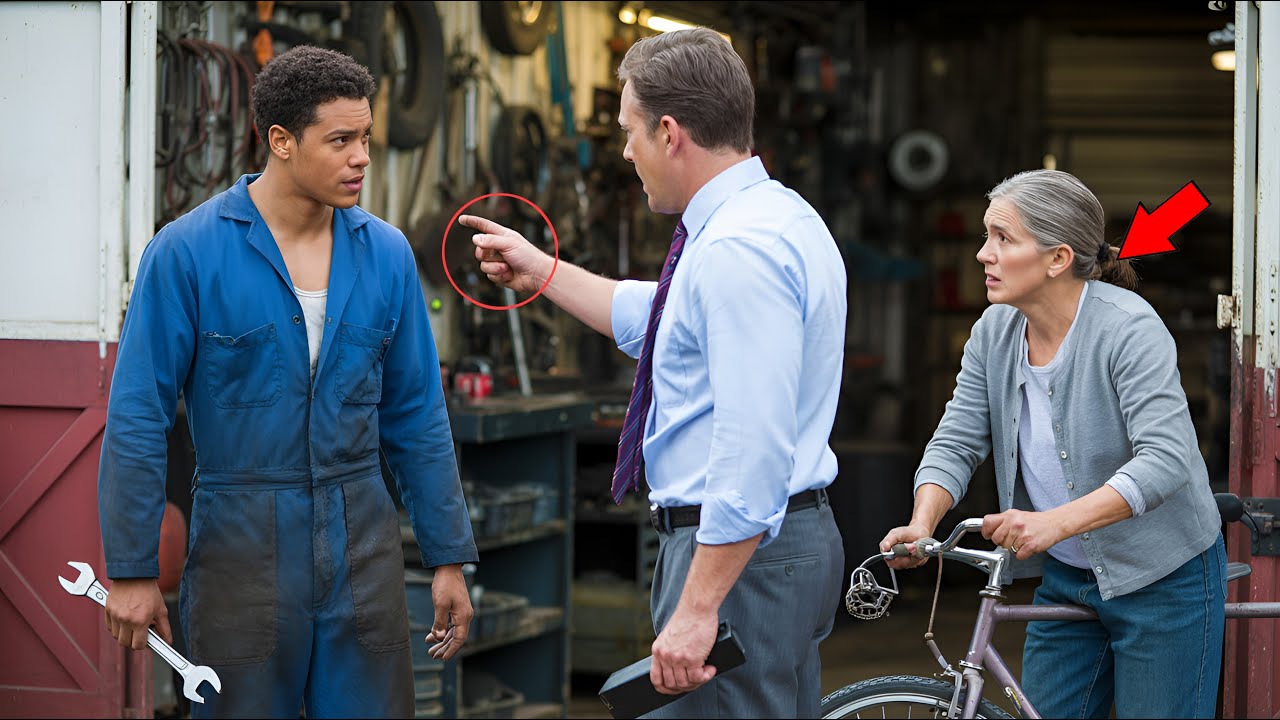
Noah Whitaker, 16 years old, stood beside a mop bucket near the janitor's closet. His jeans were dusty, his boots covered in dried mud, and the sleeves of his plaid shirt were rolled up past his elbows. His uncle, Roy Whitaker, had worked there as a night janitor for the past 5 years.
Noah had come to visit him after school, waiting for Royy's shift to end so they could ride home together in his pickup. Leonard narrowed his eyes and gestured toward the boy. Hey, farm boy.
Want to take a shot at it? Maybe you will get lucky. His voice dripped with sarcasm, but he knew the cameras were rolling.
The crowd chuckled. It was a performance, a joke for social media. Surely the uneducated kid would stumble, panic, and give everyone something to laugh about.
But Noah did not laugh. He looked up slowly, his blue eyes calm and focused. Then he stepped forward.
Noah walked past rows of engineers and managers who parted like waves in a sea of tension. Some chuckled under their breath. Others stared in silence, unsure if they should stop him or let the joke play out.
Leonard folded his arms, clearly amused, waiting for the boy to embarrass himself. Roy Whitaker, Noah's uncle, stepped forward quickly, his voice shaking. Sir, Noah is just here to visit.
He is not. Leonard raised a hand. Let the kid try.
It is just a dead machine, right? The crowd watched, every eye fixed on the boy in the flannel shirt. Noah placed his hand on the side of the steel panel, then traced his fingers along the control interface.
His touch was confident, not hesitant. He squinted at the diagnostic screen, then at the circuit grid beneath the glass panel. For a few seconds, no one breathed.
He crouched beside the massive base and looked at a junction of tangled wires and sensors. This was installed backward, he muttered. A few engineers leaned in, frowning.
Noah pulled a small screwdriver from his backpack. One of the executives started to protest, but Leonard motioned him to stay silent. The cameras were still rolling.
This was turning into better content than expected. With steady hands, Noah opened the base plate and exposed the machine's pulse regulator. The wires were a mess.
Some looped improperly. One even pinched between two metal brackets. Whoever installed this misread the polarity markers, he said.
His voice was soft but clear. That is why the power resets every time it tries to cycle. He unclipped two wires, reversed their ports, adjusted the sensor alignment, then pressed the reset panel.
For a moment, nothing happened. Then a low hum filled the room. The conveyor belt lit up.
Gears rotated smoothly. Lights on the interface flashed green one after another. The machine roared to life.
Gasps erupted from the crowd. Phones that were recording trembled in stunned hands. Leonard's jaw tightened.
He took a step forward, forcing a smile as the machine completed a full test cycle without a glitch. Beginner's luck, he said too loudly. But one of the senior engineers, a woman named Clara Donnelly, shook her head slowly.
No, she whispered. That was not luck. That was expertise.
She turned toward Noah. How did you know that? Noah stood, brushing dust from his jeans.
I helped my dad build something like this. Back on our farm. Leonard frowned.
And who exactly is your father? Noah looked him in the eye and said, "His name is Cole Whitaker. " Every face in the room went pale.
The name Cole Whitaker hit the room like a thunderclap. Leonard Graves confident smirk vanished instantly. Whispers started spreading and heads turned toward the back of the room where a tall, rugged man was walking through the entrance.
Cole Whitaker, a respected and legendary engineer, had built some of the most innovative machinery in the country. His reputation was unmatched and his expertise was worth millions. The secret everyone thought was buried deep had just walked right into the factory.
Noah's face remained calm, but inside his heart was pounding. This moment had been years in the making. Cole was not just the farmer everyone assumed him to be.
He was a brilliant engineer who had retired early to take care of the family farm after an accident. The same accident that forced Noah to learn every trick and trade to keep their land running smoothly. Noah's knowledge was a product of hard work, grit, and determination.
lessons taught not in classrooms but in the unforgiving fields and late nights in the workshop. Leonard stepped forward, his voice steady, but with an edge that betrayed his panic. Mr Whitaker, we did not realize your son was here.
This is quite the surprise. The crowd watched closely. This was no longer a joke.
This was a power shift. Leonard's position was threatened, and everyone sensed it. Cole smiled slightly, his eyes filled with pride and something deeper.
Hope. Noah is exactly where he belongs. He has inherited more than just my name.
He has inherited the passion and the skill. The room went silent. Even the hum of the machine seemed to pause in respect.
An assistant hurried over to Leonard, whispering something urgently in his ear. Leonard nodded curtly, but he could not hide the sweat forming on his brow. This was more than a mechanical failure fixed by a janitor's son.
This was a story that could change the company's future and shake the entire industry. Noah turned to the engineers and said, "I have been watching your work here. This machine was designed to be powerful, but the installation was careless.
It takes knowledge, respect, and attention to detail to make technology work, not just software commands. " His voice was clear, and every word carried weight. Clara Donnelly approached Noah with a smile.
you could teach all of us a thing or two. Her respect was genuine. She knew talent when she saw it.
Leonard looked around the room, realizing the tide had turned. What had started as a mocking challenge was now a lesson in humility for the CEO. Mr Whitaker, if you are willing, we would like you and Noah to join our team permanently.
We need people like you. Cole nodded slowly, glancing at his son. Noah's eyes sparkled with a new sense of purpose.
This was just the beginning. The janitor's son was no longer invisible. Noah took a deep breath as the room slowly began to accept his presence.
Not as a janitor's son, but as a skilled engineer with a vision. The moment was surreal, yet the weight of what lay ahead pressed firmly on his shoulders. He knew that this opportunity was not just for him, but for every hardworking person who had been overlooked simply because of their background.
Leonard Graves's cold gaze lingered, but it no longer held power. The narrative had changed, and the company was about to witness a transformation far beyond machines. Over the next few weeks, Noah and Cole worked side by side with the top engineers.
Every day, Noah's insights revealed flaws in the old designs and introduced ideas that combined practical experience with technical brilliance. He did not just fix the machines. He reinvented them, turning them into more efficient, durable, and smarter systems.
The factory buzzed with a new energy, hope, and innovation, replacing doubt and dismissal. The CEO watched cautiously, but found himself drawn to Noah's relentless dedication. It was clear this young man possessed more than just inherited knowledge.
He had the heart of a leader. Clara became an unexpected ally, often defending Noah in meetings and highlighting his breakthroughs to the board. Slowly, the old walls of prejudice began to crumble, replaced by respect and collaboration.
Word about Noah's talent spread beyond the factory walls. Industry leaders, journalists, and investors started paying attention. The company's stock began to climb, fueled by anticipation of revolutionary technology.
But for Noah, success was not about money or fame. It was about proving that no one should be judged by their background. Talent and determination could come from anywhere.
Then came the day when Leonard Graves was asked to step down. His resistance to change and dismissal of Noah's abilities made his position untenable. The board recognized the need for fresh leadership, someone who could bridge tradition and innovation.
Cole was offered a consultant role while Noah was invited to lead the new innovation team. The janitor's son had become a key player in shaping the future of the company. At a celebratory event, Noah looked out at the crowd, feeling a sense of accomplishment and responsibility.
He remembered the long nights on the farm, the challenges faced, and the doubts he had to silence within himself. This was not just a victory for him, but for every person who had ever been underestimated. His father, Cole, approached him with pride shining in his eyes.
"You have made more than machines work, son. You have made people believe in themselves. " Noah smiled, knowing this was only the beginning.
The real test would be sustaining this change and inspiring others to break their own barriers. Noah's story became a beacon of hope, proving that courage, knowledge, and heart could rewrite destiny. The factory was no longer just a place of work.
It was a symbol of transformation and possibility. The CEO's challenge had unleashed a force that no one could ignore. The janitor's son had not only fixed the impossible engine, he had fixed the future.
Noah stood on the factory floor, the same place where his journey had begun, under skeptical eyes and heavy doubt. Now the hum of machines was different, brighter, stronger, alive with purpose. He was no longer just a janitor's son or the farmer's boy trying to fix what seemed impossible.
He had become a leader, an innovator who shattered every glass ceiling with integrity and brilliance. The years had tested Noah in ways he never imagined. The whispers of doubt still echoed in some corners, but they were drowned out by the undeniable results of his work.
He had transformed not only the machines, but the entire company culture. Where once there was division and prejudice, now there was unity and respect. Noah's story was no longer about proving himself.
It was about inspiring others to believe in their potential regardless of where they came from. One chilly autumn morning, Noah received a call from the CEO, Leonard Graves. the same man who had once dismissed him so harshly.
But this time the tone was different, respectful, almost admiring. Leonard acknowledged the changes Noah had brought and invited him to lead a new initiative focused on sustainable technology that could revolutionize the industry once more. It was a full circle moment, a chance to build something that would outlast them all.
As Noah accepted the challenge, he thought of his father, Cole, who had worked tirelessly on the farm, teaching him the value of hard work and humility. The lessons from his childhood were his true foundation, the roots from which his success grew. Noah realized that his greatest strength was not just his knowledge, but his resilience and heart.
He carried the hopes of many who had been overlooked, a beacon for those still fighting to be seen. At a companywide meeting, Noah shared his vision, his voice steady and filled with passion. He spoke about innovation grounded in community, technology serving people, and the power of believing in one's own worth.
The room was silent, hanging on every word. This was more than a speech. It was a call to action, a movement that everyone wanted to be part of.
Outside the factory, the world began to notice. Stories of Noah's rise inspired countless others to pursue their dreams, no matter the obstacles. Media outlets featured his journey not as a tale of luck, but as a testament to perseverance and character.
Noah became a symbol of hope, a reminder that the greatest changes come from the most unexpected places. The CEO's dare to a farmer's son had unleashed a force far beyond fixing machines. It had sparked a revolution in mindset, proving that greatness is not inherited, but earned.
Noah's legacy was not just in the engines he rebuilt, but in the lives he transformed. As the sun set over the factory, Noah stood tall, ready for the future. The impossible was no longer a barrier, but a challenge waiting to be met.
With every breath, he carried the promise of change, the strength of his past, and the unshakable belief that anyone from anywhere could rewrite their story. The journey was far from over.