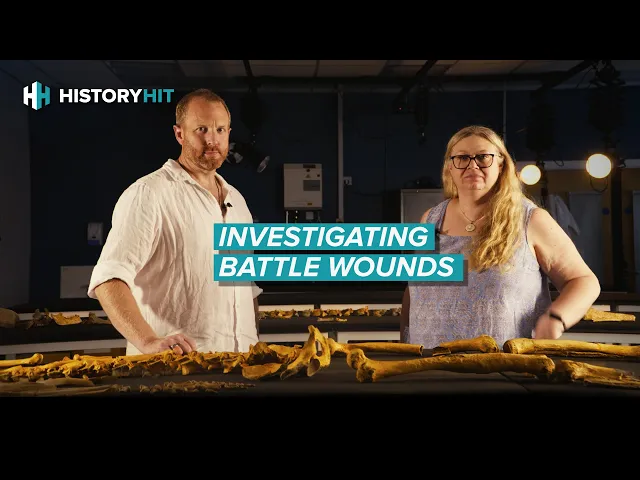
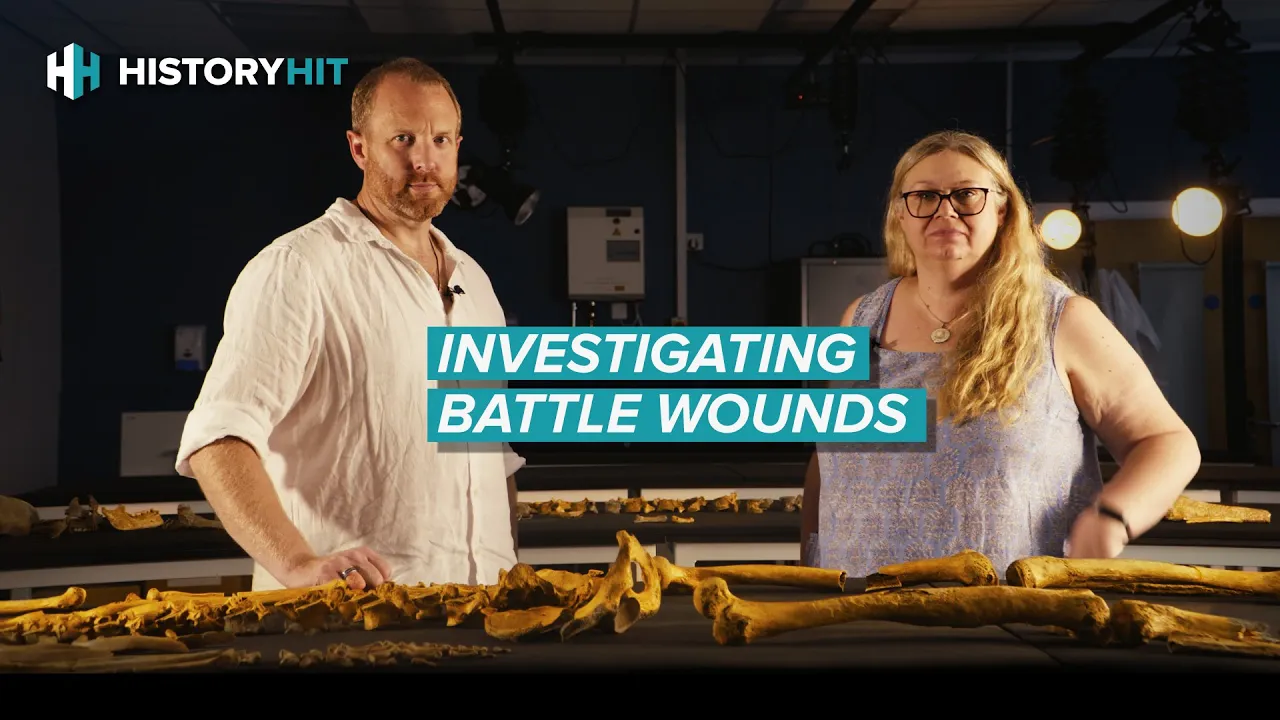
The dark ages, a period of collapse, [music] chaos, and violence, or was it? New discoveries are helping to challenge that idea. After centuries buried beneath the soil, the graves of Anglo-Saxons are unlocking the secrets [music] of these elusive people, revealing a civilization far more complex than history often remembers. I'm medieval historian Matt Lewis and I'll be joining osteoarchchaeologist Dr. Joe Buckbury at the University of Bradford to investigate the remains of three individuals who lived and died in Anglo-Saxon [music] England and who in death may help reveal the truth about life in early medieval Britain. Team
Cole Case, don't go anywhere. Stick with us right to the end because we've got a genuinely extraordinary update on our very first investigation, including New revelations about the mysterious warrior who may just have been felled by a trebushe. Trust me, you're going to want to hear this. So Joe, what do we have for our first skeleton today? >> So this is an early medieval individual from Eckles in Kent and a cemetery was on top of a Romano British villa, but it dates to the early medieval period. >> Lodged in time between the fall of Rome
and the coming of the Normans lies a Forgotten age, the early medieval period, often referred to as the dark ages. It's here in a land populated by angles, Saxons, Judes, Celtic [music] Britons, and Viking settlers that the foundations of modern Britain were first laid. So, when we're talking early medieval, we're going to go with Rome evacuates the British Isles in about 410. You've got the arrivals of the Anglos, Saxons, and the Judes over the fifth, sixth centuries. The Vikings will Arrive towards the end of the 8th century, and then we've got 1066 with the Normans
coming. So we've got that kind of span. >> Yeah. The sort of like 4 410 450 through to about 1066. Well, this individual is kind of in the middle of that. So more specifically, we're looking between the 7th and the 10th century AD. So we're looking at the period after the conversion to Christianity or just as that conversion has taken place. >> When we think about who this might be, what I very much remember from last time is that we go straight to the pelvis if we're trying to this is a male or a female.
Yeah. >> And if I remember what you taught me rightly last time, it's this bone here and having that kind of UV shape suggest this is a male. >> Yep. Absolutely. I mean, ideally, we'd want the pubic bone, which would be sitting in here, but as you can see, This individual is not very complete. Doesn't have any [music] armbones, doesn't have lower legs and feet, and quite a lot of damage in the pelvis. So, we're missing one of the key sex indicators, which is frustrating. [music] And that's because there was a lot of plow damage
at this cemetery. A lot of individuals are quite complete. This is one of the more complete people in a lot of ways. But yes, so absolutely in this case, because I'm missing the Bone at the front, I'd be going straight in there. And I would agree with you on male. >> Excellent. Pass the first test. >> Pass the first test. >> How might we try to establish what kind of age this person was when they died? >> Well, again, if I had it, I'd be looking at pubic bone, but I can look at the appearance
of this joint in here, which is the sacuriliac joint. that this is the joint between your pelvis and your Sacrum at the back of your body. I can also look at this ridge on here and I can see that this has fused. So this edge here is actually connected to the bone which tells me a little bit older. And I can also look at the wear on the teeth. And this is basically telling me when I look at everything, this is a younger adult male. So probably somewhere like 20 to 30 years old. Running a
YouTube channel like ours means managing a lot of moving parts and Ongoing conversations. But whether it's a work meeting or an ideation session, it can be tricky to note down absolutely everything. The Plaude Note is a credit cards sized AI [music] assistant designed to solve this. And it really is credit card size. It even comes with a magnetic case that you can magnetically attach to the back of your phone. and you'd forget it's even there. With just the press of a button, you can capture high quality Audio of whatever conversation you're having. And you can
add photos and jot down your own ideas, too. The battery will last for 30 hours continuous audio capture, 60 days standby, and it has 64 GB of storage capacity. And then the Plaude app transforms it all into structured summaries with 3,000 templates with clear to-do lists and key insights. Another great feature is Ask Plaude. It can combine the info it's captured even From the past to answer [music] any question like what were the most popular ideas in the last video brainstorm. It also drafts emails and to-do lists helping me see meetings from a clearer, more
complete perspective. And you might be wondering, is my data really secure? Especially for those in sensitive or confidential professions. Claude keeps your information protected with top global compliance standards like SOC2, GDPR, EN18031, And HIPAA. At the same time, it helps us move toward a more paperless workflow. Everything is stored and organized digitally, [music] which is both efficient and environmentally friendly. So, if you want to make the most out of every meeting, Claude would be right for you. Click the link in the description to learn more. >> And is there enough of his remains here to
work out what might have happened to Him? What caused his death? >> Absolutely. This is another one of those um trauma cases. So, we have a lot of sharp force trauma in this case. So, things that have come from a weapon with a blade of a sharp edge to it. And that really plays into our notion of that early Anglo-Saxon period in which we think everything is quite lawless. Everybody is running around with a sword hitting everybody else desperately trying to get land. And here is someone Who has died in exactly that way. >> Yeah.
I mean, you've got a period with multiple battles and skirmishes taking place. The vast majority of people did not die in a battle. And certainly this cemetery, it's not a a a cemetery for a battle. It does have a few individuals with the trauma, but it's a community cemetery with a broad spectrum of people, children, women, people who died in their old age, various diseases, but We have a few with injuries like this, including this particular person. >> So, this is someone who even if he died in battle, he was taken probably back home. >>
Yeah. >> And buried with his community in his community cemetery. >> What kind of injuries can you show us on [music] here that that demonstrate those battle wounds? Well, given that [music] we're starting Down here, I'm going to start actually with the pelvis. And hopefully what you can [music] see, these two pieces do connect together, but it's a little bit snug. But you've actually got this very straight edge just across here. [music] And this edge in here is really polished. Um, so this is a blade injury that's coming [music] through the pelvis >> that's coming
and >> Yeah. right up top of the hip just [music] below the waist and there is Another one on this side and you can see [music] this sort of more shallow cut >> just in this point here. So that one's looking more in the butt region. >> So that's two different >> two different wounds >> in the pelvis. >> So this is someone who has taken several wounds before he's >> Absolutely. So we've also got injuries to [music] these vertebrae in here. We're looking in the lumbar spine, so The lower back. And we've got another
cut injury in here. The surface isn't as nice as I'd like it to be. There's a bit of postmortem damage, but it's absolutely flat. You can see just how straight [music] it is if you get the angle right. There is a similar appearance just in here, and it's exposing the sort of tbecular bone on the inside. They've got lots of small struts of bone, so it's Harder to see the cut marks, but that is again perfectly straight. And then this one in here, another injury coming from a different direction. So there are few >> potentially
more than one attacker at this point as well. >> Certainly more than one injury, potentially more than one attacker. It's hard to say whether or not it's one person having a bit of a frenzy or multiple people. >> Is there any way of telling from those Injuries? Is this someone attacking from behind? These injuries um they're happening on the back of the vertebrae. So those are from behind and certainly this one is from behind. Harder to tell with this one, but my gut feeling is the one's coming from the front just because this edge is
so much more sharp, which tends to be the where the first point of impact is, but we have a lot of postmortem damage here. So it's kind of difficult to be certain about that Particular injury. >> So this is beginning to feel like someone who was either surrounded or perhaps was trying to escape. [music] >> Yes. after an initial injury perhaps and was chased. >> Absolutely. And it's that kind of frenzied fighting. You don't stand facing each other and very noly fight just facing each other. It's it's a much more frenetic type [music] of experience.
>> But a terrifying experience for a young man in his 20ies. He sustained a battle injury. He's perhaps trying to get away to save his own life. >> Yes. But he's being pursued and hacked [music] from behind until he's he's brought down. >> And [music] the injuries become even more brutal to a certain extent when we look at his skull. But before we get there though, I just want to show you a few other ones. It's time in the ribs. And I think I was particularly interested in this rib here. So this fragment again, you've
got a really sharp cut right the way across um that particular rib. It's very very clean on this edge. It's actually broken away. You can actually see there's a fracture running up the length of the rib with this roughened edge. This kind of tells me that the direction is coming from here and it's separating and crumpling in Here. So again, this is coming from the outside of the rib cage because it's this tiny little fragment. It's really hard to say if it's at the back. or the or the or the side or the middle. >>
Can you tell the difference between something that happened with a sword while he was alive and something that's just a bro bone being broken in the ground? >> Great question. So, actually this piece directly next to it, you can see these Edges. Well, first of all, they're very pale. That tells me that that area bone hasn't been in touch with the soil for as long. So, it's kind of when it's broken, it's paler in color, but it's very irregular and the texture is all over the place. So, it's not that smooth straight cut that we
see with with this one here, but it's also different to the appearance in here cuz this is also permortm, but it isn't a cut. But you've got a a sort of regular texture To the bone surface in here when you look at it, particularly under magnification, whereas this is really jagged and irregular. >> I think even without magnification, you put them next to each other, you can really see the difference. So, if I just look over here, um, another very similar sort of thing. In this case, you can see the cut on here, but postmortem,
you know, perhaps this is one that went partway into the rib And then the weapon was pulled out and it didn't fully fracture. And then in the burial environment, because you've got the weight of the soil on top, that's kind of snapped off. And so, we've got a mixture of something permort around the time of death. And a really clear contrast on the same piece of bone there. >> It it just reinforces what we've just looked at this one over here. >> Perhaps that cuts weakened it so that in The grave it's >> Yeah, absolutely.
In any of this kind of trauma, it's weakening the bone, increases the likelihood of further fragmentation, which is why we have to look really carefully at all of the broken surfaces and not just assume something happened in the barrel environment. >> Yeah, I mean, I'm finding myself feeling quite sorry for this young man. There's several injuries there. Some from behind, painful broken ribs as well, but you mentioned there's worse to his head. >> Yeah, the injuries to the cranium are really quite traumatic. This cranium was quite fragmented in the barrel environment. Not long after excavation,
pieces were stuck back together with adhesive, but it's not not um survived as well as we would like. So, in some cases, pieces of have since come away. We'll start off looking at this this piece in here. And this has been reconstructed [music] to a certain extent following the excavation. It was quite highly fragmented. And what we can see first off is this kind of glancing blow on the top of the cranium. So your cranial bones come in three layers. We've got the inner table which is cortical bone. It's quite dense. We've then got a
spongy layer in the middle which is called the deployic space and Then we've got the cortical bone on the outside or the outer table. So this has actually cut through the outer table and exposed that deployic space. So these are the flowy that spongy open material. So that's kind of an injury that has basically taken off that layer and it's very very smooth at this side in here. This is actually quite polished. >> But when you look up here, can you see that's a little bit more textured? >> Yeah. So again that tells me a
little Bit about the orientation that it's kind of coming in this direction and then that's the end of the blow where that flake has come away. >> That's again from behind >> we have a similar injury just in here and again the roughened edge is over here. So the blade is coming in in that particular direction. And then to the back of the cranium we've got these three really dramatic sort of hacks really is perhaps the best Way to describe it. They're basically sectioning the back of the head. So that's really quite frenzy, really, really
brutal. And in this case, it looks like it did go all the way through the bone. We got little bits of of damage on the inside. You can actually see the three layers of bone >> in that edge, but it's coming all the way through that side. So that is something that's going to then be impacting the brain as well as as the um Bones themselves. So really, really quite dramatic just on that piece. There are other smaller injuries to the base of the cranium, but also to the mandible. So, if we look in here,
we've got a injury just in here. This one doesn't look as sharp. It looks to me like there's been a force applied in here and that could have come from a blade that hasn't cut in or it could have come from some other weapon. But this is a permortm fracture. We can Tell that because of the texture. So that's essentially breaking the bottom of his jaw. >> Yeah. So and at the front just just towards the front of of where your ear is >> and perhaps the different weapon from the the slicing of a sword
or crushing weapon possibly >> potentially. Or it could be that a different part of the sword is being used. You know, people don't always use The cutting edge. So just because a weapon is a bladed weapon doesn't mean it will only cause sharp force trauma. It could also cause blunt force trauma. And also you don't know if there's anything cushioning them. So, you know, if they had some kind of a helmet and then this blow happened, then perhaps it's been, you know, lost or these blows are much more significant at the back. I think the
ones on top suggest at this point there is nothing protecting the Top of the head up there. We need to do a lot more experimental work to figure out the impact of armor and protection against this kind of injury. >> I guess what you can't tell is what he was wearing at the time. That could be a sword that didn't quite get in very far, but it could be someone using the pommel of a sword to smack him around the jaw >> to to to knock him unconscious or something like that or the the haft
of an axe or something like that. >> Yep. >> We can tell that he died from these injuries. There's no evidence of healing and the quantity of them, the orientation of them really, it's not consistent with somebody surviving. This is really quite brutal. And given that it's not a complete skeleton, do you have a sense of how many injuries you've been able to identify on on what we have? >> We've noted um 30 different injuries. And actually the one that most definitely would have been fatal had this person survived all the others is actually in
the neck. These three fragments here are actually the first vertebrae of the neck. So the first cervical vertebrae. And in this case here, this has been bisected and separated through. And that is the potential um a decapitation blow >> if he's not already >> if he's not already dead. This this would have actually yeah absolutely finished that. >> I mean it feels like a really horrific way to go that is really reinforcing that idea of this early medieval period of England being a bit lawless and wild. But I'm also struck by the fact that you
mentioned this this person was taken back to be buried in a community graveyard. He was taken home. >> Yeah, absolutely. So I've actually got a A diagram of the cemetery. And so the these lines in here, these are the rooms of the Roman villa that predate um the cemetery. And you can see that we have this cemetery in here. What's really interesting is you can see that all of these graves are orientated approximately west typically with the head at the west end of the grave. This is very characteristic of the sort of middle late Anglo-Saxon
cemetery type. >> So we're looking at Christian burials Head to the west so that when you sit up on the day of judgment you're facing east, you're facing Jerusalem. >> Absolutely. And what's really interesting for this cemetery is there actually three layers of burials and the earliest layer there's about 24 individuals I think it was had some form of a graveg good and there the kind of thing that we see around about the time of documented conversion of Anglo-Saxons to Christianity. So that gives us an Early date of the 7th century for this cemetery. And
then if you move to the top layers we're looking at more like the 10th century. So, so about a 300 year use for the site. And our individual, he's buried just out here. So, he's a little bit away from all of the other individuals. There's two two people in this little um ditch around here. That could have been a deliberate placement that they're still within the community cemetery. There's a bit of Otherness about this individual. So, they're separate slightly, but we need to bear in mind there was an awful lot of plow damage. So whether
or not we've lost anything is hard to say cuz because they're in this ditch perhaps they're a little bit deeper. Unfortunately the cemetery records are not good enough for us to be able to establish that. >> And I find it quite interesting that there is a sense of continuity about this that you've got this old Roman Villa there and that after the Romans have gone people are using that site still they're living nearby enough that their cemetery is adjacent to that old Roman villa. There is a sense that people are are staying in that place.
you know, there are a few hundred years between the abandonment of that villa and the reuse of it as a cemetery. So, it's not so much continuity through that period, but reuse of a site. And we see this quite a lot um throughout the early Medieval period that people are using [music] earlier monuments, earlier buildings as a focal point for a cemetery. So we see the the reuse of of barrerows dating to the Bronze Age um or the Neolithic or the Iron Age for cemeteries of this period elsewhere in the country, but [music] also Romano
British places like this. >> Yeah. Incredible. >> Well, that was so interesting. I'm really struck by how easy it might be to Forget that these skeletons were once real people. That's a young man in his 20ies. I've got sons that age who's received 30 battle wounds, some of them from behind. He's either surrounded or he's being chased and attacked from behind. Either way, this is someone who died scared. It reinforces that idea of this Anglo-Saxon period as brutal, as full of fights and battles and a need to survive. But against that, we can place the
fact that he's taken home to be Buried back to his community. that there were people who loved and cared for this young man. So Joe, this is our second skeleton for today. Where on our early medieval slider can we place this one? >> This cemetery, which is from Northampton shed, dates to the 10th to 11th century. So right towards the end of that sort of timeline that we we talked about earlier. And given that we've met at the pelvis, I'm going to start here and and Again, look at that U shape that I can see
in there and say that I would suggest this would be a male. >> Absolutely. And what's really great here is that we've also got the pubic bone, which is this one here. And so that allows us to assess the sex, looking at the angle, and also the fact that we don't have a ridge running up that side. >> And looking at the tops of these bones, as we did on the previous one, they look fused to me. So maybe a similar sort of Age, an adult. >> U definitely an adult. Although I would say the
fusion is only just finishing. So there's a slight depression running around here. And we have these much more recently fused with a bit of a gap. >> Yeah. Just see those there. So do we have any sense of what might have befallen this? This is another person who's passed away probably in their 20ies. >> So this case we're looking at somebody who had leprosy. And the first place to look for that evidence is on the upper jaw. So if we look at this area in here, we've got the the porous bone, new bone formation, we've
got rounding of the nasal margins and then loss of the area just in here which is called the anterior nasal spine. So we're talking about the area kind of at the bottom of the nose and Around the top of the lip. Is this something that would have been clearly visible to people who met this person >> potentially? So what would happen with this sort of sceal change? You may see a sort of a dipping of the nose, a sort of a a less prominent nose. And associated with this, we would have sort of nasal stuffiness,
perhaps a a horse voice, but also skin lesions. So early on you get patches of paler skin, but later on and and certainly when you're seeing this Kind of change, you like to see nodules of hardened skin on the face which are really quite distinctive. >> So if this has given us an indicator of leprosy, are there other places that you would look on a skeleton to try to to confirm that? >> Yep. So the next place to look for this person would be the hands. What we have in this bone here are the little
um depressions um caused by the pressure of those hands are sort of Flexing in. >> Yeah, you can see that little dip worn in there and that's just from a prolonged period of having your hands stuck like that and the bones rubbing together. >> Yeah, absolutely. And you can see there's a slightly more obvious one >> on this one as well. So this suggests this person had a claw hand deformity >> which presumably makes it harder for Them to to function as a member of society to work for example. >> They probably did get around
this. People are very very adaptable and so they may have been using their hands in a different way but there are some things they may not have been able to do certainly in the same way as you or I might do it. Um but some things may have been a little bit more challenging and difficult. >> And is there any other indicator on the Skeleton of leprosy? >> The next place we'd look for in a case of leprosy is the feet. And that's because the mcoacterium lepery, the pathogen that causes leprosy, likes cold areas of
the body. >> So we've gone for extremities. We've gone nose, fingers, toes. >> We see features in the feet um that this person doesn't have. So we're not seeing thinning of the um toe bones. We're not seeing loss of the heads of the Metatarscils. They've been lost postmortem, but there doesn't seem to be anything associated with that there. But what we do have is new bone formation. And you can see an area just in here where it's porous. >> Oh yeah. So it's a different texture and a different color. >> Yeah, absolutely. And it you
can kind of see the difference. >> And what do you think would be causing new bone growth on a foot there? If you Injure that foot and you don't know that you have an injury because you can't feel it, you might get ulceration and you [music] might get infections coming in through that open skin. And that infection can then track its way up the body. And so this person, we've also got quite a lot of bone formation on this um heelbone, the calccanous, but also into the um lower limb. So particularly on this fibula, you
can see large areas of bone formation right the Way up and there's very little of the original bone surface present just at [music] the top but down here it's very very altered in its shape. >> So that suggests a really serious infection has got into this person's left leg and presumably is causing them discomfort pain making walking quite difficult. Yeah, I mean the walking quite difficult may come from nervous loss. So things like the loss of propriception and due to the nerve Damage in the feet. This is associated with swelling of the leg. So edema.
To what extent it causes pain will depend very much on to what extent the nerves of the leg have been altered. But the likelihood it would have been painful as well. And so this um so I'd call it inflammation rather than infection. the likelihood in leprosy that this is an infection. If we just saw this on its own, we'd be talking about an Inflammation. But it looks in this case, it's actually tracked up and is also affecting that feur. >> And that is that is strikingly different. There's something about that bone even I can see.
>> Yeah. So, if I pick that one up there, you can see it's massively increased in size um due to lots of new bone formation. And we've got a little area just in here where we got some postmortem damage, which is unfortunate In terms of bone preservation, but it allows us to see multiple layers of bone forming one on top of the other on the outside of this femur. >> So, it's almost like when if you go to the beach and you see those kind of slate cliffs where you can clearly see the lines in
them, you've almost got that effect there of bone growing on top of bone on top of bone where it's healing. >> Yeah. And in this case, um because it is So enlarged, there's a chance that the infection is also impacting the bone cortex itself. And so that could become increased in size as well, increasing the the breadth of this bone. >> So that swelling from the inside of the bone pushing it all out, which sounds really painful, >> nasty, nasty stuff. >> Leprosy isn't particularly contagious. Do we have any kind of idea of how this
person may have contracted leprosy? So That's really interesting because we did a study jointly with um Manchester and from that we were able to identify the specific subtype of leprosy that caused the disease of this person and that's subtype 3K and today this is found more in East Asia. Archaeologically it's been identified in Hungary, it's been identified in Turkey and also a little bit later on in the in the later medieval period in Denmark. So that's suggesting that this particular pathogen Has come from the east rather than being one that's seen elsewhere in Britain. >>
So he may have contracted it or contracted it from someone who's been to those kinds of places. But either way, that really speaks to the connectivity of the early medieval world that a disease that is present mostly in East Asia is finding its way to Northamptonshire in England. And you've got kind of all of these roots that that knit that world together. There's the Silk Road trade routes, but you've got the Vikings who are coming over to raid and get lots of easy gold, but they're also collecting slaves who they are moving to the east
as well along that line. And with early Christians, you've got pilgrims heading off to the Holy Land. And that's aside from people who are just doing business. There's lots of reasons that we could have this individual traveling so far east that he's picked up a form of leprosy that You wouldn't normally see in Britain. >> Yeah. And [music] you know, we need to bear in mind that we may have other cases of this strain in Britain, but they've not been identified at this point from the data that we do have. But certainly, it's looking more
likely that this this pathogen came from the east and perhaps this person was the one who did the traveling or they knew somebody else who carried that that pathogen back with them and they caught it from them. But again, like our first skeleton, it's quite striking that for all of the stigma that we might think is associated with leprosy, this is someone that you said was buried in their community still. >> Yeah. And I've actually got a grave plan. So this [music] is a plan of the RN cemetery. And you can see we've got a
church smack bang in the middle. And then we have all of these burials. They're west aligned. They're lying on their backs extended [music] very much in the Christian fashion. And this individual was buried just down here. So he's within this community cemetery, but he's about as far away from the church as you could get within that. So it's kind of a little bit more marginal. And what's really noticeable to me is um that there are other individuals who are buried in that location who also have some form of Physical impairment. Um and that's these three
here. This is still within the bounds of the churchyard. He's buried on hallowed ground. He's still part of the community. It perhaps speaks to someone who was less able to contribute to the community. He perhaps wasn't as wealthy or politically important as some of the people who are closer to the church or making their way into the church. But despite that inability to contribute Quite so much, they are still y members of the community who are buried on hallowed ground of that community. That second individual, much like the first, is another young man, someone who
possibly didn't make it out of his 20ies. The big difference, I guess, is in the first individual's case, he suffered a lot of violence and no doubt fear all in a short space of time on one day. This is someone who has contracted Leprosy and suffered, possibly struggled for much of his short life, not being able to be the active member of his community that he might have wished he could be. We can't be certain what caused this young man's death, but we can be sure that he suffered and struggled during his lifetime. And like
our first case, I'm struck that whatever happened to him in life and however he met his end, he was ultimately embraced by the community around him. He's buried On hallowed ground with the people that he'd lived with. We quite often think of the early medieval period as as brutal where people are disconnected and it's every man for himself. But here is a community who have shown in death care and [music] respect to one of their own. Perhaps despite his inability to contribute as they and he might have liked. So Joe, while I try and work
out whether this would be a male or a female Skeleton from the pelvis, where are we placing this on our early medieval scale of dates? This cemetery is um walking to mold in East Yorkshire and radiocarbon dates suggest it's [music] from the 7th century to the 11th century. So firmly in the later Anglo-Saxon period but in use for a quite long period of time. >> And I'm going for this this curve in the pelvis here. And I'm seeing that same U shape that we've seen before that suggests that this is a male. >> Absolutely. So
if we look at this one, you can see we've got a a narrow angle underneath here and it's not concave at all. There isn't a ridge and it's nice and flat. So this is again >> if this was a female, you'd expect this angle to be greater. >> Yeah, it would be a much greater angle but also concave. So cutting away a little bit and you'd expect to see a ridge >> coming up the front in this area as Well. >> And in terms of age, I'm looking at the top of these bones and they
look fused to me, which suggests they're adults. >> Looking fused. If we actually look at the joint surface in here, which is the pubic symphysis, this gives me an age range of 21 to 46, which is quite broad. But if I bring in the sacrum, where we have this slight fusion, I can narrow that down to lower than 32. So, we've got an overall age range of 21 to 32. >> It's fascinating just detective work moving through the bones to help you weedle your way down to a narrower date than you can start off. Yeah,
I mean, you sometimes start off with something that's impossibly wide, but by looking at multiple methods and seeing where they overlap, you end up with something that's better for that individual, cuz we all age at different rates. >> There's three things that I've noticed about this skeleton, And I'm going to probably leave the most obvious till last. The first is that on the legs, there is this weird texture [music] to the bones. Do you know what's causing this? >> Yeah. So, this is classic postmortem damage. And in this case, if we look in really really
closely, you'll see this kind of almost like little lines etched into the surface of the bone. And that's caused by roots. And so you often get um acids secreted by roots that then etch Their way into the bone. So the very outer surface of a lot of these bones have been basically eaten away by that process. And in this case, these bones were really really fryable when they're excavated. So they actually use a consolidant at the point of excavation to keep them as intact as possible. So all of these bones or almost all of these
bones have been coated in a consolidant. I'm assuming PVA glue, but it could have been something else. Um, And that means that in places we've also got little bits of soil still attached to the bones as well. >> Would you say that that's kind of not ideal, but it's also the only way that maybe could get it out the ground. >> Yeah, absolutely. I mean, you know, they've done really, really well to get as much of the skeleton out as, you know, complete as it is given the obvious fryability of the bones. And so you
move down and look at the feet and They're really crumbly and really incomplete and you know you you're losing almost all of the surface on this tibia just in here >> cuz that almost looks like tree bark, doesn't it? >> Yeah, it's it's a completely different texture to normal bone, but it's not pathology. >> You can tell so much just from looking at the surface of it. So, I guess the second thing that I'm noticing fairly Obviously about this individual is that the torso is kind of all clumped together as well. Others that we've seen
are laid out and we can see the vertebrae spaced out nicely, but this is very much a clump of stuck together bone. Is there a reason it's like that? >> Yeah, and it's to do with this fragility of the skeleton in the barren environment. So in this case they took the decision to block lift this but by putting essentially scrunched up Newspaper underneath to support it. And so you can still see we've got areas of soil in between the vertebrae where the intervertebral discs would have been. You can still see the ribs in partial articulation
with the vertebrae. Um and you've got this layer of newspaper um that it's sitting on and then the sheet underneath [clears throat] that. And so I already know when this skeleton was excavated. Um, but if I want to do some more investigation work, we could look At that newspaper and it would have dated from somewhere like 1967 to 1969. >> Yeah. And is it more or less helpful for you to have it like this? Because you say it's partly together. >> Decidedly less helpful because I can't pick up each individual bones. So, I'm completely unable
to say if there's anything happening on the back of those vertebrae or in between the the soil. And because they've used the consolidant, it would actually Potentially cause more damage to remove that now. So, it's better to leave as it is. >> So, you've got no real way of looking for wounds or disease or anything like that in those bones. >> Not as much as I would like to. I mean, I've looked at it in as much detail as I can with what I've got in front of me, but there's a small chance there's something
going on here that isn't as obvious because of the way it's been Excavated. >> And I guess, you know, there's an elephant in the room here. There is the last obvious thing that I've noticed about this individual and that's that it's missing a head. There is no skull or anything. Is that simply an incomplete skeleton? >> That's what we normally think. You see so much intercutting of burials or later features or plow damage that disturb parts of skeletons and you know we've Seen that in other individuals before but in this case this is something that
happened around the time of death for this individual. So if we look at this vertebrae here, this is the first thoracic vertebrae. So we're looking sort of at the base of the neck and we've actually got a cut mark just through the top of this vertebral body exposing the trabacular bone on the inside. Um and we have another one um that we can see just in here slightly Higher up again exposing the trabacular bone of the process the transverse process which is the sticky out bit on either side of that vertebra. >> So where you
can see that smooth bit there and then it exposes the the spongy looking bit that's where something has cut across. >> This smooth bit here is the original bone surface. So, so the blades kind of gone between the vertebral discs and then hit at this point here. And if I Get the orientation right, what you should be able to see just in here is where that blade stopped. >> Oh, yeah. That little notch. Yeah. >> This injury would have decapitated this individual. It's unusual in that it's coming from the front. And the vast majority of
decapitations that we see are from behind. But in this case, that little nick in there really clearly tells us that this one's come from the Front. So, is this a case where there's been some attempt to bloodlet an individual, slit the throat of the individual, or is it deliberately a decapitation? And is this something that happened when the person was alive? Were they perhaps um killed in a different manner and then decapitated as a sort of mark of othering this individual in death? But certainly if they were alive, this would have ended that. And >>
I guess throughout all of those options, However that happened, whatever order it might have happened in, what we're probably looking at here is someone who was executed. >> Yep. This is very much characteristic of an execution blow. Unlike other individuals with trauma throughout the body with injuries to the neck, there isn't any evidence of any other injury elsewhere on this individual. It's just in the neck. And that's true for other individuals at this site. So there are Two skeletons, this one and another one, and then four heads that have decapitation blows, two of them from
the front and four of them from the from behind. I think interesting when we think about this period of early medieval history in Britain and again we're tending to think of it as quite a lawless period in which the the country is fractured but here is what is quite possibly a demonstration of law in action. We don't know what this person Might have done but he seems to have been executed and the suggestion would be for a crime I guess. >> Yeah. And if you go back and look at the documentary evidence for the later
Anglo-Saxon period, you start to see the development of law codes um from different kings. And so we s start picking up the different modes of execution and also the kind of things where somebody could be executed. And in This case, decapitation is one of the ones that is mentioned. Hanging is the other one that's most common. And then you may see things like stoning or drowning, although they seem to be more associated with crimes typically committed by women, which is really interesting. >> It's so frustrating, I guess, that we can't get any closer to to
what he might have done, but but nevertheless, he's being killed probably in a judicial Fashion. What do we know about the place where he's buried then? Is he buried on holy ground as part of the community? So this is the cemetery plan for Wington World. And this does not look like a churchyard at all. >> And and the bodies look very higgledy piggledy. >> They are they're not orientated east west predominantly. They're in all different orientations. We have some who are supine and Extended. So lying on their back, but we also have some that appear
to be lying on their side. Um again, this one with the the um legs um crouched up. Um, we've got a a quadruple burial here with four people in it, which again is [music] less common. And it's actually centered around this ditch here, which is actually the ditch from a Bronze Age barrerow. So, this was the original Bronze Age burial that predates this Mound. So, Walington Wald um as a barrerow was quite prominent in the landscape. It's a raised up area of ground and it's also located on the um boundaries of 200s. So 100 is
the administrative district as I'm [music] sure you already know, but it's also close to a routeway. So this is somewhere that was visible to people moving across the landscape, but as far distant from the community cemetery in the village [music] as you could Possibly get. >> All of that is is just so interesting when we think about the potential that this was a criminal because you're looking at something that suggests very little care in the burials, very little concern for their fate as Christians. >> Absolutely. And it's it's really interesting because you know we have
documentary evidence that from the sort of 10th century we actually get law codes saying that criminals cannot be Buried in consecrated ground and that coincides with roughly when cemeteries are getting consecrated as opposed to just being a Christian cemetery. But these kind of cemeteries are in use from the 7th century. So it's almost like the practice was already there and they wrote the law code later. >> And we add to that that this is from an earlier barrerow. So it's almost associating them with paganism rather than Christianity. And add to that again that this is
on a routeway and on the border of 200s and they're being pushed to the edge of communities but also put somewhere that people will pass them almost as if this is meant to be a warning. >> Yeah. And I think it was. So the cemetery was in use for for quite a long period of time but we have relatively few burials. they're just spanning, you know, several hundred years, [music] which to me suggests that this is Something that was actually a really effective deterrent. It wasn't something that was used particularly commonly in this community, um,
certainly for this particular cemetery, but it was something that was highly visible. And what's interesting is if you look at the cemetery, you can see these dots scattered around and these are all skulls. So, the paler ones um have actually got mandibles attached to them and several of those also have vertebrae Attached to them. So, we know that they were deposited as head with flesh holding all that body parts together. The black ones don't have any associated bone. It's just the cranium, the top of the skull. That suggests that when they were deposited in this
final resting place, there was no soft tissue holding those parts together. So, potentially a different practice again in that these heads have been removed from a body, but buried not with necessarily with the Bodies, but straight away, whereas these may have been displayed in some way. >> That's certainly one of the possibilities. And um we have documentary evidence of heads being placed on stakes. There is no evidence of head stakes being used um at this cemetery. The bottom of the crania are all perfect. We do also have a slight potential other reason which is postmortm
disturbance. And at Walington Wald it's not other archaeology. It's Badges. When it was excavated it was noted this was the location of a badger set and there are actually claw marks on the back of a skull. can't be 100% certain that that's how they ended up separate, but I think it's actually quite likely. >> Is there any hope of of finding a head that might have belonged to this body? >> It's really difficult. And so the first one is, as you've seen, the bone preservation is not great. So my gut Feeling is that DNA preservation
in this sort of area of the postranial skeleton is not going to give us enough to do a match. We may get reasonable stuff from part of the head. So the Petra's bone which is where the ear is is really dense and provides much better DNA survival as do teeth. But getting something from this part of the body in this condition would be challenging. So I don't think DNA is going to help us. And annoyingly because there is so much Disturbance it's really hard to match all of the bones together. So you've got the the
vertebrae that sits on top of this would have been in the cemetery somewhere but we don't necessarily have it. So, it's really hard to piece together whose head fits with whose body. >> It looks haphazard, but it seems like it's meant to be haphazard. And you add to that, you know, 13 people in 300 years. And we're we're maybe not talking About such a lawless time where people are being executed on a daily basis. This is a rare occurrence, but one that people need to be reminded of. If you if you transgress, this could be
your fate. >> Yeah. And it's really it's kind of marking out the beginning of a judicial system in the country and law codes that evolved and changed through time. But you have the beginnings of that in this later early medieval period following the conversion to Christianity, but also Around the time of the development of the kingdoms. That's when we start to see these things being written down and discussed in more detail. >> But interesting that they may just be catching up with what people are actually doing. Absolutely. In the real world. >> Yeah. We've seen
three very different skeletons that give us a window into early medieval Britain. Joe's expertise And her ability to tell the stories of these people from their remains is absolutely fascinating and incredible. What have we learned about early medieval England? Well, was it a violent and vicious age? Yes, it was. We've seen a young man who lost his life in [music] battle with 30 wounds perhaps surrounded by enemies. But we've also seen the care that he received that he was taken home and buried in a graveyard amongst his community. We've seen a young man who Suffered
with leprosy but who at the end was still buried amongst [music] the people he'd lived around with care and respect. And despite some of that violence and lawlessness, we have seen the emergence of examples of the codification of law. We've seen a man who was executed as a criminal who was thrown into a graveyard that was specifically designed to make a spectacle of people like him. And yet, in 300 years of use, there were only 13 People buried there. So perhaps violence isn't quite as prevalent as we thought it was. What strikes me most about
this period in British history is it's still a time when people care for people. Last time we looked at three skeletons uncovered at Sterling Castle. Remains that helped us piece together the brutal story of its siege. Today, Joe and I are back and we're going to dig a little deeper because you had questions and some of them might Just change how we see what happened there. So, last time we were here at the University of Bradford, we looked at some skeletons that were found at Sterling Castle. People have been very, very interested in what you
were describing from those skeletons and we had a lot of questions and comments on that video. So, I thought we'd take the chance now that we're here again to try and run some of those by you and get your thoughts on them. >> Fantastic. Let's go. So, we've got, for example, one from Northern Captain 855 who says, "The injuries to the first skeleton might easily be from falling or being thrown from the castle walls. How do you >> I mean, yeah, I mean, a few people mentioned this this did they fall from a great height."
And when I first started looking at the skeleton, I was absolutely thinking along the same lines. Um, I saw another commentator Questioned whether or not they could have been trampled through horses. Um, and that's another thing I've been thinking about as I've gone through this. But the amazing thing about this research and particularly the way I've been supported by Historic Environment Scotland is I've been able to uh go and study some forensic cases. So I've been trolling through the forensic literature. I've been visiting forensic collections overseas and looking at Injuries to people who died in
these ways. And the one thing I can say is if they did fall from a great height, it's a lot higher than Sterling Castle because the forces to create the precise kind of fractures we have on those individuals are far far greater than most falls from height that we see in that forensic literature. >> Interesting. So, next up we've got Finn Filker, who is asking about whether Sterling Castle tried to surrender prior To Warwolf, the big trebushe being completed, and Edward the First kind of refused to accept the surrender uh until he'd fired his brand
new weapon. And that the sources do support that, you know, Edward spends an awful lot of money building Warwolf. He's had materials gathered from everywhere. He's had his engineers working on it day and night. And it seems like he's a little bit annoyed that then Sterling Castle want to to surrender. So he thinks you, I've put all of this money and effort into this trebushche. You better believe I'm going to finish it and fire it so you can all wait inside there. And then as soon as he's managed to fire it once, then he's happy
and he accepts the surrender of the castle. >> Yeah. He's basically got to play with his toys. >> Yeah. Yeah. Big boy toys. Uh so next we've got Speak Up, Rise Up4549, who says that first skeleton looks like he Was used as Warwolf ammunition. >> Absolutely. And again, it's part of my thought process. And I've been working with a colleague of mine, Patrick Randolph Quinny, and we've been looking at this skeleton again in even more detail. We've picked up even more fractures on the um postranial skeleton. So, from the neck down, including um a high
proportion of tiny fractures to the back of the spine that when I first recorded them, I'm like, I'm not sure. I'll leave them as possible, but I'm not going to record them. and he's like, "No, no, I think they really are." Which was fascinating. We kind of used magnification. And from that work, we've been looking at the orientation of every single blow. And from what we can tell, it's looking like this person was hit from behind and quite high up across the shoulders, perhaps the back of the head, but also that they were perhaps crouched
in a sort of crouching position, which Is less likely to be the case if they were um being used as Warwolf ammunition. Bill Acres 6082 says, "Didn't they throw people infected with all sorts of diseases over the walls hoping to infect the enemy?" >> It's not a common tactic. It's not unheard of. So, this is one of the ways that people think perhaps the Black Death was spread in particular, but I don't think it's a common tactic, and I'm not sure it's something we Particularly see happening in the Scottish Wars of Independence. Uh, Mr. Sunlander
says maybe he was a Scottish rebel hurled by the trebuche at the wall just to make a point. Edward always keen to make a point. Well, we've already said that with the with the warwolf is keen to make a point. >> Absolutely. And you know, and again, it falls down to that really careful mapping of those fractures. And I think it's highly unlikely that that would Have happened. he would have had to have hit the wall at a very specific angle that is much more consistent with somebody hunching down rather than if you're being flung.
You wouldn't be in that position, but also likely that they were standing. And so the force that's running through the body and through the legs to the floor contributing to the way that those fractures are happening. So I think in thinking about it, not convinced for that one. >> Yeah. Uh and so the next uh comment came from Long Snapper 538 who is a dentist who wanted to talk about teeth. Uh and he says amongst his comment that's a lot of wear on those posterior teeth. We don't see wear like that even on most 80-year-olds.
Uh he had paranormal habits like tooth grinding from stress or something like that. >> So if this was a forensic case absolutely 100%. And you know I've I've talked to forensic anthropologists who Said you know or people working in forensic situations who find the difference in that rate of wear between modern people and people in the past really quite quite astonishingly different. For the medieval period, there was a lot of coarseness in the diet. So, in particular, when you're grinding flour, um, because it's being done on on stones and it's also not then being sieved
at a really high grade, you're going to get bits of grit into That food and that wears your teeth down. And so, teeth wear a much much um, faster um, in the past. And I've actually got a few props to explain how we work it out if that's okay. >> Yeah, I mean that that's great. So, this is a model. And so, we've got a baby um with all of the teeth under the gums. This one's a young child um and their first permanent mer hasn't erupted yet. We then get one in here where that
first mer has actually erupted. And that Happens at about 6 years old. We then don't have the model, but when they're about 12, this second mer would erupt and hit that biting surface again. So if you take a series of 12 year olds, you can work out how much wear you get in six years. So 12 minus 6 on that first tooth. >> Yeah. >> And then third mer is going to erupt around about 18 something like that. So you can then say okay the amount of wear On the second tooth is six years of
wear and on the first tooth it's 12 years of wear. and you extrapolate out from that and you end up with a chart of dental wear. Um going from really early levels of wear which our individual was looking somewhere in here with very little exposure of the of the dental um dentine inside the teeth. Um whereas somebody who was in their 80s would be having very very little enamel left if any teeth and may well have lost them all Due to the excessive wear. Um, so just in here we've got virtually no um enamel on
the tops of these teeth, but enamel all the way around the outside. And this is something that's more consistent with somebody who who died between sort of 30 and 50, that kind of region. So dental wear was far far greater um in the medieval period than it is today. >> Right. And probably down to just a coarser diet, coarse food that you're Chewing on, wearing your teeth down faster than you would today. >> Right. Our next comment comes from Nimttz 1739. Uh, who says at 13 minutes and 9 seconds in the vid video. Interesting that
he had a cavity. I thought cavities were a modern thing because we have a lot of sugar in our diet and they pretty much had no sugar in their diet unless they were royalty. >> Um, so first of all, it's not just sugar that's going to cause carries. It's any Form of carbohydrate um can then create sugars when they're sort of like degrading down. And it's that sugar that stimulates bacteria and acids from the bacteria that create that particular cavity. >> I think when you think about it, the medieval diet can be quite sugary because
the amount of honey and fruit and things like that that people consuming that is full of sugar, but it's not processed sugar, >> not processed sugar and it's not the quantity is lower and then because of that the rate of carries that we see in the population is far lower than in the 19th century when sugar is really common. >> Yeah. Fascinating. South Mark just asks St. Katherine's wheel. I think we're back to our man with lots of >> fractures. Absolutely. And again, it's to do with the forces. This is a really high energy kind
of trauma. It's the Sort of things that I was seeing in people who died in car crashes or who were hit by a train or um more recently I've seen images of somebody who um died in an explosion um in the 20th century. >> And St. Catherine's wheel was a medieval form of torture and execution where you were manicled to a wheel. All of your bones were systematically broken with a a hammer of some description and then you were eventually beheaded on the wheel and that's where the firework gets Its name from as well. So
next time you're cheering at a St. Catherine's wheel being around your lounge, >> maybe think about it a bit more. Yeah, that's all life force trauma. >> It's from a medieval torch here. Uh Joshua 7233 says uh the slash across the chin almost looks like it could have been done to someone on foot via an upward sword slash from horseback. So perhaps an infantryman being attacked by a cavalryman >> possibly. But I would say that the injury we're seeing is blunt force trauma, not sharp force trauma. So it's not looking like it's a slashing injury.
It's something with more force, but certainly the the angle of that force appears to be coming from from in front and potentially below, forcing it upwards. Um but when you're not using a sword, they they could be in much closer proximity to each other. >> Yeah. So it could be that action but Perhaps with something like a mace or >> Yeah. Something like that. Yeah. >> Yeah. User Y9 HV2 PB2Q says what would have been square or rectangular are metal nails, bolts, and construction pieces. So possibly the female skeleton that we looked at last time
uh was caught under some collapsing structure, a falling beam or something like that. >> And again, this is again falling down to those forces required. It takes quite a Lot of force to fracture the skull. And if that had been the case and that had fallen with enough force to break the skull, I would expect to see blunt force trauma around the impact of the beam rather than those nails or bolts being forced in. Um, and the force required from something like that is unlikely to have been the case. And I think we're looking at
something that has spikes on it. >> Yeah. And I do quite like that people Are asking questions that you've asked as well that you you've investigated already. But it's great to be able to to respond to them and give them some some clarity about whether those things are possible or not. >> And it is an investigation. It's, you know, it's a mystery and you're trying to piece piece the pieces of the puzzle together. And to do that, I'm using a lot of sources that are out there in the literature. I'm kind of relying on um
Other people's research and talking to people and [music] exchanging ideas to build up a picture and that's how science develops. That's how we we learn from each other and piece all these things together and figure out what's going on. >> Yeah. Well, thank you so much for taking the time to do that, Jo. >> No, happy to do so. >> Remember to let us know your thoughts and theories in the comments below and Stay tuned for future episodes.