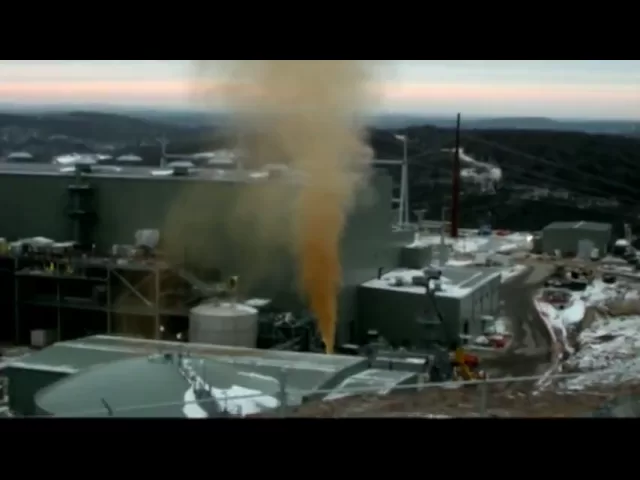
[Music] Narrator: On August 28, 2008, a powerful explosion . . .
[Sound of explosion] killed two workers and injured eight others at the Bayer CropScience Plant in Institute, West VA, just outside of Charleston, the State Capital. A Chemical Safety Board investigation found the accident resulted from a runaway chemical reaction inside a process vessel, used to treat pesticide waste. The CSB determined that if the exploding vessel .
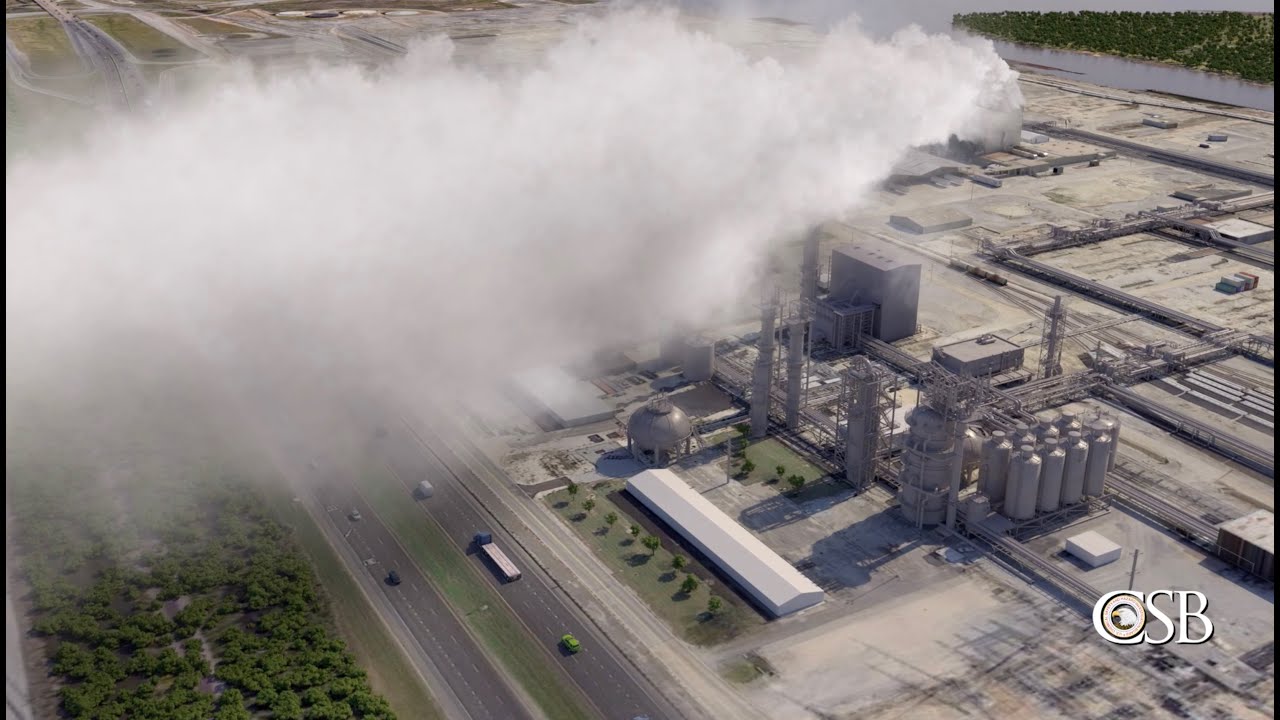
. . [Sound of explosion] had taken a different trajectory, pieces of it could have hit nearby piping, potentially causing a release of highly toxic methyl isocyanate, or MIC, the same dangerous chemical that killed thousands in Bhopal, India in 1984.
Moure-Eraso: The CSB determined that the explosion at Bayer could have caused a release of MIC into the nearby community. And it raised the question, was there an inherently safer alternative to storing and using this highly toxic chemical? [Music] Narrator: At the direction of Congress, the CSB commissioned the National Academy of Sciences .
. . [Sound of explosion] or NAS, to study the feasibility of reducing or eliminating the inventory of MIC stored at the Bayer plant.
The NAS study explored how the concept of inherent safety could be applied at the Bayer facility. Dr Dorothy Zolandz directs the NAS's Board on Chemical Sciences and Technology, which assembled a diverse panel of experts to conduct the study. Zolandz: Inherently safer process assessment is a tool that can allow companies, employees, engineers and corporate officials to take a fresh look at how to carry out their business in a way that would not only be safer, but would also perhaps be better in terms of other business decisions.
Narrator: Industry experts generally describe four main approaches to inherently safer design. They are: minimize, reducing the amount of hazardous material in the process. Substitute; replacing one material with another that is less hazardous.
Moderate, using less hazardous process conditions, such as lower pressures or temperatures. And simplify, designing processes to be less complicated and therefore less prone to failure. Hendershot: Inherently safer design is a philosophy for design and operation of any technology, including chemical processing.
It's not a specific technology or a set of tools and activities, but it's really an approach to design and it's, it's a way of thinking. Narrator: Longtime industry consultant, Dennis Hendershot, served on the NAS study panel and spoke in 2009 at a CSB public meeting, about the advantages of inherently safer processes. Hendershot: And what that means is that the safety features are built right into the process, not added on.
Hazards are eliminated or significantly reduced, rather than controlled or managed. Narrator: The NAS panel noted that the goal of inherently safer design is not only to prevent an accident . .
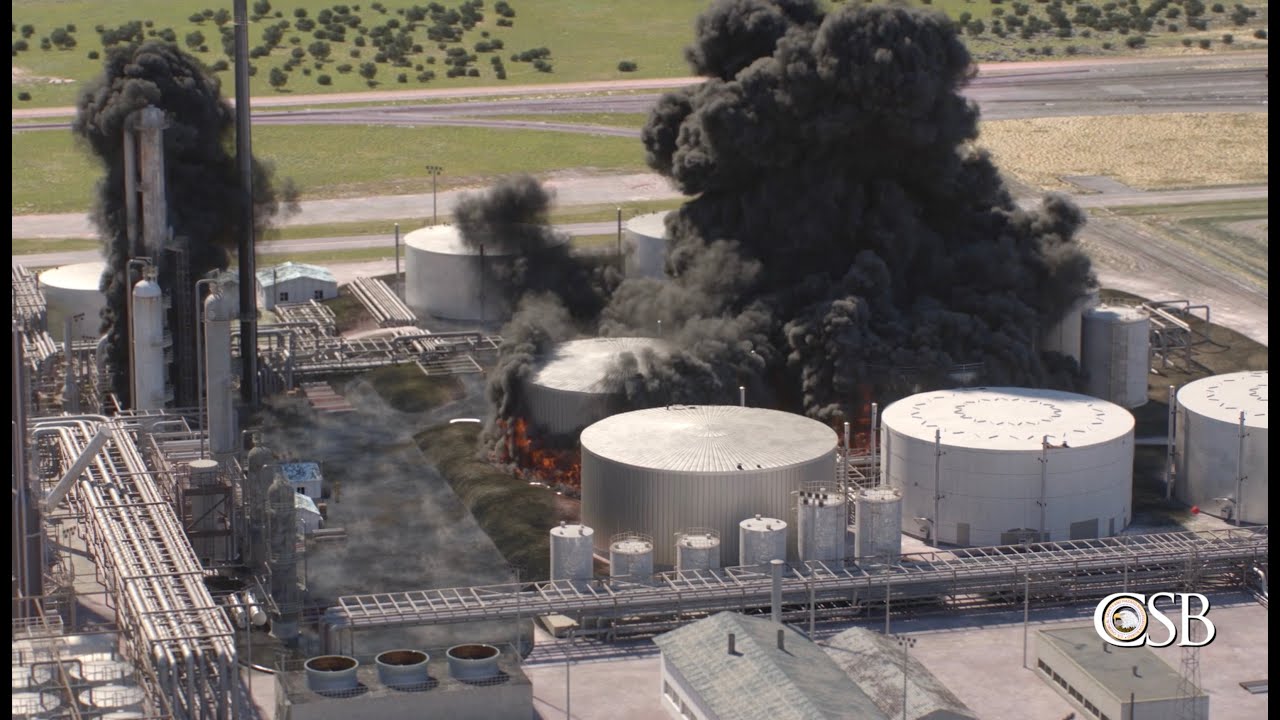
. [Sound of explosion] but to reduce the consequences of an accident should one occur. That helps make emergency preparedness efforts more focused and effective.
Amyotte: We may tend to think of certain principles of inherent safety as focusing primarily on mitigation or primarily on prevention, but I think there is some overlap there and we can really address both aspect of risk; the likelihood of occurrence and the severity of consequences. Narrator: NAS panel member, Dr Paul Amyotte, is a professor of chemical engineering at Dalhousie University in Nova Scotia, Canada. Amyotte: Not that inherently safer design will solve all ills or cure all ills; it won't deal with all hazards all of the time, but it's, it's really important, I think to ask the inherent safety questions before we go to adding devices and developing safe work procedures.
Kletz: The first choice after an accident is to say, how can we improve the design, so this can't happen? Narrator: Dr Trevor Kletz is an internationally recognized chemical process safety expert. Kletz: Very often you can change the design, often very cheaply and very easily and people don't do it and don't see it.
Narrator: Prior to the 2008 accident, the Bayer CropScience Plant in Institute, West Virginia was the only facility remaining in the United States that produced and stored large quantities of highly toxic MIC. Bayer and the prior owners of the site used MIC to manufacture carbamate pesticides. Following the Bhopal disaster, other pesticide manufacturers had quickly moved away from the transportation and bulk storage of MIC.
The NAS study noted that members of the community around the Bayer plant were concerned with the quantity of MIC and wanted a process that eliminated or reduced use of the dangerous chemical. According to the report, Bayer and its predecessors considered factors including risk, cost, quality of final product and community perception when evaluating alternative methods for producing carbamate pesticides. Zolandz: In its most recent decision about its manufacturing process, Bayer was weighing off the toxicity and hazard of MIC in the process against a process that might have used less MIC but would have generated more wastewater.
Each of the processes that were considered had drawback and positive aspects. Narrator: Bayer ultimately decided against the process that reduced MIC. But some community members remained unsatisfied, eventually bringing a lawsuit against Bayer over plant safety concerns.
Early in 2011, a federal judge granted a temporary restraining order, stopping Bayer from restarting the MIC Unit. Meanwhile, the Environmental Protection Agency and Bayer had agreed to phase out various carbamate pesticides. On March 18, 2011, Bayer told the court and the public that it would not seek to restart MIC production at the plant and would end the manufacturing of carbamate pesticides, deemed hazardous by the World Health Organization.
In the Kanawha Valley, decades of controversy drew to a close. The Bayer plant no longer produces or stores MIC. But the CSB believes the NAS study and other publications illustrate how the chemical industry could benefit from incorporating the principles of inherently safer design into making decisions, decisions which will satisfy the interests of chemical companies, workers and members of the communities near their plants.
Zolandz: Inherently safer process assessment is important and can be useful to companies, because it is a way of continually examining and assuring that a company is using, making the best choices in the processes that it uses. Narrator: In the course of its investigations, the CSB has noted many cases where inherently safer methods of production could have prevented or reduced the consequences of deadly accidents. In a 2011 journal article, Professor Amyotte noted over 90 implicit references to using inherently safer technology in existing CSB reports.
And the CSB has made several major recommendations, advocating inherently safer alternatives. For example, on February 7, 2010, six workers were killed in an explosion at the Kleen Energy Power Plant under construction in Middletown, Connecticut. The blast occurred during a planned pipe cleaning activity called a "gas blow".
Natural gas was forced through newly constructed piping at high-pressure and volume to blow out debris that could damage turbine blades. The gas vented directly to the atmosphere from open pipe ends and accumulated in a congested outdoor area, where it found an ignition source . .
. [Sound of explosion] and triggered a massive explosion. Tillema: We were surprised to learn that such an unsafe procedure was commonly used throughout the electric power industry.
There are inherently safer ways to clean piping and the CSB believes they should be used. Narrator: The CSB recommended inherently safer alternatives to flammable natural gas for pipe cleaning. The CSB investigation found that cleaning with compressed air was equally effective and completely avoided the explosion hazard, without significantly affecting costs.
The CSB urged OSHA, State governments and the National Fire Protection Association or NFPA, to ban gas blows in their regulations and codes. Connecticut promptly outlawed the practice and the NFPA developed a new code mandating the use of inherently safer alternatives, like compressed air cleaning. Moure-Eraso: The principles of inherently safer processing can be an effective way for chemical companies to eliminate or reduce hazards, prevent accidents and protect nearby communities.
Narrator: The CSB strongly urges companies to implement the four main approaches to inherent safety. Minimize, substitute, moderate and simplify throughout the entire life cycle of hazardous chemical processes, from the initial design phase to operation to final decommissioning. Narrator: For more information on the CSB's investigations, please visit CSB.
gov.