Hi. It’s Mr Andersen and this AP Physics essentials video 126. It is on the wave-particle duality of light.
There is an old story of four blind men and an elephant and they are each touching it at a different point. And so this guy says it is pointy. This one says it is strong and sturdy like a tree.
This one say it is flat like a wall. And this one says it is a snake. Now they are all right.
They are all just touching different parts of the elephant. And light is like that. Depending on our scale it can bee both a wave and a particle.
And so light travels as photons. And those photons can act as waves and particles. Evidence that showed us they are waves is their interference.
They can interfere with one another, sometimes build up the waves. Sometimes build them down. And they also, if we look at them as a particle, the photoelectric effect tells us that photons are quantized.
They travel in these discrete units, like particles. And so if you are a physics student or physicist how do you know which model to use? Well it really depends on a sense of scale.
And so we would use a wave model if the size of the objects that we are measuring are comparable to the wavelength of the light. And we would use the particle model if the energy that we are studying is comparable to the energy of a photon, remember which is described as Plank’s constant times the frequency of the photon itself. Let me give you a little bit of history.
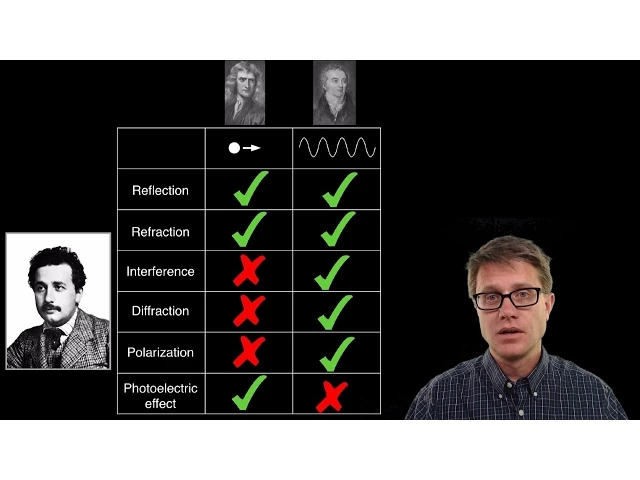
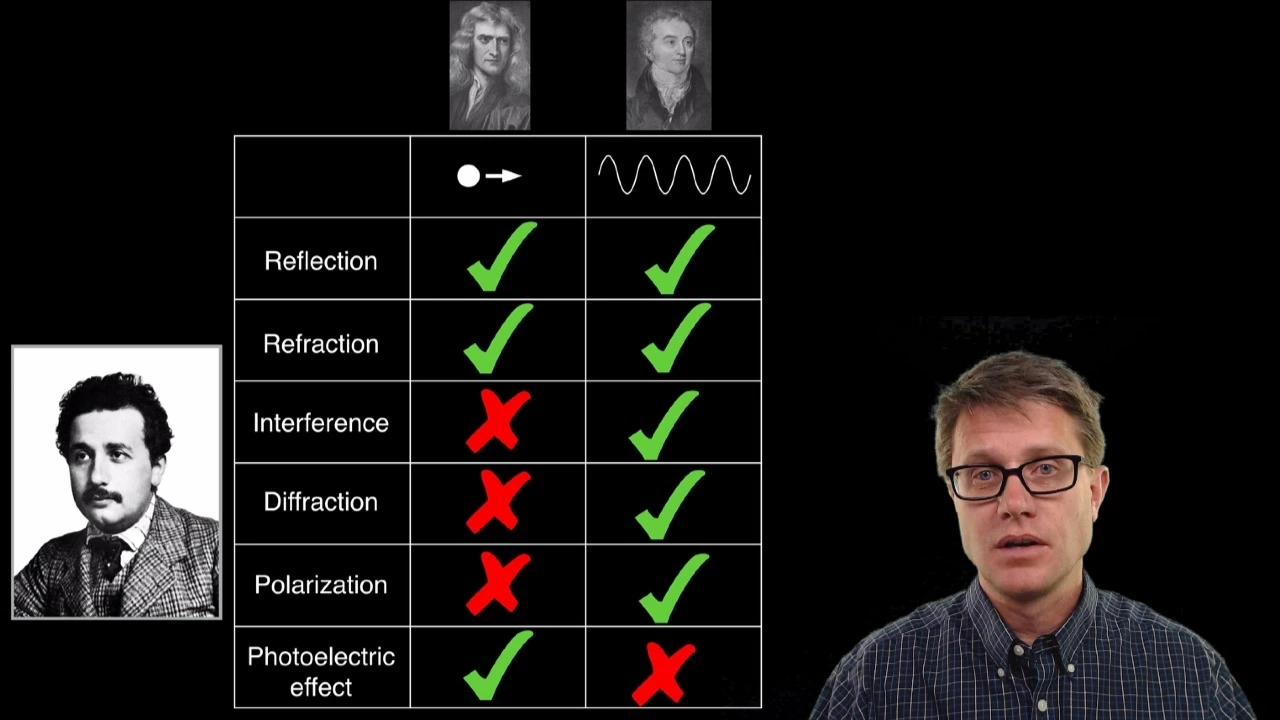
The first person to tackle this issue was Isaac Newton. And he thought that it travelled in these small microscopic corpuscles or these small particles. And then finally Thomas Young looked at that evidence, gathered more evidence and said that they are waves.
And so scientists looked at this for hundreds of years. And so if we kind of look at all of the evidence and kind of go through those two particle and wave models, we could first start with reflection. Do they bounce off objects?
And we would say yes and yes. If we look at refraction, can they bend as they move from one medium to another? We would say yes and yes.
If we look at interference, can they interfere with one another? The particle model does not hold up. They cannot interfere with one another.
But the wave does. Do they diffract, do they bend around objects or as you go through an opening? We would say particle no.
We would say wave yes. What about can they be polarized? In other words when they are traveling in one dimension can we use small slits to just limit the amount who go through?
We would say no and we would say for waves. So waves are looking great. And finally the photoelectric effect came around.
And Einstein came around. And what it showed is that the wave model does not work. Only the particle model works.
And so now we have a duality, this view of light as both a wave and a particle. And so what is the answer? Well both are right.
And so how do we know which model to use? Again, it is a sense of scale. And so if we are looking at objects that are comparable to the wavelength of the light then we use the wave model.
But if we are looking at experiments where the energy is comparable to the energy of a photon, it is going to be a really small amount of energy, then we have to treat them as a particle. And so did you learn to select a model that is going to be appropriate for measuring photons? It all comes down to the size of the wavelength, the size of the energy and I hope that was helpful.