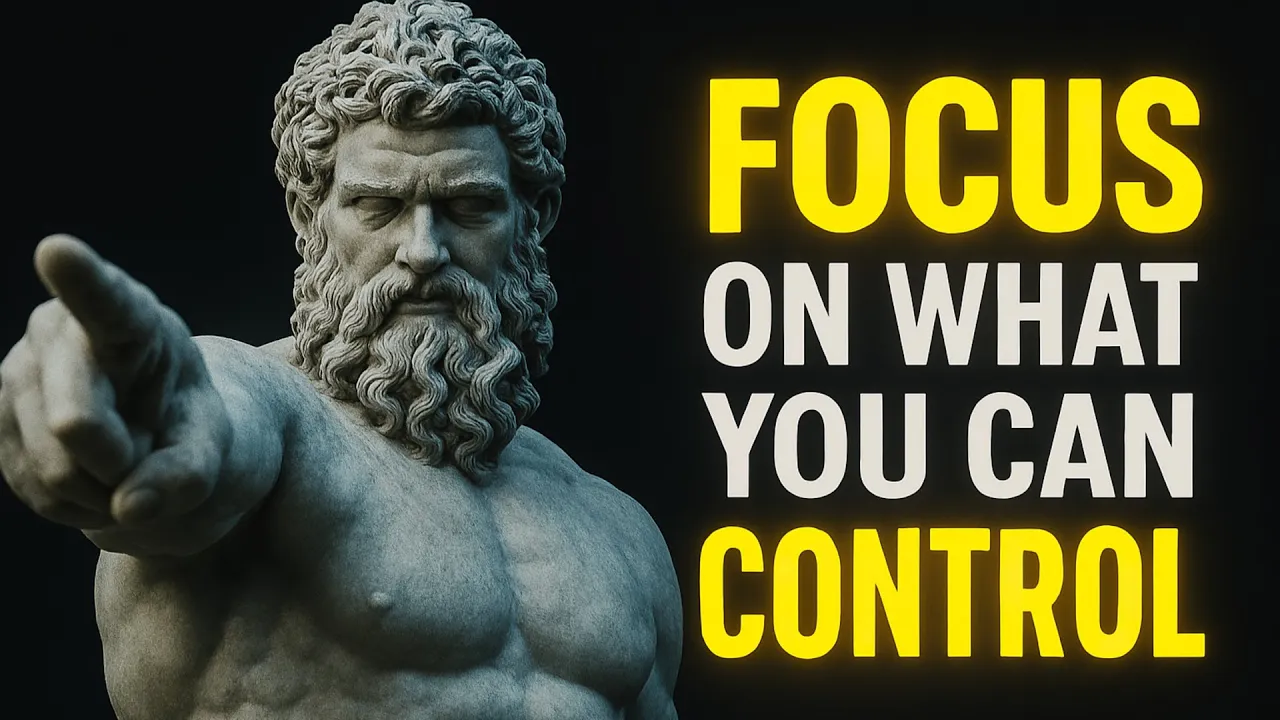
It's a big world out there. There's a lot about it that you can't control. The stock market, trade wars, military wars.
It hurts when you feel big emotions about things you can't change. But what can you change? You can change yourself.
You can change your actions and reactions, your habits, your mindset, the hundreds of things that are within your direct control. And that's not all. In the world at large, you can influence things too with your money, your support, your blood, sweat, and tears.
But you have to be smart about it. You have to do it right by focusing on what you can change. The topic of our video today using ancient Stoic wisdom, we're going to show you eight powerful techniques to take back control of your mind and your life.
If you want the focused life, here is our road map for getting you there. Point one, we'll talk about the dichotomy of control and how to stop wasting your time on things you can't change. Point two, we'll talk about causing effective change because you have more power than you think.
Point three, we'll discuss the view from above, about gaining perspective by zooming out to see the balanced hole. Point four, we'll talk about how the obstacle is the way. The thing that is blocking you is actually pointing you towards growth.
Point five, we'll talk about negative visualization, the counterintuitive power of imagining what could go wrong to protect yourself. Point six, we'll talk about momento mori. Remembering that you will die, not to be morbid, but to be more alive.
Point seven, we'll talk about voluntary discomfort. Choosing the most uncomfortable thing that will make a difference and then doing it. Point eight, to get the most out of focus.
We'll explain the strategy of list making and how to use it for your advantage. But it all starts with our first point. If any of this is going to work, you must focus on what you can actually change.
Because right now, you're wasting precious emotional energy on things you can't influence in a meaningful way. And that will make you miserable because you cannot control the economy tanking. You can't control your neighbors barking dog or climate change or whether Netflix cancels your favorite show.
But the things you can control, your reactions, your habits, your attention, your effort, the way you interpret events, the meaning you assign to what happens, the boundaries you set, the conversations you start. These are things you can do and they matter. Unfortunately, most people spend years years agonizing over things beyond their reach.
So, how do we escape this trap? We do it by accepting this brutal truth. Our sphere of influence is tiny compared to the universe of things we care about.
When you accept this, really accept it, you feel liberation. When people stop exhausting themselves fighting unwinable battles, they have energy for the fights that matter, the ones where their actions make a tangible difference. Your job isn't to control the uncontrollable, because you can't.
Your job is to focus your finite energy on what you can actually change and to practice the ancient art of letting go of everything else. Sounds simple, doesn't it? It's not.
No one does it perfectly, but you can try and you can get better and keep trying and keep learning and eventually you will start to focus on what matters. Our second point is related, the good news that accompanies this truth. Our second point is that there is a lot you can control.
Most people get stuck in this false binary. Either they're utterly powerless or they need complete control. That's nonsense.
The truth is messier and more magnificent. You have a tremendous capacity to create change, just not where you've been looking. When people fixate on changing things beyond their control, they waste their power.
Meanwhile, their genuine influence, their real power, sits untapped, gathering dust. Your real power lies in your consistent deliberate actions, your thoughtful responses, your strategic choices, your unwavering persistence. Most folks understand this intellectually but fail at it in practice.
They bounce between resignation, nothing I do matters, and magical thinking. If I worry enough, maybe things will change. Here's the uncomfortable reality.
Effective change requires methodical, sustained effort in places where your actions ripple outward. It means abandoning the seductive fantasy that you can control everything and instead channeling your energy to places where it matters. Look at anyone who's created meaningful change.
They didn't waste energy lamenting what they couldn't influence. They identified exactly where they could apply pressure and then pushed relentlessly, strategically, and with absolute focus. So, stop exhausting yourself trying to move immovable objects.
Find the levers that actually respond to your touch and pull them with everything you've got. Our next point builds on the last one. In order to create change, you have to see the whole.
Our third point is be ready to zoom out in order to maintain balance and get your most important work done. If you're not there, then you're usually caught in the minutia again. The email that offended you, the promotion someone else got, the way your voice cracked during the presentation.
It's easy to magnify these details until they fill your entire emotional landscape. This is what happens when we get stuck in tunnel vision. We make mountains out of mole hills while completely losing sight of the actual mountains all around us.
The Stoics knew the antidote. They practiced what Marcus Aurelius called the view from above. Mentally zooming out to see your life, your problems, everything from a bigger perspective.
So in your own life, take stock. Yes, there are difficulties, but there are also positives. You have a job history which you could use to get a similar job if you apply for one.
You have an education, professional friends from the past, probably even some ideas about how to make money. You may have savings, even a house. These are all part of your life, too.
These are the positives that balance out the negatives. They should be counted too. If you never zoom out, you can live your whole life fixated on daily irritations, perceived slights, and small winds.
All you'll see are immediate concerns. No wonder people feel anxiety. Without perspective, even minor setbacks feel apocalyptic.
When you cultivate the view from above, you see not just your problems but the interconnected whole, including the good parts. You recognize patterns. You understand suffering is universal.
You grasp how temporary everything truly is. The next time you're overwhelmed, try this. Close your eyes.
Visualize yourself rising up. See your problems getting smaller. Notice how your perspective shifts when you return to Earth.
Bring this wisdom with you. The balanced whole awaits your notice. So look up and consider all that you have and the many positive possibilities.
And yet for all that stoicism is about realism too. Sometimes in this life you will face obstacles. And that brings us to our fourth point.
The obstacle is the way. Embrace what blocks you. Marcus Aurelius, the great Stoic philosopher and Roman emperor, said this.
Let's unpack it. It means that obstacles reveal opportunities we might otherwise miss, force us to develop new skills and strengths, test and refine our character, and often show us the correct direction through resistance. So that thing you're banging your head against, look at it again.
Really look at it. Because what you're seeing as a roadblock is actually a signpost pointing directly toward your growth. When most people hit obstacles, they retreat.
They complain. They decide the universe is conspiring against them. This is nonsense.
The obstacle isn't proof you should stop. It's a light on the exact place you need to focus your attention. Think about how we build physical strength.
Muscles develop only when they encounter resistance. No resistance, no growth. Your life obstacles function exactly the same way.
They are resistance training for your character, your creativity, your resilience. If your career has stalled, that's information about where your skills need development. Relationship troubles, they reveal precisely which emotional areas need strengthening.
Health problems illuminate the exact ways you've neglected your body's needs. The obstacle isn't a cosmic accident. It's a teacher you should heed.
Just know that the transformation may not be easy. And that bring us to our fifth point. You know that difficulties lie ahead.
So while it may sound paradoxical, in order to make life easier, try to imagine the difficulties you may face. I know it's strange. You've been told your entire life to think positive and visualize success.
But look where that's gotten you. You've been blindsided again and again when things fall apart. So why not try something different?
The Stoics had a radically unique approach. They called it premeditatio mealorum, the premeditation of evils. They deliberately imagined worstcase scenarios not to manifest them but to prepare for them.
Most people avoid thinking about potential disasters because it feels uncomfortable. They superstitiously believe that contemplating something bad might somehow make it happen. But this set us up for an imaginary world where nothing bad ever happens.
Only the good things we crave happen. The problem, of course, is that's not reality. Your thoughts don't control external reality, but they absolutely control how you respond to it.
Try this. Take whatever you value most, your job, your relationship, your health, your home, and vividly imagine losing it. Really feel it.
What would the first day be like, the first week? How would you handle it? This practice is clarifying.
It strips away the delusion that what you have is guaranteed. It reminds you that everything in your life is effectively on loan from the universe, including your very life. When you regularly visualize potential losses and difficulties, good things start to happen.
First, you develop contingency plans that make you genuinely resilient. Second, you appreciate what you currently have with much greater intensity. Third, you discover that even your worst fears, when faced directly, lose much of their power over you.
The most bulletproof people aren't those who avoid negative thoughts. They're the ones who've stared their worstcase scenarios in the face and said, "Even this, I can survive. " Next time anxiety creeps in about what might go wrong, don't push it away.
Examine it thoroughly. Ask yourself, "What would I do if this actually happened? " This brings us to your sixth point.
This is momento my remember death so that you may truly live. Most people behave like you have unlimited time. Wake up.
Your time is running out. As the Stoics pointed out, a lot of the death you fear has already happened for you. The past decades of your life are dead in a sense.
Dead and gone. You have lived them. They aren't coming back.
If you think of death not as happening overnight, but as coming in parts, part of the death that is your share has come already. The Stoics practiced momentomory. Remember you will die frequently.
They kept skulls on their desks. They visualized their deaths daily. They reminded themselves constantly of life's shortness.
Most people pretend they'll live forever. They waste decades on things that don't matter, assuming there's endless time to get to what does. This willful ignorance won't protect you.
And truthfully, there's a better way. Confronting your mortality can invigorate you. It strips away everything superficial and forces you to reckon with what truly matters.
Would you waste another minute on petty resentments? If you knew you had one year left, would you stay in a soulc crushing job? Would you keep postponing the conversation, the life change, the leap?
So try this radical shift. Live each day as if you've died and been granted one more chance to experience it. Feel the miracle of your lungs filling with air.
See the extraordinary beauty in ordinary moments. Now that you recognize your time is limited, what will you do with it? That leads us to our seventh point.
To maximize the value of your time, embrace hardship by choice. In the modern world, everyone builds comfort fortresses, temperature controlled homes, ondemand entertainment, food delivered with a tap. And then we wonder why we crumble when real adversity hits.
The ancient Stoics were mental athletes who trained relentlessly through voluntary discomfort. They didn't wait for hardship to arrive uninvited. They issued formal invitations, welcoming it through their front doors.
This is the opposite of the average person's relationship with discomfort. They've systematically removed every opportunity to practice enduring difficulty, then feel blindsided when inevitable challenges arrive. Voluntary discomfort flips this narrative completely.
It says, "I will choose hardship on my terms before it chooses me on its terms. " It's sleeping on the floor occasionally to remind yourself you don't need luxury to rest. It's fasting to discover hunger isn't an emergency.
It's exercising in terrible weather to prove to yourself that you can be uncomfortable and still function beautifully. But the most important part of this is turning your attention to where it normally doesn't want to go. To the things you need to do but have been putting off.
So look there. Look at what you don't want to do but need to do and then do it. When you deliberately practice being uncomfortable, when you choose the hardest meaningful thing and do it anyway, something transformative happens.
You find out that you can do what you were afraid of and instantly stop being stressed by it. This is what the most capable people do. They aren't those who've faced the fewest challenges.
They're those who voluntarily subjected themselves to countless small hardships, building an unshakable confidence in their ability to endure. And then they did the things they didn't want to do and vaulted to the top because of it. But how do you put it all together?
This brings us to our eighth and final point. To make the most of your ability to focus, make lists. The average mind is a tornado of competing priorities and half-for-med ideas.
Maybe you end each day wondering where the hours went, buried beneath the weight of what you couldn't finish. And yet you resist the simplest solution of all, making a list. You may think lists are basic, boring, beneath you.
Or maybe you make them and abandon them, creating fresh ones each week that grow dusty before being tossed away. I'm here to tell you that's a mistake. You're not recognizing list making as the superpower it actually is because your brain is a spectacular idea generator, but a bad storage system.
The brain was never designed to hold an entire life's worth of commitments. A list is a strategic psychological intervention, a way of tricking your distractable brain into sustained focus. It's how you translate ephemeral intentions into concrete reality.
The mind wants structure. Your intentions want commitment. Your projects need completion.
The humble list is the answer to all three. Start simply with one list. Make it easily visible and review it daily.
Choose what goes on it with care. Mark what matters most. Then start going down the list.
It's that easy. And it's equally as effective. People who make lists focus better and get more done.
So start today and watch the results start flowing in. Your future self will thank you. And with that, to take it from the top, you have eight powerful techniques to take back control of your mind and your life.
One, focus on what you can actually change. Two, recognize your power to create change. Three, try the view from above to gain perspective.
Four, see obstacles as the way forward. Five, practice negative visualization to prepare. Six, remember death to truly live.
Seven, embrace voluntary discomfort. Eight, make lists to focus better. So, in conclusion, start with accepting what you can and cannot control.
Channel your energy where it truly matters. Finally, don't waste your finite time on things beyond your influence. Start with just one technique today.
See how it feels, then build on it one day at a time. And stick with us as we keep developing these concepts in future videos. In our next video, we'll share more ancient stoic wisdom to help with your daily struggles.
Don't forget to subscribe and turn on notifications to join our stoic community. Your comments help others find these tools when they need them most. Until next time, remember what Marcus Aurelius said.
You have power over your mind, not outside events. Realize this and you will find strength. It's up to you to practice stoic wisdom and use your focus to build the best life you possibly can.
So go out there and do it.