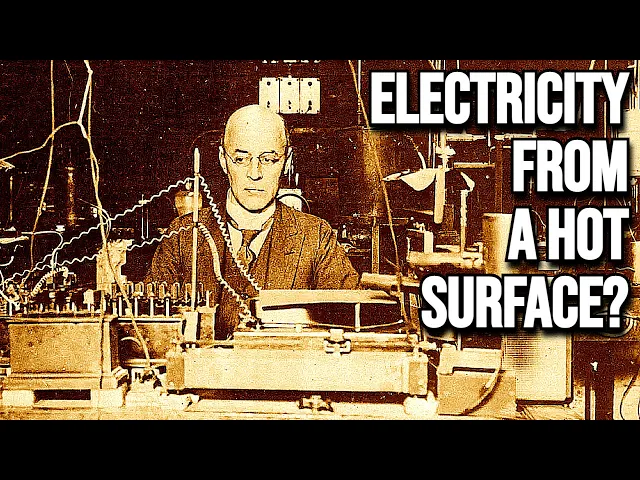
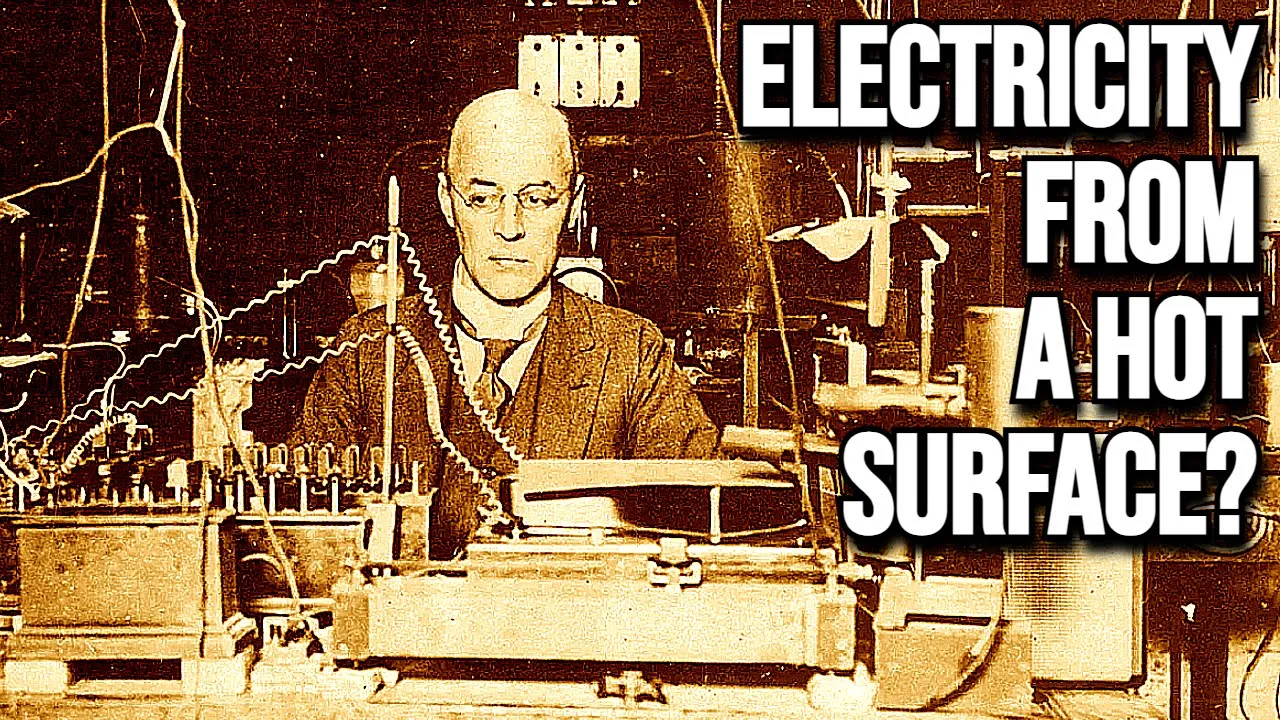
For a few hundred years, it has been known that the air surrounding hot objects is able to conduct electricity. But the exact science behind the phenomenon remained a mystery for quite some time. As simple an effect as it seems, the theory surrounding heat's effect on conductivity underwent a slew of changes and progress developed rather slowly.
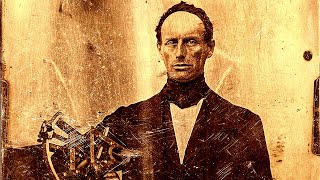
The task to explain it became so difficult that the man who was finally able to describe the phenomenon with a mathematical equation was awarded the Nobel Prize in Physics. The first major step in understanding thermionic emission beyond its simple surface layer characteristics was made in 1853 by a French physicist. His name was Alexander Edmund Beckel and he was the father of the man who discovered radioactivity on Rebeckroll.
His experiment was rather simple. He heated up two electrodes and applied some voltage to them and quickly noticed that it didn't take much voltage to get a current running through the air between the two platinum rods. 20 years later, British physicist and chemist Frederick Guthrie took this one step further by heating up a ball of iron.
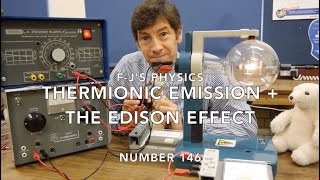
He found this ball of iron to be unable to conduct a positive static electrical charge, but however was able to conduct a negative static electrical charge, with the discharge somehow dispersing through the air. The effect was first named in 1880, but not as thermionic emission as we know it today. It actually first became known as the Edison effect after one of Edison's assistants, William Joseph Hammer, noticed its presence when trying to develop a sustainable light bulb.
Hammer was trying to figure out why the inside of the bulbs blackened as they burned for longer durations. He added a metal foil to the inside of the bulb and found something very similar to Beckerel and Guthrie before him. The filament conducted electricity through the air and to the aluminum foil, but only when the foil had a positive charge.
He and Edison found no practical use for this phenomenon, but Edison patented it anyways, as he did with everything new stumbled across, and thus the Edison effect was born. But still, no one knew exactly how it happened. To understand this effect would mean to understand electricity at a fundamental level.
No one was able to progress further until the key discovery about the composition of matter itself was made. And that discovery was the electron in 1897 by JJ Thompson. As the era of the electron began, scientists quickly reached a consensus that electric discharges were carried by ions and electrons.
And during the Edison effect, these charged particles are generated when the hot body interacts with surrounding gas molecules. However, another British physicist by the name of Owen Richardson had a different theory. He believed that the surrounding gas had nothing to do with the phenomenon.
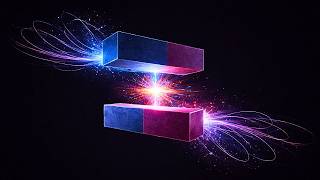
Rather, Owen believed the electrons are solely emitted from the hot body and go towards the nearby charged metal with or without the presence of a gas. To test his theory, all he had to do was one simple thing, and that was to get rid of the gas and test conductivity in a vacuum. Well, it wasn't that simple.
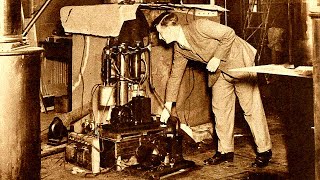
It was actually rather difficult, as vacuum technology was still rather primitive, and most labs were still using hand pumps to evacuate air from tubes. To add to that, according to Richardson himself, as his apparatus he used in his experiments heated up, it also continuously emitted gas inside its own tube. So, it was a straining task to not only remove the gas from his tubes, but to keep the gas out as well.
On multiple occasions, Richardson heated a wire in a tube for weeks on end to make sure he was getting accurate data with no residual gas. But finally in 1901 he was able to reach conclusive results using a platinum surface as an emitter. What he found was that the platinum surface did in fact emit electrons and that the rate of emission increased with temperature and followed a relationship that he derived from this data.
This is the equation Owen first came up with in 1901. I is the maximum current, T is the temperature, K is the Boltzman constant, and A and W are constants that are specific to the material used. Richardson continued his experiments over the next decade, testing more emitting materials such as sodium and carbon at a multitude of temperatures and by 1911 had refined his equation even further and renamed the phenomenon from the Edison effect to what it is now known as therionic emission.
Today, this equation is known as Richardson's law, and it states that the current density from a heated surface varies exponentially based on its temperature and its work function. Richardson won the Nobel Prize in physics in 1928 for his work on the thermionic phenomenon and especially for the discovery of the law named after him. This law still isn't perfect to this day due to quantum mechanical effects and surface irregularities of emitting materials, but it provides a nice comprehensive overview of emitting materials and has many technological applications.
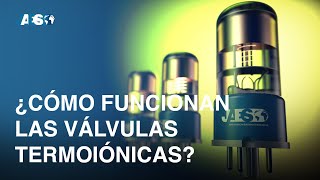
Vacuum tubes, electron microscopes, and thermionic energy converters were all made possible thanks to Owen Richardson, his tedious handwork, and his brilliant theoretical mind that led to a fundamental understanding of thermionic emission. If you enjoyed this video, please consider liking and subscribing. Click here if you want to see more scientific progress made during this time period.
Thank you for watching and I will see you in the next video.