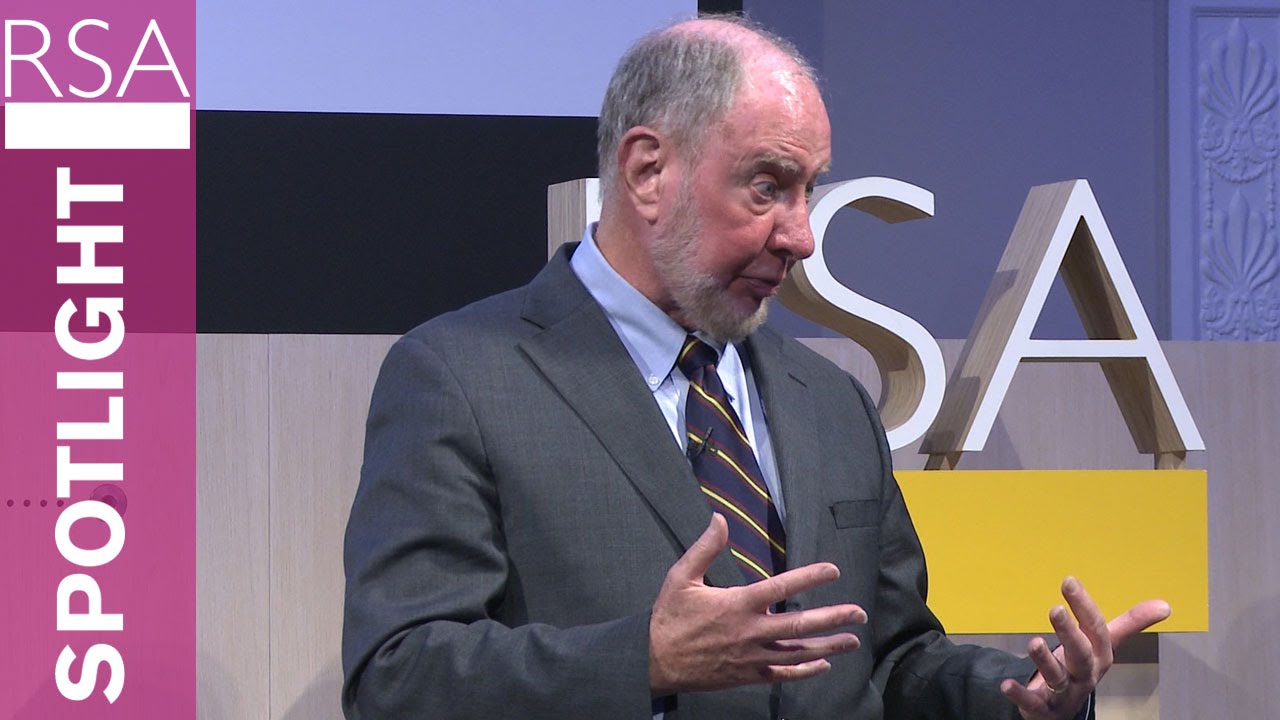
dr. Putnam you are a professor at Harvard University but the next two years you will also be a distinguished visiting professor at always University in your inaugural lecture here at always University you underline that immigration has benefits for countries what exactly do you mean well certainly my own country America is greatly benefited from wait successive waves of immigration a disproportionate number of our Nobel Prize winners are immigrants or children of immigrants a disproportionate number of our best artists are immigrants or children of immigrants our economy benefits from the new energies that and the youth and
the the vitality that immigrant groups have brought to the United States so there's no doubt that our country is greatly advantaged by the fact that we're a country of immigrants but on the other hand some of your newest research show that it's not that easy to live in a in a diverse community and diversity has negative consequences for a community how that's true yeah how does these the benefits and then also the negative consequences go handle well let me say just a word about the the negative consequences it's our research shows that the more diverse
a community the lower the level of social trust in that community and not just distrust between the immigrants and the native-born Americans but trust white people native-born Americans trust other people like them less in more diverse settings so it's everybody just trust everybody less in in in more diverse settings volunteerism and philanthropy and civic engagement involvement in the community all of that tends to decline with greater greater civic engagement we say summarizing our work that diversity seems to bring out the turtle in all of us we all kind of hunker down in the face of
diversity or I would say new diversity unfamiliar diversity and therefore that is a real challenge doing diversity managing an immigration society is not simple as not as simple as managing a society which everybody looks alike and talks alike and so on yeah but if I did it because you also said that a diversity you said in your lecture and that diversity is the key challenge of the 21st century yes I think that's right and the reason is the challenge is to figure out how you can minimize these short-run costs that are you can see in
our data the effects on social capital the effects on social cohesion of the arrival of immigrants how you can balance those and diminish those costs and therefore gain the benefits the undoubted big benefits that come from immigration and the way that happens is that over time a successful immigration society reduces the effect reduces the degree to which people see one another as different sometimes in Europe nowadays the issue of immigration is discussed in terms of how to make them the immigrants more like us to speak like us to talk like us to eat like us
to sing like us in America the American experience suggests that's not the right way to think about the problem the right way to think about the problem is not how to make them like us but how to create a new US yeah not what is a new us a new us is a is a national identity that is not rooted in ethnicity ethnicity but a national identity that is rooted in shared civic engagement so that to be an American once upon a time to be an American meant to look like me actually my own ancestors
came to America in 1620 we were one of the first and and we thought from my ancestors thought this is what an American is and then the Dutch arrived and then the Germans arrived and then the Danes arrived and then the Swedes arrived and then the poles arrived and then the Italians arrived and then the Irish arrived and then the Jews arrived and then people from and now the Cambodians and the the Vietnamese and the Mexicans and each time my people the original you could say laughingly the original victims of all this we've always we've
each time we've said no no please not have any difference we want to all be like US and then gradually we began to see that they were like us and so we stopped seeing the Dutch or the Germans or the eventually the Italians and the Irish we'd not begin to see them as different but we're all just the same and I mean that in a deep sense not just a happy talk sense but in the sense that our what at me to be American has changed it's not that we require the Italians to stop being
interested in opera when they came we became more interested as a country in Opera because of that it Italian characteristic Jews are really funny and when the first time that when four Jews started coming to this country most to our country most of the comedian's in America were Jewish but now nobody thinks of Woody Allen as a Jewish comic people think of it as an American comic and that's because our sense of identity has been transformed by incorporating many of the features and many of the gifts and many of the accents that the foreigners bring
to America but you still have these hyphenated identities you have Greek Americans Italian Americans and Americans all these hyphenated identities so don't you still have these mixed identities the hyphenation of identities exactly as you say Greek American or Italian American or Danish American that is the key to our success we don't require people to stop being Danish when they become American they've become Danish American that in English to say that someone is Danish American or Irish American or Mexican American doesn't sound odd at all it probably does sound odd to say that someone in Denmark
is a Somali Dane but that's the difference between a nationality that is rooted in a national identity that is rooted in ethnicity and a nationality that is rooted in shared civic commitments but not necessarily shared ethnicity it's fight in Denmark we rather say bilingual or immigrants we don't say Turkish things you see I think it's important it's important to be clear at what's at stake here going into the 21st century societies that manage diversity effectively societies that manage immigration effectively will be the winners of the 21st century America has many many problems we have great
inequality we have lots of problems in America but one of our greatest advantages is that we are not so an immigration I don't mean we're perfect we always have problems with each new way but we've had the experience and so we know that it doesn't in the end threaten our identity to have large numbers of Mexicans or Cubans or or Chinese people come in to America it enriches our nation and that fact that we are a multinational a Multan a multicultural country depends upon hyphenation depends upon our being comfortable with the idea that people have
both Danish or Cuban or Chinese characteristics and they're still American that's the one that's one alternative for the 21st century the other alternative is a country like Japan which has the great advantages of homogeneity homogeneity has advantages it enables you to act and cooperate more easily because everyone is the same and you all know the same jokes and you all speak in the same language and so on but it has in a globalized world as the 21st century will be that homogeneity is a global disadvantage so you say that America has a key advantage when
it comes to immigration as opposed to Japan well I really want to say that's the choice that other countries face countries including countries like Denmark have the option of becoming comfortable with immigration and that means not merely expecting the immigrants to become like us but developing a new US becoming comfortable with a new more diverse sense of identity that's one choice or the other choice is to Rican Tinh you to try to be homogeneous all similar and with that with some advantages but with serious disadvantages Japan faces a serious crisis it's an older slower growing
frankly in world terms declining economy and but they have the better the benefits of homogeneity that is the kind of choice one should not think that one can get the benefits of diversity without transforming one's the sense of what it means to be a member of that nation so if you look into the future are you an optimist or are you a pessimist when it comes to two living together in a diverse group well in the long run I'm an optimist my and I'm sorry an optimist for America my daughter happens to be married to
a Costa Rican immigrant and therefore I have four latino grandchildren they don't look anything like me I'm pink they're brown they speak Spanish much better than I speak Spanish they speak English about as well as I speak English now today many other people in my country would think of those kids my grandchildren as being something other than American I'm confident that that will not be true because the history of America is that we gradually over time with difficulty begin to think of these newcomers as us and I'm confident that that probably during my lifetime America
will change in such a way that we won't think of Miriam my granddaughter as being something other than just an ordinary American in that sense I'm an optimist not that it'll happen instantly but that it will happen let's hope that we'll be able to create a new US also in Denmark thank you thank you very much dr. Putnam thank you you