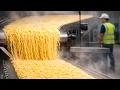
It is one [music] of the most consumed fast foods on the planet. Every year, billions of Moroccan soups [music] are produced around the world. In the United States alone, production exceeds 3 billion units.
[music] But how is Moroccan soup made? In this video, we'll uncover the untold story of the world's most famous instant noodles. The story of Moroan soup goes back to postwar Japan.
The [music] country was facing a severe food shortage and the government promoted the consumption of imported wheat to alleviate hunger. [music] That's when a visionary entrepreneur named Mama Fuku Ando decided to find a practical and [music] affordable solution for millions of people. After numerous experiments in a small shed in 1958, [music] he made a revolutionary discovery.
Cook the noodles, marinate them in chicken broth, and then fry them in oil. This process removed moisture and created a [music] porous texture that allowed the noodles to rehydrate in minutes when hot water was poured over them. Thus was born [music] chicken instant soup.
Considered the world's first instant soup, the invention was an immediate success [music] in Japan and soon spread to other countries. But Ando noticed that many people [music] didn't always have a bowl handy to prepare the soup. In 1971, he introduced an even greater innovation.
[music] Cup noodles. instant noodles in a disposable cup that allowed you to cook and eat [music] directly from the same container. This format forever changed the way people consume quick and convenient meals.
Over the years, the idea spread across the world. In the United States, the Japanese company Toyosway [music] founded Marukin in 1977, establishing a plant in California. [music] Its growth was so rapid that within a few years it became one of the leading brands in the [music] North American market with an annual production easily exceeding 3 billion units.
[music] This volume is possible thanks to highly automated production lines capable of manufacturing and packaging [music] tens of thousands of packs per hour. It all begins in the receiving area. Trucks arrive loaded with wheat flour, salt, [music] additives, and vegetable oils, the main ingredients for making the noodles.
Huge metallic silos store tons of this cereal to ensure purity and quality. [music] From there, automated systems transport the ingredients to the production lines. [music] Once the raw materials are approved, the kneading process begins in enormous industrial mixers.
The wheat flour is combined with purified water, salt, and an alkaline solution known as canned sway. This ingredient is essential. It strengthens the gluten network, adds elasticity, [music] and gives the noodles their characteristic yellowish tone.
These precisely measured ingredients are poured into giant industrial meters that work tirelessly. Their mechanical arms apply constant pressure, kneading the mixture until a homogeneous, firm, and elastic dough is obtained. This dough will form the base of the noodles.
After kneading, the dough is allowed to rest in large [music] compartments for a short period, typically between 15 and 30 minutes. During this time, moisture distributes evenly and the gluten structure stabilizes, [music] resulting in firmer, more resilient noodles. After resting, the dough is ready to be transformed into noodles.
First, enormous stainless steel rollers begin to progressively flatten [music] it. With each pass, it becomes thinner until forming a uniform sheet just a few millm thick. This rolling not only refineses the dough, but also aligns the gluten chains in one direction, giving the noodles their signature [music] elasticity.
The thickness of the sheet is controlled by automatic sensors that adjust [music] roller pressure to ensure precision in every batch. Next, the sheet passes through a cutting machine equipped with special blades [music] that create long strands of noodles. The blades have wavy edges that produce the [music] classic curly look of instant noodles in seconds.
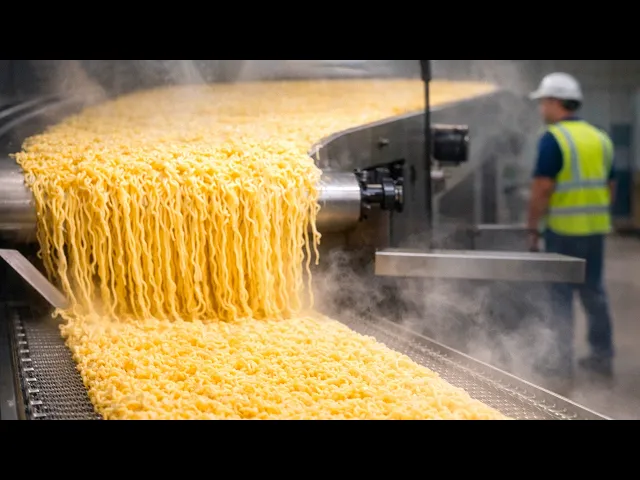
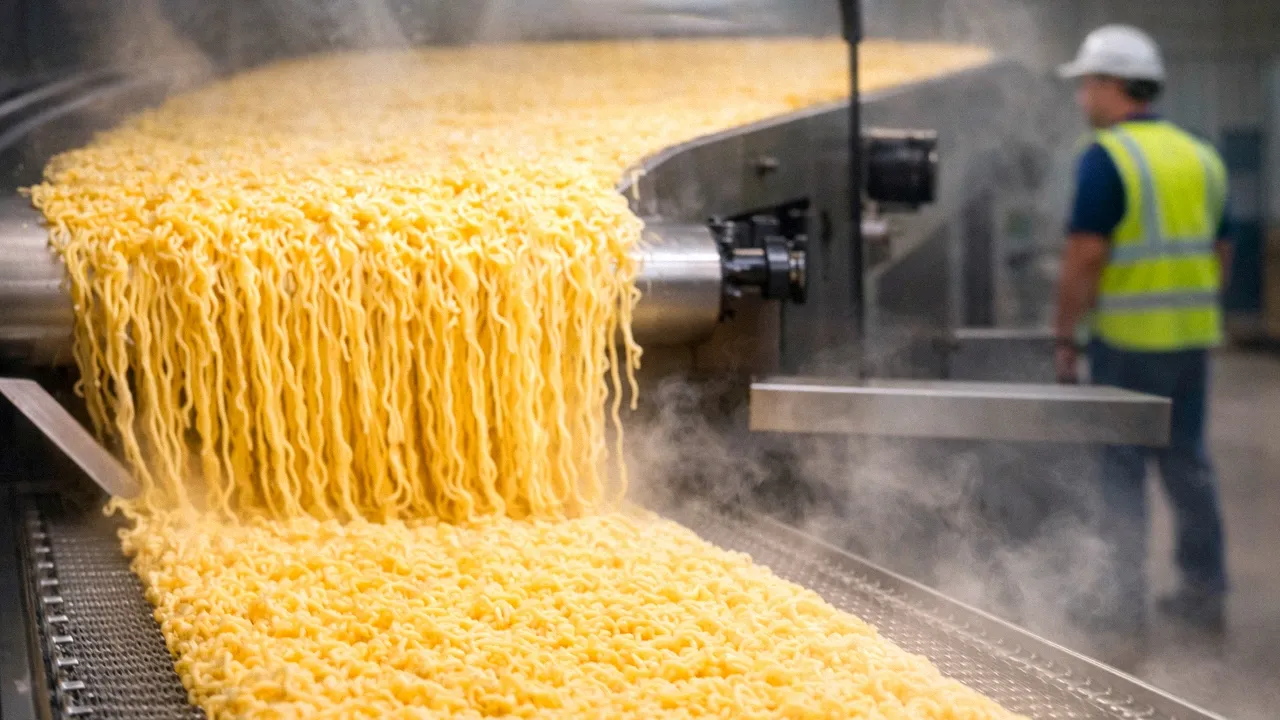
The dough has now become the characteristic Moroccan noodles, ready for steam cooking. The steam rapidly [music] penetrates each noodle, gelatinizing the wheat starch and partially cooking the dough. The time is very short, just [music] a few minutes, but enough for the noodles to gain consistency and strength without being fully cooked.
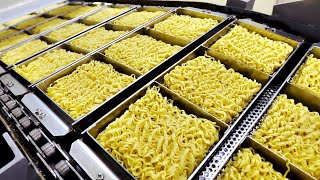
This way, they retain their shape [music] during storage and can rehydrate quickly when the consumer adds boiling water. After steaming, the noodles are divided into exact portions. [music] The dough is distributed across several lines, each cut into uniform strips of [music] precise length to fit a Moroccan cup.
A powerful blast of air compresses them, [music] giving their distinctive shape. After steaming, the noodle blocks still contain a lot of moisture. To turn them into a long-asting [music] product, they must be dehydrated.
The most common technique in Moroccan soup production [music] is quick frying in hot oil. The noodles travel along a metal conveyor belt that submerges [music] them for a few seconds in large tanks of vegetable oil at around 320 Fahrenheit degree. In that brief time, the trapped water evaporates instantly, creating a network of tiny [music] pores inside the noodles.
This porocity allows them to rehydrate in just [music] 3 minutes when in contact with boiling water. Frying reduces the moisture content [music] to less than 5% ensuring a long shelf life and preventing microorganism growth. At the same time, the noodles acquire a light, brittle texture, ideal for packaging.
When they exit the oil, the blocks go through a draining and air cooling system that removes excess fat after the quick fry. The noodle blocks come out still hot and fragile, so they must be stabilized before handling. First, they move along a conveyor belt with fans that [music] gradually reduce their temperature to a safe level for packaging.
This cooling prevents heat from damaging the texture or altering the flavor. Once stabilized, the blocks pass through an alignment system where each portion is checked to ensure it maintains its standard shape, [music] whether the classic rectangular block for packets or the round mold that fits perfectly into instant cups. Weight sensors and vision cameras verify that each unit meets specifications.
Any deformed noodles are automatically removed. The result of [music] this stage is uniform, lightweight, perfectly shaped noodle blocks, ready to receive [music] their essential companion, the seasoning packet. While the noodles move along their production line, another [music] section of the plant prepares the flavoring that defines each Moroccan soup signature taste.
In large industrial mixers, [music] ingredients and additives are combined. The formula varies by flavor, but includes salts and flavor enhancers [music] like monosodium glutamate, concentrated broth powders made from meat or vegetable extracts, sugars, and spices that balance the flavor [music] profile. Dehydrated vegetables such as onion, garlic, carrot, corn, or chives add aroma and color.
Once homogenized, the mixture passes to machines that form small airtight sachets. [music] Each packet is filled with an exact dose and heat sealed to ensure freshness and [music] protection from moisture. With the noodle blocks cooled in the seasoning packets ready, both elements meet in the automatic packaging line.
A dosing arm places [music] each noodle block into its corresponding container. For cup soups, the vegetables are placed directly on top of the noodles. Before sealing the lid, the thermal [music] sealing system ensures that the packages are airtight, preserving the product for months without refrigeration.
Finally, the cups are grouped into cardboard boxes, palletized, and stored in warehouses, ready to be distributed to [music] supermarkets and stores worldwide. Give this video a like if you enjoyed it, and share it with someone who might find it interesting. Also, [music] subscribe to this channel and turn on notifications to keep learning.