hello this lecture we'll look at the nature of international criminal law focusing upon the various International courts and tribunals in this area and a particular offenses while the rights of individuals in international law have evolved significantly in the post-1945 era the placing of obligations directly upon persons as opposed to States has not developed as fast those committing piracy or slave tracing have long been regarded as guilty of crimes against International Society bearing direct responsibility for which they may be punished by International tribunals or by any state at all indeed all states May both arrest and punish Pirates provided of course that they have been apprehended on the high seas or within the territory of the state concerned the punishment of the offenders takes place whatever their nationality and wherever they happen to carry out their criminal activities however the range of offenses under international law for which individuals bore International responsibility was narrow indeed it is doubtful whether it had extended Beyond piracy and slave trading by the turn of the 20th century after the conclusion of the first world war a commission set up by the Allied Powers recommended that as the defeated Powers had violated the laws of war High officials including the Kaiser be prosecuted for ordering such crimes and on the basis of command responsibility accordingly the Treaty of Versailles 1919 noted that the German government recognized the right of the Allied and Associated powers to bring individuals accused of crimes against the laws and customs of War before military tribunals and indeed established the individual responsibility of the Kaiser in the event the Netherlands refused to hand over the Kaiser and only a few trials were held before German courts in Leipzig with at best mixed results the charter annexed to the agreement for the prosecution and Punishment of the major war criminals however in 1945 provided specifically for individual responsibility for crimes against peace war crimes and crimes against humanity there was also a conspiracy charge the Nuremberg Tribunal composed of four principal judges from the U. S UK USSR and France and for alternate was the first international criminal Tribunal and marks the true starting point for international criminal law it declared that the international law imposes duties and liabilities upon individuals as well as upon States as crimes against the international law are committed by men not by abstract entities and only by punishing individuals who commit such crimes can the provisions of international law be enforced included in the relevant category for which individual responsibility was posited were crimes against peace war crimes and crimes against humanity in addition a number of war crimes trials were instituted within Allied occupied Germany under the authority of control Council law number 10. the international Military Tribunal for the Far East was established in January 1946 to deal with Japanese war crimes this tribunal was composed of Judges from 11 states and it essentially reaffirmed the Nuremberg tribunal's legal findings as to for example the criminality of aggressive War and the rejection of the absolute defense of superior orders the provisions of the Nuremberg Charter can now be regarded as part of international law particularly since the general assembly in 1946 affirmed the principles of this Charter and the decision of the Tribunal the assembly also stated the genocide was a crime under international law bearing individual responsibility this was reaffirmed in the genocide Convention of 1948 which also called for prosecutions by either domestic courts or an international penal Tribunal individual responsibility has also been confirmed with regard to grave breaches of the four 1949 Geneva Red Cross conventions and the 1977 additional protocols one and two dealing with armed conflicts it is provided specifically that the high Contracting parties undertake to enact any legislation necessary to provide effective penal sanctions for persons committing or ordering to be committed any of a series of grains grave breaches ranging from willful killing and torture or in human treatment to unlawful deportation or transfer of protected persons undertaking of hostages any individual regardless of rank or governmental status would be personally liable for any war crimes or gray breaches committed while the principle of command or Superior responsibility means that any person in a position of authority altering the commission of a war crime or a grave breach would be as accountable as the subordinate committing it the international law Commission in 1991 provisionally adopted a draft code of crimes against the peace and security of mankind which was revised in 1996.
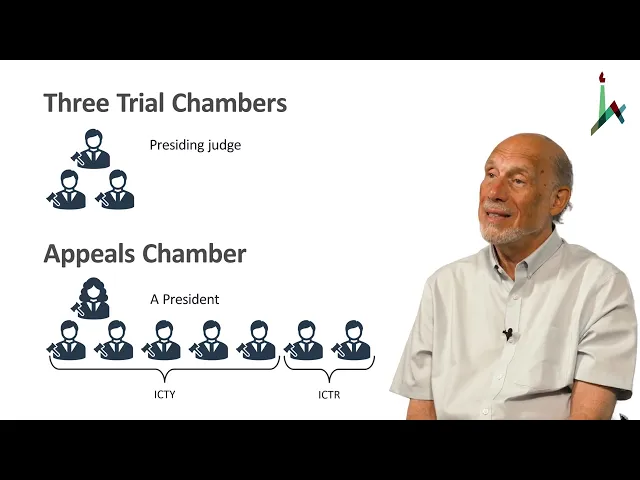
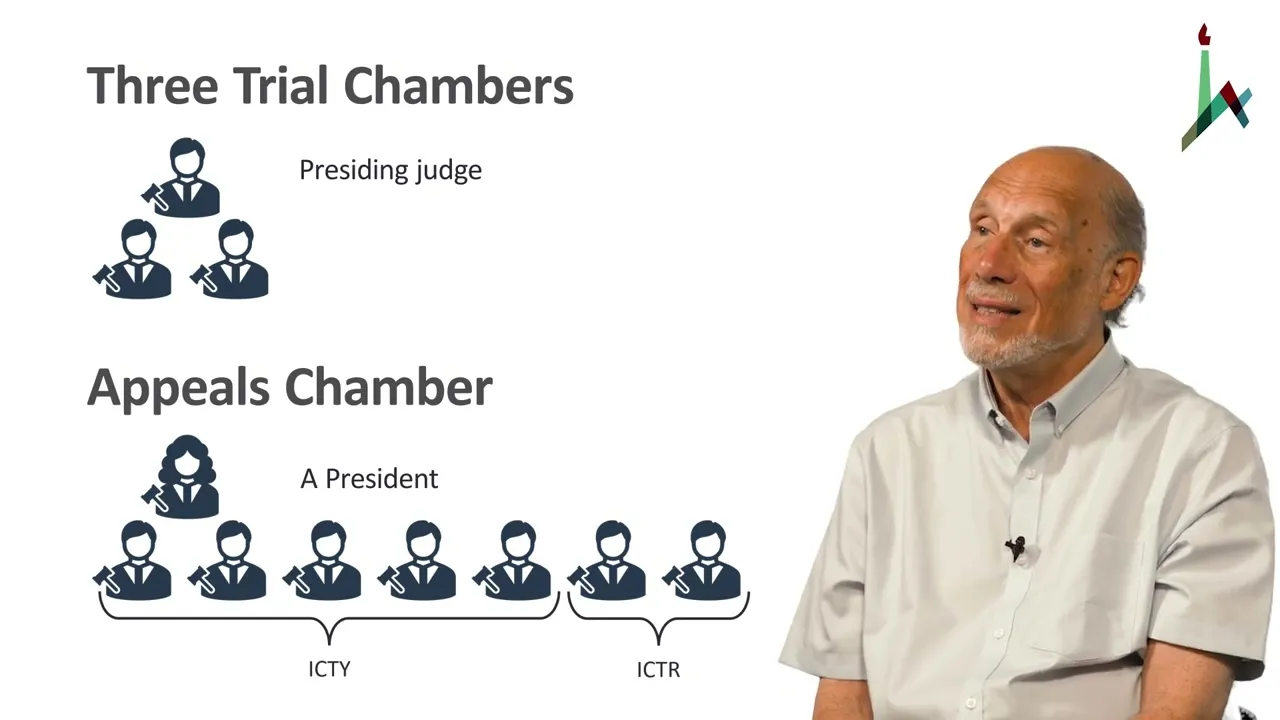
the 1996 draft code provides for individual criminal responsibility with regard to aggression genocide crimes against humanity crimes against U. N and Associated personnel and war crimes the fact that an individual may may be responsible for the crimes in question is deemed not to affect the issue of State responsibility I turn now to look at some of the key international criminal courts and tribunals it was the events in the former Yugoslavia that impelled a renewal of interest in the establishment of an international criminal court which had long been under consideration but in a half-hearted fashion the Yugoslav experience and the Rwanda massacres of 1994 led to the establishment of two specific war crimes tribunals this was done by the use of the UN Security Council to adopt decisions binding upon all member states of the organization under chapter 7 of the charter rather than by an International Conference as was to be the case with the international criminal court this method was used in order both to enable the tribunal in question to come into operation as quickly as possible and to ensure that the path is most closely associated with the subject matter of the war crimes alleged should be bound in a manner not dependent upon their consent as would have been necessary in the case of a Court established by International agreement the tribunal had the power to prosecute persons responsible for serious violations of international humanitarian law committed in the territory of the former Yugoslavia since 1991. indeed the absence of a closing date meant that the later conflict in Kosovo could also be the subject of prosecutions the tribunal which operated from 1993 to the end of 2017 consisted of three main organs the registry the office of the prosecutor and the chambers the registry was the administrative body while the office of the prosecutor was responsible for investigations indictments and bringing matters to trial there were three trial Chambers each consisting of a presiding judge and two other judges and an appeals chamber consisting of seven members but sitting in a panel of five headed by a President of the seven five came from the icty the international criminal Tribunal for the former Yugoslavia and two from the international criminal Tribunal for Rwanda the chambers had a maximum of 16 permanent judges and a maximum of 12 at least M judges drawn from a pool of 27 such as elected by the general assembly for four-year renewable terms articles two to five of the statute laid down the crimes with regard to which the tribunal could exercise jurisdiction these were grave breaches of the Geneva conventions of 1949 violation of the laws or customs of War genocide and crimes against humanity article 7 established that persons who planned instigated ordered committed or otherwise aided and abetted in the planning preparation or execution of crimes shall be individually responsible for the cronloop this article also provided that the official position of any accused person was not to relieve a person of criminal responsibility nor mitigate punishment while the fact that a subordinate committed the crime was not to relieve a superior of responsibility if the Latin knew or had reason to know that these subordinate was about to or had committed the crime and that the superior had failed to take the necessary and reasonable measures to prevent the acts or to punish the perpetrators thereof it was also provided that the fact that an accused person acted pursuant to an order of a government or of a superior was not to relieve him of criminal responsibility although this could constitute a mitigating Factor if the tribunal determined that Justice are required the appeals chamber of the tribunal in The Tadich case confirmed that customary international law had imposed criminal responsibility for serious violations of humanitarian law governing internal as well as International armed conflicts the tribunal and National courts had concurrent jurisdiction with regard to the prosecution of accused persons but the tribunal had Primacy over National courts so that the former was able to request the latter to defer to its competence states were obliged to cooperate with the international tribunal in the investigation and prosecution of persons accused of committing serious violations and had to comply without undue delay with any request for assistance or an order issued by a trial chamber including the identification and location of persons The Taking of Sesame and the prediction of evidence the irrational Detention of persons and they surrender or transfer of the accused to the international Tribunal investigations into alleged offenses under the statute were initiated by the prosecutor either ex officio or on the basis of information obtained from any Source particularly from governments U.
N organs intergovernmental and non-governmental organizations information received was assessed by the prosecutor who then decided whether there was a sufficient basis to proceed the prosecutor could question suspects victims and Witnesses collect evidence and conduct on-site investigations where it was determined that a prima fascia case existed the prosecutor was to prepare an indictment containing a concise statement of the facts and the crime or crimes with which the accused was charged this indictment was then transmitted to a judge of the trial chamber for review if satisfied that a prime official case had been established by the prosecutor the judge would confirm the indictment if not So Satisfied the indictment was to be dismissed upon confirmation of an indictment the judge could at the request of the prosecutor issue such orders and warrants for the arrest detention surrender or transfer a persons or any other orders that may be required for the conduct of the trial it was then for the trial Chambers to ensure that the trial was fair and expeditious and their proceedings were conducted in accordance with the rules of procedure and evidence with full respect for the rights of the accused and due regard for the protection of victims and Witnesses judgment would then be reached by the trial chamber concerned and Punishment limited to imprisonment imposed upon conviction the appeals chamber called affirm reverse or revise the decisions taken by the trial Chambers the tribunal dealt with a number of significant issues in an early case the appeal chamber held that it had the power to review the question of the legality of the establishment of the tribunal and noted that the security Council had adopted a decision on the chapter 7 of the U. N Charter binding on all member states to create the tribunal in the framework of the restoration of International Peace and security by the end of 2017 the tribunal had issued 161 indictments with regard to which 90 individuals had been sentenced 19 acquitted 37 indictments withdrawn and 13 persons transferred to National jurisdictions two individuals were sent for retrial before the mechanism for international criminal tribunals the U. N security Council had confirmed the completion strategy under which the tribunal concentrated on the prosecution and trial of the most senior leaders while referring other cases to National courts cases began to be transferred to the National courts of the success Estates to the former Yugoslavia particularly Bosnia and Croatia in 2005 the tribunal ceased operation on the 31st of December 2017.
following events in Rwanda during 1994 and the Mass Slaughter that had taken place an international criminal Tribunal for Rwanda was established by the security Council with the power to prosecute persons responsible for serious violations of international humanitarian law the statute of this tribunal was annexed to the body of the security Council resolution in question and bears many similarities to the statute of the Yugoslav Tribunal the two tribunals shared a joint appeals chamber to members of whom were members of the Rwanda Tribunal articles 2 to 4 stipulated the crimes over which the tribunal had jurisdiction Article 2 dealt with genocide article 3 with crimes against humanity being the crimes of murder extermination enslavement deportation imprisonment torture rape persecutions on political racial and religious grounds and other in human inhumane acts when committed as part of a widespread or systematic attack against any civilian population on National political ethnic racial or religious grounds Article 4 dealt with violations of common article 3 of the Geneva conventions and of additional protocol too article 6 provided for individual criminal responsibility with regards to persons planning ordering committing or aiding the crimes listed while Provisions similar to the statute of the Yugoslav tribunal with regard to the absence of immunity for persons holding official positions command responsibility Superior orders applied the tribunal jurisdiction with regards to Serious violations of international humanitarian law committed in the territory of Rwanda and Rwandan citizens responsible for such violations committed in the territory of neighboring states between the 1st of January 1994 and the 31st of December 1994. as in the case with the icty the ictr had concurrent jurisdiction with national courts and Primacy over National courts of all states at any stage of the procedure the tribunal could formally request National courts to defer to its competence similarly no person could be tried before a national court for acts constituting serious violations of international humanitarian law under the president's childhood statute for which he or she had already been tried by the international criminal Tribunal for Rwanda while a person who has been tried before a national court for Acts constituting serious violations may be subsequently Tried by the tribunal only if either the act for which he or she was tried was characterized as an ordinary crime or the national Court proceedings were not impartial or independent were designed to Shield the accused from international criminal responsibility or the case was not diligently prosecuted after several difficult early years during which problems of mismanagement with regard to the office of the prosecutor and the registry predominated the tribunal began to produce some significant decisions these commenced with the kambander case which was the first time that a former head of government was convicted for the crime of genocide after having pleaded guilty and the AKA yesu case in 1998 in which for the first time an international tribunal was called upon to interpret the definition of genocide in the genocide convention 1948 and to define the crime of rape in international law however the rate of progress was disappointing and tensions with Rwanda surfaced from time to time the tribunal formally closed on the 31st of December 2015 93 people were indicted and 61 sentenced in the two decades of its operation and international residual mechanism for criminal tribunals to carry out a number of essential functions of the ICT R and the icty after the after the closure of the tribunals including the trial of fugitives who are among the most senior leaders suspected of being responsible for crimes was established in 2010 the mechanism was intended to be a small temporary and efficient structure in accordance with this statute the mechanism as a president a prosecutor and a registrar who together have responsibility over the two branches one in Arusha in Tanzania and one in The Hague the mechanism was planned to operate for an initial period of four years and then for subsequent periods of two years following reviews of its progress unless the security Council decided otherwise the mechanism commenced operations at its Arusha branch on the 1st of July 2012 covering functions inherited from the ictr and the Hague Branch commenced on the 1st of July 2013.